Why Japanese Articles Change How You Read: Cognitive Shifts and Structural Mechanics
Reading Japanese articles—whether analyzing written prose in periodicals or navigating sentences that operate without grammatical articles like "a" and "the"—fundamentally rewires cognitive reading strategies. By relying on topic-comme...
Reading Japanese articles—whether analyzing written prose in periodicals or navigating sentences that operate without grammatical articles like "a" and "the"—fundamentally rewires cognitive reading strategies. By relying on topic-comment grammar, multi-script visual decoding, and non-linear narrative structures like Ki-Shō-Ten-Ketsu, Japanese text trains the brain to process context holistically rather than linearly.
Contents
The Fundamental Grammar Shift: Reading Without Articles
In English and other Indo-European languages, definite (the) and indefinite (a, an) articles act as immediate cognitive signposts. They instantly tell the reader whether a noun refers to a specific, previously established entity or a novel, unspecified concept. Japanese lacks grammatical articles entirely. Instead, information status is managed through contextual framing, zero-pronouns, and postpositional particles.
Understanding how Japanese prose functions requires shifting focus from noun-level modification to sentence-level and paragraph-level discourse flow.
- English Framing
- Article ("The")
- Specific Noun
- Predicate
- Japanese Framing
- Context / Topic Marker (は)
- Broad Category
- Delayed Predicate
Topic-Comment Structure vs. Subject-Predicate Framing
English is primarily a subject-predicate language. Sentences require a explicit subject that performs an action or exhibits a state. Japanese, by contrast, is a topic-comment language. The primary grammatical anchor is often marked by the particle wa (は), which establishes the topic ("as for X"), followed by a comment that elaborates on that topic.
When reading an English sentence such as "The scientist published a study," the reader processes the specificity of "the scientist" and "a study" before reaching the end of the clause. In a Japanese article, the equivalent sentence structure might translate literally as "As for scientist, study published." The distinction between a specific scientist and any scientist is inferred from the surrounding discourse.
This absence of explicit articles forces readers to adopt a dynamic context evaluation strategy:
- Retroactive Disambiguation: Readers hold entities in working memory until subsequent sentences clarify whether the noun is specific or general.
- Topic Tracking over Subject Tracking: Instead of following who is doing what in every isolated clause, the reader tracks what broad domain is currently under discussion.
- Zero-Anaphora Processing: Japanese frequently omits subjects and objects entirely when they can be inferred from context. Readers must actively maintain a mental model of the conversational foreground rather than relying on explicit pronouns like "he," "she," or "it."
Structural Architecture: How Ki-Shō-Ten-Ketsu Alters Information Flow
Western journalistic and expository articles typically follow the Inverted Pyramid or a direct thesis-proof framework. The most critical facts—who, what, where, when, and why—are placed in the opening paragraph, followed by supporting evidence and background details. Readers trained in Western media scan for the core takeaway near the top.
Japanese articles, essays (zuihitsu), and editorial commentary often utilize a classical four-act structural framework known as Ki-Shō-Ten-Ketsu (起承転結), derived from classical Chinese poetic structures (Qǐ Chéng Zhuǎn Jié).
| Act | Description |
|---|---|
| Ki (起) | Introduction: Establishes the core topic or scene. |
| Shō (承) | Development: Expands and explores the topic. |
| Ten (転) | The Twist: Introduces an unexpected perspective. |
| Ketsu (結) | Reconciliation: Blends lines into a unified thought. |
The Four-Stage Logical Progression
- Ki (起 - Introduction): Introduces the subject, setting, or underlying topic without immediately revealing the author's final conclusion or main argument.
- Shō (承 - Development): Expands upon the introduction, building context, introducing historical background, or adding supporting examples.
- Ten (転 - The Twist/Turn): Introduces a seemingly unrelated subtopic, counter-argument, or conceptual shift. This section disrupts the linear trajectory established in the first two acts.
- Ketsu (結 - Reconciliation): Connects the subtopic from Ten back to the original topic from Ki and Shō, drawing a synthesis or reflective observation.
This structure fundamentally alters the reading experience. A reader scanning a Japanese editorial for an immediate, front-loaded thesis will often misinterpret the initial sections. The "Ten" phase requires the reader to tolerate temporary ambiguity, holding divergent ideas in mind until the "Ketsu" phase unifies them into a coherent conclusion.
Cognitive and Visual Mechanics: Dual-Hemisphere Text Processing
Beyond grammar and high-level structure, the physical layout and orthography of written Japanese fundamentally alter visual scanning and neurological processing. Japanese text integrates three distinct writing systems within a single sentence:
- Kanji (漢字): Logographic characters originating from China, representing concepts and lexical roots.
- Hiragana (ひらがな): A phonetic syllabary used for grammatical endings, functional words, and native vocabulary.
- Katakana (カタカナ): A phonetic syllabary primarily used for foreign loanwords, technical terms, and visual emphasis.
Saccades, Kanji Ideograms, and Phonetic Kana
Neuroimaging and eye-tracking studies demonstrate that reading alphabetic scripts relies heavily on visual saccades—rapid eye movements that skip across letter sequences to decode phonemes into words. In contrast, reading mixed-script Japanese text engages distinct visual and cognitive pathways.
- Alphabetic Text
- Linear Sequential Saccades
- Phonological Decoding (Left Brain)
- Japanese Mixed
- Logographic Visual Parsing
- Ideographic + Phonetic Dual-Processing
Research indexed in neurological databases such as the National Center for Biotechnology Information (NCBI) highlights that logographic scripts like Kanji trigger enhanced activation in the right visual cortex and bilateral spatial-processing regions, alongside traditional left-hemisphere language centers like Broca's and Wernicke's areas.
Because Kanji characters contain high semantic density within a single block, experienced readers absorb the core meaning of a clause visually before phonologically reading the full phonetic string. Hiragana particles and verb inflections then act as structural markers around these dense semantic anchors.
Spatial Orientation: Vertical (Tategaki) vs. Horizontal (Yokogaki)
Traditional Japanese articles, newspapers, literary magazines, and printed books are set in Tategaki (vertical writing), where text runs top-to-bottom, moving in columns from right to left. Modern online articles and technical publications often use Yokogaki (horizontal left-to-right writing).
Reading vertical prose forces distinct visual scanning patterns. Vertical reading reduces horizontal eye-movement strain, leveraging vertical oculomotor movements that allow readers to use peripheral vision to preview upcoming grammar particles at the bottom of a column before moving to the next line.
Comparative Analysis: Western vs. Japanese Article Processing
To understand how these structural and cognitive elements interact, compare how readers process informational articles in English versus Japanese:
| Feature / Dimension | English / Western Articles | Japanese Articles (Tategaki / Yokogaki) |
|---|---|---|
| Grammatical Signposting | Definite/Indefinite Articles (the, a/an) establish noun status upfront. | Grammar particles (wa, ga, o) mark discourse roles; zero-articles require contextual inference. |
| Sentence Word Order | Subject-Verb-Object (SVO); head-initial syntax. | Subject-Object-Verb (SOV); head-final syntax (key assertion at sentence end). |
| Macro-Structure | Inverted Pyramid (news) or Thesis-Argument-Conclusion. | Ki-Shō-Ten-Ketsu (Intro, Development, Twist, Reconciliation). |
| Orthography | Single alphabetic script (linear phonological decoding). | Tri-script system: Kanji (logographic), Hiragana/Katakana (syllabic). |
| Neurological Activation | Primary reliance on left-hemisphere language pathways. | Dual-hemisphere activation (spatial/visual processing for Kanji + phonological decoding). |
| Reading Strategy | Deductive scanning for main claims near the top of sections. | Inductive/Synthetic tracking; waiting for final resolution in clauses and structural endings. |
Practical Applications for Language Learners and Cross-Cultural Readers
Adapting to Japanese text requires updating core reading habits. Readers moving from alphabetic, SVO-structured languages into Japanese prose frequently encounter specific cognitive bottlenecks.
Overcoming the "End-of-Sentence Verb" Delay
Japanese features strictly head-final, Subject-Object-Verb (SOV) sentence architecture. Relative clauses precede the noun they describe (left-branching), and sentence-final verbs carry essential grammatical information such as tense, negation, causation, and politeness markers.
English: "The manager did not approve the budget proposal despite the team's presentation." Japanese: [Team's presentation despite] [budget proposal] [manager] [approve did not].
In long, complex sentences common in journalistic prose, a reader cannot confirm whether an action occurred, was denied, was requested, or was hypothetical until reaching the final word of the clause.
Practical Adaptation: Maintain an open mental buffer. Rather than translating sentence elements sequentially as they appear, treat early nouns and modifiers as modular blocks placed into temporary storage until the sentence-final predicate establishes the logical relationship between them.
Deciphering Contextual Highlighting via Particles
Because Japanese lacks grammatical articles, sentence focus is modulated through particles:
- The Topic Marker は (wa): Marks known or background information ("as for this subject..."). It establishes a persistent frame that applies across multiple subsequent sentences until a new topic is introduced.
- The Subject/Focus Marker が (ga): Marks new information, variable selection, or exclusive focus. In an article, ga frequently indicates an unexpected detail or signals that the noun preceding it is the specific actor being emphasized.
- Zero-Pronouns (Omission): Once a topic is established with wa, subsequent sentences will frequently omit the noun altogether. Recognizing that an empty subject slot refers back to the active topic marker prevents confusion when scanning dense paragraphs.
Cognitive Benefits of Reading Japanese Prose
Engaging regularly with Japanese articles provides measurable cognitive benefits for multilingual readers and linguists alike:
- Enhanced Working Memory Capacity: Holding left-branching relative clauses and un-negated nouns in suspension until reaching sentence-final predicates exercises verbal working memory.
- Improved Contextual Flexibility: Because zero-pronouns and zero-articles demand continuous inference, readers develop heightened awareness of macro-level discourse context rather than over-relying on individual word definitions.
- Dual visual-phonological cognitive processing: Navigating Kanji ideograms alongside phonetic scripts maintains strong cognitive agility by activating cross-hemisphere neural networks involved in pattern recognition and spatial mapping.
Common Challenges and Strategic Fixes
When transitionally reading Japanese articles, readers often encounter specific operational roadblocks.
Misinterpreting the "Ten" (Twist) Phase
- Problem: Readers assume an unexpected paragraph midway through an article represents a change of topic or a contradictory opinion by a different author.
- Fix: Recognize the Ki-Shō-Ten-Ketsu framework. Treat sudden shifts in focus as deliberate structural setups designed to yield a broader synthesis in the concluding act (Ketsu).
Reading Fatigue from Mixed Scripts
- Problem: Novice readers experience visual exhaustion trying to decode Kanji character-by-character while simultaneously processing phonetic Hiragana markers.
- Fix: Shift focus from individual character stroke order to global character shape and component radicals (bushu). Treat Kanji compounds as visual semantic blocks rather than puzzles requiring mental translation into alphabet sounds.
Loss of Subject Continuity
- Problem: Sentences appear to lack actors, leading to confusion over who performed a given action.
- Fix: Trace backward to the last explicitly stated topic marker (wa). In Japanese prose, an omitted subject remains active until a new topic marker explicitly replaces it.
Frequently Asked Questions
How does the lack of articles like "a" and "the" in Japanese affect sentence clarity?
Japanese maintains clarity without articles through postpositional particles (such as は wa and が ga) and context. While English uses "a" to introduce new items and "the" for known items, Japanese uses the subject marker が (ga) to highlight new or focused information and the topic marker は (wa) to mark established, shared context.
What is Ki-Shō-Ten-Ketsu, and how does it differ from Western article structures?
Ki-Shō-Ten-Ketsu is a traditional four-part structural organization: Introduction (Ki), Development (Shō), Twist (Ten), and Conclusion (Ketsu). Unlike the Western Inverted Pyramid structure—which places the most important conclusion at the very top of an article—Ki-Shō-Ten-Ketsu introduces a contrasting perspective midway through before reconciling both concepts in the final section.
Why does reading Japanese text activate different brain regions compared to English?
Reading English relies heavily on left-hemisphere language areas dedicated to phonological decoding (translating letters to sounds). Reading Japanese involves Kanji (logographic characters), which require visual-spatial pattern recognition. Neuroimaging shows this process activates both the left hemisphere and right-hemisphere visual cortex regions.
How do Japanese particles change reading speed and focus?
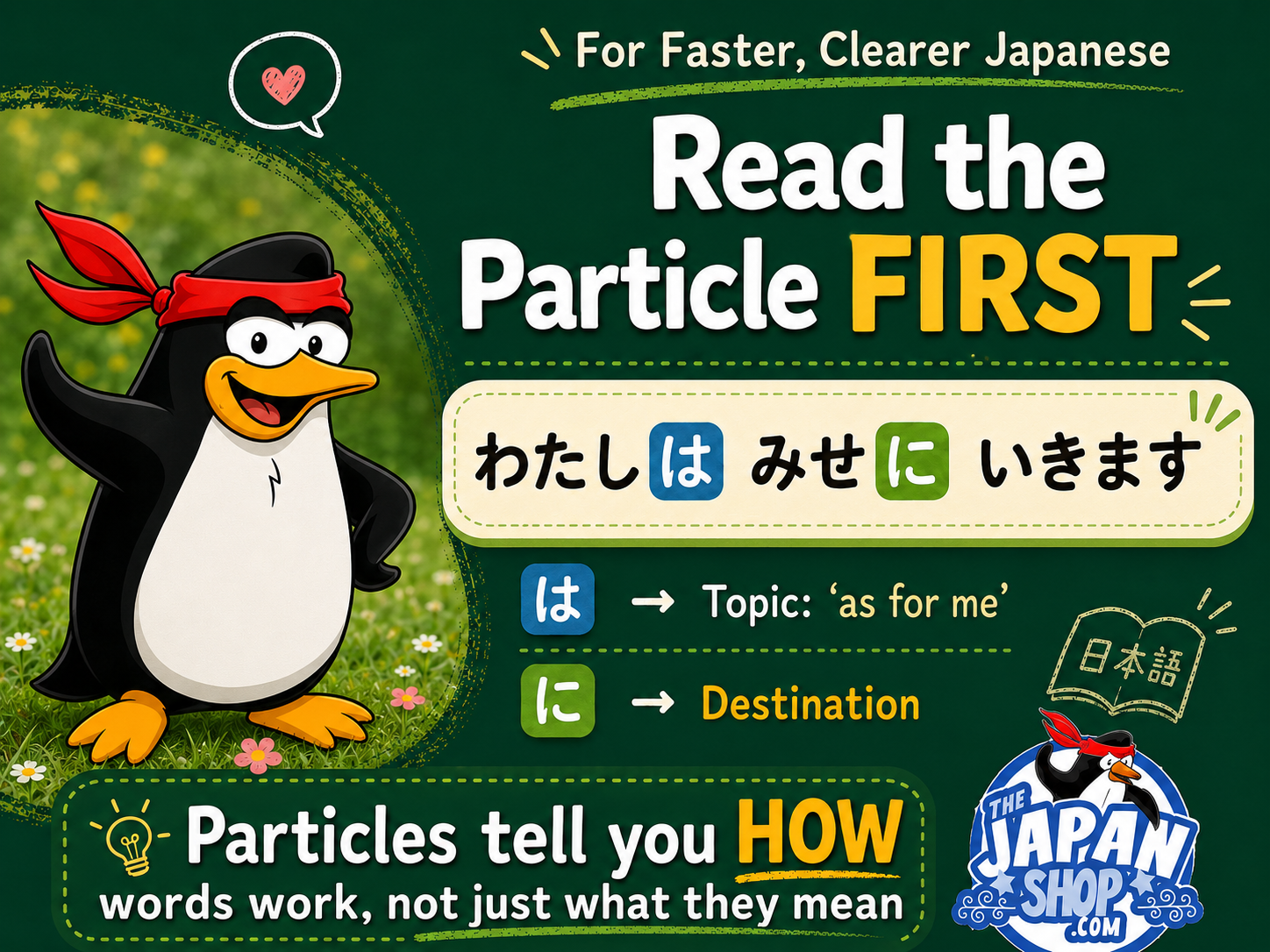
Particles act as structural post-tags attached directly to nouns and clauses. Instead of looking ahead to prepositions or articles, readers look immediately after a noun to identify its role (such as topic, subject, direct object, or direction). This turns reading into a process of identifying semantic blocks marked by consistent functional tags.
Is reading vertical Japanese text (Tategaki) harder for English native speakers?
Initially, yes, because English readers are trained in horizontal left-to-right eye movements. However, vertical reading utilizes vertical saccades that can reduce line-wrap eye fatigue and allow readers to use peripheral vision to track sentence-final verbs and particles down the page column.
Next Steps for Mastering Japanese Article Reading
To build fluency and adapt your cognitive scanning habits to Japanese prose:
- Practice Structural Mapping: Take an editorial from a major news outlet (such as Asahi Shimbun or Nikkei) and map its paragraphs to the Ki-Shō-Ten-Ketsu framework to identify where the central shift (Ten) occurs.
- Track Topic Persistence: Highlight every instance of the particle は (wa) in a text block to visually map how long a single topic persists across sentence boundaries without explicit pronoun repetition.
- Train Clause-Final Resolution: Practice reading long, complex sentences by jumping directly from the topic marker to the sentence-final verb before parsing middle relative clauses. This anchors the core statement before filling in conditional details.
Image Gallery