Understanding Short Term Life Insurance for Temporary Mortgage Protection
Short term life insurance for temporary mortgage protection provides targeted financial coverage designed to pay off or service a mortgage balance if the primary borrower dies during a specific, limited timeframe. Unlike permanent life...
Short term life insurance for temporary mortgage protection provides targeted financial coverage designed to pay off or service a mortgage balance if the primary borrower dies during a specific, limited timeframe. Unlike permanent life insurance, these policies—typically structured as 1-year annual renewable term, 2-year, or 5-year level term contracts—offer high coverage amounts at lower initial premiums to match short-term loan obligations or bridge temporary financial liabilities.
Contents
Disclaimer: This article is provided for informational purposes only and does not constitute formal financial, legal, or insurance advice. Life insurance terms, state regulations, and policy availability vary by jurisdiction and underwriting insurer. Consult a qualified insurance broker or financial planner to evaluate your specific situation.
What Is Short Term Life Insurance for Mortgage Protection?
When purchasing a home or refinancing an existing property, securing the debt against unforeseen life events is a central pillar of financial planning. Short term life insurance for mortgage protection refers to temporary life insurance policies used specifically to hedge against mortgage debt over a restricted duration, such as one to five years.
Homeowners typically seek temporary coverage when standard long-term policies (such as 20-year or 30-year level term insurance) do not align with their financial timeline. For instance, a borrower might only have three years remaining on a mortgage, may be utilizing a short-term bridge loan, or might need temporary coverage while waiting for a full medical underwriting decision on a long-term policy.
Core Mechanisms of Short-Term Coverage
Life insurance contracts designed for short-term mortgage protection generally fall into two primary insurance categories:
- Individual Term Life Insurance (Short Duration): Policies issued directly to the policyholder by an insurance carrier with fixed terms ranging from 1 to 5 years, or Annual Renewable Term (ART) contracts that renew every 12 months. The death benefit is paid in a tax-free lump sum directly to named beneficiaries, who retain total discretion over how the funds are used.
- Mortgage Protection Insurance (MPI) / Mortgage Life: Insurance policies marketed specifically to cover home equity loans or primary mortgages. In traditional MPI, the policy payout often decreases alongside the loan principal balance, and in some lender-backed plans, the death benefit is remitted directly to the mortgage servicer rather than family members.
Understanding the mechanics of these options ensures that homeowners select a structure that offers adequate risk mitigation without paying excessive administrative fees or unnecessary long-term premiums.
Key Reasons to Use Temporary Coverage for a Mortgage
While traditional financial advice often recommends matching a life insurance term to the full 30-year duration of a mortgage, specific financial scenarios call for short-term, targeted solutions.
| Common Temporary Protection Scenarios |
|---|
| 1. Final Years of a Mortgage (1 to 5 years remaining on principal balance) |
| 2. Real Estate Bridge Loans or Short-Term Construction Financing |
| 3. Interim Coverage During Underwriting for Long-Term Policies |
| 4. Temporary Business or Personal Debt Secured by Residential Equity |
| 5. Transitional Family Income Protection During Career or Medical Adjustments |
1. Nearing the End of a Mortgage Term
If a homeowner has 24 to 60 months remaining on a 30-year mortgage, buying a new 20-year term policy creates redundant coverage and unnecessary cost. A 2-year or 5-year term policy aligns precisely with the residual debt maturity date.
2. Securing Short-Term Real Estate Loans
Investors and homeowners frequently use short-term financing, such as 12-to-36-month bridge loans or construction loans, to acquire or renovate property. Lenders routinely require proof of assignment of life insurance equal to the loan balance prior to disbursing funds.
3. Bridging Medical or Financial Underwriting Periods
If an applicant recently underwent surgery or experienced an employment transition, standard long-term underwriting might result in higher rated premiums ("table ratings"). Securing short-term simplified issue coverage allows the homeowner to protect the mortgage immediately while waiting to qualify for preferred rates on long-term coverage later.
Policy Types Suitable for Short-Term Mortgage Protection
Selecting the appropriate short-term policy requires comparing contract flexibility, rate guarantees, and conversion options.
Annual Renewable Term (ART)
An Annual Renewable Term (ART) policy guarantees coverage for one year at a time. The policyholder has the right to renew the policy annually for a set period (often up to age 70 or 75) without submitting to new medical exams or health underwriting.
- Pros: Extremely low initial premium during Year 1; flexible year-to-year cancellation.
- Cons: Premiums increase automatically every year upon renewal based on the insured's attained age. Over three to five years, total cumulative costs can exceed a fixed short-term level policy.
5-Year Level Term Life Insurance
A 5-year level term policy locks in both the premium payment and the death benefit for exactly 60 months.
- Pros: Complete rate stability over five years; lower total cost over a 3-to-5-year window compared to ART; full beneficiary control over death proceeds.
- Cons: Fixed term length; cancellation before five years forfeits the locked rate without cash value recovery.
Decreasing Term / Lender Mortgage Protection (MPI)
Decreasing term life insurance features a fixed premium, but the total death benefit declines periodically to track an amortization schedule.
- Pros: Often offered on a simplified issue basis (no blood work or medical exam required).
- Cons: Less value over time as the payout decreases while the premium remains static; payouts may be tied directly to the mortgage lender rather than personal heirs.
Comparative Analysis of Policy Options
Evaluating policy options requires assessing benefit structures, underwriting speed, premium behavior, and payout flexibility. The table below outlines how common short-term mortgage protection structures perform against key criteria.
| Feature / Policy Type | Annual Renewable Term (ART) | 5-Year Level Term | Decreasing Mortgage Protection (MPI) | Guaranteed Issue Short-Term |
|---|---|---|---|---|
| Guaranteed Rate Period | 1 Year (re-priced annually) | 5 Years (fixed) | 5–30 Years (fixed premium) | 1–3 Years (fixed premium) |
| Death Benefit Behavior | Level throughout the year | Level for 5 years | Decreases with mortgage principal | Level |
| Medical Exam Required? | Usually yes (for best rates) | Usually yes (or digital underwriting) | Often No (Simplified Issue) | Never (Guaranteed acceptance) |
| Beneficiary Choice | Policyholder selects (Family/Estate) | Policyholder selects (Family/Estate) | Often strictly the Mortgage Servicer | Policyholder selects (Family/Estate) |
| Best Used For | Coverage needs under 24 months | 3-to-5 year mortgage balances | High-risk health profiles needing fast setup | Immediate short-term interim bridging |
| Relative Initial Cost | Lowest (Year 1) | Moderate / Low | Moderate to High | Highest per $1,000 of coverage |
How to Calculate Your Short-Term Mortgage Protection Needs
Determining the appropriate coverage amount for short-term mortgage protection requires evaluating more than just the outstanding principal balance on your loan statement.
- Total Required Coverage Calculation
- Current Outstanding Mortgage Balance
- Estimated Interest Charges Over Remaining Term
- Expected Closing/Settlement Costs & Escrow Deficits
- Temporary Living Expenses Buffer (6–12 months)
- Existing Liquid Assets Designated for Debt Payoff
- = Net Short-Term Coverage Amount Needed
1. Calculate the Net Payoff Amount
Obtain an official payoff quote from your mortgage servicer. The payoff figure is slightly higher than the principal balance because it includes accrued interest up to the expected settlement date.
2. Factor in Escrow and Property Taxes
In many jurisdictions, mortgages incorporate escrow accounts for property taxes and homeowners insurance. If the primary earner passes away, the estate must continue making escrow payments to prevent tax liens or coverage lapses until the home is refinanced or sold.
3. Determine the Required Duration
Select a term length that matches your specific milestone:
- 0–18 Months: Choose Annual Renewable Term (ART) or a flexible simplified issue policy.
- 18–60 Months: Choose a 5-year fixed level term policy to lock in pricing and protect against rate increases.
Essential Underwriting and Application Considerations
Securing short-term life insurance requires navigating carrier underwriting guidelines efficiently to avoid coverage delays.
Fully Underwritten vs. Simplified Issue
- Fully Underwritten Policies: Require a detailed medical questionnaire, medical record releases (Attending Physician Statement or APS), and often a paramedic exam (blood sample, urine sample, ECG). Fully underwritten policies offer the lowest cost per thousand dollars of coverage, but approval can take 2 to 8 weeks.
- Simplified Issue Policies: Skip the medical exam and rely instead on automated data checks, including prescription history databases, Motor Vehicle Records (MVR), and Medical Information Bureau (MIB) reports. Approval can take as little as 24 to 48 hours, making this option ideal for fast real estate closings, though premiums are generally higher.
Beneficiary Designation vs. Collateral Assignment
When securing a mortgage or short-term loan, lenders may ask to be named in policy documentation:
- Direct Beneficiary Designation: Naming the lender as the primary beneficiary means the insurer pays the lender directly upon proof of death. Any proceeds exceeding the debt balance are remitted to contingent beneficiaries.
- Collateral Assignment: This is often the preferred legal arrangement. The policyholder owns the policy and names family members as beneficiaries. A legal document (Collateral Assignment) is filed with the insurer, granting the lender first rights to the portion of death proceeds equal to the outstanding debt balance at the time of death. The remaining funds are paid directly to the designated family members without going through probate.
Common Mistakes to Avoid
Using short-term life insurance for mortgage protection requires careful management to avoid costly pitfalls:
- Relying on ART for Extended Periods: Holding an Annual Renewable Term policy beyond two or three years can lead to steep annual premium increases. If there is a chance your mortgage obligation will extend beyond three years, a 5-year fixed term policy is usually more cost-effective.
- Ignoring Policy Conversion Rights: Ensure your short-term policy includes a term conversion rider. This clause allows you to convert your temporary coverage into a permanent policy without taking a new medical exam, preserving your insurability if your health changes.
- Failing to Review Policy Exclusions: Review standard policy exclusions, such as the two-year contestability period and suicide clause. If material misstatements are made on the application, the insurer may rescind coverage or deny claims during the first two years.
- Confusing Mortgage Protection Insurance with Mortgage Insurance (PMI): Private Mortgage Insurance (PMI) protects the lender if you default on payment, but it provides zero death benefit to your family or estate. Short-term life insurance is a separate policy that protects your household by satisfying debt obligations upon death.
Frequently Asked Questions
Can I buy a life insurance policy for just one or two years?
Yes. You can purchase an Annual Renewable Term (ART) policy, which provides coverage in one-year increments, or buy a standard 5-year level term policy and cancel it once your mortgage is paid off. Life insurance policies generally do not impose prepayment or early cancellation penalties.
What happens if I pay off my mortgage earlier than expected?
If you pay off your mortgage before the policy term ends, you can either keep the life insurance policy for general family protection or cancel it immediately. If you cancel a traditional term policy, coverage simply ends on the next billing date, and no future premiums are owed.
Is short-term mortgage protection life insurance tax-deductible?
For individual taxpayers and homeowners, life insurance premiums paid for personal mortgage protection are not tax-deductible. However, the death benefit payout received by your beneficiaries is generally free from federal income tax under current tax codes.
Is a medical exam mandatory for short-term mortgage life insurance?
No, a medical exam is not always required. Many insurers offer simplified issue term policies up to specific coverage limits (such as $500,000 or $1,000,000) that use digital medical records and prescription databases for approval instead of physical exams.
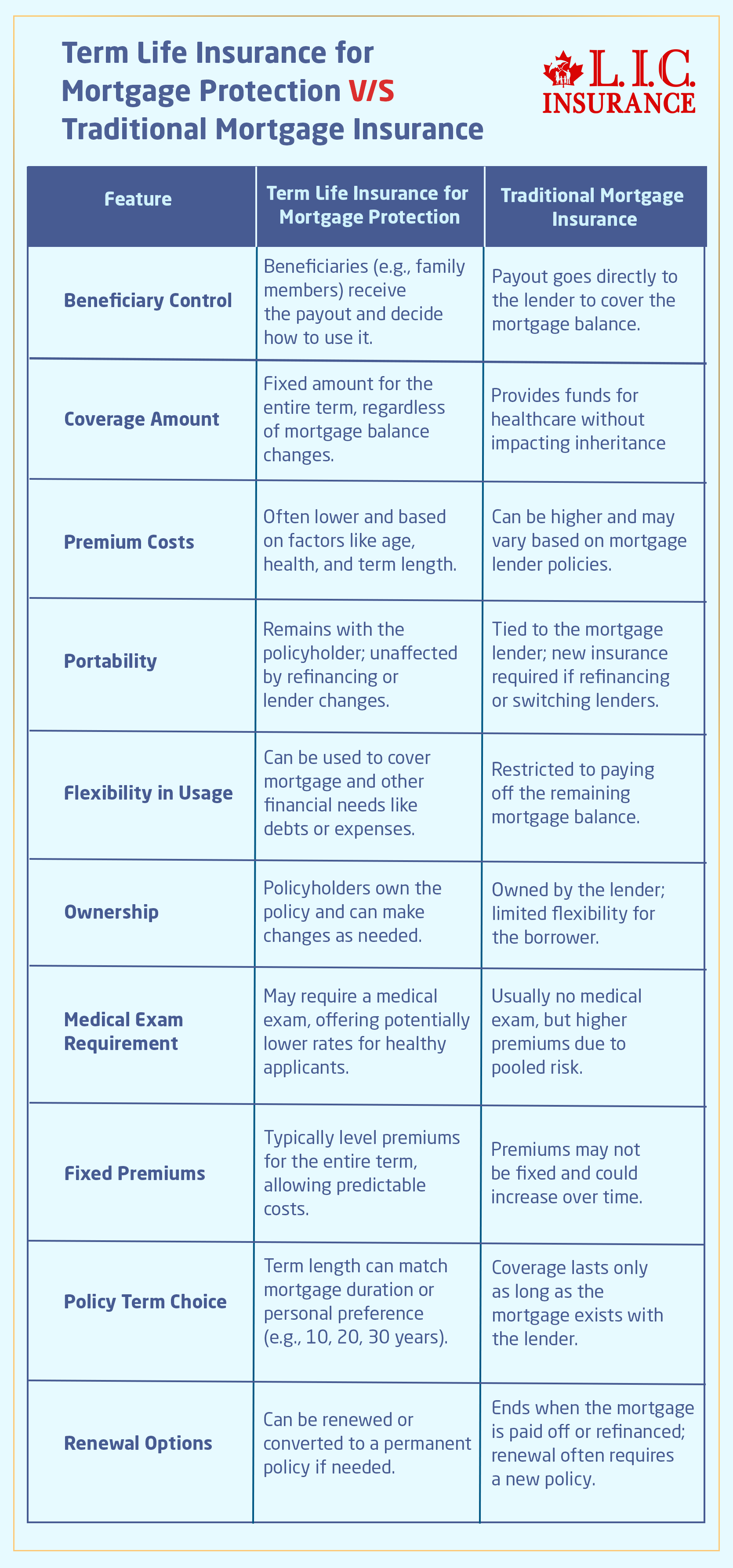
How does short-term term life insurance differ from lender-offered MPI?
Short-term term life insurance is owned by you, allows you to select your own beneficiaries, maintains a level death benefit, and stays with you even if you refinance or switch lenders. Lender-offered Mortgage Protection Insurance (MPI) often pays the lender directly, decreases in coverage value over time, and may terminate automatically if you refinance with a different bank.
Recommended Next Steps
- Obtain an Exact Payoff Balance: Request an official payoff statement from your current mortgage servicer to determine your baseline coverage requirement.
- Determine Your Horizon: If your coverage need is strictly under 24 months, evaluate Annual Renewable Term (ART) rates. If your timeframe is 2 to 5 years, request quotes for 5-year fixed level term policies.
- Compare Underwriting Options: If you need immediate coverage to satisfy a lender requirement before closing, compare simplified issue policies against fully underwritten options to balance approval speed against monthly cost.
- Review Ownership Structure: Work with an insurance broker or financial advisory professional to properly set up beneficiary designations or file a formal collateral assignment to protect both your lender obligations and your heirs' financial security.
Image Gallery