Master Your SUP Paddling Technique: A Comprehensive Guide to Efficiency and Power
Effective SUP paddling technique relies on using your core muscles rather than just your arms to propel the board. By mastering the five phases of the stroke—the catch, power phase, exit, recovery, and feathering—you can increase your...
Effective SUP paddling technique relies on using your core muscles rather than just your arms to propel the board. By mastering the five phases of the stroke—the catch, power phase, exit, recovery, and feathering—you can increase your speed, improve stability, and significantly reduce the risk of repetitive strain injuries.
Contents
The Foundation of Stand Up Paddleboarding Technique
To understand the mechanics of stand up paddleboarding (SUP), one must first view the paddle not as a spoon used to move water, but as a lever. In 2026, the consensus among professional instructors is that the most efficient paddlers treat the paddle as a fixed point in the water, pulling the board past that point rather than pulling the blade through the fluid.
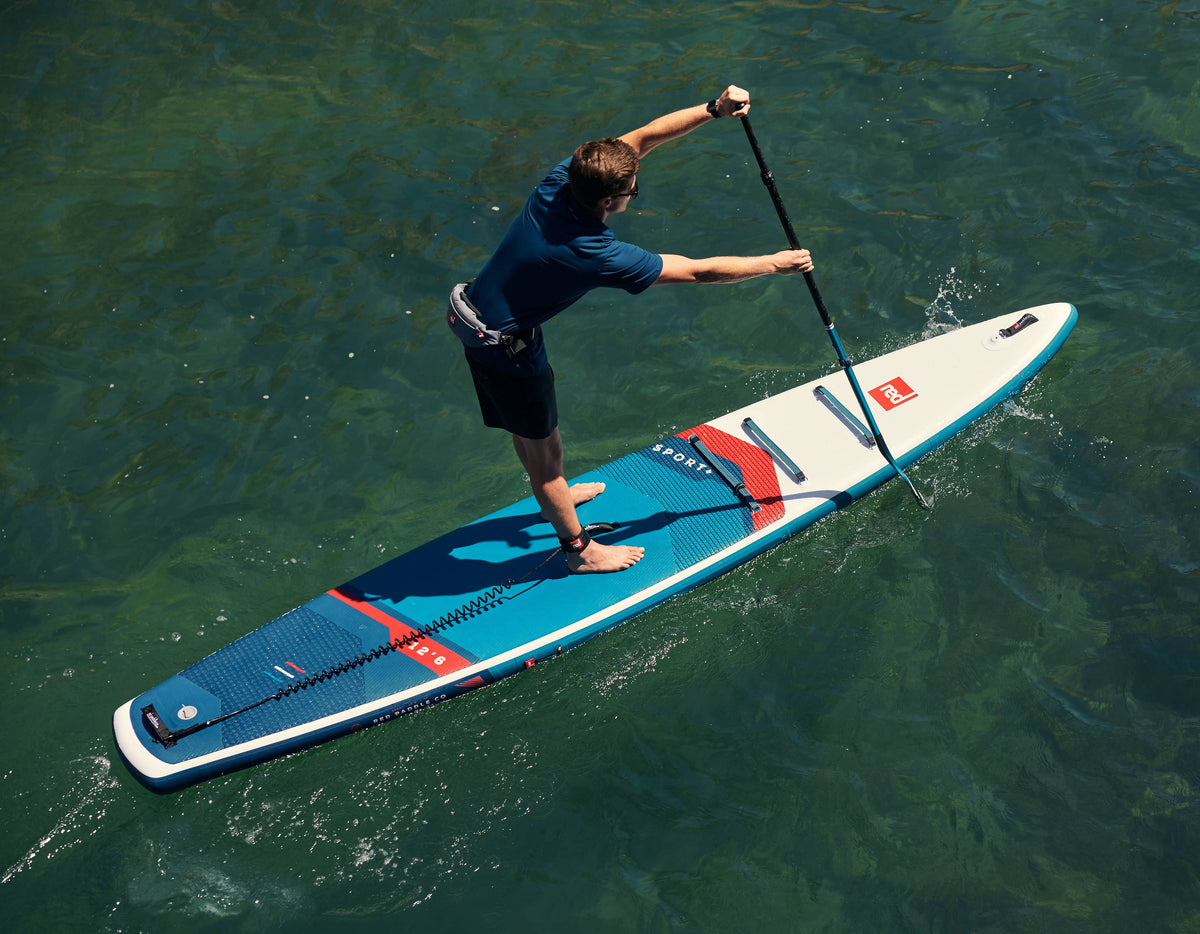
The foundation of this movement is the A-Frame. When you hold your paddle correctly—one hand on the T-grip and the other roughly shoulder-width apart on the shaft—your body and the paddle should form a triangle. This structure allows you to transfer the power generated by your legs and torso directly into the water.
Proper Blade Orientation
A common mistake for beginners is holding the paddle blade backward. The blade should always angle forward, toward the nose of the board. This design might seem counterintuitive, but the forward slant allows the blade to rise naturally at the end of the stroke, preventing "lifting" water, which creates drag and instability. In the context of modern 2026 paddle designs, which often feature complex dihedral contours to reduce blade flutter, correct orientation is essential for maintaining a clean path through the water.
The Neutral Stance
Your stance dictates your balance and your ability to rotate your hips. Position your feet parallel, about hip-width apart, flanking the carry handle at the center of the board. Keep your knees slightly bent; locked knees act like rigid shock absorbers, making it harder to adjust to surface chop. A "soft" stance allows your lower body to react to the water while your upper body remains focused on the stroke.
The Five Phases of the SUP Stroke
Refining your SUP paddling technique requires breaking down the motion into five distinct phases. Mastery of these segments ensures that no energy is wasted and that the board maintains a constant glide.
1. The Reach and Catch
The "catch" is the moment the paddle enters the water. To maximize efficiency, you must reach forward as far as comfortably possible by hinging at the hips and extending your bottom arm. The goal is to submerge the entire blade into the water before applying any backward force.
A "splashy" entry indicates that you are applying power too early, which introduces air into the water around the blade (cavitation) and reduces traction. In 2026, high-performance coaching emphasizes the "silent entry," where the blade slides into the water with minimal disturbance, ensuring immediate engagement with the water column.
2. The Power Phase
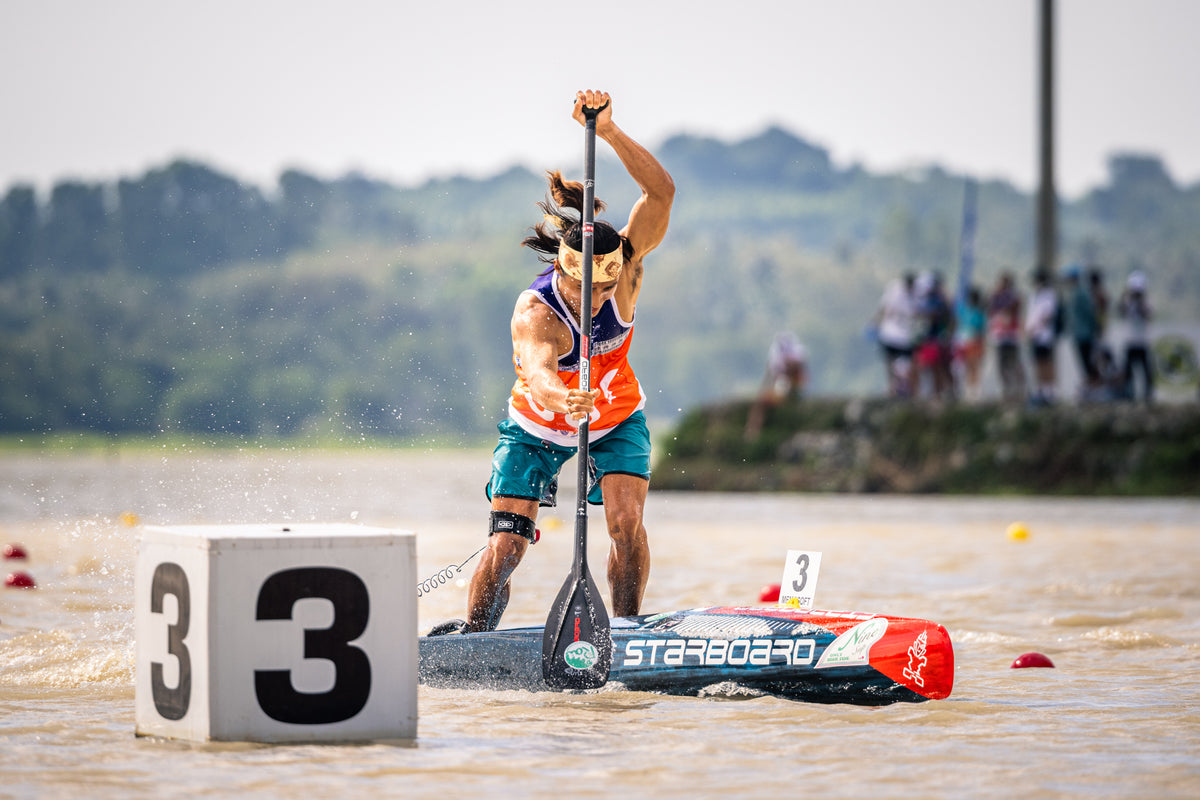
Once the blade is fully submerged, the power phase begins. The most critical technical detail here is core rotation. Rather than pulling with your arms, you should use your top hand to push down and forward while your torso rotates. This allows the large muscles of your back (the latissimus dorsi) and your core to do the heavy lifting.
Think of your arms as "tethers" or "cables" that connect the paddle to your powerhouse—your torso. Your bottom arm should remain relatively straight. As you pull the board toward the paddle, your core untwists, providing a much higher ceiling for power and endurance than the biceps alone could ever offer.
3. The Release and Exit
One of the most frequent technical errors is pulling the paddle too far back. The power phase should end when the blade reaches your feet. Continuing the stroke past your ankles creates upward lift on the tail of the board, which pushes the nose down and creates significant drag.
To execute a clean exit, lift the paddle out of the water to the side by slightly dropping your top hand and pulling the blade out "sideways" like a wing. This minimizes the amount of water you accidentally "carry" or lift at the end of the stroke.
4. The Recovery
The recovery is the transition phase where the paddle moves back to the front of the board. While it is a rest period for your muscles, it must be performed with intention. Keep the paddle low to the water to maintain a low center of gravity. This is also the time to realign your posture and ensure your feet haven't shifted from the sweet spot of the board.
5. Feathering the Blade
In windy conditions, "feathering" becomes essential. As you move the paddle forward during the recovery phase, turn the blade 90 degrees so that the thin edge of the paddle slices through the air. This reduces wind resistance, which can be a significant factor in 2026, given the trend toward larger, high-volume touring boards that sit higher on the water's surface.
Essential Paddle Strokes for Maneuverability
While the forward stroke is your primary engine, you need a repertoire of maneuvers to navigate effectively, especially in crowded waterways or changing currents.
| Stroke Name | Primary Purpose | Key Technical Action | Common Mistake |
|---|---|---|---|
| Forward Stroke | Propulsion | Vertical shaft, core rotation, exit at feet. | Pulling past the feet. |
| Sweep Stroke | Turning | Wide arc from nose to tail away from board. | Keeping the blade too close. |
| Reverse Stroke | Braking/Backing | Push blade forward from tail to nose. | Not looking behind you. |
| Draw Stroke | Lateral movement | Reach out to the side and pull board toward blade. | Leaning too far over the rail. |
| J-Stroke | Tracking | A small outward flick at the end of a forward stroke. | Over-correcting and losing speed. |
The Sweep Stroke for Efficient Turning
To turn your board without losing momentum, use the sweep stroke. Instead of a vertical entry, place the paddle in the water near the nose and sweep it out in a wide semi-circle toward the tail. The wider the arc, the more leverage you exert on the nose of the board. For a faster turn, you can shift your weight slightly toward the tail (the "pivot turn" stance), which lifts the nose out of the water and allows the board to spin with less resistance.
Maintaining a Straight Line (Tracking)
New paddlers often find themselves switching sides every two or three strokes. While switching sides is a valid way to rest muscle groups, technical mastery allows you to stay on one side longer. By keeping the paddle shaft as vertical as possible and ensuring the blade enters the water close to the rail (the edge) of the board, you minimize the "yaw" or side-to-side wiggle.
Biomechanics and Injury Prevention
Proper SUP paddling technique is as much about safety as it is about speed. Because SUP involves repetitive motions, improper form can lead to "SUP shoulder" (tendonitis) or lower back strain.
Engaging the "Kinetic Chain"
The kinetic chain in paddling starts at the feet and ends at the paddle blade. Power is generated in the legs, transferred through the hips and core, and finally delivered through the shoulders and arms. If any link in this chain is weak or bypassed—for instance, if you don't engage your legs—the remaining links must overcompensate.
In 2026, sports physiotherapists recommend a "slight hip hinge" rather than a "slouch." Keeping your spine neutral and your chest open ensures that your diaphragm can expand fully, improving oxygen intake during high-intensity paddling.
Shoulder Safety: The "Safety Box"
To protect your rotator cuffs, always keep your hands within your "safety box." This is the area directly in front of your torso. Avoid reaching too far across your body or allowing your top hand to move behind your head. If your top hand stays in front of your face and below the level of your eyes, you significantly reduce the stress on the shoulder joint.
Advanced Considerations: Gear and Environment
As we look at the landscape of paddleboarding in 2026, equipment technology has evolved to support better technique. Modern carbon-fiber paddles are designed with specific flex patterns. A "stiff" shaft provides immediate energy transfer for racing, while a "soft" or "medium" flex shaft is more forgiving on the joints for long-distance touring.
Paddle Length Calibration
The old rule of "shaka over the head" has been refined. For general touring, the T-grip should be roughly 6 to 8 inches (15–20 cm) above your head. For racing, some prefer it slightly shorter to allow for a higher cadence, while for surfing, a shorter paddle still (around head height) allows for a lower center of gravity and quicker transitions.
Dealing with Wind and Chop
When paddling into a headwind, your technique must adapt. Lower your stance to reduce your "sail area." Shorten your stroke and increase your cadence (the number of strokes per minute). This helps the board maintain its momentum between strokes, preventing the wind from stopping your forward progress.
Improving Your Cadence and Flow
Once you have mastered the individual phases of the stroke, the next step is "flow"—the seamless connection of one stroke to the next. High-level paddlers in 2026 focus on a rhythmic breathing pattern, often exhaling during the power phase and inhaling during the recovery.
To test your efficiency, count how many strokes it takes to cover a set distance. As your technique improves, you should find that you require fewer strokes to cover the same ground, indicating that each stroke is delivering more "distance per stroke" (DPS).
Final Technical Recommendations
Refining your SUP paddling technique is a continuous process of micro-adjustments. To take your skills to the next level, consider the following actions:
- Video Analysis: Record yourself from the side and the front. Compare your "A-Frame" and blade entry to professional standards.
- Core-Specific Training: Incorporate planks and rotational exercises (like Russian twists) into your off-water fitness routine.
- Variable Practice: Practice your strokes in different conditions—calm lakes, flowing rivers, and light ocean chop—to build a versatile skill set.
- Professional Coaching: Seek certification or clinics from recognized bodies such as the International Surfing Association (ISA) or the Academy of Surfing Instructors (ASI), which provide standardized technical frameworks.
By focusing on the physics of the lever and the power of the core, you transform paddleboarding from a simple hobby into a sophisticated, full-body athletic discipline.
Image Gallery