Understanding Strike Options in Equity Markets: Mechanics, Valuation, and Selection Strategies
A strike price—also known as the exercise price—in equity options represents the fixed price at which an option buyer can purchase or sell an underlying stock, and the price at which the option seller is legally obligated to fulfill th...
A strike price—also known as the exercise price—in equity options represents the fixed price at which an option buyer can purchase or sell an underlying stock, and the price at which the option seller is legally obligated to fulfill the contract. Choosing the right strike price determines an option's moneyness, intrinsic value, premium cost, and overall risk-reward ratio.
Contents
What Is a Strike Price in Equity Options?
In equity derivatives, stock options grant the buyer the right, but not the obligation, to execute a transaction involving an underlying stock at a specified price within a designated timeframe. That specified price is the strike price.
Option contracts on individual U.S. equities typically represent 100 shares of the underlying stock. The strike price sets the exact benchmark around which the entire financial mechanics of the contract revolve:
- Call Options: A call option gives the buyer the right to buy 100 shares of the underlying stock at the strike price on or before the expiration date. The seller (writer) of the call option is obligated to sell those shares at that exact strike price if the buyer exercises the contract.
- Put Options: A put option gives the buyer the right to sell 100 shares of the underlying stock at the strike price on or before the expiration date. The seller of the put option is obligated to purchase those shares at the strike price if the buyer exercises.
Options exchanges, such as the Cboe Options Exchange and Nasdaq PHLX, standardize strike prices across designated intervals. Depending on the underlying stock price, volatility, and trading volume, strike price intervals typically range from $0.50 or $1.00 for lower-priced stocks up to $5.00, $10.00, or wider increments for high-priced equities.
Disclaimer: Options trading involves substantial risk and is not suitable for all investors. The information in this article is provided for educational purposes only and does not constitute financial, legal, or investment advice.
The Core Framework: Options Moneyness
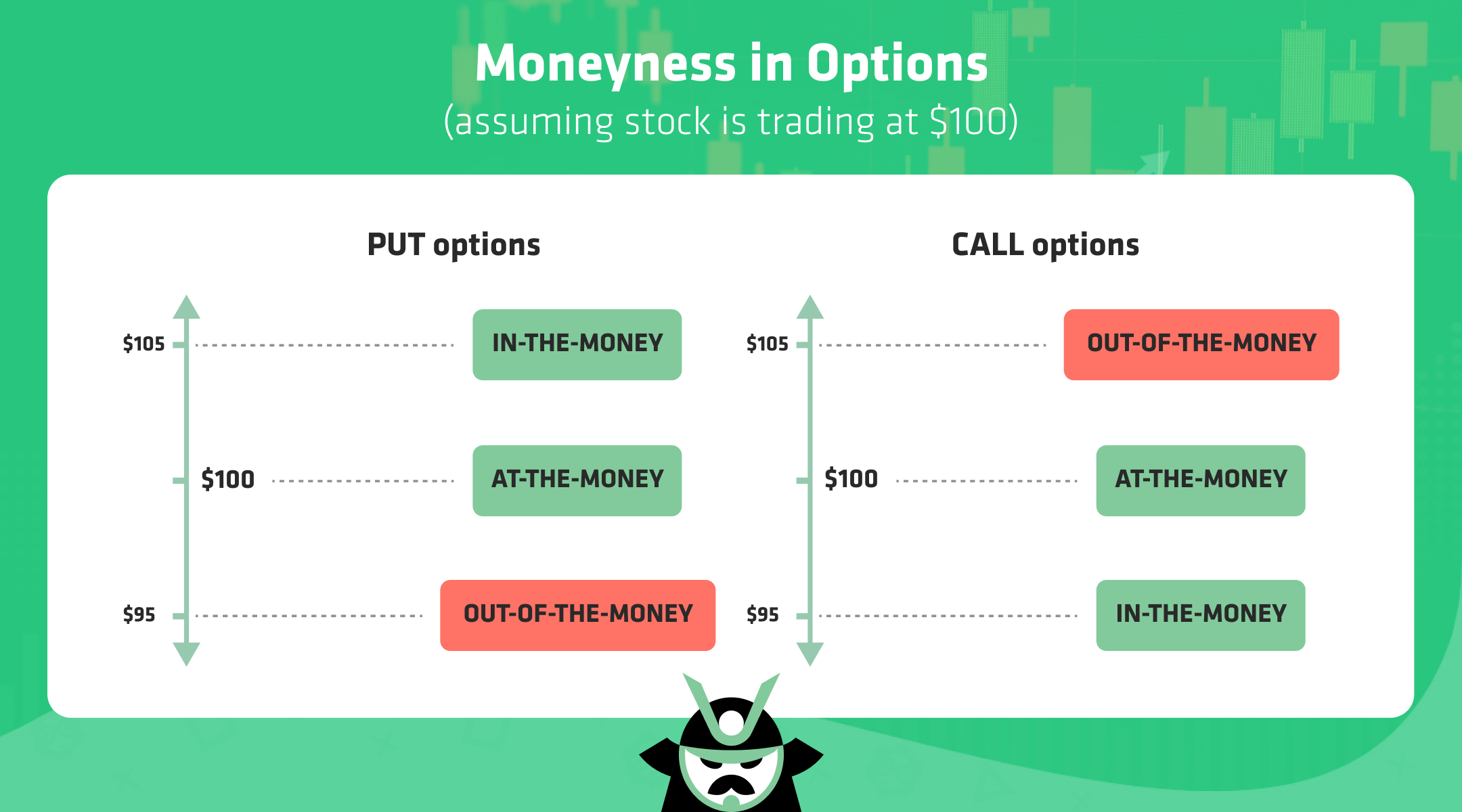
"Moneyness" describes the relationship between the current market price of the underlying stock ($S$) and the strike price ($K$) of the option contract. Moneyness directly dictates whether an option holds immediate tangible value (intrinsic value) or consists entirely of speculative value (extrinsic or time value).
- Underlying Stock Price
- Strike Price Relationship
- Call Options:
- Stock > Strike : ITM
- Stock = Strike : ATM
- Stock < Strike : OTM
- Put Options:
- Stock < Strike : ITM
- Stock = Strike : ATM
- Stock > Strike : OTM
- Call Options:
- Strike Price Relationship
1. In-the-Money (ITM)
An option is In-the-Money when exercising it would yield a financial benefit based on current market prices.
- ITM Call: Current Stock Price ($S$) > Strike Price ($K$). For example, if Stock XYZ is trading at $105, a $100 Call option is ITM by $5.
- ITM Put: Current Stock Price ($S$) < Strike Price ($K$). If Stock XYZ is trading at $90, a $100 Put option is ITM by $10.
ITM options possess both intrinsic value and extrinsic value. Because they require a higher capital outlay (higher premium), they experience less leverage but exhibit higher directional sensitivity (higher Delta).
2. At-the-Money (ATM)
An option is At-the-Money when the underlying stock price equals (or is virtually identical to) the strike price ($S = K$).
- If Stock XYZ trades at $100.00, both the $100 Call and the $100 Put are ATM options.
- ATM options contain zero intrinsic value; their premium is composed entirely of extrinsic (time) value. ATM options feature the highest rate of time decay (Theta) and the greatest sensitivity to changes in implied volatility (Vega).
3. Out-of-the-Money (OTM)
An option is Out-of-the-Money when exercising it would result in an immediate financial loss relative to prevailing spot market prices.
- OTM Call: Current Stock Price ($S$) < Strike Price ($K$). For example, a $110 Call when Stock XYZ is trading at $100.
- OTM Put: Current Stock Price ($S$) > Strike Price ($K$). For example, a $90 Put when Stock XYZ is trading at $100.
OTM options have zero intrinsic value and consist purely of extrinsic value. If an OTM option remains OTM at expiration, it expires worthless, resulting in a 100% loss of the premium paid by the buyer.
How Strike Prices Dictate Option Valuation
An option's market price (the premium) is driven primarily by the distance between the underlying asset price and the strike price, combined with time to expiration and implied volatility.
$$\text{Total Option Premium} = \text{Intrinsic Value} + \text{Extrinsic Value}$$
Mathematical Definition of Intrinsic Value
Intrinsic value represents the objective cash value realized if the contract were exercised immediately. It can never be less than zero.
$$\text{Call Intrinsic Value} = \max(0, S - K)$$
$$\text{Put Intrinsic Value} = \max(0, K - S)$$
Where:
- $S$ = Current Stock Price
- $K$ = Strike Price
Impact on Option Greeks
The choice of strike price directly governs the risk parameters known as the "Greeks," calculated via pricing models such as Black-Scholes:
- Delta ($\Delta$): Measures expected option price change per $1.00 move in the underlying stock.
- Deep ITM Calls approach a Delta of $+1.00$ (acting like stock ownership).
- ATM Calls maintain a Delta near $+0.50$.
- Far OTM Calls approach a Delta of $0.00$.
- Put Deltas mirror this scale from $0.00$ (far OTM) to $-0.50$ (ATM) to $-1.00$ (deep ITM).
- Gamma ($\Gamma$): Measures the rate of change of Delta. Gamma is highest for ATM strikes near expiration, meaning Delta can change rapidly for ATM strikes as the stock price fluctuates.
- Theta ($\Theta$): Measures daily time decay. ATM strikes undergo the absolute highest monetary dollar-decay per day as expiration approaches.
Implied Volatility Skew and the Volatility Smile
In equity markets, option strikes across the same expiration cycle rarely trade at uniform implied volatility (IV) levels. This structural phenomenon is known as the volatility skew (or volatility smile).
- Implied Volatility (IV) across Strike Prices (Downside Skew / Put Demand):
- OTM Puts
- ATM
- OTM Calls
In stock index options and individual equities, out-of-the-money put option strikes consistently trade at higher implied volatilities than out-of-the-money call option strikes. This asymmetric pricing occurs because market participants frequently purchase OTM puts as portfolio insurance against market crashes, bidding up the relative demand—and thus the premium—for lower strike prices.
Understanding volatility skew is essential for traders evaluating strike selection:
- Buying OTM Puts: Traders pay a volatility premium due to skew, increasing the break-even hurdle rate.
- Selling OTM Puts (Cash-Secured Puts): Traders can collect enhanced premium relative to distance from spot price due to the inflated IV of lower strikes.
Comparative Matrix: Strike Selection Trade-Offs
The table below illustrates how selecting different strike prices alters financial parameters for an investor evaluating a stock trading at $100.00:
| Option Type | Strike Price ($K$) | Moneyness | Premium Cost | Intrinsic Value | Extrinsic Value | Approximate Delta ($\Delta$) | Primary Use Case / Strategy |
|---|---|---|---|---|---|---|---|
| Call | $90.00 | Deep ITM | High ($13.00) | $10.00 | $3.00 | ~0.85 | Stock Replacement / Low Time Decay |
| Call | $100.00 | ATM | Moderate ($4.50) | $0.00 | $4.50 | ~0.50 | Directional Leverage / Maximum Vega |
| Call | $110.00 | Far OTM | Low ($1.20) | $0.00 | $1.20 | ~0.20 | High-Leverage Speculation / Spread Wing |
| Put | $110.00 | Deep ITM | High ($12.50) | $10.00 | $2.50 | -0.82 | Synthetically Shorting Stock / Hedging |
| Put | $100.00 | ATM | Moderate ($4.20) | $0.00 | $4.20 | -0.50 | Neutral-to-Bearish Speculation |
| Put | $90.00 | Far OTM | Low ($1.50) | $0.00 | $1.50 | -0.18 | Tail-Risk Insurance / Income Generation |
Practical Strategies for Strike Selection
Choosing an appropriate strike price depends on trade horizon, risk tolerance, market outlook, and strategic intent.
- Choose Your Trading Intent:
- Directional Buy:
- Pick ITM/ATM
- Low time decay
- Higher Delta
- Premium Selling:
- Pick OTM
- High probability
- Delta 0.15–0.30
- Vertical Spread:
- Pick Strike Gap
- Defined risk
- Caps upside/loss
- Directional Buy:
1. Long Directional Trades (Buying Calls or Puts)
When buying options outright, traders balance capital outlay against probability of profit:
- In-the-Money Strikes (0.70 to 0.80 Delta): Preferred by positional traders seeking stock replacement. Higher upfront premium reduces financial leverage, but the contract moves almost dollar-for-dollar with the stock while suffering less percentage loss from daily Theta decay.
- Out-of-the-Money Strikes (0.20 to 0.40 Delta): Preferred by momentum traders seeking maximum percentage leverage. OTM options require significant price moves in the underlying asset to overcome non-stop time decay.
2. Income Strategies (Selling Covered Calls & Cash-Secured Puts)
Option sellers generate income by capturing premium and allowing extrinsic value to decay to zero. Strike selection centers on probability of expiring out-of-the-money:
- Covered Calls: An investor holding 100 shares of stock might write a Call option with a strike 5%–10% above the current stock price (typically a 0.15 to 0.30 Delta). This allows capital appreciation up to the strike price while collecting income.
- Cash-Secured Puts: An investor willing to buy a stock at a discount might write a Put option with a strike below current market value (e.g., a 0.20 Delta). If the stock stays above the strike, the seller retains the premium. If it drops below, the seller is assigned shares at an effective cost basis equal to the strike price minus premium received.
3. Spread Strategies (Defined Risk Vertical Spreads)
Spreads combine long and short strikes to bound both potential profit and loss:
- Bull Call Spread (Debit Spread): Buy an ITM or ATM Call at a lower strike ($K_1$) and simultaneously sell an OTM Call at a higher strike ($K_2$). The width between $K_1$ and $K_2$ defines maximum payout, reducing overall cash outlay compared to buying a call alone.
- Bear Put Spread (Debit Spread): Buy an ATM Put at a higher strike ($K_2$) and sell an OTM Put at a lower strike ($K_1$) to offset time decay costs.
Common Execution Pitfalls and Structural Risks
1. Bid-Ask Spread Friction in Extreme Strikes
Far In-the-Money and deep Out-of-the-Money options frequently suffer from wide bid-ask spreads due to lower market maker liquidity. High transaction costs can negate theoretical strategy edges. Traders should evaluate open interest and daily volume before committing to illiquid strikes.
2. Pin Risk at Expiration
Pin risk occurs when the underlying stock price closes extremely close to an option's strike price on expiration Friday. The option holder remains uncertain whether the contract will be exercised or assigned, exposing the trader to unwanted overnight market risk in the underlying stock over the weekend.
3. Corporate Actions and Strike Adjustments
When a company executes a stock split, reverse stock split, or special dividend, options contracts undergo standard adjustments managed by the Options Clearing Corporation (OCC).
- Forward Stock Split (e.g., 2-for-1): The number of contracts doubles, and the strike price is reduced by half. A single $100 strike contract becomes two $50 strike contracts.
- Special Cash Dividends: The strike price is typically reduced by the exact dollar value of the non-routine dividend distribution to protect contract valuation neutrality.
Frequently Asked Questions
How do options exchanges set strike price listings?
Options exchanges establish strike price intervals according to standard rules governed by national regulators (such as the U.S. Securities and Exchange Commission) and clearinghouses like the OCC. Standard intervals depend on stock price levels ($1.00, $2.50, $5.00, $10.00 increments). Exchanges introduce new strike prices automatically as the underlying stock price trades higher or lower into new price ranges.
What happens to my option's strike price when a stock split occurs?
When a stock splits, the OCC adjusts the contract specifications so neither the option buyer nor the seller experiences financial gain or loss due strictly to the corporate action. In a standard split, the strike price is reduced proportionally while the number of contracts (or contract multiplier) increases by the exact split ratio.
Should beginner option traders buy ITM or OTM options?
Beginners often gravitate toward OTM options because of lower absolute dollar premiums. However, OTM options carry a lower statistical probability of profit and frequently expire worthless due to time decay. Many risk managers prefer ATM or slightly ITM options for long directional plays, as higher Deltas provide better tracking of stock movements with lower percentage drag from Theta.
What is the relationship between strike price and Delta?
Delta measures the theoretical likelihood that an option will expire In-the-Money. An At-the-Money strike carries a Delta of roughly 0.50 (call) or -0.50 (put), indicating a roughly 50% chance of expiring ITM. As a call strike moves deeper ITM, Delta increases toward 1.00; as a call strike moves further OTM, Delta decreases toward 0.00.
What happens on expiration day if the stock price is exactly equal to the strike price?
If the underlying stock closes exactly at the strike price at expiration, the option has zero intrinsic value and expires At-the-Money. Under standard exchange rules, the contract will generally expire unexercised and worthless, as there is no economic benefit to exercising it versus buying or selling stock in the open market.
Conclusion and Next Actions
Selecting the optimal strike price requires balancing financial leverage, probability of profit, and time decay against your underlying thesis. There is no single "best" strike price—only the strike price that aligns with your specific risk profile and trade structure.
Actionable Next Steps:
- Define Your Market Thesis: Determine your expected direction, target price level, and time horizon before reviewing the option chain.
- Evaluate Volatility and Greeks: Analyze the Delta and implied volatility skew across available strike prices to identify mispriced premiums.
- Calculate Total Risk and Break-Even Points: For long options, add the premium paid to the call strike (or subtract put premium from put strike) to establish your exact break-even price.
- Check Liquidity Metrics: Prioritize strikes with tight bid-ask spreads and robust open interest to minimize transaction slippage.
Image Gallery