Navigating Workers Compensation Claims Settlements: A Comprehensive Guide
A workers compensation claims settlement is a final, legally binding agreement between an injured employee and the employer's insurance carrier that resolves all or part of a disputed workplace injury claim, typically exchanging future...
A workers compensation claims settlement is a final, legally binding agreement between an injured employee and the employer's insurance carrier that resolves all or part of a disputed workplace injury claim, typically exchanging future medical and indemnity benefits for a lump-sum cash payment.
Contents
Navigating the aftermath of a workplace injury requires a clear understanding of your rights, the mechanics of the insurance system, and the long-term implications of closing a claim. When an injured worker reaches maximum medical improvement, the focus often shifts from ongoing treatment to a negotiated financial resolution. Understanding how these settlements are calculated, evaluated, and finalized ensures that injured employees can make informed choices regarding their financial and physical futures. Because workers' compensation laws vary significantly by jurisdiction, navigating this process requires careful attention to state-specific statutes, medical evaluations, and procedural deadlines.
Understanding the Workers Compensation Framework
Workers compensation is a form of statutory insurance providing wage replacement and medical benefits to employees injured on the job in exchange for mandatory relinquishment of the employee's right to sue their employer for negligence. This no-fault system is designed to streamline the recovery process, ensuring that medical bills are paid and a portion of lost wages is replaced without the necessity of proving employer fault.
However, the routine management of bi-weekly benefit checks and ongoing medical approvals often transitions into a negotiation phase known as a settlement. Insurance carriers routinely seek to close out files to eliminate long-term financial liabilities, administrative overhead, and the uncertainty of future medical inflation. For the injured worker, a settlement provides immediate liquidity and finality, but it also shifts the financial burden of any future complications entirely onto the claimant once the agreement is approved by the state's workers' compensation board or commission.
Types of Workers Compensation Settlements
Settlements generally fall into two primary structural categories, though the terminology can vary by jurisdiction. Recognizing the distinction between these structures is critical for determining how future medical care and income replacement will be handled.
Compromise and Release (C&R)
A Compromise and Release represents a full and final settlement of the entire workers compensation claim. Under a C&R agreement, the injured worker receives a single lump-sum payment (or occasionally a structured settlement involving periodic payments) in exchange for completely closing out all future rights to medical treatment, temporary disability benefits, permanent disability benefits, and vocational rehabilitation. Once a C&R is approved by a judge or workers' compensation appeals board, the case cannot be reopened, even if the worker's medical condition deteriorates significantly in the future.
Stipulation and Award (Stips)
In contrast to a full buyout, a Stipulation and Award leaves the medical care portion of the claim open while resolving the issue of permanent disability. The parties agree on a specific percentage of permanent disability, and the insurance carrier pays out the corresponding monetary value either in weekly installments or as a commuted lump sum. Crucially, the injured worker retains the right to request future medical treatment authorized by the treating physician and paid for by the insurer, provided the treatment is related to the original industrial injury.
The Valuation Process: How Settlements Are Calculated
Determining the appropriate monetary value of a workers compensation claim involves a meticulous review of medical records, earnings history, and statutory guidelines. Insurance adjusters and claimants' attorneys do not pull settlement figures out of thin air; rather, they analyze several distinct financial components.
- Past and Future Medical Expenses: The cost of projected future medical care is often the most heavily contested element of a settlement valuation. Insurers rely on independent medical evaluations (IMEs) and life care planners to project future pharmaceutical costs, surgical interventions, physical therapy, and durable medical equipment.
- Permanent Disability Ratings: Once a worker reaches Maximum Medical Improvement (MMI)—the point at which their condition has stabilized and is unlikely to change substantially with or without medical treatment—an authorized physician assigns a permanent impairment rating based on standardized medical guidelines, such as the American Medical Association (AMA) Guides to the Evaluation of Permanent Impairment.
- Lost Earning Capacity: Compensation rates are tied to the worker's Average Weekly Wage (AWW) prior to the injury. Statutory formulas dictate the maximum weekly benefit payable for temporary and permanent disability, which directly influences the baseline calculation for indemnity benefits.
| Settlement Component | Description | Impact on Final Payout |
|---|---|---|
| Past Medical Care | Bills incurred from the date of injury to MMI. | Directly reimbursed or paid to providers; does not form part of the cash payout to the worker. |
| Future Medical Care | Projected costs for surgeries, medications, and therapy post-settlement. | Highly negotiable; often capitalized into a lump sum or managed via a Medicare Set-Aside (MSA). |
| Permanent Disability | Statutory monetary value assigned to permanent functional loss. | Calculated using the impairment rating multiplied by statutory rates based on the body part affected. |
| Vocational Rehabilitation | Costs associated with retraining or job placement if unable to return to the pre-injury occupation. | Can be cashed out or utilized for retraining programs depending on state rules. |
Key Factors That Influence Settlement Offers
Numerous variables can drive an insurance carrier's willingness to settle and alter the perceived value of a claim. Recognizing these leverage points helps manage expectations during negotiations.
Medical Stability and Prognosis
The clarity of the medical outlook plays a decisive role. If a physician predicts that a worker will require costly revision surgeries or long-term pain management, the insurer's potential liability increases, driving up the settlement valuation. Conversely, a clean bill of health with minimal residual impairment will yield a lower settlement value.
Jurisdiction and State Laws
Workers' compensation is strictly governed by state-level statutes and administrative codes. States differ wildly in how they calculate permanent partial disability, whether they permit full compromise and release agreements, and how stringently judges scrutinize settlement terms to protect vulnerable claimants.
Medicare Compliance
When an injured worker is a Medicare beneficiary or is reasonably expected to become Medicare-eligible within 30 months, federal regulations mandate the protection of Medicare's interests. This often requires the establishment of a Medicare Set-Aside (MSA) allocation, which sets aside a designated portion of the settlement funds specifically for future injury-related medical care before Medicare will begin paying for those services. Failure to properly structure an MSA can jeopardize the claimant's future federal health benefits.
Step-by-Step Settlement Lifecycle
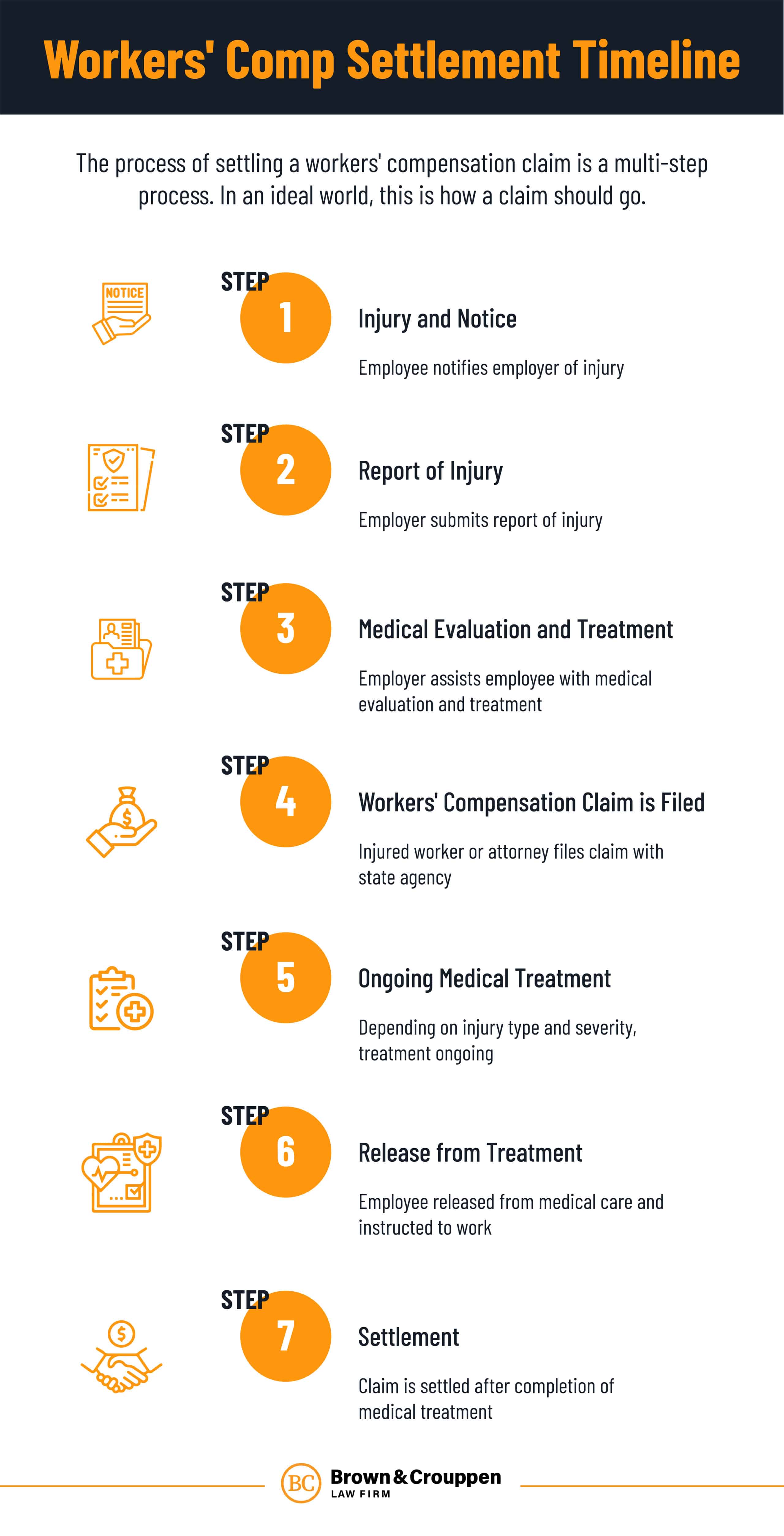
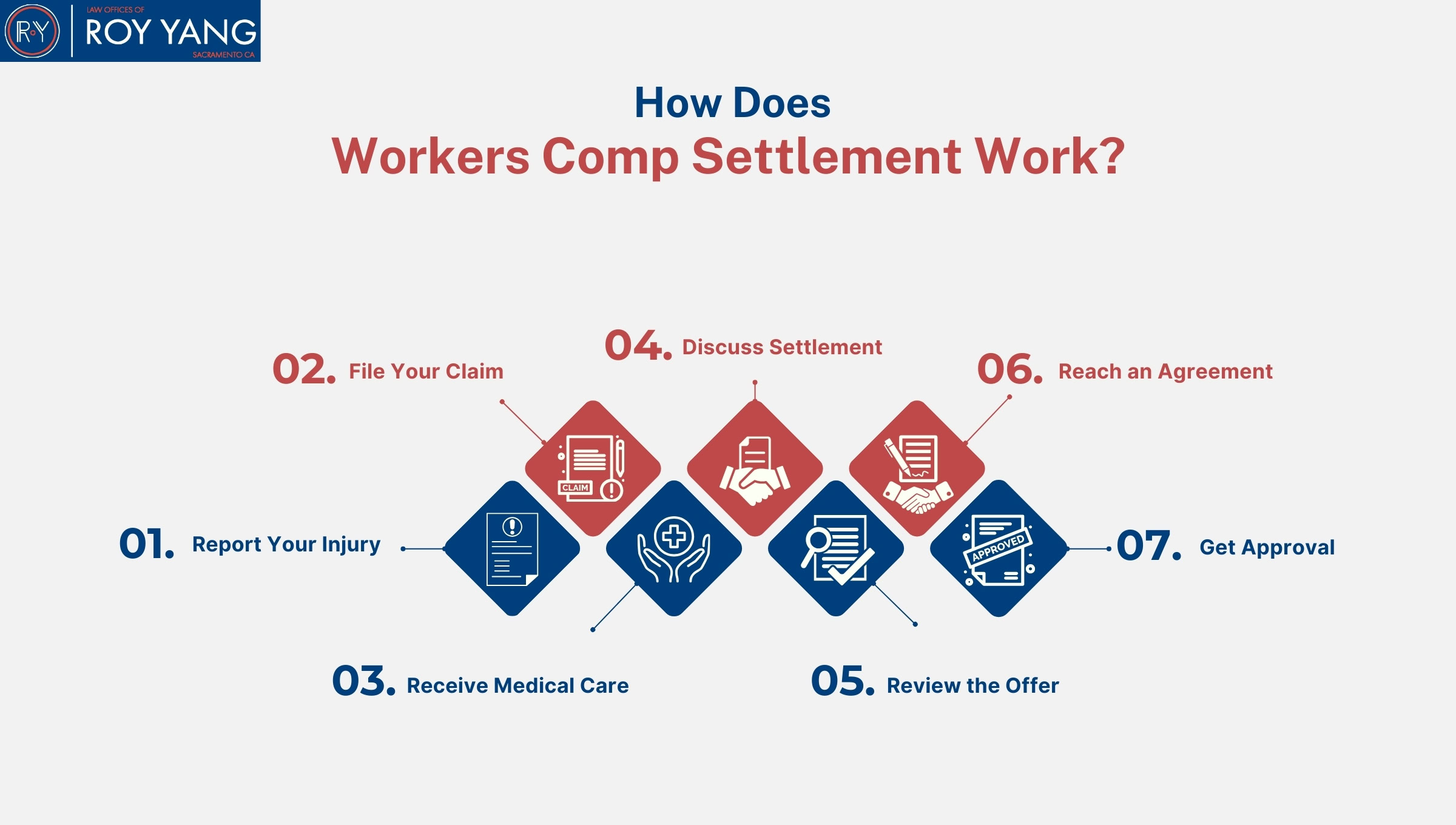
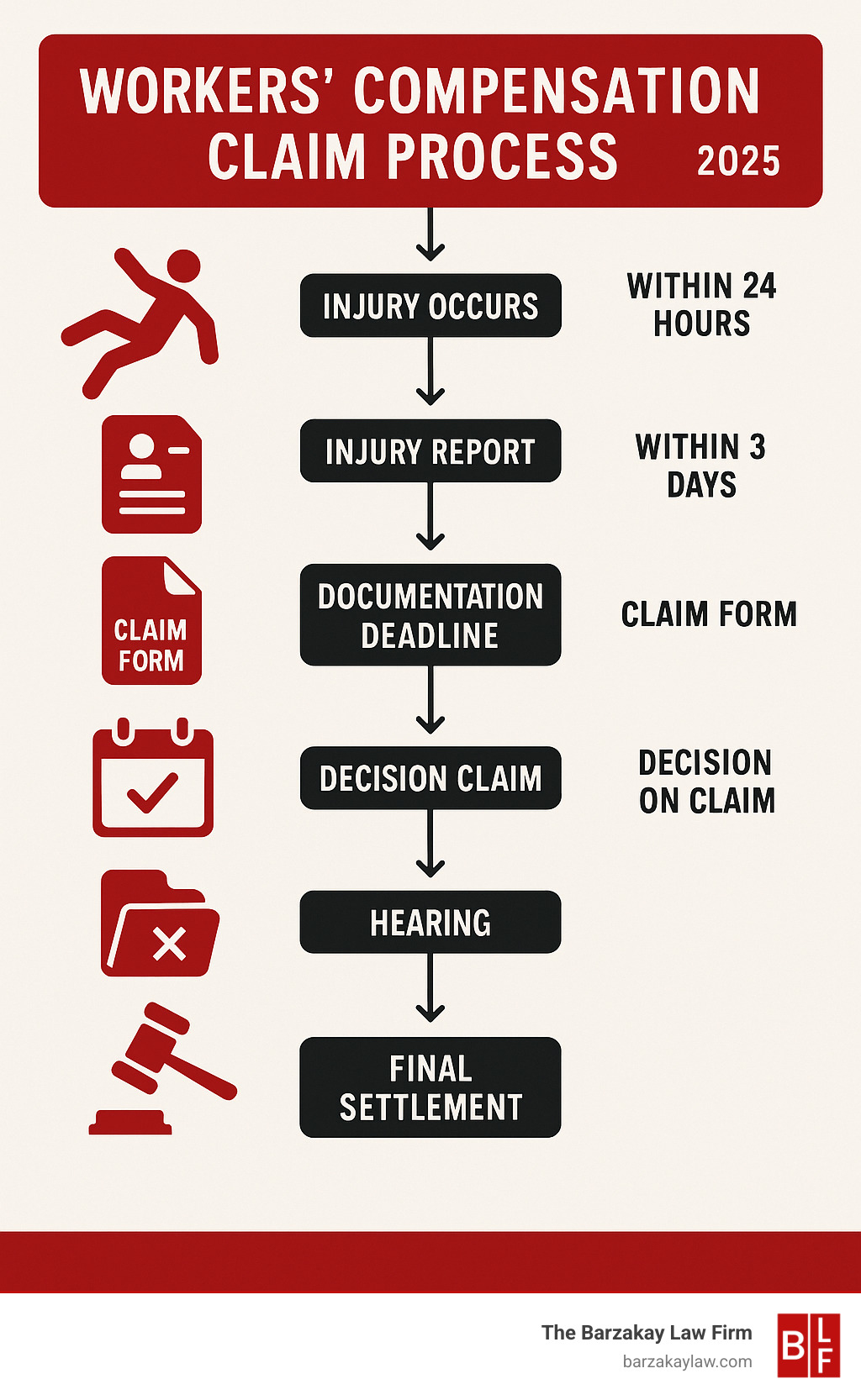
Navigating the timeline from injury reporting to final settlement disbursement involves distinct procedural milestones that require diligence and documentation.
- Injury Reporting and Medical Treatment: Immediately report the workplace injury to the employer and seek authorized medical care to establish an official record of the incident and diagnosis.
- Benefit Administration: Receive temporary disability benefits for lost wages and have authorized medical treatments paid by the insurance carrier while recovering.
- Maximum Medical Improvement (MMI): Attend evaluations with the treating physician or an independent medical examiner to determine when recovery has plateaued and whether any permanent impairment remains.
- Disability Rating and Valuation: Obtain the permanent impairment rating and compile all medical, employment, and financial data to calculate a comprehensive settlement demand.
- Negotiation and Mediation: Exchange settlement offers and counteroffers with the insurance adjuster. If an impasse occurs, participate in formal mediation or administrative hearings overseen by a workers' compensation judge.
- Drafting and Approval: Finalize the written settlement agreement, submit it to the state workers' compensation board or commission for formal review, and await judicial approval and subsequent disbursement of funds.
Common Pitfalls and Strategic Considerations
Entering into a settlement without professional guidance or a complete understanding of long-term medical needs can lead to irreversible financial strain.
One major pitfall is underestimating future medical costs. Workers frequently settle claims quickly to secure cash, only to discover later that their condition requires expensive medical interventions that are no longer covered by the closed claim. Furthermore, claimants must account for liens, such as child support obligations, health insurance subrogation claims, or outstanding medical bills, which may be legally required to be satisfied out of the settlement proceeds before the worker receives their net distribution.
Retaining an experienced workers' compensation attorney can help level the playing field against institutional insurers and ensure that all statutory benefits, rating methodologies, and compliance obligations are properly addressed. Legal representation is particularly valuable when navigating complex disputes regarding liability, pre-existing conditions, or the establishment of Medicare Set-Asides.
Frequently Asked Questions
Can I reopen my workers compensation claim after settling?
In most jurisdictions, a full Compromise and Release settlement is final and cannot be reopened under any circumstances, even if your medical condition deteriorates significantly. However, if you settled via a Stipulation and Award that left medical care open, you may be able to petition the board for additional medical treatment related to the original injury.
Are workers compensation settlement funds taxable?
Generally, workers compensation benefits—including lump-sum settlements received in lieu of periodic indemnity and medical benefits—are exempt from federal and state income taxes under Section 104(a)(1) of the Internal Revenue Code. However, complications can arise if the settlement is structured in a way that affects Social Security Disability Insurance (SSDI) offsets.
How long does it take to receive a settlement check after approval?
Once a workers' compensation judge or administrative board formally approves the settlement agreement, insurance carriers typically have a statutory window—often between 14 to 30 days depending on the state—to issue and mail the settlement funds. Delays beyond this statutory timeframe can result in penalties assessed against the insurer.
What is a Medicare Set-Aside (MSA) and why is it required?
An MSA is a financial agreement that allocates a specific portion of a workers' compensation settlement to pay for future medical services that would otherwise be covered by Medicare. It is required by federal guidelines to protect Medicare's financial interests when settling claims involving current or prospective Medicare beneficiaries.
Do I need a lawyer to negotiate a workers compensation settlement?
While you are legally permitted to represent yourself, insurance carriers employ adjusters and legal counsel whose primary objective is minimizing financial payout. An experienced workers' compensation attorney understands the nuances of impairment ratings, valuation strategies, and state-specific procedural rules, significantly improving the likelihood of a fair recovery.
Next Actions
If you are currently managing an open workers' compensation claim and considering a settlement, your immediate priority should be obtaining a definitive evaluation of your medical status and future care needs from your treating physician. Request a complete copy of your medical file and earnings history. Consult with a qualified workers' compensation attorney in your jurisdiction to review the insurance carrier's initial offers, calculate your potential permanent disability value, and ensure that all federal and state compliance requirements, such as Medicare Set-Asides, are properly satisfied before signing any binding release.
Image Gallery