Understanding Buy-Sell Agreement Life Insurance: A Comprehensive Definition and Guide
A buy-sell agreement life insurance policy is a funding mechanism for a legally binding contract between business owners. It ensures that if an owner dies, the surviving partners or the business entity itself receives a tax-free death...
A buy-sell agreement life insurance policy is a funding mechanism for a legally binding contract between business owners. It ensures that if an owner dies, the surviving partners or the business entity itself receives a tax-free death benefit to purchase the deceased owner’s interest at a predetermined price, ensuring business continuity.
Contents
Defining the Buy-Sell Agreement and Its Funding
To understand the definition of buy-sell agreement life insurance, one must first distinguish between the legal contract and the financial instrument used to satisfy it. A buy-sell agreement (often called a "business prenup") is a legal document that outlines what happens to a business interest when an owner departs due to death, disability, or retirement.
However, a legal agreement is only as strong as the capital behind it. Without a dedicated source of funds, surviving owners may be forced to take out high-interest loans, sell off company assets, or allow the deceased owner's heirs—who may have no business experience—to become active partners. Life insurance serves as the most efficient funding vehicle because it provides an immediate, guaranteed influx of cash exactly when the legal obligation to buy out the deceased owner’s shares is triggered.
In 2026, as business valuations continue to fluctuate amidst evolving economic landscapes, having a clearly defined buy-sell agreement funded by life insurance is considered a fundamental pillar of risk management for any multi-owner enterprise, from small LLCs to large corporations.
Why Life Insurance is the Preferred Funding Method
While business owners could technically fund a buy-out using cash reserves, sinking funds, or bank loans, life insurance is the industry standard for several reasons:
- Immediate Liquidity: The death benefit is usually paid out within weeks, providing the necessary cash to complete the transaction without disrupting the company’s cash flow.
- Cost-Efficiency: Premiums typically cost only a fraction of the total death benefit. Funding a buy-out with a loan requires paying the principal plus interest, which is significantly more expensive than paying insurance premiums.
- Tax Advantages: Under current 2026 tax codes, life insurance death benefits are generally received by the business or the surviving partners income tax-free, provided certain IRS requirements (such as Section 101(j)) are met.
- Fixed Valuation: It allows owners to agree on a fair market value for the business while they are all still alive and healthy, preventing messy litigation with grieving heirs later.
Structural Types of Buy-Sell Life Insurance
The "definition" of how these agreements are structured depends on who owns the policy and who receives the benefit. There are two primary structures, along with a hybrid approach.
1. Cross-Purchase Agreements
In a cross-purchase agreement, each business owner purchases, owns, and is the beneficiary of a life insurance policy on every other owner.
- How it works: If Partner A and Partner B own a business together, Partner A buys a policy on Partner B, and Partner B buys one on Partner A. If Partner A dies, Partner B receives the death benefit and uses those funds to buy Partner A’s shares from their estate.
- Key Advantage (Step-up in Basis): The surviving partner receives an increase in their "cost basis" for the shares they purchased. This is crucial if they decide to sell the business later, as it can significantly reduce their future capital gains tax liability.
- The Complexity Factor: This structure becomes unwieldy as the number of partners grows. The formula for the number of policies needed is $n \times (n-1)$. For five partners, you would need 20 separate policies, making administration difficult.
2. Entity-Purchase (Stock Redemption) Agreements
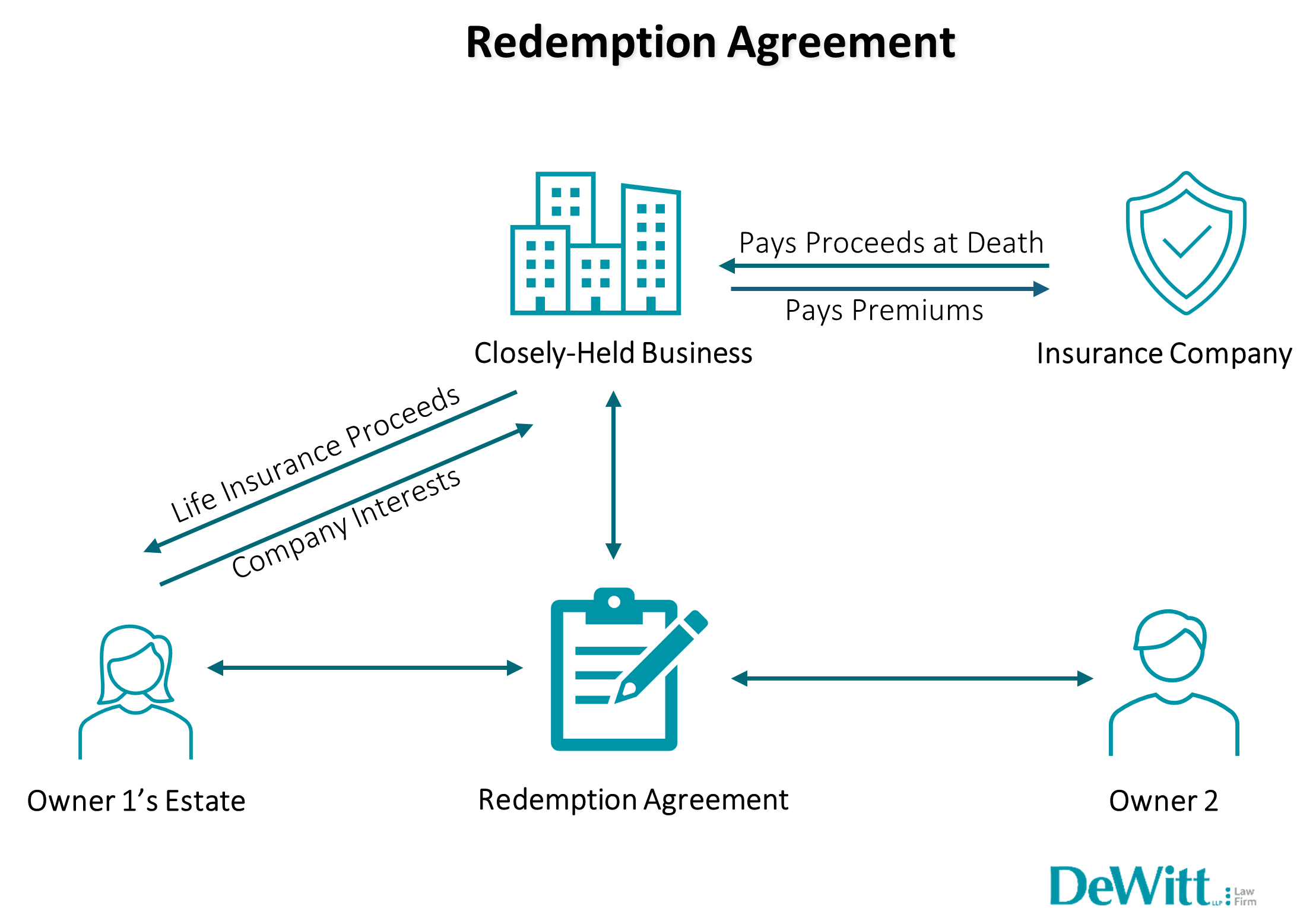
In this structure, the business entity itself (the LLC or Corporation) purchases, owns, and is the beneficiary of policies on each owner’s life.
- How it works: When an owner dies, the company receives the death benefit and uses the cash to buy back (redeem) the deceased owner's shares. Those shares are then typically retired or redistributed among the remaining owners.
- Key Advantage (Simplicity): The company only needs one policy per owner. This is the preferred method for businesses with many partners or shareholders.
- The Basis Drawback: Unlike the cross-purchase agreement, the surviving owners do not receive a "step-up" in their tax basis because they didn't personally buy the shares; the company did.
3. Wait-and-See (Hybrid) Agreements
This approach provides flexibility by allowing the owners to wait until a death occurs to decide whether the surviving owners or the business entity will buy the shares. The insurance is typically owned by the business, but the agreement allows for the proceeds to be used in whichever manner is most tax-efficient at that specific time in 2026.
Comparison of Buy-Sell Funding Structures
| Feature | Cross-Purchase Agreement | Entity-Purchase (Stock Redemption) |
|---|---|---|
| Policy Owner | Individual Partners | The Business Entity |
| Policy Beneficiary | Individual Partners | The Business Entity |
| Number of Policies | $n \times (n-1)$ (Many) | 1 per partner (Fewer) |
| Tax Basis for Survivors | Increases (Step-up) | Remains the same |
| Creditor Protection | Policies owned by individuals | Policies are assets of the business |
| Complexity | High with 3+ partners | Low, regardless of partner count |
| Best For | Small partnerships, S-Corps | Large groups, C-Corps |
Critical Tax and Legal Considerations in 2026
When defining and implementing these agreements, business owners must navigate complex legal and tax waters. Failure to do so can result in the IRS reclassifying death benefits as taxable income.
IRS Section 101(j) Compliance
For entity-purchase agreements, the business must comply with Section 101(j) of the Internal Revenue Code. This requires that the insured employee (the owner) is notified in writing that the employer intends to insure their life and provides written consent. This must be completed before the policy is issued. If these formalities are ignored, the death benefit may be taxed as ordinary income, defeating the primary purpose of the insurance.
The Transfer-for-Value Rule
If you change the ownership of an existing life insurance policy to fund a new buy-sell agreement, you must be wary of the Transfer-for-Value rule. Generally, if a policy is transferred for something of value (money or a promise), the death benefit loses its tax-exempt status. However, there are "safe harbor" exceptions, such as transfers to the insured, to a partner of the insured, or to a partnership in which the insured is a partner.
Valuation Accuracy
A buy-sell agreement is only effective if it uses a valid valuation method. In 2026, courts and the IRS scrutinize "fixed price" agreements that haven't been updated in years. Most modern agreements use a formula-based approach (e.g., a multiple of EBITDA) or require a professional appraisal at the time of the triggering event to ensure the insurance coverage aligns with the actual value of the business.
Common Pitfalls to Avoid
Even with a clear definition, the execution of buy-sell life insurance often fails due to simple oversight.
- Underfunding: As the business grows, the original life insurance policy may no longer cover the full value of a partner’s share. It is vital to review the policy limits every 2-3 years.
- Using the Wrong Policy Type: While term insurance is cheaper, it expires. If a partner dies at age 75 but the term policy expired at 70, the agreement is unfunded. Many businesses use Permanent Life Insurance (Whole Life or Universal Life) because it provides lifelong coverage and builds cash value that can be used to fund a retirement buy-out.
- Inconsistent Language: The buy-sell agreement and the life insurance policy must be synchronized. If the legal agreement says the buy-out price is $2 million but the insurance policy is only for $1 million, the surviving partners may face a liquidity crisis.
Frequently Asked Questions
What happens if one owner is uninsurable? If an owner cannot qualify for life insurance due to health issues, the buy-sell agreement remains legal, but the funding method must change. Common alternatives include using the business's cash flow to pay the heirs in installments or setting up a dedicated "sinking fund" (a savings account for the buy-out).
Can we use existing life insurance policies for a buy-sell agreement? Yes, but you must consult with a tax professional to avoid violating the Transfer-for-Value rule. It is often cleaner and safer to issue new policies specifically earmarked for the agreement to ensure the death benefit remains tax-free.
Who pays the premiums for the life insurance? In an entity-purchase plan, the business pays. In a cross-purchase plan, the individual partners pay. It is important to note that life insurance premiums for buy-sell agreements are generally not tax-deductible for the business or the individuals.
What happens to the policy if I retire instead of die? If you have a permanent life insurance policy, the business (or partner) may choose to keep the policy, or you may buy it from them. The cash value accumulated within the policy can also be used as a down payment for the business to buy out your shares upon retirement.
Is a buy-sell agreement necessary for a sole proprietorship? While you don't have "partners" to buy you out, a one-way buy-sell agreement can be made with a key employee. The employee buys a life insurance policy on the owner, and upon the owner's death, the employee receives the funds to purchase the business from the owner's family, ensuring the business continues.
Final Recommendation for Business Owners
The definition of buy-sell agreement life insurance is more than just a financial term; it is a vital safeguard for your legacy and your partners' livelihoods. To implement this correctly in 2026, you should not attempt a "DIY" approach.
Next Steps:
- Obtain a Professional Valuation: Determine the current fair market value of your business.
- Consult a Triad of Experts: Work with a corporate attorney to draft the agreement, a tax professional to ensure compliance with Section 101(j), and a specialized insurance advisor to select the appropriate policy structure.
- Review Annually: Ensure your coverage amounts keep pace with your company's growth and changes in tax law.
Disclaimer: This article provides general information and does not constitute legal, financial, or tax advice. Laws and regulations regarding life insurance and business contracts vary by jurisdiction and are subject to change. Always consult with qualified professionals before making significant financial decisions.
Image Gallery