Understanding the Liquidated Net Worth of a Business: A Comprehensive Guide
Liquidated net worth measures the net cash value remaining for a company's equity owners after all tangible and intangible assets are sold under liquidation conditions and all liabilities, wind-down costs, and priority claims are fully...
Liquidated net worth measures the net cash value remaining for a company's equity owners after all tangible and intangible assets are sold under liquidation conditions and all liabilities, wind-down costs, and priority claims are fully satisfied. Unlike standard accounting book value, it reflects realistic, discounted market realization rates achieved during an orderly or forced sale.
Contents
Disclaimer
This guide is for informational and educational purposes only and does not constitute formal legal, accounting, tax, or financial advisory services. Corporate liquidation, restructuring, and valuation involve complex statutory requirements and jurisdiction-specific laws. Consult a certified public accountant (CPA), accredited business appraiser, or restructuring attorney before making financial or legal decisions.
What Is Liquidated Net Worth?
Liquidated net worth—frequently referred to as liquidation value of equity or net liquidation value—is a financial metric that establishes the bottom-dollar value of a business if operations were halted immediately and assets were converted to cash to pay off debt.
While conventional corporate balance sheets list assets according to historical cost minus accumulated depreciation under the assumption of a "going concern," liquidated net worth assumes the enterprise is terminating operations. As a result, assets are written down to their net realizable values (NRV), reflecting the reality that distressed or rapid asset sales rarely yield full market price.
To determine liquidated net worth, an analyst calculates the expected gross recovery from selling all company assets, subtracts the costs required to execute the liquidation (such as professional fees, holding costs, and auction commissions), and deducts all outstanding liabilities according to legal priority.
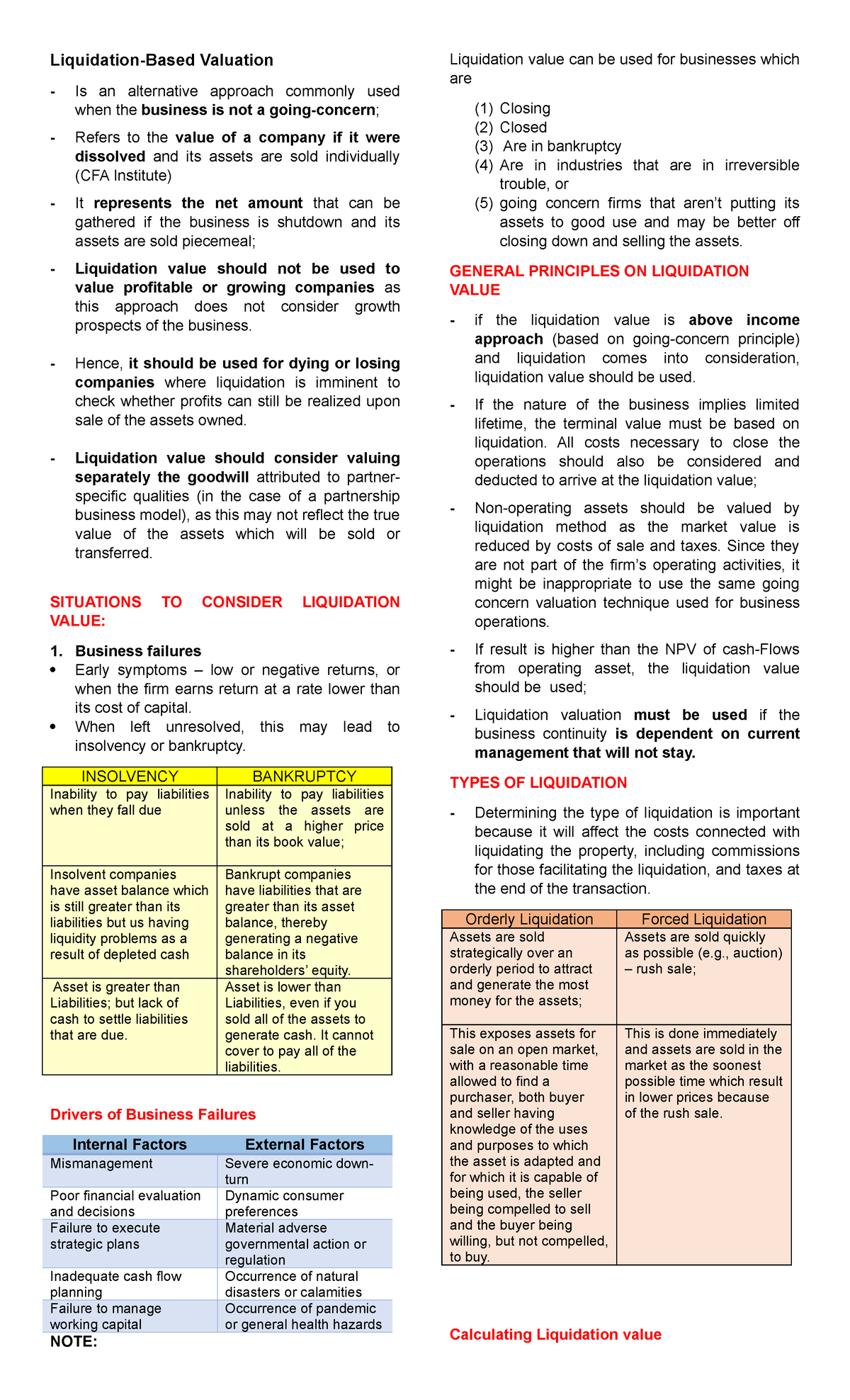
Orderly Liquidation Value (OLV) vs. Forced Liquidation Value (FLV)
Understanding liquidated net worth requires distinguishing between the two primary conditions under which a business wind-down occurs:
- Orderly Liquidation Value (OLV): The estimated gross amount of real estate, equipment, inventory, and intangible assets that could be realized in a privately negotiated sale, given a reasonable period to find qualified buyers (typically 6 to 12 months). OLV assumes the seller is under pressure, but not so severely constrained by time that assets must be sold at fire-sale prices.
- Forced Liquidation Value (FLV): The estimated gross amount realized in a rapid, public auction or immediate sale where assets must be converted to cash in a very short timeframe (often 30 to 90 days or fewer). FLV results in significantly steeper discounts ("haircuts") because potential buyers have minimal inspection time and leverage the seller's urgency.
Liquidated net worth can be computed under either OLV or FLV premises, depending on the purpose of the valuation.
Why Liquidated Net Worth Matters: Strategic & Legal Contexts
Liquidated net worth serves as an indispensable risk management and corporate finance metric. While profitability and discounted cash flow (DCF) models measure operational potential, liquidation analysis provides the absolute economic floor of a business.
- Total Gross Asset Sales proceeds
- MINUS: Liquidation Expenses & Administrative Costs (Legal, Accounting, Auctions, Rent, Staff)
- MINUS: Total Outstanding Liabilities (Secured Debt, Priority Claims, Unsecured Claims)
- EQUALS: LIQUIDATED NET WORTH (Distributable Equity Value)
1. Distress Restructuring and Insolvency
In formal insolvency proceedings—such as Chapter 7 or Chapter 11 bankruptcy under the United States Bankruptcy Code—liquidated net worth forms the baseline for legal compliance. Under the "Best Interests of Creditors Test" (11 U.S.C. § 1129(a)(7)), a bankruptcy court cannot confirm a Chapter 11 reorganization plan unless unsecured creditors receive under the plan at least as much value as they would receive if the debtor were liquidated under Chapter 7. Calculating net liquidation value is legally required to satisfy this threshold.
2. Collateralized Lending and Credit Underwriting
Asset-based lenders (ABLs) rely heavily on liquidation value rather than book value when extending commercial credit lines. Lenders establish loan-to-value (LTV) ratios against a borrower's accounts receivable, inventory, and equipment based on estimated liquidation realization rates. If a borrower defaults, the lender needs to know whether liquidating the underlying collateral will fully cover the outstanding principal and accrued interest.
3. M&A Acquisition Valuation Floor
In corporate mergers and acquisitions, particularly when acquiring underperforming or asset-heavy businesses, liquidated net worth represents the baseline transaction value. Buyers use liquidation analysis to ensure that even in a worst-case operational failure, the tangible asset value exceeds or equals the purchase price, insulating the acquirer from total capital loss.
4. Partnership Dissolutions and Buyouts
When shareholder disputes occur or a business partnership unwinds without a pre-negotiated buy-sell agreement, courts and forensic accountants often calculate liquidated net worth to determine the equitable distribution of capital to departing partners.
Liquidated Net Worth vs. Book Value vs. Going-Concern Value
A common financial mistake is confusing a company’s book value on its accounting ledger with its actual liquidation value. The table below illustrates how these financial metrics differ across critical operational criteria.
| Metric | Valuation Basis | Asset Realization Rate | Intangible Asset Inclusion | Typical Target Audience | Primary Use Case |
|---|---|---|---|---|---|
| Book Value (Balance Sheet) | Historical Cost minus Depreciation (GAAP/IFRS) | 100% of reported net book value | Included if capitalized or acquired | Accountants, Tax Authorities | Financial reporting, compliance |
| Going-Concern Value | Future cash flows, earnings multiples, DCF | Premium over book value | Fully valued (Brand, Goodwill, IP) | Equity Investors, Buyers | Growth acquisitions, stock pricing |
| Orderly Liquidation Value (OLV) | Market realization over 6–12 months | Discounted (typically 40%–80% of book value) | Minimal value (only broadly transferable IP) | Asset-Based Lenders, Restructuring Advisors | Refinancing, plan of reorganization |
| Forced Liquidation Value (FLV) | Rapid public auction / immediate disposition | Severely discounted (typically 10%–50% of book value) | Near-zero value | Chapter 7 Trustees, Distressed Debtors | Chapter 7 liquidations, fire sales |
Key Takeaways from the Comparison
- Goodwill and Intangibles: Under going-concern principles, a strong brand, proprietary software, or customer list carries immense economic value. In a liquidation scenario, goodwill is typically written down to zero because it cannot be separated cleanly from operating management or sold independently.
- Depreciated Physical Assets: Industrial machinery might be fully depreciated on a balance sheet (zero book value), yet hold substantial market value in an orderly liquidation auction. Conversely, custom-built leasehold improvements may carry millions in book value but hold zero liquidation value once removed from the premises.
Key Components of a Liquidation Net Worth Calculation
Calculating liquidated net worth requires systematically auditing three financial buckets: realizable asset values, administrative wind-down expenses, and actual liabilities.
1. Asset Recovery Rates ("Haircuts")
Financial analysts apply recovery percentages (haircuts) to standard balance sheet items to reflect estimated net cash realization. While exact rates vary by industry and market conditions, common benchmarks include:
- Cash and Cash Equivalents (100%): Standard bank deposits retain full face value, though frozen accounts or restricted cash reserves must be evaluated.
- Accounts Receivable (50%–85%): Customers often delay or refuse payment when a supplier enters liquidation, claiming offsets, product defects, or lack of ongoing warranty support. Older receivables (over 90 days) frequently yield less than 20%.
- Inventory:
- Raw Materials (40%–70%): Commodity materials retain higher value because they are easily repurposed by competitors.
- Work-in-Process (10%–30%): Partially finished goods carry negligible value unless a buyer pays to complete them.
- Finished Goods (30%–60%): Wholesalers and liquidators purchase finished inventory only at steep wholesale discounts.
- Property, Plant & Equipment (PP&E) (20%–60%): Standard vehicles and commercial real estate hold higher market liquidity than specialized or custom-engineered manufacturing equipment.
- Intangible Assets (0%–20%): Patents, domain names, and trademarks retain value only if clear title exists and an active secondary market exists for the intellectual property.
2. Liquidation Wind-Down Expenses
Realizing asset proceeds requires spending money. A comprehensive liquidation net worth model must subtract estimated wind-down costs, including:
- Professional Fees: Retainers for legal counsel, restructuring advisors, auction houses, and forensic accountants.
- Asset Disposition Costs: Auctioneer commissions (typically 5% to 15% of gross sales), freight, rigging, and transport costs.
- Facility Holding Costs: Lease payments, utility bills, security services, and building maintenance necessary to secure physical inventory during the sale period.
- Retention Payroll: Compensation for key operational staff needed to assist with asset audit, liquidation logistics, and record reconciliation.
3. Liabilities and Creditor Waterfalls
Once gross asset recovery is calculated and wind-down costs are deducted, the remaining net proceeds are applied to company obligations in a strict statutory order of priority:
- Super-Priority and Administrative Claims: Expenses directly incurred during the liquidation process itself (such as professional fees and court costs).
- Secured Claims: Creditors holding perfected liens on specific collateral (e.g., mortgages, equipment loans, UCC-1 liens). Secured creditors are satisfied up to the liquidation proceeds of their specific collateral.
- Priority Unsecured Claims: Statutory obligations such as unpaid employee wages, benefit contributions, and local, state, or federal taxes.
- General Unsecured Claims: Trade payables, unsecured lines of credit, lease termination damages, and bond obligations.
- Subordinated Debt: Junior debt instruments structured to yield to senior unsecured creditors.
- Equity Holders (Liquidated Net Worth): Preferred and common stockholders receive the remaining balance. If total proceeds after expenses are less than total debt, the liquidated net worth is negative, and equity holders receive zero.
Step-by-Step Process to Calculate Liquidated Net Worth
To construct a defensible liquidation model, follow this step-by-step framework.
Step 1: Establish the Valuation Date and Sale Premise
Define clearly whether the evaluation is based on an Orderly Liquidation or a Forced Liquidation, as this decision determines the recovery percentages applied throughout the financial model.
Step 2: Conduct an Inventory of All Balance Sheet & Off-Balance Sheet Items
Extract the latest trial balance. Identify off-balance sheet liabilities, such as pending lawsuits, tax audits, environmental remediation costs, or unfulfilled long-term contractual commitments.
Step 3: Apply Realization Haircuts to Gross Asset Values
Adjust each asset line item to its estimated realizable liquidation value based on market appraisals, historical liquidation data, or broker quotes.
$$\text{Gross Realizable Value} = \sum (\text{Book Value of Asset}_i \times \text{Recovery Rate}_i)$$
Step 4: Calculate Total Liquidation Administrative Expenses
Sum all anticipated costs required to execute the wind-down, including legal, auction, security, lease holding, and professional fees. Subtract this total from the Gross Realizable Value to arrive at the Net Realizable Asset Pool.
$$\text{Net Realizable Asset Pool} = \text{Gross Realizable Value} - \text{Total Liquidation Expenses}$$
Step 5: Deduct Liabilities in Accordance with Priority Waterfalls
Subtract all secured, priority, and unsecured obligations from the Net Realizable Asset Pool.
$$\text{Liquidated Net Worth} = \text{Net Realizable Asset Pool} - \text{Total Creditor Claims}$$
Practical Example: A Liquidation Valuation Scenario
To see how book value differs from liquidated net worth in practice, consider Apex Manufacturing LLC, a mid-sized industrial parts supplier undergoing an orderly liquidation.
Balance Sheet Comparison (Orderly Liquidation Basis)
| Financial Category | Reported Book Value ($) | Estimated Recovery Rate (%) | Realizable Liquidation Value ($) |
|---|---|---|---|
| Cash & Cash Equivalents | $250,000 | 100% | $250,000 |
| Accounts Receivable | $800,000 | 70% | $560,000 |
| Raw Materials Inventory | $400,000 | 50% | $200,000 |
| Finished Goods Inventory | $600,000 | 40% | $240,000 |
| Machinery & Equipment | $1,200,000 | 35% | $420,000 |
| Commercial Real Estate | $2,000,000 | 85% | $1,700,000 |
| Goodwill & Intellectual Property | $500,000 | 0% | $0 |
| TOTAL GROSS ASSETS | $5,750,000 | — | $3,370,000 |
Step-by-Step Step Analysis
- Gross Asset Liquidation Proceeds: $3,370,000 (down from $5,750,000 book value).
- Deduct Liquidation Expenses:
- Legal, Accounting, and Auction Commissions: $220,000
- Facility Maintenance & Holding Expenses (6 Months): $150,000
- Essential Staff Retention Bonus & Payroll: $100,000
- Total Liquidation Expenses: $470,000
- Net Realizable Asset Pool: $3,370,000 - $470,000 = $2,900,000
- Deduct Outstanding Liabilities:
- Mortgage on Real Estate (Secured Debt): $1,200,000
- Equipment Senior Loans (Secured Debt): $300,000
- Unpaid Taxes & Priority Wages: $150,000
- Trade Accounts Payable (General Unsecured): $800,000
- Total Liabilities: $2,450,000
Final Result
$$\begin{aligned} \text{Liquidated Net Worth} &= \text{Net Realizable Asset Pool} - \text{Total Liabilities} \ &= $2,900,000 - $2,450,000 \ &= \mathbf{$450,000} \end{aligned}$$
While Apex Manufacturing reported an accounting book value equity of $3,300,000 ($5,750,000 assets minus $2,450,000 liabilities), its actual liquidated net worth is only $450,000. If forced into a rapid auction (Forced Liquidation Value), recovery rates would fall further, pushing the net liquidation equity well into negative territory.
Common Pitfalls and Mistakes in Liquidation Analysis
When evaluating the liquidated net worth of a corporate entity, financial analysts and business owners often make critical errors that distort their conclusions:
- Overestimating Accounts Receivable Recoveries: Assuming that existing customers will pay their balances fully once a company ceases operations is a common mistake. Customers frequently withhold payment to offset loss of future warranty service or ongoing maintenance obligations.
- Ignoring Lease and Contractual Termination Penalties: Breaking long-term real estate leases, equipment leases, or vendor software contracts often triggers substantial default liabilities. These damages rank as general unsecured claims and directly erode the net proceeds available to equity holders.
- Failing to Account for Cancellation of Debt (COD) Income Taxes: If creditors agree to accept less than full repayment as part of a negotiated workout or out-of-court restructuring, the forgiven debt may generate federal or state taxable income, creating unexpected tax liabilities that reduce final net values.
- Neglecting Environmental and Regulatory Remediation: Industrial businesses often face mandatory environmental assessments before selling commercial property or manufacturing plants. Cleanup obligations can quickly consume the equity value of commercial real estate.
Frequently Asked Questions
What is the difference between net worth and liquidated net worth?
Standard net worth (book value) reflects total assets minus total liabilities calculated according to standard financial accounting rules, assuming the company operates indefinitely. Liquidated net worth reflects the net cash remaining after selling assets under distressed or wind-down conditions, deducting all costs associated with the sale, and satisfying outstanding debt according to statutory priority.
Can a business have a positive book value but a negative liquidated net worth?
Yes. This situation occurs frequently in asset-heavy or highly leveraged businesses. If a company's balance sheet includes substantial intangible assets (like goodwill), customized machinery, or specialized inventory that suffers heavy market discounts during a sale, the gross asset proceeds may fall short of total debt obligations. This results in a negative liquidated net worth despite a positive balance sheet book value.
How do liquidation haircuts vary across different industries?
Haircut percentages depend on asset liquidity and market demand. Service companies with minimal physical assets and high goodwill face severe haircuts (often 80% to 90% total reduction). Conversely, logistics or real estate holding companies that own liquid assets, fleet vehicles, or prime real estate experience smaller haircuts (typically 10% to 30% reduction).
Is liquidation net worth identical to liquidation value of equity?
Yes, in corporate finance and business valuation terminology, liquidated net worth, net liquidation value, and liquidation value of equity refer to the identical concept: the net residual value left for equity owners after satisfying all asset disposition costs and debt claims.
What accounting standards govern financial reporting on a liquidation basis?
In the United States, when a company's liquidation becomes probable, accounting rules shift from standard U.S. GAAP to the Liquidation Basis of Accounting (FASB Accounting Standards Codification ASC 205-20). Under ASC 205-20, assets are revalued to reflect the estimated net cash proceeds from liquidation, and liabilities are accrued to include estimated costs expected to be incurred during the wind-down period.
Strategic Recommendations for Business Owners and Analysts
To effectively monitor and manage a company's bottom-dollar asset value, financial managers and investors should adopt the following best practices:
- Perform Annual Liquidation Stress Tests: Run an annual liquidation analysis alongside standard financial audits. Knowing your company's liquidation value floor provides vital leverage when negotiating credit agreements, securing asset-based loans, or evaluating strategic buyouts.
- Maintain Clear Asset Documentation and Appraisals: Up-to-date machinery serial numbers, real estate titles, and equipment appraisals allow restructuring teams to negotiate higher Orderly Liquidation Values rather than being forced into fire-sale auctions.
- Monitor Asset-Based Lending Covenants: If your business utilizes a borrowing base loan tied to inventory or receivables, track changes in lender recovery assumptions closely. A shift in third-party appraisal discounts can trigger sudden borrowing base defaults.
- Engage Professional Restructuring Counsel Early: If a business faces distress, engaging turnaround professionals and insolvency attorneys early preserves options. Timely execution helps maintain an orderly liquidation timeline rather than sliding into a forced liquidation, preserving millions in residual equity.
Image Gallery