The Impact of Tariffs on Clothing in the US
Tariffs on clothing in the United States function as a mandatory tax on imported apparel, significantly increasing the landed cost for retailers and retail prices for consumers. As of 2026, these duties—often ranging from 10% to over 3...
Tariffs on clothing in the United States function as a mandatory tax on imported apparel, significantly increasing the landed cost for retailers and retail prices for consumers. As of 2026, these duties—often ranging from 10% to over 30%—continue to drive supply chain diversification away from China while pressuring profit margins across the fashion industry.
Contents
The Economic Mechanics of Apparel Tariffs
In the United States, tariffs on clothing are primarily ad valorem duties, meaning they are calculated as a percentage of the value of the imported goods. When a domestic brand or retailer imports a shipment of garments, the U.S. Customs and Border Protection (CBP) assesses these fees based on the Harmonized Tariff Schedule (HTS). For clothing, the HTS is notoriously complex, with rates varying wildly based on fiber content (cotton vs. synthetic), the gender of the wearer, and even the specific construction of the garment (knit vs. woven).
The immediate impact of a tariff is an increase in the landed cost. For example, if a jacket costs $20 to manufacture in a foreign factory and is subject to a 25% tariff, the cost to bring that item into the U.S. jumps to $25 before shipping, insurance, or marketing costs are even considered. In 2026, many apparel companies are operating on thin margins, meaning these additional costs are rarely absorbed entirely by the corporation. Instead, they are typically passed on to the consumer through higher "ticket" prices or "hidden" through shrinkflation, where the quality of materials is reduced to maintain a specific price point.
Beyond the direct financial cost, tariffs create a significant administrative burden. Businesses must employ trade compliance experts or customs brokers to ensure that every item is classified correctly under the HTS. Misclassification can result in heavy fines or shipment seizures, adding a layer of operational risk to international sourcing.
The Role of Section 301 and the China Strategy
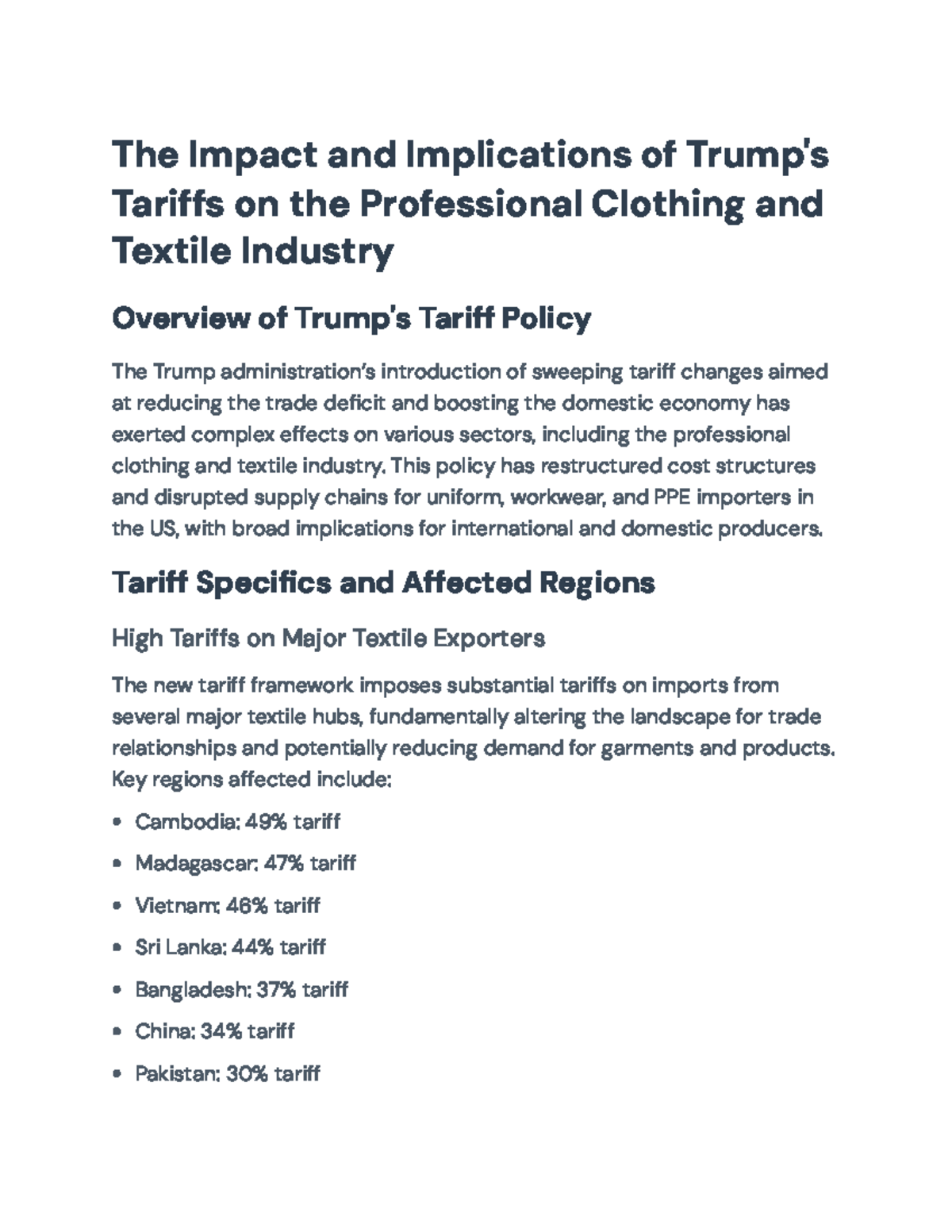
The most significant disruption in the US clothing market over the last decade has been the application of Section 301 tariffs on goods originating from China. Initially implemented as part of a broader trade dispute, these tariffs added an extra layer of cost on top of the standard Most Favored Nation (MFN) rates. By 2026, while some exclusions have been granted, the overarching policy remains a cornerstone of U.S. trade strategy aimed at reducing reliance on Chinese manufacturing.
China has historically been the "world's factory" for apparel due to its unmatched infrastructure, skilled labor force, and massive textile mills. However, the cumulative effect of Section 301 tariffs has made Chinese production economically unviable for many basic apparel categories. This has led to a "China Plus One" strategy, where brands maintain some production in China for high-complexity items while moving high-volume, price-sensitive items to countries like Vietnam, Bangladesh, and India.
However, moving production is not a simple "flip of a switch." China still controls a vast portion of the global fabric and trim supply (buttons, zippers, linings). Consequently, even if a shirt is sewn in Vietnam, the components often originate in China. U.S. trade policy in 2026 has become increasingly sophisticated in tracking these Rules of Origin, ensuring that tariffs are applied correctly even when goods are finished in a third-party country.
Supply Chain Migration and the Rise of Near-shoring
The pressure of tariffs has accelerated the migration of the apparel supply chain toward regions that benefit from Free Trade Agreements (FTAs) with the United States. Two of the most critical frameworks in 2026 are the USMCA (United States-Mexico-Canada Agreement) and CAFTA-DR (Central America-Dominican Republic Free Trade Agreement).
Goods imported from these regions can often enter the U.S. duty-free, provided they meet specific "yarn-forward" requirements. This rule mandates that the yarn spinning, fabric weaving, and final assembly must all occur within the member countries. This creates a powerful incentive for brands to invest in Western Hemisphere production, a trend known as near-shoring.
| Region/Agreement | Typical Tariff Rate (Apparel) | Primary Benefit | Key Challenges |
|---|---|---|---|
| China (Section 301) | 7.5% - 25% (Additional) | Unmatched scale and speed | High cost; geopolitical risk |
| Vietnam / SE Asia | 10% - 32% (Standard MFN) | Skilled labor; established hubs | Rising labor costs; infrastructure |
| USMCA (Mexico) | 0% (If compliant) | Proximity to market; speed | Security; limited fabric variety |
| CAFTA-DR | 0% (If compliant) | Duty-free access; sustainability | Political stability; energy costs |
While near-shoring offers a way to bypass tariffs and reduce shipping times, it faces significant hurdles. The textile infrastructure in the Americas is currently less robust than in Asia. Brands often find that while they save 15% on tariffs by sourcing from Central America, their raw material costs are 20% higher because they cannot access the subsidized, mass-produced fabrics available in the Far East.
The De Minimis Controversy and Direct-to-Consumer Imports
A major focal point for trade policy in 2026 is the Section 321 de minimis rule. This provision allows shipments valued at $800 or less to enter the U.S. duty-free and with minimal documentation. Originally intended to simplify small personal imports, the rule has been utilized extensively by ultra-fast fashion platforms to ship millions of individual packages directly from overseas warehouses to U.S. doorsteps.
Domestic retailers and manufacturers argue that this creates an unlevel playing field. A U.S.-based brand importing a container of 10,000 shirts must pay standard tariffs and Section 301 duties. Meanwhile, a competitor shipping those same 10,000 shirts individually to 10,000 different customers pays zero tariffs.
In 2026, legislative efforts are actively targeting this loophole. Potential changes include lowering the $800 threshold specifically for "covered" goods like apparel or requiring more detailed data submissions for de minimis shipments. Any reduction in the de minimis threshold would immediately increase the price of ultra-cheap clothing, as these platforms would be forced to factor duties into their pricing models for the first time.
Compliance Costs and the UFLPA Factor
Tariffs are not the only financial "gate" at the U.S. border. The Uyghur Forced Labor Prevention Act (UFLPA), which established a rebuttable presumption that goods made in the Xinjiang region of China are made with forced labor, has significantly increased compliance costs. Since Xinjiang produces a large portion of the world's cotton, apparel brands must provide rigorous documentation—often down to the farm level—to prove their supply chains are "clean."
The cost of this supply chain mapping is substantial. Brands must invest in specialized software, third-party audits, and isotopic testing of fibers to verify the origin of their materials. If a shipment is detained by CBP under UFLPA, the storage fees and potential loss of seasonal inventory can be more devastating than the tariffs themselves. In 2026, trade compliance has evolved from a back-office function to a core strategic necessity for any apparel business.
Impact on the American Consumer
Ultimately, the impact of tariffs is felt most acutely at the cash register. While tariffs are intended to protect domestic jobs, the U.S. apparel manufacturing sector is a fraction of what it once was. Consequently, tariffs on clothing act primarily as a regressive tax. Because lower-income households spend a larger percentage of their earnings on basic necessities like clothing, they bear a disproportionate share of the tariff burden.
Retailers have responded to the high-tariff environment of 2026 in several ways:
- Price Hikes: Direct increases in the MSRP (Manufacturer's Suggested Retail Price).
- Product Re-engineering: Swapping a high-tariff material (like silk) for a lower-tariff synthetic blend.
- Tiered Sourcing: Using high-tariff regions for "fast fashion" (where speed justifies the cost) and duty-free regions for "basics" (where margins are tighter).
Frequently Asked Questions
Do tariffs apply to all clothing imported into the US?
Most imported clothing is subject to some level of duty, but the rate depends on the country of origin and the existence of free trade agreements. Goods from countries with "Most Favored Nation" status pay standard rates, while countries like Mexico or those in Central America can export clothing duty-free to the U.S. if they meet specific yarn and fabric origin requirements.
How do tariffs affect the price of a single t-shirt?
If a t-shirt has a manufacturing cost of $5 and is subject to a 16% tariff plus a 7.5% Section 301 duty, the importer pays an extra $1.17 in taxes. While $1.17 seems small, when you account for the retail markup (typically 2x to 4x the landed cost), that single tariff can result in a $3 to $5 increase in the final price the consumer sees in a store.
Why doesn't the US just make all its own clothing to avoid tariffs?
The U.S. lacks the massive labor force and integrated textile mill infrastructure required to meet total domestic demand. While high-end or specialized "Made in USA" apparel exists, the cost of labor in the U.S. is significantly higher than in major sourcing hubs. For most mass-market brands, the cost of domestic production still exceeds the cost of imported goods plus tariffs.
What is the "yarn-forward" rule?
The "yarn-forward" rule is a requirement found in many U.S. trade agreements. It stipulates that for a garment to qualify for duty-free treatment, the production process starting from the spinning of the yarn, through the weaving of the fabric, to the final sewing must occur within the trade agreement member countries. This prevents countries like China from simply shipping fabric to a trade partner for final assembly to bypass tariffs.
Can individuals avoid tariffs by buying clothes online from overseas?
Currently, under the de minimis rule, individual shipments valued under $800 usually enter the U.S. duty-free. However, as of 2026, this rule is under intense regulatory scrutiny. If you purchase from international platforms, you may not see a "tariff" charge, but if laws change, these retailers may eventually be forced to collect duties at checkout or increase their base prices.
Practical Recommendation for Businesses and Consumers
For apparel businesses, the priority in 2026 must be diversification and transparency. Relying on a single country for production is no longer a viable strategy given the volatility of trade policy. Investing in digital supply chain mapping tools is essential not just for UFLPA compliance, but for optimizing duties through "First Sale" valuation—a legal method to pay tariffs based on the price paid to the factory rather than the price paid to a middleman vendor.
For consumers, the best way to navigate tariff-driven price increases is to look for brands that prioritize "near-shored" production or use sustainable, high-quality materials that justify the higher price point. Understanding that "cheap" clothing often relies on trade loopholes can help shoppers make more informed decisions about the true value of the garments they purchase.
Image Gallery