Navigating an Associate Degree in Retail Management: Curriculum, Career Paths, and Admission Requirements
An associate degree in retail management is a two-year undergraduate academic program designed to equip students with practical skills in store operations, merchandising, inventory control, and staff leadership. Typically comprising 60...
An associate degree in retail management is a two-year undergraduate academic program designed to equip students with practical skills in store operations, merchandising, inventory control, and staff leadership. Typically comprising 60 credit hours, this degree prepares graduates for immediate workforce entry into retail supervisory roles or for transfer into a four-year bachelor’s degree program in business administration or retail logistics.
Contents
Understanding the Retail Management Associate Degree Structure
An associate degree in retail management bridges foundational business theory and real-world store operations. Offered primarily by community colleges, vocational institutes, and accredited online universities, these programs teach students how physical and digital retail environments operate from the sales floor to the corporate supply chain.
When evaluating programs, prospective students typically encounter three distinct degree designations:
Associate of Applied Science (AAS) in Retail Management
The AAS is a workforce-oriented degree designed for students who intend to enter the job market directly upon graduation. General education requirements (such as English composition and college algebra) are minimized to make room for specialized, hands-on courses in visual merchandising, retail loss prevention, and point-of-sale (POS) systems management.
Associate of Science (AS) in Retail Management or Business Administration
The AS degree balances functional retail courses with broader foundational science and quantitative business courses. It is structured primarily for students who plan to transfer into a four-year institution to earn a Bachelor of Science (BS) in Business Administration, Marketing, or Supply Chain Management.
Associate of Arts (AA) in Business with a Retail Focus
The AA degree emphasizes liberal arts coursework alongside introductory business classes. This option works best for students seeking a broad educational foundation who intend to pursue humanities or consumer psychology degrees alongside retail management at a four-year university.
Core Curriculum and Skill Development
Standard associate degree programs in retail management require approximately 60 semester credits (or 90 quarter credits), which standard full-time students complete in two academic years. The curriculum is split into three main course blocks: general education, business foundations, and specialized retail operations.
- General Education (15–20 Credits)
- Communication, Quantitative Reasoning, Math
- Business Foundations (18–24 Credits)
- Financial Accounting, Microeconomics, Law
- Retail Operations Core (18–24 Credits)
- Inventory Management, Merchandising, CRM
Business Foundations
Before diving into retail specifics, students gain a macro-level understanding of commercial operations. Core business coursework generally includes:
- Financial Accounting: Learning to read balance sheets, profit-and-loss (P&L) statements, and cash flow reports tailored to retail margins.
- Principles of Microeconomics: Understanding consumer demand curves, pricing elasticity, and market competition dynamics.
- Business Communication: Developing professional verbal, written, and digital presentation skills for corporate reporting and employee engagement.
- Legal Environment of Business: Examining employment law, wage regulations, consumer protection statutes, and contract fundamentals.
Retail Management Concentration
The specialized core focuses directly on the operational mechanics of consumer sales environments:
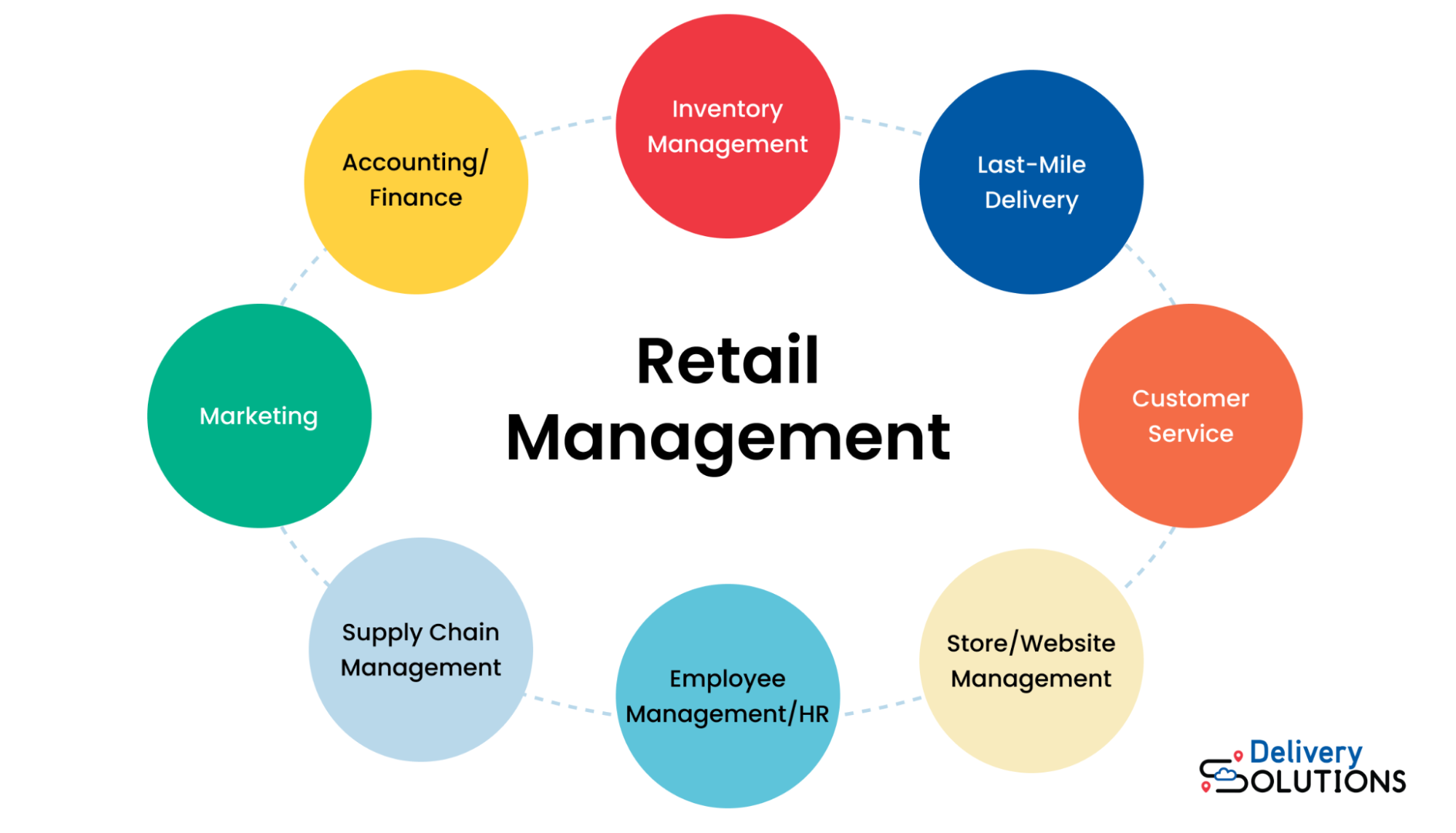
- Retail Operations and Logistics: Analyzing floor management, store layout strategies, labor scheduling, and backroom receiving processes.
- Principles of Marketing and Visual Merchandising: Studying consumer buying behavior, store planograms, promotional signage, end-cap displays, and digital storefront alignment.
- Inventory Control and Supply Chain Management: Mastering stock keeping unit (SKU) tracking, just-in-time (JIT) replenishment, vendor negotiations, and stock turn ratio calculations.
- Loss Prevention and Safety: Identifying shrinkage risks, implementing asset protection protocols, establishing physical security measures, and managing internal audit procedures.
- Customer Relationship Management (CRM): Utilizing software analytics to build loyalty programs, handle service escalations, and personalize the omni-channel shopping experience.
- Supervisory Leadership: Developing techniques for frontline talent recruitment, onboarding, performance reviews, and conflict resolution on the sales floor.
Program Delivery Formats: On-Campus vs. Online
Educational institutions structure retail management programs to accommodate traditional students as well as active retail workers looking for internal promotions.
Asynchronous Online Programs
Online associate degrees allow students to review lectures, complete coursework, and participate in discussion boards on their own schedules. This format is popular among full-time retail employees (such as shift leaders or department associates) seeking academic credentials without stepping away from work. Reliable internet access and self-directed time management are critical for success in asynchronous formats.
Hybrid and On-Campus Programs
Traditional classroom settings offer hands-on practice through physical visual merchandising labs, mock store setups, and real-time group negotiation exercises. Hybrid models combine online lecture delivery with weekend or evening campus workshops, offering face-to-face networking with regional retail hiring managers.
Cooperative Education and Internships
Many programs integrate a cooperative education (co-op) credit or practicum. Students work paid or unpaid hours at an approved retail store, completing structured learning objectives under the supervision of both an academic advisor and an on-site store manager.
Comparing Retail Management Qualifications
Choosing between an associate degree, a short-term certificate, or a four-year bachelor's degree depends on your current career stage, budget, and long-term professional goals.
| Qualification Level | Average Time to Complete | Total Credit Hours | Primary Operational Focus | Typical Target Career Level |
|---|---|---|---|---|
| Retail Management Certificate | 6 to 12 months | 12 to 30 credits | Specific practical skills (e.g., POS systems, floor supervision) | Shift Supervisor, Lead Cashier |
| AAS in Retail Management | 2 years (Full-Time) | 60 credits | Direct store management, inventory control, personnel leadership | Assistant Store Manager, Department Manager |
| AS in Business (Retail Track) | 2 years (Full-Time) | 60 credits | General business theory, analytical accounting, preparation for university transfer | Department Manager, Junior Buyer, Academic Transfer |
| BS in Retail & Supply Chain Management | 4 years (Full-Time) | 120 credits | Corporate strategy, global logistics, multi-unit analytics, enterprise finance | General Store Manager, Regional Operations Manager, Corporate Buyer |
Career Pathways, Job Titles, and Salary Potential
Graduates holding an associate degree in retail management possess a credential that validates both technical understanding and leadership capability. While entry-level sales associate roles rarely require higher education, supervisory and operational roles increasingly favor candidates with formal postsecondary training.
Common Career Roles for Associate Degree Graduates
Assistant Store Manager
Assistant store managers oversee day-to-day department operations, manage floor staff schedules, handle customer escalations, and assist the general manager with sales target tracking. They ensure that corporate merchandising guidelines are correctly executed across departments.
Department Manager
Responsible for a specific section within a big-box store, supermarket, or department store (such as apparel, electronics, or grocery). Tasks include managing department inventory levels, conducting cycle counts, maintaining visual standards, and coaching department sales representatives.
Visual Merchandiser
Visual merchandisers translate corporate branding guidelines into physical store floor plans, window displays, and promotional focal points. They analyze sales data to determine which product placements maximize revenues per square foot.
Inventory Control Specialist
These specialists monitor product movement within physical stores and regional fulfillment centers. They manage stock receiving audits, track damaged goods, analyze inventory shrinkage, and coordinate with supply chain vendors to prevent out-of-stock scenarios.
Store Loss Prevention Supervisor
Loss prevention leaders implement safety procedures, monitor store surveillance systems, conduct internal investigations, and train floor staff on theft prevention and physical safety compliance.
Salary Overview and Advancement Horizons
Salaries for associate degree graduates vary based on store size, geographic region, and sector (e.g., luxury retail versus grocery chains). Supervisory roles typically offer base salaries alongside performance-based quarterly or annual bonuses linked to store sales quotas, shrinkage reduction metrics, and labor cost management.
Earning an associate degree accelerates the timeline for promotion into multi-unit leadership positions, such as District Manager or Area Operations Specialist, particularly when paired with several years of store floor experience.
Admission Requirements, Costs, and Financial Opportunities
Admission Prerequisites
Enrolling in an associate degree program in retail management typically requires:
- A high school diploma or a recognized equivalent (such as the GED).
- Official high school or prior college transcripts.
- Basic placement testing in reading and mathematics (some institutions waive this requirement based on high school GPA or standard test scores).
- A brief personal statement or goal essay (required by select private or competitive online institutions).
Tuition and Educational Expenses
Tuition costs vary significantly by institution type:
- Public Community Colleges (In-District): Generally offer the most affordable option, with tuition ranging from $3,000 to $5,000 per academic year.
- Public Colleges (Out-of-District / Out-of-State): Tuition typically ranges from $6,000 to $10,000 per academic year.
- Private or For-Profit Online Universities: Tuition can range from $8,000 to $15,000 per academic year.
Additional costs include digital course software licenses, textbooks, and program materials.
Employer Tuition Assistance Programs
Major retail employers frequently partner with higher education institutions to sponsor employee education. Companies like Walmart, Target, The Home Depot, and Amazon offer full or partial tuition coverage programs for eligible part-time and full-time workforce members pursuing undergraduate credentials in retail operations, business administration, and management. Prospective students currently working in retail should check their employer's human resources benefits portal before applying.
Program Accreditation and Credit Transferability
Before enrolling in any academic program, students should verify the institution's accreditation status to protect their financial investment and ensure educational quality.
Institutional Accreditation
Ensure the college or university holds regional institutional accreditation from a recognized accrediting organization (such as the Higher Learning Commission or the Southern Association of Colleges and Schools Commission on Colleges). Institutional accreditation guarantees that the school meets rigorous academic standards and qualifies for federal financial aid programs (such as Pell Grants and Federal Direct Student Loans via the FAFSA).
Specialized Programmatic Accreditation
Top-tier business programs may hold programmatic accreditation from bodies such as the Accreditation Council for Business Schools and Programs (ACBSP) or the International Accreditation Council for Business Education (IACBE). This specialized endorsement signals that the business curriculum aligns directly with modern industry requirements.
Transfer Articulation Agreements
For students who plan to eventually pursue a bachelor's degree, articulation agreements are essential. These are formal contracts between two-year community colleges and four-year universities that guarantee all 60 credits from an associate degree will transfer smoothly into a corresponding bachelor's degree program. Without a formal articulation agreement, some technical or operational courses might be classified as non-transferable electives, extending the time needed to earn a four-year degree.
Frequently Asked Questions
How long does it take to earn an associate degree in retail management?
A standard associate degree requires 60 credit hours, which takes two years of full-time study (usually four 15-credit semesters). Students enrolled part-time while working full-time typically complete the program in three to four years. Accelerated online programs may allow dedicated students to finish in 15 to 18 months.
Is an associate degree in retail management worth it for store promotion?
Yes, an associate degree provides formal proof of management capability, financial literacy, and operational understanding. While store floor experience is valuable, combining practical store knowledge with a formal credential helps candidates stand out for promotions to shift lead, department manager, or assistant store manager roles over uncredentialed peers.
Can I transfer my associate degree credits toward a bachelor's degree?
Yes, provided you choose an accredited program designed for transfer (such as an Associate of Science or Associate of Arts in Business). Check with academic advisors at both institutions to confirm that an established articulation agreement exists so your credits transfer directly into a four-year Bachelor of Business Administration (BBA) or Bachelor of Science in Retail Management program.
What is the difference between an associate degree and a retail management certificate?
An associate degree is a formal academic degree requiring 60 credits, including general education courses alongside business topics. A certificate is a non-degree credential consisting of 12 to 30 credits focused strictly on specific technical skill sets. Certificates take less time to earn but generally carry less academic weight for university transfers or upper-level corporate advancement.
Can I complete a retail management associate degree entirely online?
Yes, many accredited community colleges and universities offer 100% online associate degrees in retail management or business administration with a retail concentration. Course material is typically delivered asynchronously through online learning management systems, allowing students to balance study with job schedules.
Next Steps for Prospective Students
If you are ready to pursue an associate degree in retail management, follow these concrete steps to select the right program:
- Audit Your Current Employer Benefits: If you currently work in retail, speak with your HR manager to determine if your company offers tuition reimbursement or fully funded degree programs through corporate education partnerships.
- Review Regional Community Colleges: Look for accredited local colleges offering an AAS or AS in Retail Management or Business Administration. Check whether they hold programmatic accreditation from organizations such as the ACBSP.
- Inspect Transfer Pathways: If your ultimate goal is a bachelor's degree, select an Associate of Science (AS) program with clear articulation agreements mapped to four-year state universities.
- Submit the FAFSA: Complete the Free Application for Federal Student Aid to evaluate your eligibility for federal grants, state scholarships, and work-study options.
- Connect with an Academic Advisor: Schedule an appointment with an admissions representative to evaluate any previous college credits, review course schedules, and build a manageable degree completion plan.
Image Gallery