Leap Year Rules Explained: The Math, Science, and Calendar Logic Behind February 29
To determine whether a given year in the modern Gregorian calendar is a leap year, you must apply three sequential mathematical rules. A year is a leap year if it is evenly divisible by 4, unless it is also evenly divisible by 100. How...
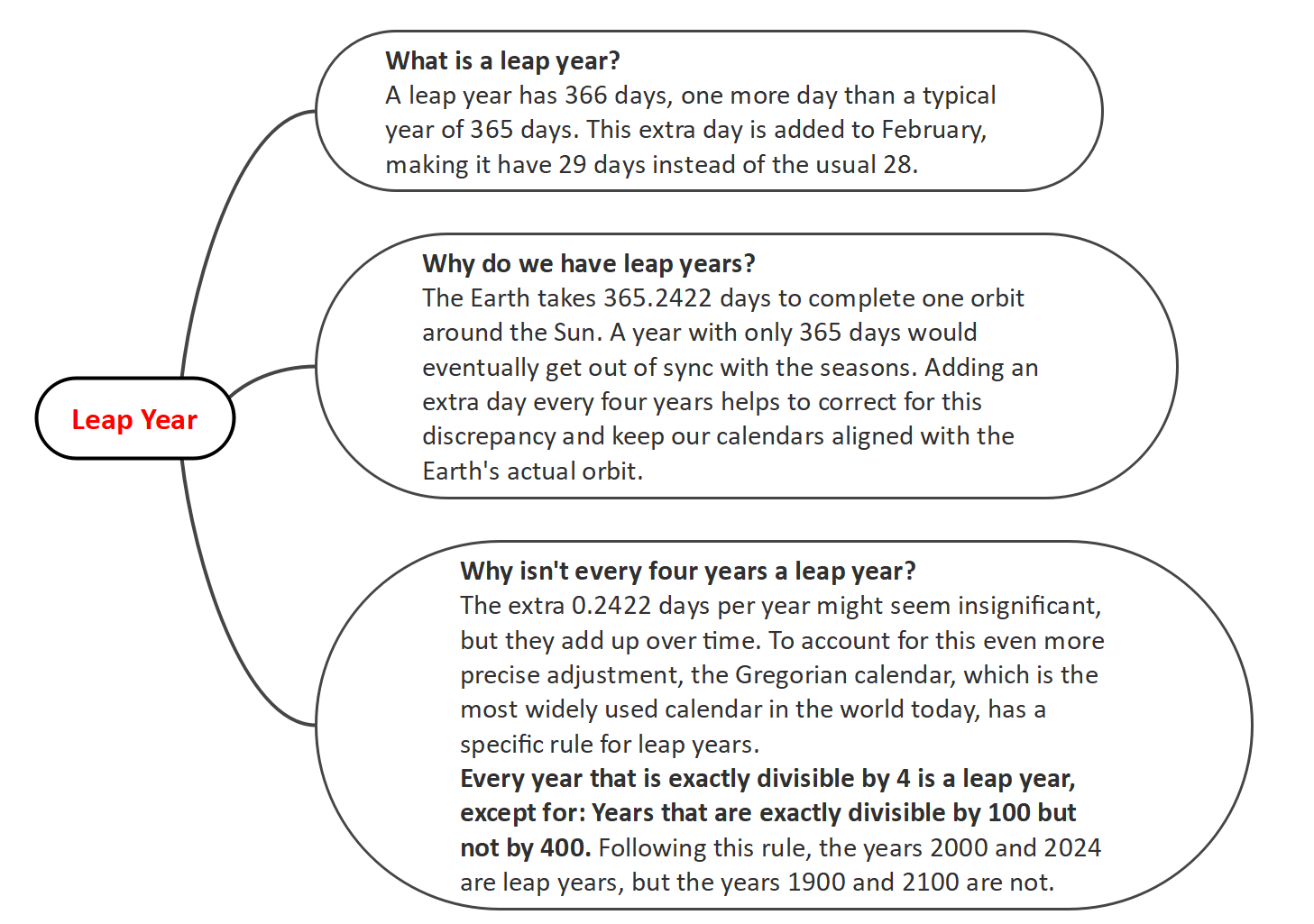
To determine whether a given year in the modern Gregorian calendar is a leap year, you must apply three sequential mathematical rules. A year is a leap year if it is evenly divisible by 4, unless it is also evenly divisible by 100. However, if that century year is evenly divisible by 400, it remains a leap year.
Contents
For example, 2024 was a leap year because it is divisible by 4 and not by 100. The year 2026 is a common year of 365 days because it cannot be divided evenly by 4. The year 1900 was a common year because it was divisible by 100 but not 400, whereas the year 2000 was a leap year because it satisfied the 400-year divisibility test.
Understanding these three rules requires examining why our calendar requires periodic adjustment, how historical calendar reforms shaped modern timekeeping, and how these mathematical conditions are executed in software systems and everyday date calculations.
The Three Core Rules of the Gregorian Calendar
The Gregorian calendar, which serves as the international standard for civil timekeeping, uses a three-tiered mathematical rule set to determine the presence of an extra day—February 29—in any given calendar year.
Rule 1: The Basic 4-Year Cycle
Any year that is evenly divisible by 4 is candidate for a leap year.
- Mathematical Test:
Year % 4 == 0 - Result: If false, the year is a standard common year consisting of 365 days. If true, the year moves to the second evaluation step.
- Examples: 2020, 2024, and 2028 are all divisible by 4, making them leap years under basic conditions.
Rule 2: The 100-Year Century Exception
If a year is evenly divisible by 4, but can also be divided evenly by 100, it is stripped of its leap year status and reverts to a common year.
- Mathematical Test:
Year % 100 == 0 - Result: Century years (years ending in
00) fail the basic leap year criteria by default to prevent long-term calendar drift. - Examples: 1700, 1800, 1900, 2100, 2200, and 2300 are all divisible by 100 and are therefore 365-day common years, despite being divisible by 4.
Rule 3: The 400-Year Exception to the Exception
If a century year divisible by 100 is also evenly divisible by 400, its leap year status is restored.
Mathematical Test:
Year % 400 == 0Result: The year is confirmed as a leap year consisting of 366 days.
Examples: 1600, 2000, and 2400 are evenly divisible by 400. Thus, the year 2000 featured 366 days, featuring February 29.
Is the year divisible by 4?
- NO: Common Year (365 days)
- YES: Is it divisible by 100?
- NO: Leap Year (366 days)
- YES: Is it divisible by 400?
- NO: Common Year (365 days)
- YES: Leap Year (366 days)
By applying these three rules, a full Gregorian cycle spans 400 years. Over this 400-year cycle, there are exactly 97 leap years and 303 common years, rather than the 100 leap years that a simple "every four years" rule would produce.
Why We Need Leap Years: The Astronomical Science
Leap years exist to solve a fundamental misalignment between human calendar units and celestial mechanics. A calendar day is measured by one complete rotation of Earth on its axis relative to the Sun (a solar day). A calendar year is designed to track one complete revolution of Earth around the Sun, marking the repeat of seasonal cycles (a tropical year).
The Fractional Orbit Problem
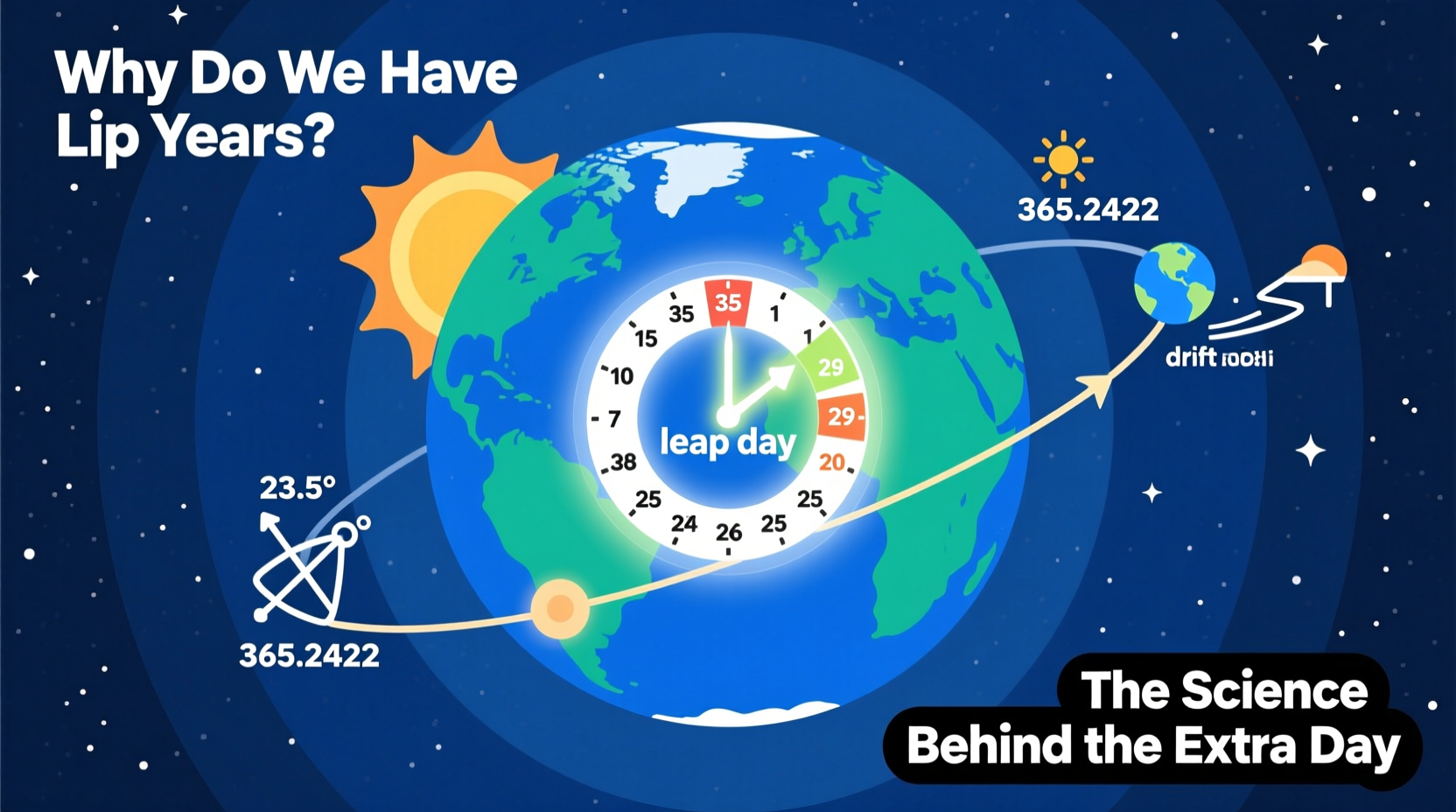
A tropical year—measured from one vernal equinox to the next—does not consist of an integer number of days. Astronomically, a solar year lasts approximately 365.242189 days, or roughly 365 days, 5 hours, 48 minutes, and 45 seconds.
If civil calendars strictly adhered to a 365-day year without adjustment, the calendar would lag behind the solar year by roughly 0.2422 days each year:
- After 4 years: The calendar shifts by roughly 0.9688 days (nearly 1 full day).
- After 100 years: The calendar shifts by approximately 24.22 days.
- After 400 years: The calendar shifts by nearly 97 days.
Without corrections, calendar months would drift out of sync with natural weather patterns and seasonal markers. Over a few centuries, northern hemisphere inhabitants would experience the summer solstice in December and winter freezing in June.
The Precision Adjustment of 97 Days
Adding a extra day every four years (0.25 days per year) compensates for the majority of the solar fractional day. However, adding an extra day every four years over-corrects the drift:
- 0.2500 added days per year (Julian system) minus 0.2422 actual solar fractional days leaves an annual surplus of 0.0078 days (about 11 minutes and 14 seconds).
- Over 400 years, this slight annual excess accumulates to 3.12 days of over-correction.
To eliminate those extra ~3 days every 400 years, the Gregorian rule removes three leap years during that span. By omitting leap days in century years that cannot be divided by 400 (such as 1700, 1800, and 1900), the average length of a Gregorian calendar year becomes:
365 + (97 / 400) = 365.2425 days
This average calendar year of 365.2425 days differs from the true tropical year of 365.2422 days by only 0.0003 days per year. At this rate, it will take roughly 3,300 years for the Gregorian calendar to drift by just one single day relative to Earth's orbit.
Julian vs. Gregorian Calendar: How the Rules Evolved
The modern leap year framework is the result of thousands of years of observational astronomy and political calendar reform.
The Julian Reform (45 BCE)
Prior to Roman calendar reforms, early Mediterranean calendars relied heavily on lunar cycles, requiring periodic administrative insertion of intercalary months to realign dates with agricultural seasons.
In 45 BCE, Julius Caesar, acting on advice from the Alexandrian astronomer Sosigenes, introduced the Julian calendar. Caesar established a fixed 365-day year divided into 12 months, with a single intercalary day added every four years without exception.
While the Julian calendar was a massive operational improvement, assuming a solar year length of exactly 365.25 days introduced an error of roughly 11 minutes per year. By the 16th century, this small annual drift accumulated to 10 full days. The vernal equinox, which the Christian Church used to calculate the date of Easter, had moved from March 21 back to March 11.
The Gregorian Reform (1582 CE)
To correct this structural drift, Pope Gregory XIII issued the papal bull Inter gravissimas in October 1582. The reform included two crucial steps:
- Immediate Realignment: Ten days were deleted from the calendar to realign the vernal equinox to March 21. In participating countries, Thursday, October 4, 1582, was followed immediately by Friday, October 15, 1582.
- The Century Exclusion Rule: The rule for adding leap years was altered from "every 4 years" to the modern three-part rule (omitting leap years in century years unless divisible by 400).
Catholic states like Spain, Portugal, Italy, and Poland adopted the Gregorian calendar immediately in 1582. Protestant and Orthodox nations resisted for decades or centuries. Great Britain and its American colonies adopted the Gregorian system in September 1752, requiring an 11-day adjustment. Russia adopted the calendar in 1918, while Greece transitioned in 1923.
Century Year Classification & Leap Status Comparison
To understand how the three Gregorian rules function across historic, present, and future timelines, consider the following structural breakdown of century and non-century years:
| Year | Divisible by 4? | Divisible by 100? | Divisible by 400? | Total Days | Leap Status | Rule applied |
|---|---|---|---|---|---|---|
| 1600 | Yes | Yes | Yes | 366 | Leap Year | Divisible by 400 exception |
| 1700 | Yes | Yes | No | 365 | Common Year | Century rule (omits leap day) |
| 1800 | Yes | Yes | No | 365 | Common Year | Century rule (omits leap day) |
| 1900 | Yes | Yes | No | 365 | Common Year | Century rule (omits leap day) |
| 1996 | Yes | No | No | 366 | Leap Year | Standard 4-year rule |
| 2000 | Yes | Yes | Yes | 366 | Leap Year | Divisible by 400 exception |
| 2020 | Yes | No | No | 366 | Leap Year | Standard 4-year rule |
| 2024 | Yes | No | No | 366 | Leap Year | Standard 4-year rule |
| 2026 | No | No | No | 365 | Common Year | Basic indivisibility by 4 |
| 2028 | Yes | No | No | 366 | Leap Year | Standard 4-year rule |
| 2100 | Yes | Yes | No | 365 | Common Year | Century rule (omits leap day) |
| 2200 | Yes | Yes | No | 365 | Common Year | Century rule (omits leap day) |
| 2400 | Yes | Yes | Yes | 366 | Leap Year | Divisible by 400 exception |
How to Implement Leap Year Logic in Code and Spreadsheets
Implementing leap year rules correctly is a fundamental task in software engineering, database administration, and financial modeling. Failing to evaluate all three conditions leads to classic software defects.
The Boolean Logical Formula
In logical pseudocode, leap year evaluation can be represented in a single conditional statement:
isLeapYear = (year % 4 == 0 AND year % 100 != 0) OR (year % 400 == 0)
Step-by-Step Execution:
year % 4 == 0: Checks if the year is divisible by 4.year % 100 != 0: Ensures the year is not a century year.- Combining them with
ANDconfirms standard 4-year leap years. OR (year % 400 == 0): Overrides the century block if the year is divisible by 400.
Practical Implementation Examples
Python Logic
In Python, evaluating a leap year manually can be written as:
def is_leap_year(year): return (year % 4 == 0 and year % 100 != 0) or (year % 400 == 0)
Python's built-in calendar module also handles this natively via calendar.isleap(year).
SQL Queries
In standard database queries (such as PostgreSQL or MySQL), logical tests can be executed dynamically:
SELECT year, CASE WHEN (year % 4 = 0 AND year % 100 <> 0) OR (year % 400 = 0) THEN TRUE ELSE FALSE END AS is_leap_year;
Spreadsheets (Excel & Google Sheets)
To test if a year stored in cell A1 is a leap year in Microsoft Excel or Google Sheets, use logical cell functions:
=OR(AND(MOD(A1, 4)=0, MOD(A1, 100)<>0), MOD(A1, 400)=0)
Alternatively, you can evaluate the last day of February directly using date functions:
=DAY(DATE(A1, 3, 0)) = 29
This formula generates the 0th day of March (which evaluates to the final day of February) and checks if that day number equals 29.
The Lotus 1-2-3 Leap Year Bug Legacy
When building date systems, engineers occasionally contend with intentional historical anomalies. Lotus 1-2-3, a dominant spreadsheet program in the 1980s, incorrectly coded the year 1900 as a leap year (failing to implement the century exception rule).
To ensure backward compatibility with existing business spreadsheets, Microsoft Excel deliberately replicated this error. In Excel, the date February 29, 1900 exists, even though mathematically and historically 1900 had only 28 days in February. Modern date libraries and databases do not replicate this bug, but financial systems relying on legacy Excel serial numbers must account for it.
Real-World Impacts and Common Software Defects
The occurrence of leap years extends beyond simple date tracking. Incorrect handling of February 29 introduces legal, financial, and technical complications.
Financial Day-Count Conventions
In corporate finance, banking, and bond markets, accrued interest calculations rely on precise day-count conventions. The presence of a leap day alters interest payout formulas depending on the contractual standard used:
- Actual/365: Fixed denominator of 365 days. In a leap year, 366 days of interest accumulate, raising annual interest yield slightly.
- Actual/366: Denominator adjusts to 366 during leap years.
- Actual/360: Commonly used in commercial banking. Daily interest rate is calculated using a 360-day year (
Rate / 360), but applied to the actual number of days elapsed. A leap year adds an extra day of charged interest. - 30/360: Assumes every month has 30 days regardless of calendar variations, ignoring leap days entirely for interest accumulation purposes.
In financial engineering, failing to account for leap years in trading algorithms can result in miscalculated interest payments when processing transactions across February 29.
Software Outages ("Leap Day Bugs")
Edge cases involving February 29 have caused severe operational software failures across major enterprise networks:
- Hardcoded Month Lengths: Software developers assuming February always has 28 days often hardcode array sizes or date input parsers, causing array index out-of-bounds errors on February 29.
- Year-Ahead Calculations: Code that attempts to calculate annual expirations using simple date arithmetic (such as
Date + 365 days) fails during leap years, setting expiration dates off by one day. - Date Parsing Failures: On February 29, 2012, cloud server services experienced regional outages when cloud management software failed to validate February 29 as a legitimate date in SSL certificate and internal token generation routines.
- Device Crashes: On March 1, 2010, millions of legacy video game consoles experienced connection errors and disabled trophy data because internal clock chips incorrectly identified 2010 as a leap year and attempted to load February 29, 2010.
Legal Status for "Leaplings" (Born February 29)
Individuals born on February 29 are colloquially known as "leaplings." Because February 29 occurs only once every four years, legal systems establish official guidelines for age-dependent rights (such as driver's licenses, legal drinking ages, and voting eligibility):
- Standard Common Year Recognition: In jurisdictions where statutory age updates occur on the day following the completion of a full year, legal adulthood for a leapling is officially recognized on March 1 in common years.
- Specific Jurisdiction Rules: In the United Kingdom and East Asian jurisdictions, legal age milestones officially advance on March 1. In several U.S. state statutes, official administrative status defaults to February 28 for non-leap years.
Frequently Asked Questions
When is the next leap year?
Following the 2024 leap year, the next leap year will occur in 2028. It will be followed by 2032, 2036, and 2040. The current year, 2026, is a common year containing 365 days.
Why was the year 2000 a leap year, but 1900 was not?
The year 1900 was divisible by 100 but not by 400, triggering the century exception rule that reverts century years to 365-day common years. Conversely, the year 2000 was divisible by 400 (2000 / 400 = 5), satisfying the exception-to-the-exception rule and remaining a leap year.
Will 2100 be a leap year?
No. The year 2100 is divisible by 4 and by 100, but it is not evenly divisible by 400 (2100 / 400 = 5.25). Consequently, 2100 will be a common year consisting of 365 days, with February ending on February 28.
What would happen if we completely abolished leap years?
If leap years were abolished, the civil calendar would drift backward against the solar astronomical year by approximately 1 day every 4 years. Within 100 years, the calendar would be out of sync by 24 days. Over 700 years, northern hemisphere summer weather would occur in December, causing chaos for agriculture, seasonal energy tracking, and climate monitoring.
Is a leap second the same thing as a leap year?
No. A leap day (leap year) compensates for the fact that Earth's orbital period around the Sun is not an exact integer of days. A leap second is a one-second adjustment applied periodically to Coordinated Universal Time (UTC) to accommodate minor, unpredictable fluctuations in Earth's axial rotational speed caused by tidal friction and atmospheric movement. International metrology bodies decided in 2022 to phase out leap seconds by or before 2035.
Key Takeaways and Next Actions
To successfully work with leap year calculations across modern software, business systems, and calendar management:
- Remember the 4-100-400 Rule Hierarchy: A year is a leap year if divisible by 4, except for century years, which must be divisible by 400.
- Use Standard Date Libraries: Never write custom date arithmetic functions or hardcode month lengths in application code. Rely on native date-time modules in your programming language (e.g., Python's
datetime, Java'sjava.time, or JavaScript'sTemporalAPI) to ensure automated, edge-case-proof leap year handling. - Audit Financial Models: Ensure spreadsheets and interest-calculation engines explicitly define day-count conventions (Actual/365 vs Actual/360) for contracts spanning leap day bounds.
- Test Date Validation: When building forms or database schemas, validate February 29 inputs against variable leap years to prevent application crashes during leap cycle transitions.
Image Gallery