The Symbol for Rational Numbers: Origins and Usage of $\mathbb{Q}$
In mathematics, the symbol for the set of all rational numbers is $\mathbb{Q}$. This specialized "blackboard bold" capital letter stands for the word quotient, which refers to the result of dividing one integer by another. In formal se...
In mathematics, the symbol for the set of all rational numbers is $\mathbb{Q}$. This specialized "blackboard bold" capital letter stands for the word quotient, which refers to the result of dividing one integer by another. In formal set notation, $\mathbb{Q}$ represents any number that can be expressed as a fraction $p/q$, where $p$ and $q$ are integers and $q$ is not zero.
Contents
The study of numbers begins with simple counting, but as mathematical complexity grows, the need for precise categorization becomes essential. As of 2026, the symbol $\mathbb{Q}$ remains the global standard used in classrooms, scientific journals, and engineering documentation to distinguish these numbers from integers, irrational numbers, and real numbers. Understanding this symbol involves more than just identifying a letter; it requires a grasp of the history of notation, the set's unique properties, and the rigorous definitions that govern modern mathematics.
The Historical Origin of the Symbol $\mathbb{Q}$
The choice of the letter $\mathbf{Q}$ is not arbitrary, nor is it simply the next letter available in the alphabet. It originates from the Italian word quoziente, meaning "quotient." While mathematical concepts have existed for millennia, the standardization of symbols for sets of numbers is a relatively recent development in the history of the discipline.
The formal introduction of $\mathbb{Q}$ is widely attributed to the Italian mathematician Giuseppe Peano. In his 1895 work Formulario Mathematico, Peano sought to create a unified symbolic language for mathematics. Before this period, mathematicians often used various notations or simply wrote out "the set of rational numbers" in their native languages.
One might wonder why the letter R was not chosen, given that "rational" starts with that letter. In the hierarchy of number sets, the letter $\mathbb{R}$ was already reserved for the "Real numbers." Similarly, $\mathbb{N}$ was used for Natural numbers. By selecting $\mathbb{Q}$ to represent the quotient, Peano provided a logical and distinct identifier that avoided confusion with other fundamental sets.
The Mathematical Definition of $\mathbb{Q}$
To understand the symbol, one must understand the set it represents. In formal mathematical language, the set $\mathbb{Q}$ is defined using set-builder notation:
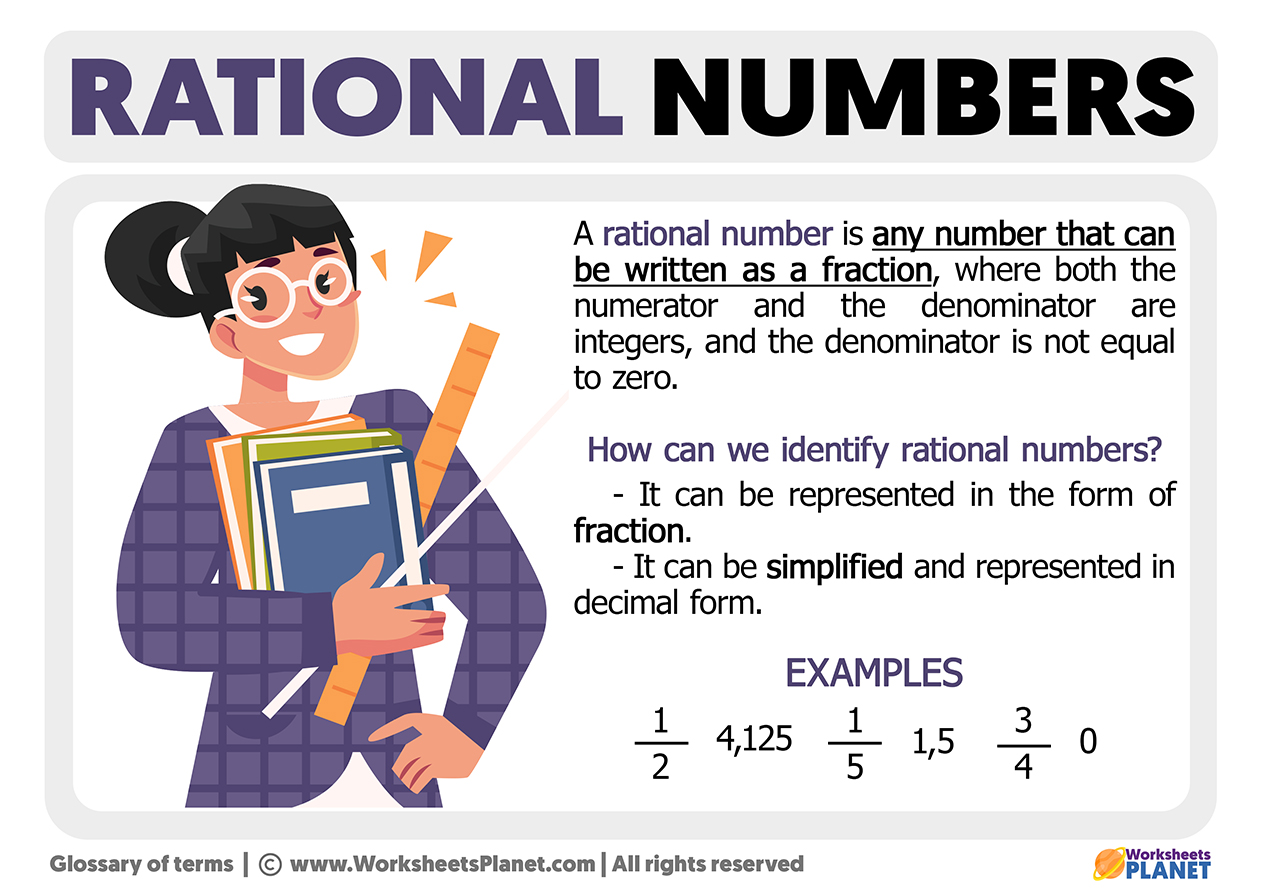
$$\mathbb{Q} = \left{ \frac{p}{q} : p, q \in \mathbb{Z}, q \neq 0 \right}$$
This definition establishes three critical criteria for a number to be considered a member of $\mathbb{Q}$:
- The Numerator ($p$): Must be an integer (a member of the set $\mathbb{Z}$). This includes positive numbers, negative numbers, and zero.
- The Denominator ($q$): Must also be an integer.
- The Non-Zero Constraint: The denominator $q$ cannot be zero, as division by zero is undefined in standard arithmetic.
Every integer is also a rational number because any integer $n$ can be written as the fraction $n/1$. Therefore, the set of integers $\mathbb{Z}$ is a subset of $\mathbb{Q}$. This relationship is a cornerstone of number theory and real analysis.
Blackboard Bold: Why the Double Lines?
In textbooks and on digital platforms, you will notice that the symbol is often written as $\mathbb{Q}$ (with a double vertical line) rather than a simple bold Q. This style is known as blackboard bold.
This typographical tradition emerged from the practicalities of teaching. On a chalkboard, it is difficult to indicate a "bold" letter clearly. To distinguish a set of numbers from a standard variable like $Q$, mathematicians began adding an extra stroke to the letter. When mathematical typesetting evolved with systems like TeX and LaTeX, these "handwritten bold" characters were digitized into the fonts we use today. In modern 2026 digital publishing, using the standard Unicode character $\text{U+211A}$ ensures that the symbol is recognized universally as the set of rational numbers rather than a generic variable.
Comparing $\mathbb{Q}$ to Other Number Sets
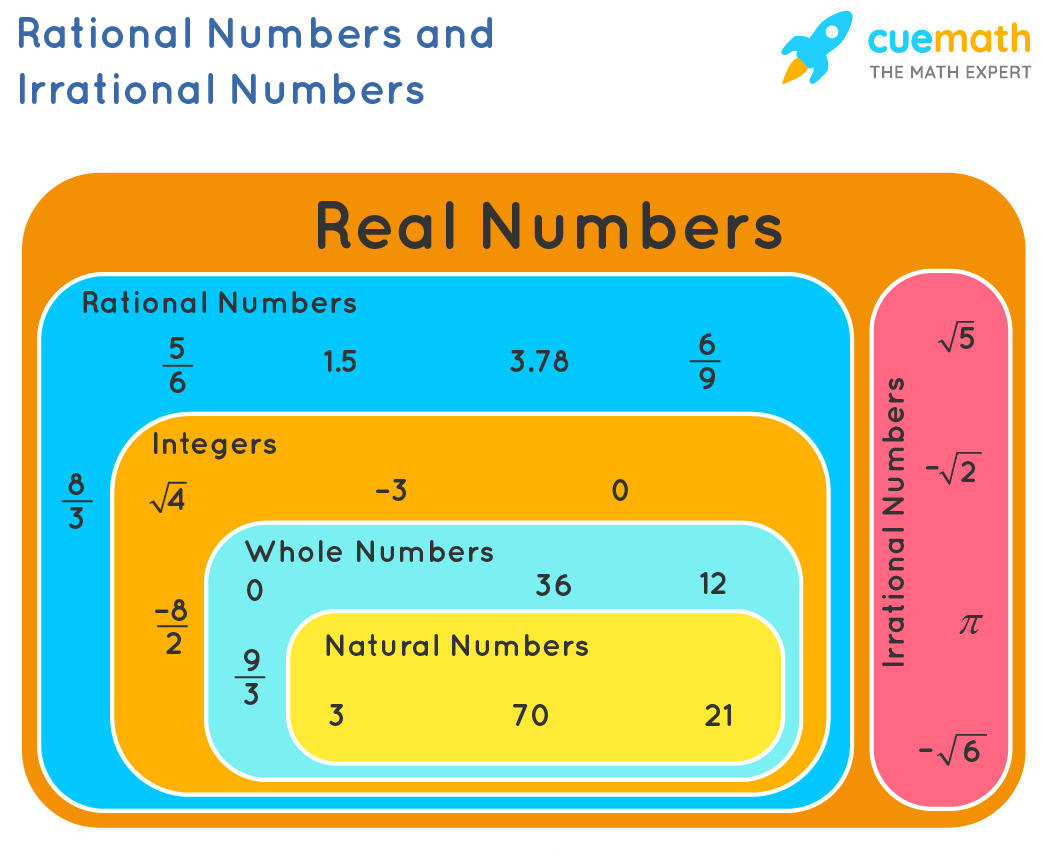
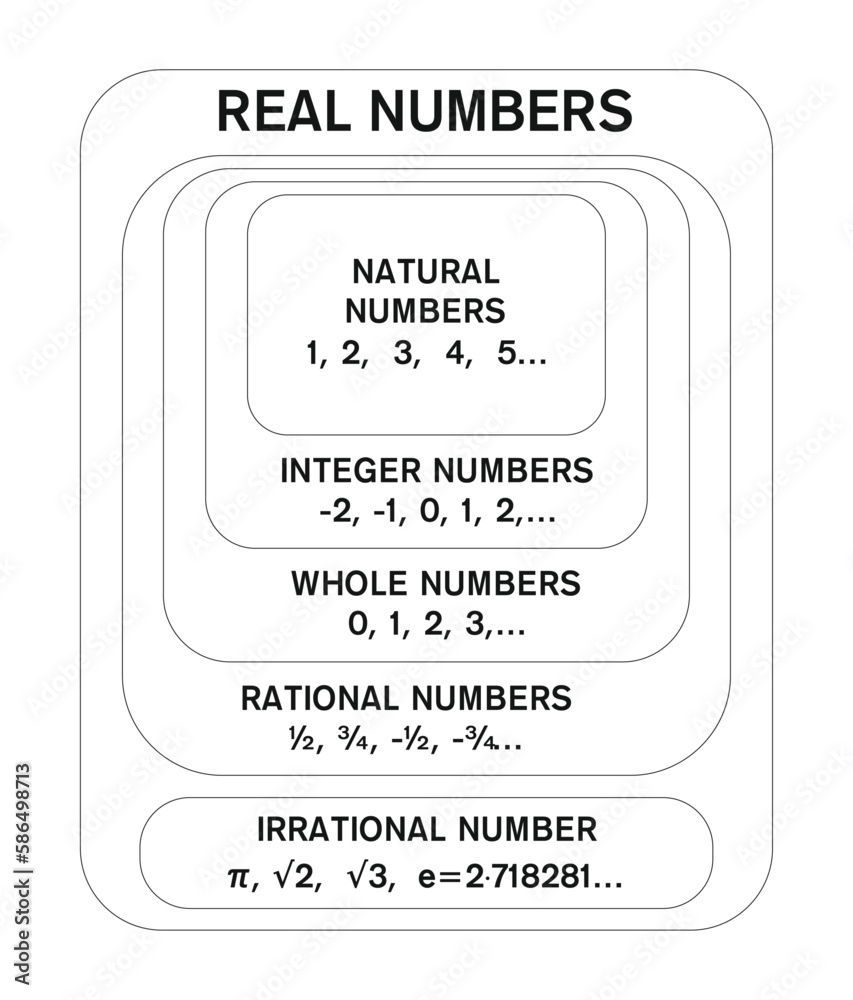
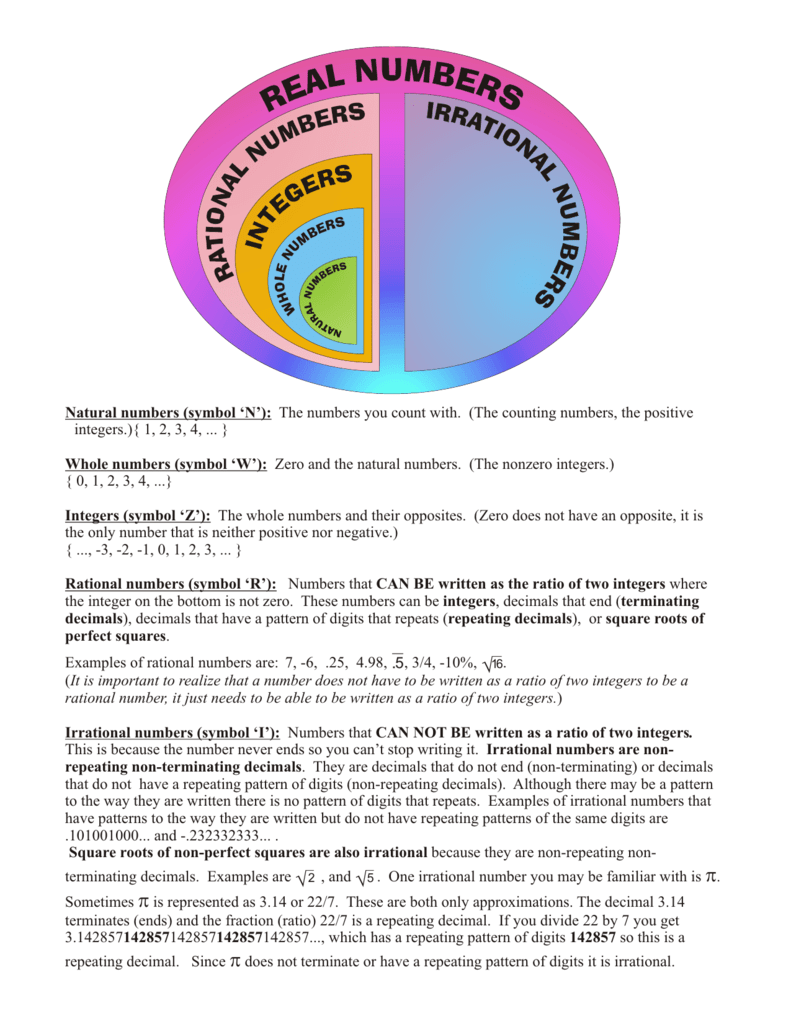
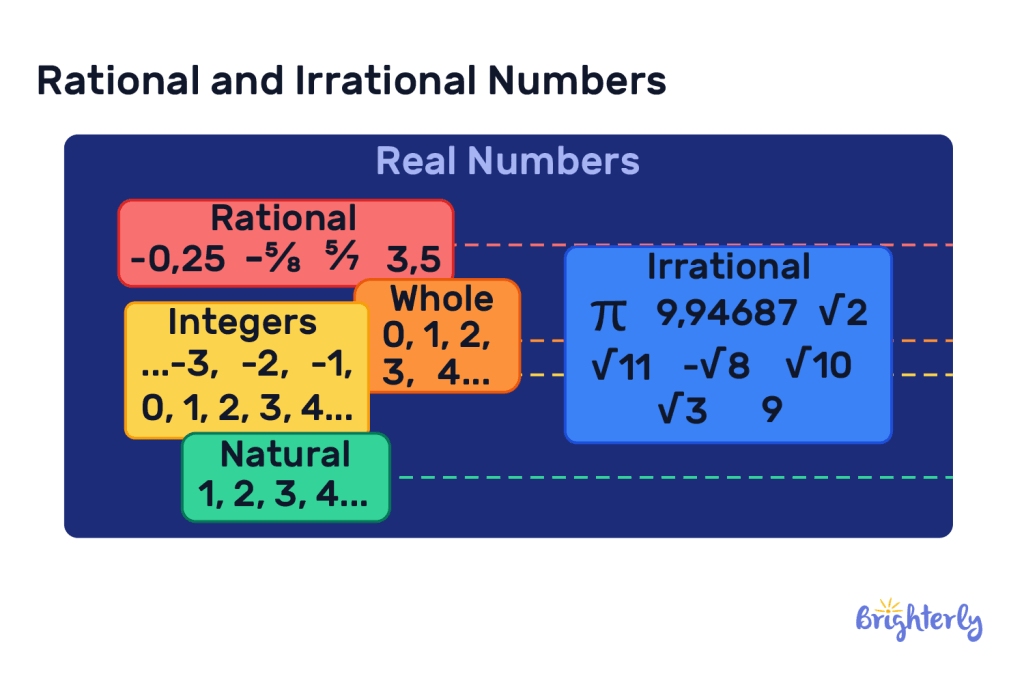
To grasp the role of rational numbers, it is helpful to see where they sit in the hierarchy of mathematics. The number system is often visualized as a series of nested containers, where each larger set includes the ones before it.
| Symbol | Name | Description | Example |
|---|---|---|---|
| $\mathbb{N}$ | Natural Numbers | Counting numbers starting from 1 (or 0). | $1, 2, 3...$ |
| $\mathbb{W}$ | Whole Numbers | Natural numbers including zero. | $0, 1, 2...$ |
| $\mathbb{Z}$ | Integers | Positive and negative whole numbers. | $-3, 0, 5$ |
| $\mathbb{Q}$ | Rational Numbers | Any number expressible as a ratio $p/q$. | $1/2, -0.75, 5$ |
| $\mathbb{I}$ | Irrational Numbers | Numbers that cannot be written as $p/q$. | $\pi, \sqrt{2}$ |
| $\mathbb{R}$ | Real Numbers | All rational and irrational numbers. | $1/2, \pi, -4$ |
| $\mathbb{C}$ | Complex Numbers | Numbers with a real and imaginary part. | $3 + 2i$ |
As shown in the table, $\mathbb{Q}$ encompasses all integers and fractions. However, it does not include numbers like $\pi$ or $\sqrt{2}$, which have non-repeating, infinite decimal expansions. These belong to the set of irrational numbers, which, when combined with $\mathbb{Q}$, form the set of real numbers $\mathbb{R}$.
Unique Properties of the Set $\mathbb{Q}$
The set $\mathbb{Q}$ possesses several fascinating mathematical properties that distinguish it from the sets of integers or real numbers. These properties are essential for students entering fields like calculus or abstract algebra.
1. Density
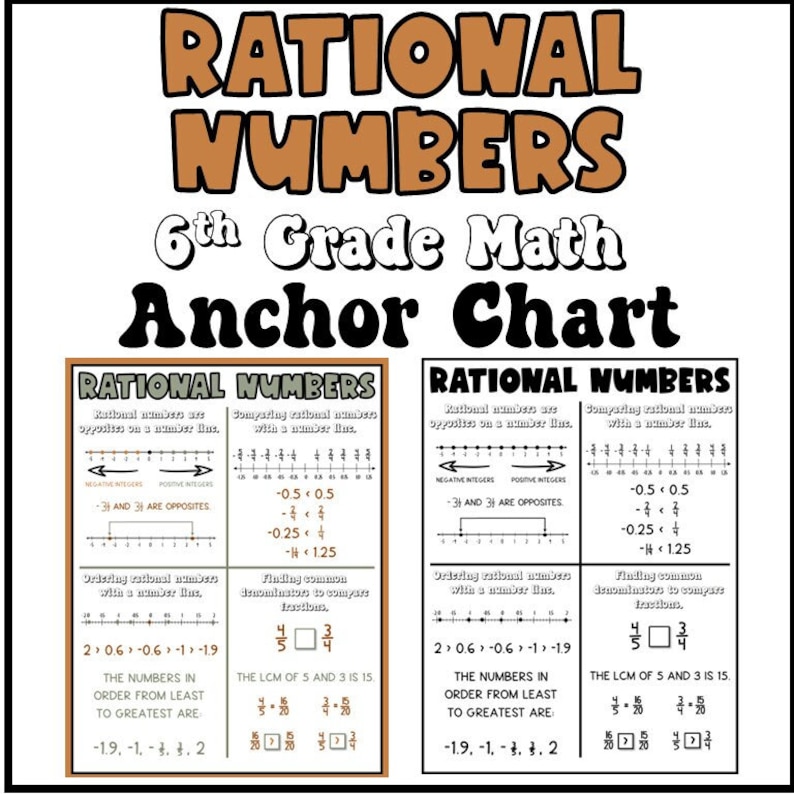
The set of rational numbers is dense. This means that between any two distinct rational numbers, there is always another rational number. For example, between $1/4$ and $1/2$, you can find $3/8$. Between $1/4$ and $3/8$, you can find $5/16$. This process can continue infinitely. In contrast, the set of integers $\mathbb{Z}$ is not dense; there is no integer between 1 and 2.
2. Countability
Despite being infinite and dense, $\mathbb{Q}$ is a countable set. This is a counterintuitive concept proven by Georg Cantor. It means that there is a way to create a one-to-one correspondence between the set of natural numbers $\mathbb{N}$ and the set of rational numbers $\mathbb{Q}$. In simpler terms, you could technically "list" or "count" every single fraction if you had an infinite amount of time, whereas you cannot do the same for the set of real numbers $\mathbb{R}$ (which is "uncountably infinite").
3. Closure
The set $\mathbb{Q}$ is closed under four basic arithmetic operations: addition, subtraction, multiplication, and division (excluding division by zero). This means if you take any two rational numbers and perform these operations, the result will always be another rational number. The set of integers $\mathbb{Z}$ is not closed under division (e.g., $1 \div 2$ is not an integer), which is exactly why the set $\mathbb{Q}$ was conceptualized—to allow for division to be a fully defined operation within a set.
Specialized Notations Within $\mathbb{Q}$
In advanced mathematics and physics, scholars often need to refer to specific subsets of the rational numbers. To do this, they add superscripts or subscripts to the primary symbol $\mathbb{Q}$.
- $\mathbb{Q}^+$: This symbol represents the set of all positive rational numbers (all $x \in \mathbb{Q}$ such that $x > 0$).
- $\mathbb{Q}^-$: This represents the set of all negative rational numbers.
- $\mathbb{Q}^*$ or $\mathbb{Q} \setminus {0}$: This denotes the set of all rational numbers excluding zero. This is often used when discussing the multiplicative group of rational numbers.
- $\mathbb{Q}_p$: In number theory, this refers to the field of p-adic numbers, a specialized system that extends the rational numbers in a different way than the real number system does.
How to Type and Display the Symbol
For researchers and students in 2026, knowing how to produce the $\mathbb{Q}$ symbol in various software environments is a practical necessity. Standard "bolding" of a letter is usually insufficient for formal academic work.
LaTeX and Markdown
In the world of scientific publishing, LaTeX is the gold standard. To produce the symbol, you must use the amsfonts or amssymb package and the following command:
\mathbb{Q}
Unicode and Keyboard Shortcuts
If you are writing in a standard word processor or a web-based application, you can use Unicode. The Unicode point for the double-struck capital Q is U+211A.
- On Windows: Hold
Altand type+211A(if your system supports Hex input). - On macOS: Use the Character Viewer (
Cmd + Ctrl + Space) and search for "double struck capital Q." - In HTML: Use the entity
ℕ(though this often refers to $\mathbb{N}$) or the hex codeℚ.
Microsoft Word
In the Microsoft Word Equation Editor (inserted via Alt + =), you can type \doubleQ followed by a space to automatically convert the text into the blackboard bold symbol.
Common Misconceptions About Rational Numbers
Despite the clear definition, students frequently encounter confusion regarding which numbers belong to $\mathbb{Q}$.
One common error is the treatment of repeating decimals. A number like $0.333...$ (where the 3 repeats forever) is a rational number because it can be expressed exactly as $1/3$. Any decimal that either terminates (like $0.25$) or repeats a pattern (like $0.142857...$) is a member of $\mathbb{Q}$. Only decimals that are both infinite and non-repeating, such as the digits of $\pi$ ($3.14159...$), fall outside of $\mathbb{Q}$.
Another misconception is that the "symbol" is just the letter Q. While a standard Q might be used in lower-level math, the double-struck $\mathbb{Q}$ is the specific mathematical entity representing the entire field of rational numbers. Using a plain Q in a paper on set theory could lead to ambiguity, as Q is frequently used to represent heat in physics or a point in geometry.
Practical Recommendation for Students
If you are a student or professional working with mathematical sets in 2026, always prioritize the use of the blackboard bold $\mathbb{Q}$ in your formal documentation. It eliminates ambiguity and adheres to international standards set by organizations like the International Organization for Standardization (ISO) for mathematical signs and symbols. When introducing the symbol in a paper for a non-expert audience, it is a best practice to define it briefly upon first use: "Let $\mathbb{Q}$ denote the set of rational numbers."
Frequently Asked Questions
1. Is zero a member of the set $\mathbb{Q}$? Yes, zero is a rational number. It can be written as the fraction $0/1$, $0/5$, or $0/n$ for any non-zero integer $n$. Since it fits the definition $p/q$ where $p$ is an integer and $q$ is a non-zero integer, it is included in $\mathbb{Q}$.
2. Why is the symbol for integers $\mathbb{Z}$ instead of I? The letter $\mathbb{Z}$ stands for the German word Zahlen, which means "numbers." The letter 'I' was avoided because it is frequently used for the unit interval $[0,1]$, the identity matrix, or the imaginary unit in complex numbers.
3. Can a rational number have a negative denominator? Yes, but by convention, we usually move the negative sign to the numerator or the front of the fraction. For example, $1/-2$ is the same as $-1/2$. Both $1$ and $-2$ are integers, so the definition of a rational number is satisfied.
4. What is the difference between $\mathbb{Q}$ and the set of fractions? In most contexts, they are the same. However, "fractions" can technically include ratios of non-integers (like $\pi/2$), which are not rational numbers. The symbol $\mathbb{Q}$ strictly refers to ratios of integers.
5. Does every rational number have a terminating decimal expansion? No. A rational number $p/q$ (in simplest form) has a terminating decimal expansion if and only if the prime factors of the denominator $q$ are only 2 and/or 5. For example, $1/8$ ($2^3$) terminates at $0.125$, but $1/3$ repeats forever as $0.333...$.
Image Gallery