Understanding the Gender Inequality Index: Dimensions, Calculation, and Policy Impact
The Gender Inequality Index (GII) is a composite metric introduced by the United Nations Development Programme (UNDP) to quantify the loss in potential human development caused by gender disparities. By assessing reproductive health, e...
The Gender Inequality Index (GII) is a composite metric introduced by the United Nations Development Programme (UNDP) to quantify the loss in potential human development caused by gender disparities. By assessing reproductive health, empowerment, and labor market participation, the GII yields a score between 0 and 1, where higher values indicate greater inequality between women and men.
Contents
What Is the Gender Inequality Index?
Introduced in the 2010 Human Development Report by the United Nations Development Programme, the Gender Inequality Index (GII) was created to address the methodological limitations of earlier metrics, specifically the Gender-related Development Index (GDI) and the Gender Empowerment Measure (GEM).
While traditional economic metrics focus exclusively on income or national output, the GII exposes how systemic gender disparities impede overall human development. It measures the disadvantage women experience across three critical life dimensions: healthcare access during vulnerable life stages, political and educational empowerment, and economic participation.
Unlike standard development indexes where a higher score indicates progress, the GII measures inequality-induced loss. A GII score of 0 represents complete equality, meaning women and men fare equally across all measured dimensions. Conversely, a score of 1 represents total inequality, where women suffer maximum disadvantage relative to men across every indicator.
GII Value Scale:
- 0.000: Complete Gender Equality (Zero Development Loss)
- 1.000: Extreme Gender Inequality (Maximum Loss Due to Disparity)
The Three Core Dimensions and Five Indicators
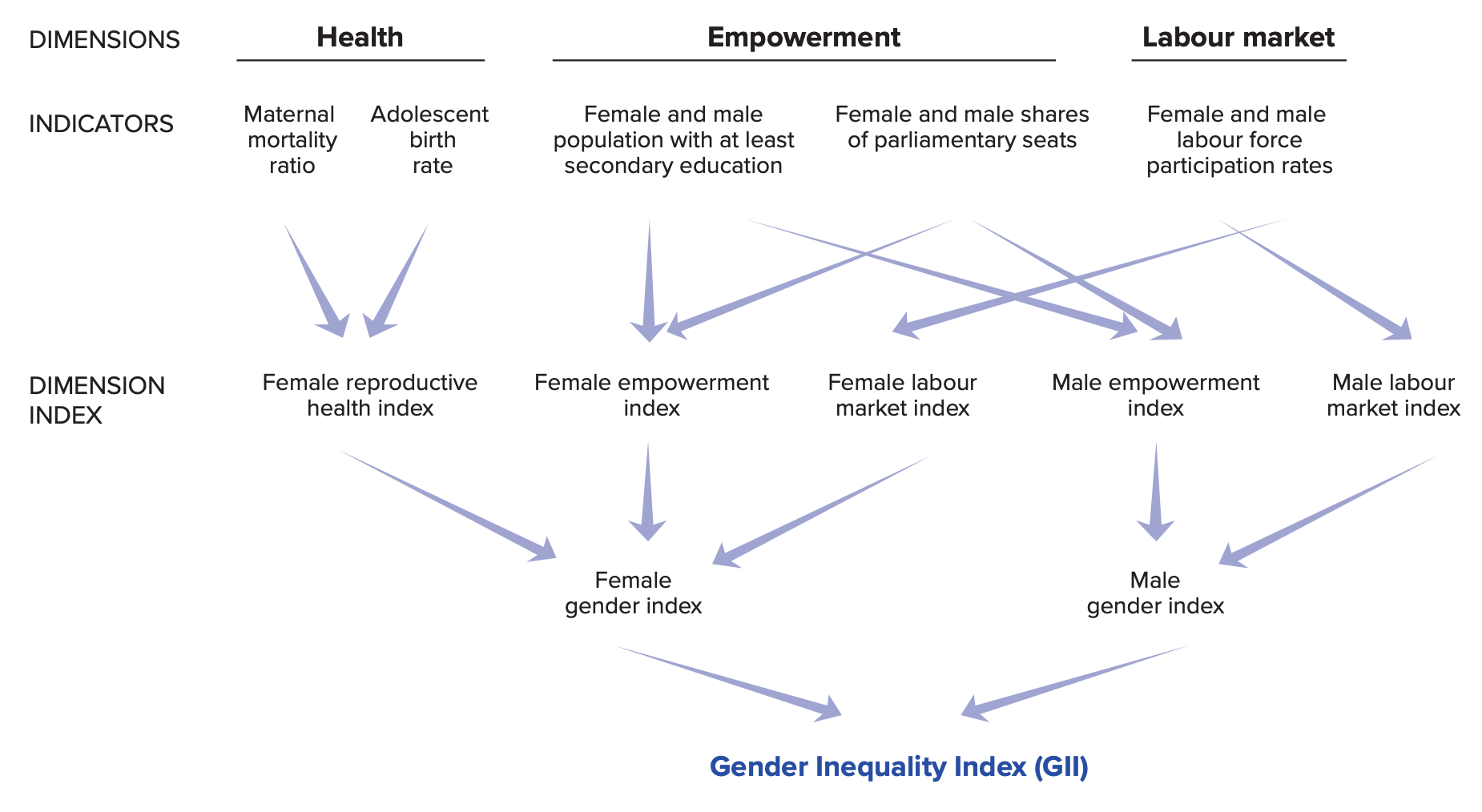
The GII measures national gender disparities using five specific indicators distributed across three essential dimensions. Each dimension captures critical structural factors that either expand or restrict individual capabilities.
- Gender Inequality Index (GII)
- Reproductive Health
- Maternal Mortality Ratio
- Adolescent Birth Rate
- Empowerment
- Parliamentary Seats
- Secondary Education Attainment (Female vs. Male)
- Labor Market Participation
- Labor Force Participation Rate (Female vs. Male)
- Reproductive Health
1. Reproductive Health
Reproductive health is a foundational baseline in the GII model. Poor reproductive health services deprive women of fundamental bodily autonomy, increase mortality risks, and permanently hinder educational and economic participation. Because reproductive health measures apply uniquely to women, this dimension does not feature a direct male comparison; instead, the calculation compares national performance against optimal global standards.
- Maternal Mortality Ratio (MMR): Sourced from statistics compiled by organizations such as the World Health Organization, MMR records the number of maternal deaths per 100,000 live births. High maternal mortality reflects inadequate emergency obstetric care, poor healthcare infrastructure, and limited family planning services.
- Adolescent Birth Rate (ABR): Measures the number of births per 1,000 women aged 15 to 19. High adolescent birth rates frequently correlate with early marriage, disrupted secondary education, and reduced long-term economic independence.
2. Empowerment
The empowerment dimension measures relative balance in political decision-making and advanced educational attainment, which are essential for shaping policy and participating in the formal economy.
- Parliamentary Representation: Tracks the percentage of national parliamentary seats held by women. This indicator evaluates female influence over national legislation, budgeting priorities, and public administration.
- Educational Attainment: Measures the percentage of the population aged 25 and older who have achieved at least some secondary education, comparing females to males. Secondary education equips individuals with foundational literacy, critical thinking, and technical skills necessary for skilled labor and leadership.
3. Labor Market Participation
The labor market dimension focuses on economic engagement, evaluating the proportion of the population aged 15 and older that actively participates in the labor force.
- Labor Force Participation Rate (LFPR): Assesses the percentage of working-age women and men who are either employed or actively seeking formal employment. A large gap between male and female participation rates points to structural barriers, such as uncompensated domestic burdens, legal restrictions on female employment, discriminatory hiring practices, or cultural prohibitions against women working outside the home.
How the Gender Inequality Index Is Calculated
Calculating the GII involves multi-step statistical techniques to capture the compound effects of inequality across dimensions without allowing high performance in one area to completely mask severe deprivation in another.
- Raw National Data (5 Indicators)
- Calculate Female & Male Aggregates per Dimension (Reproductive Health, Empowerment, Labor Market)
- Calculate Group Means Across Dimensions
- Female Harmonic Mean (G_F)
- Male Harmonic Mean (G_M)
- Calculate Unweighted Geometric Mean of Gender Groups (G_FM)
- Calculate Equal Reference Benchmark across Population (H)
- GII Formula Application: 1 - (G_FM / H)
- Final GII Score (Scale: 0 to 1)
1. Dimension Aggregation Using Means
The GII uses geometric means to aggregate indicators within each dimension for both females and males. Using a geometric mean ensures that indicators are non-substitutable; a country cannot achieve a favorable score if one indicator drops to near zero.
2. Computing Gender-Specific Harmonic Means
Once dimension scores are established, the GII calculates a harmonic mean across dimensions for women ($G_F$) and men ($G_M$) separately. The harmonic mean is explicitly association-sensitive: it penalizes low achievement in any single dimension more heavily than standard arithmetic averaging would.
3. Calculating the Geometric Mean Across Gender Groups
The overall gender-disaggregated performance ($G_{FM}$) is determined by calculating the unweighted geometric mean of the female ($G_F$) and male ($G_M$) harmonic means:
$$G_{FM} = \sqrt{G_F \cdot G_M}$$
4. Establishing the Equal Reference Benchmark
To measure loss, the index establishes a hypothetical "equal reference benchmark" ($H$), which calculates what national achievement would be if women and men experienced complete equality across all indicators.
5. Applying the Final Ratio Formula
The final GII score represents the relative distance between actual disaggregated achievement ($G_{FM}$) and the equal benchmark ($H$):
$$\text{GII} = 1 - \frac{G_{FM}}{H}$$
If women and men experience total equality across every dimension, $G_{FM}$ equals $H$, resulting in a GII of $1 - 1 = 0$. As inequality increases, $G_{FM}$ drops relative to $H$, driving the GII score closer to 1.
Comparing GII with Other Gender Metrics
Understanding the Gender Inequality Index requires distinguishing it from other widely cited international gender metrics, such as the Gender Development Index (GDI) and the World Economic Forum's Global Gender Gap Index.
| Metric | Originating Organization | Core Focus | Scale / Score Meaning | Key Included Indicators |
|---|---|---|---|---|
| Gender Inequality Index (GII) | UNDP | Measures potential human development loss due to gender disparities. | 0 to 1(0 = Complete Equality,1 = Maximum Inequality) | Maternal mortality, adolescent birth rate, parliamentary seats, secondary education, labor participation. |
| Gender Development Index (GDI) | UNDP | Measures ratio of female-to-male achievements in human development (HDI). | Ratio around 1(1 = Absolute Parity,<1 = Male Advantage) | Life expectancy at birth, expected years of schooling, mean years of schooling, estimated GNI per capita. |
| Global Gender Gap Index (GGGI) | World Economic Forum (WEF) | Measures national gender gaps across economic, political, educational, and health criteria regardless of overall income level. | 0 to 1(0 = Complete Imbalance,1 = Total Parity) | Wage equality, professional roles, literacy rate, enrollment rates, sex ratio at birth, executive roles. |
GII vs. GDI
While both are produced by the UNDP, the GDI evaluates gender gaps directly within the standard Human Development Index components (health, education, and income). The GII, by contrast, incorporates specialized structural indicators such as reproductive health and political representation, explicitly measuring the national development loss attributable to inequality.
GII vs. Global Gender Gap Index (GGGI)
The WEF's GGGI focuses heavily on economic participation, income parity, and executive representation, designed to isolate gender performance from national wealth. The GII integrates health metrics—such as maternal mortality—that are directly affected by national health infrastructure, making GII more sensitive to baseline social investment.
Policy Applications and Real-World Impact
Governments, international agencies, and non-governmental organizations use GII scores to diagnose structural weaknesses and design targeted public policies.
- High Maternal Mortality & Adolescent Birth Rates: Emergency Obstetric Care & Clinic Infrastructure Investments
- Low Female Secondary Educational Attainment: Mandatory Education Laws, Girls' Scholarships & Safe Transportation
- Low Female Parliamentary Representation: Electoral Gender Quotas & Party Candidate Mandates
- Large Labor Force Participation Gap: Parental Leave Laws, Subsidized Childcare & Equal Pay Legislation
1. Identifying Structural Healthcare Deficits
A high GII score driven by poor reproductive health indicators signals urgent needs for healthcare reform. Countries addressing high maternal mortality often reallocate public funding toward rural health clinics, skilled birth attendants, and comprehensive family planning services.
2. Informing Electoral and Governance Reforms
Disparities in parliamentary representation highlight political entry barriers. Countries evaluating their GII scores have implemented legislated candidate quotas, reserved parliamentary seats, and targeted leadership training programs to accelerate female participation in national governance.
3. Guiding Labor and Economic Policy
A persistent labor force participation gap points to systemic obstacles preventing women from entering formal employment. Policy responses informed by GII analyses include expanding subsidized public childcare, implementing paid parental leave, establishing equal pay laws, and enforcing legal protections against workplace discrimination.
Limitations and Criticisms of the GII
Despite its analytical strengths, international development economists and sociologists note several structural limitations within the GII framework.
1. Scope of Political Representation
The GII measures political empowerment solely through national parliamentary seats. This approach misses female representation in local municipal councils, judicial appointments, civil service executive roles, and regional government assemblies—areas where women often achieve significant administrative influence before entering national parliaments.
2. Omission of Unpaid Care and Domestic Work
The labor market participation indicator tracks formal economic engagement but excludes uncompensated domestic labor, caregiving, and informal subsistence work. Because women perform a disproportionate share of unpaid care worldwide, standard labor metrics can obscure total economic contribution and workload burden.
3. Excluded Social Dimensions
The GII does not explicitly measure key social challenges, including:
- Gender-based violence and intimate partner domestic abuse.
- Asset ownership, land titling rights, and access to financial services.
- Time poverty and transport accessibility.
- Non-binary and gender-diverse population dynamics.
Actionable Strategies for Improving GII Performance
National policymakers seeking to lower their GII score (indicating reduced inequality) can implement focused interventions across all three framework dimensions:
- Strengthen Health Systems: Invest in emergency obstetric care infrastructure, expand access to modern contraception, and implement community educational programs to reduce adolescent pregnancy rates.
- Enforce Mandatory Secondary Education: Eliminate school fees for girls, provide targeted educational scholarships, and invest in safe transport infrastructure to ensure girls complete secondary schooling.
- Implement Political Quotas: Adopt legislated candidate quotas requiring political parties to field qualified female candidates for a designated percentage of parliamentary seats.
- Support Shared Caregiving Infrastructure: Enact universal paid parental leave, subsidize quality early childhood education, and protect formal flexible working arrangements to encourage women to return to and remain in the paid workforce.
Frequently Asked Questions
What does a Gender Inequality Index score of 0 mean?
A GII score of 0 represents complete gender equality across all measured dimensions. Under a score of 0, women and men experience identical achievements in secondary education, political representation, and labor force participation, alongside optimal maternal health metrics.
Why does a higher GII score indicate worse performance?
Unlike metrics where higher numbers signify growth, the GII measures development loss due to gender disparity. A higher score reflects greater inequality between genders and a correspondingly larger loss in potential human development.
How often is the Gender Inequality Index updated?
The GII is calculated and published periodically by the UNDP within its global Human Development Reports, usually updated annually or biennially depending on data collection cycles.
Does the GII measure gender-based violence?
No, the GII does not include direct indicators measuring gender-based violence or domestic abuse due to challenges in gathering standardized, cross-national data across all countries.
What is the primary difference between GII and the Global Gender Gap Index?
The GII is published by the UNDP and includes reproductive health indicators alongside political and labor metrics to assess loss in potential human development. The Global Gender Gap Index, published by the World Economic Forum, focuses strictly on relative gender gaps across economic, educational, health, and political spheres without incorporating income levels or maternal mortality ratios.
Next Steps for Researchers and Policy Analysts
To evaluate or apply Gender Inequality Index data for research, policy formulation, or institutional reporting:
- Access Primary Data: Download the latest raw datasets and country scorecards directly from the official UNDP Human Development Reports Data Portal.
- Analyze Indicator Breakdown: Examine individual indicator scores (such as parliamentary representation versus labor participation) rather than relying solely on the final composite score to identify specific policy gaps.
- Cross-Reference Regional Benchmarks: Compare national GII trends against regional peer countries with similar Gross National Income (GNI) per capita to isolate cultural and institutional dynamics from broader economic factors.
EDITORIAL CATEGORY METADATA:
TOPIC METADATA:
Image Gallery