New York State Auto Insurance Rules: Coverage Requirements, Penalties, and Claims
New York state auto insurance rules require every registered motor vehicle to carry minimum liability coverage, no-fault personal injury protection, and uninsured motorist protection issued by an insurer licensed in New York. Operating...
New York state auto insurance rules require every registered motor vehicle to carry minimum liability coverage, no-fault personal injury protection, and uninsured motorist protection issued by an insurer licensed in New York. Operating a vehicle without continuous, verified coverage results in immediate vehicle registration suspension, driver license revocation, daily civil penalties, and vehicle impoundment.
Contents
Overview of New York Auto Insurance Laws
Auto insurance in New York operates under a unique framework that combines a compulsory liability system with a comprehensive "no-fault" administrative statute. The regulatory authority over insurance companies resides with the New York State Department of Financial Services (DFS), while vehicle registration enforcement and compliance monitoring fall under the purview of the New York State Department of Motor Vehicles (DMV).
Unlike states that rely entirely on a tort-based fault system, New York enforces Article 51 of the New York Insurance Law (the Comprehensive Motor Vehicle Insurance Reparations Act). Under this structure, an injured party must first exhaust their own insurance policy's medical and wage loss benefits regardless of who caused the collision. Lawsuits for non-economic losses—such as pain and suffering—are restricted to injuries meeting strict statutory definitions.
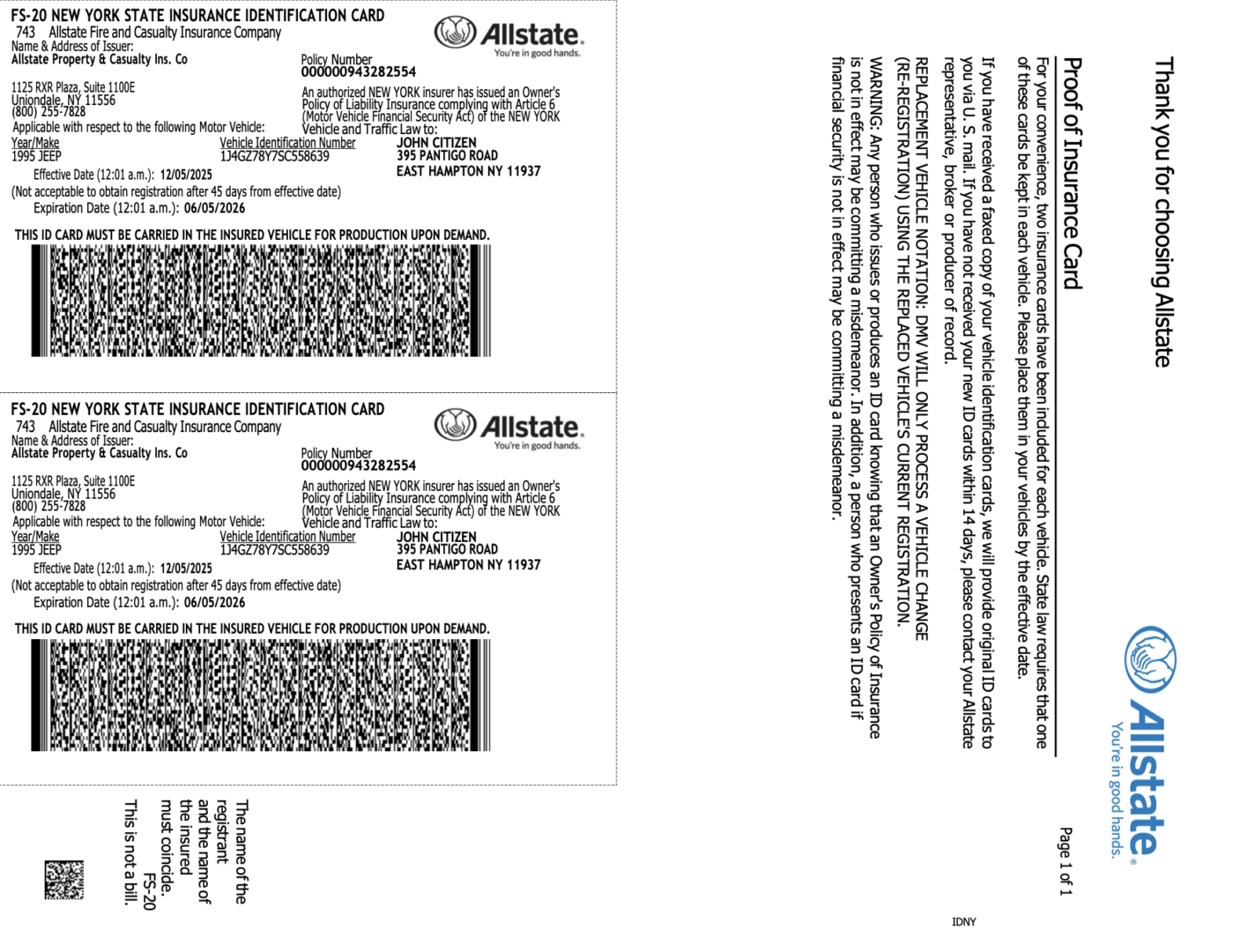
Additionally, New York enforces strict administrative reciprocity between insurance verification and vehicle registration. The state does not permit out-of-state auto insurance policies for vehicles registered with the New York DMV, even if the coverage limits match or exceed state thresholds. The named insured on the insurance card (Form FS-20) must match the registered owner's name exactly.
Mandatory Minimum Auto Insurance Requirements in New York
To legally register and operate a passenger vehicle in New York, policyholders must purchase three distinct forms of insurance coverage. Operating with anything less than these mandatory limits is a direct violation of state law.
1. Motor Vehicle Liability Insurance
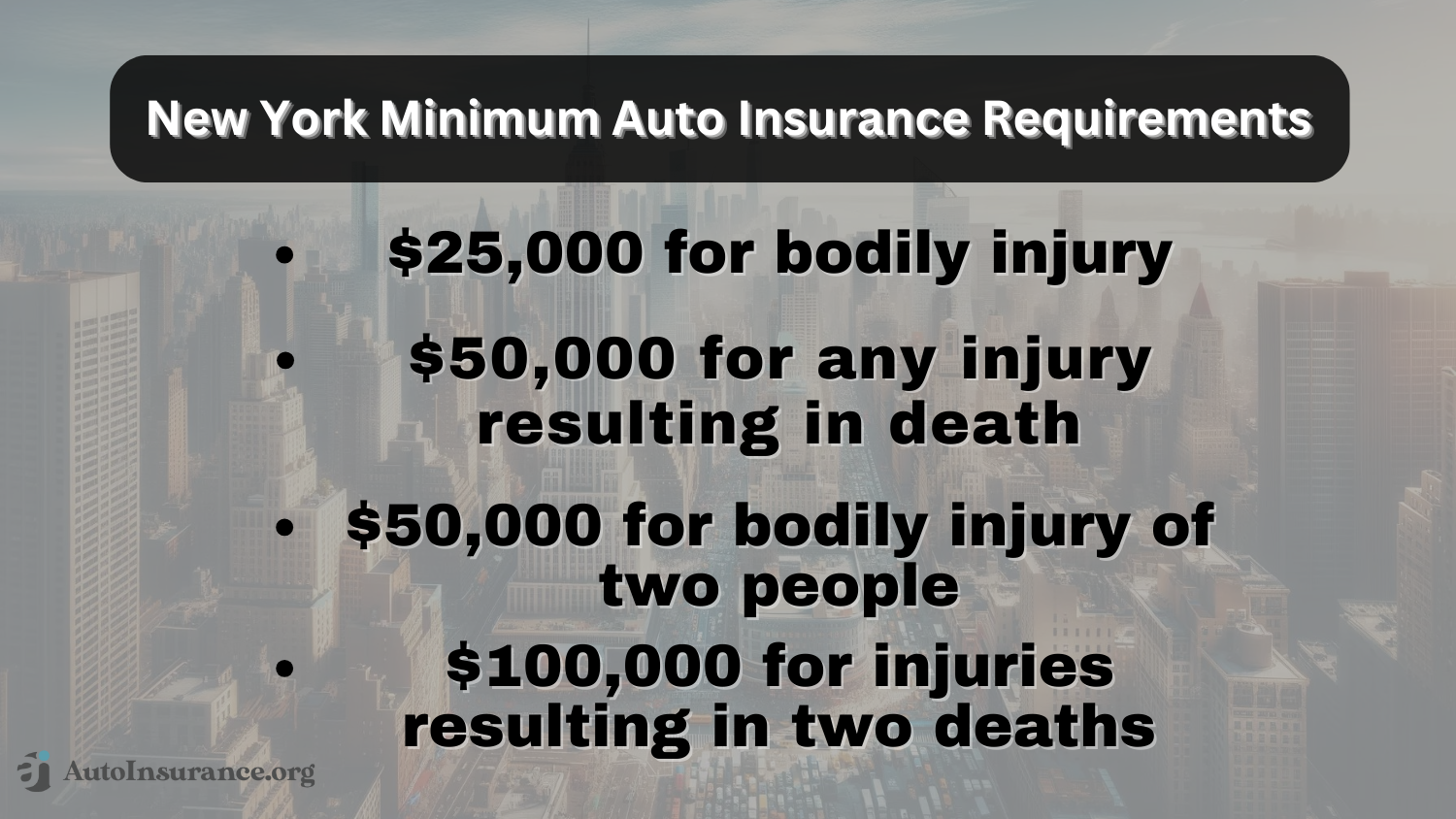
Liability insurance covers damages or injuries the policyholder inflicts on third parties during an accident where the policyholder is legally liable. New York requires minimum bodily injury and property damage liability split limits, as well as separate minimums in the event of an accident resulting in death:
- $25,000 for bodily injury to one person in any one accident.
- $50,000 for bodily injury to two or more persons in any one accident.
- $50,000 for bodily injury resulting in the death of one person.
- $100,000 for bodily injury resulting in the death of two or more persons.
- $10,000 for property damage injury or destruction in any one accident.
These thresholds are often abbreviated as 25/50/10 liability limits (or 50/100 for fatal incidents). Property damage liability pays for structural damage, municipal property, or third-party vehicles damaged during a collision. It does not pay for repairs to the insured driver's own car.
2. Personal Injury Protection (PIP / No-Fault)
Personal Injury Protection (PIP) is mandatory on all private passenger motor vehicles registered in New York. The baseline statutory requirement provides:
- $50,000 per person in basic economic loss.
PIP reimburses the driver, passengers, and pedestrians struck by the vehicle for reasonable and necessary medical, surgical, and rehabilitation expenses. It also covers 80% of lost earnings from work (up to a statutory cap of $2,000 per month for up to three years from the date of the accident), and up to $25 per day for up to one year for other reasonable and necessary expenses (such as transportation to medical appointments and household help). PIP does not compensate for property damage, nor does it pay for emotional distress or pain and suffering.
3. Uninsured Motorist (UM) Coverage
New York requires every auto policy to protect policyholders against injuries caused by uninsured drivers, unidentified hit-and-run motorists, or stolen vehicles.
- $25,000 per person for bodily injury.
- $50,000 per accident for bodily injury to two or more persons.
- $50,000 / $100,000 for wrongful death.
This mandatory coverage applies exclusively to bodily injury sustained within New York State. It does not cover vehicle damage caused by an uninsured driver.
Summary of Mandatory vs. Optional Auto Insurance in New York
| Coverage Type | Statutory Requirement | Minimum Legal Limit | What It Protects |
|---|---|---|---|
| Bodily Injury Liability | Mandatory | $25,000 / $50,000 | Third-party injuries when you are at fault |
| Death Liability | Mandatory | $50,000 / $100,000 | Third-party fatalities when you are at fault |
| Property Damage Liability | Mandatory | $10,000 | Third-party vehicles/structures you damage |
| Personal Injury Protection (PIP) | Mandatory | $50,000 per person | Your medical bills, 80% lost wages, essential tasks |
| Uninsured Motorist (UM) | Mandatory | $25,000 / $50,000 | Bodily injuries caused by an uninsured/hit-and-run driver in NY |
| Supplementary Uninsured/Underinsured (SUM) | Optional (Must be offered) | Matches liability limits | Covers injuries outside NY and underinsured third-party limits |
| Collision Coverage | Optional (Lender-required) | Actual Cash Value (ACV) | Physical damage to your vehicle from an impact |
| Comprehensive Coverage | Optional (Lender-required) | Actual Cash Value (ACV) | Theft, fire, flood, falling objects, animal strikes |
| Medical Payments (MedPay) | Optional | Varies ($1,000–$10,000) | Excess medical costs above PIP; funeral expenses |
How New York’s No-Fault System Works
New York's no-fault system is designed to streamline medical payments and replace wages swiftly without the initial need to establish who caused a crash. However, the system imposes strict procedural timelines and restricts an individual's right to pursue civil litigation.
The 30-Day Application Rule
Following a motor vehicle accident, anyone claiming no-fault benefits must submit a completed and signed Form NF-2 (Application for Motor Vehicle No-Fault Benefits) to the relevant insurer within 30 calendar days of the accident date. Failure to file within 30 days provides the insurer statutory grounds to deny all medical and wage benefits entirely, unless the applicant provides clear written proof of a reasonable medical or legal justification for the delay.
Medical providers must bill the insurer directly within 45 days of rendering treatment under the state’s Workers’ Compensation medical fee schedule, which sets reimbursement ceilings for auto accident injuries.
The "Serious Injury" Threshold for Lawsuits
Because PIP handles basic economic recovery, New York Insurance Law Section 5104 bars drivers and passengers from suing an at-fault driver for general damages (pain, suffering, loss of enjoyment of life) unless the injury meets the statutory "serious injury" threshold outlined in Insurance Law Section 5102(d).
A physical condition qualifies as a serious injury only if it results in one of the following:
- Death.
- Dismemberment or significant disfigurement.
- A fracture (broken bone).
- Loss of a fetus.
- Permanent loss of use of a body organ, member, function, or system.
- Permanent consequential limitation of use of a body organ or member.
- Significant limitation of use of a body function or system.
- A medically determined injury or impairment of a non-permanent nature that prevents the injured person from performing substantially all of the material acts that constitute their usual daily activities for not less than 90 days during the 180 days immediately following the injury (commonly known as the 90/180 rule).
Soft tissue strains, minor sprains, or temporary whiplash that resolve within weeks do not satisfy this standard, foreclosing any personal injury lawsuit for pain and suffering.
Supplemental and Optional Auto Insurance Coverages
While state law mandates bare minimums, relying strictly on basic coverage leaves motorists vulnerable to substantial out-of-pocket liabilities. Several optional protections alter risk exposure significantly.
Supplementary Uninsured/Underinsured Motorist (SUM)
Statutory Uninsured Motorist coverage applies only inside New York State and covers only up to the basic $25,000/$50,000 limits. Insurers doing business in New York must offer policyholders Supplementary Uninsured/Underinsured Motorist (SUM) coverage up to an amount equal to their chosen bodily injury liability limit.
SUM protects the insured, household family members, and vehicle occupants if they suffer bodily injuries caused by an out-of-state uninsured vehicle, a hit-and-run driver, or an underinsured motorist whose bodily injury liability limits are lower than the insured's SUM limits.
Collision and Comprehensive Protections
Neither collision nor comprehensive insurance is mandated by New York state law. However, if a vehicle is leased or financed, banks and leasing entities require both coverages to protect their asset until the loan or lease is paid in full.
- Collision Insurance reimburses repair or replacement costs (minus the deductible) if the vehicle collides with another car, a guardrail, a tree, or flips over, regardless of fault.
- Comprehensive Insurance (other-than-collision) covers damage resulting from incidents outside the driver’s control: auto theft, windshield damage, vandalism, fire, hail, falling trees, and collisions with animals (such as deer).
Additional PIP (OBEL and Additional PIP)
Drivers can buy coverage beyond the basic $50,000 PIP limit. Additional PIP increases the aggregate benefit limit (often to $100,000 or more) and can extend wage replacement and medical benefits to guest occupants or accidents occurring outside New York.
Additionally, insurers must offer Optional Basic Economic Loss (OBEL), which provides an extra $25,000 in coverage that the policyholder can elect to allocate specifically toward lost wages, psychiatric or physical rehabilitation, or medical expenses once the primary $50,000 PIP is exhausted.
The NY DMV Electronic Insurance Monitoring System (IIES)
New York maintains one of the strictest digital insurance tracking networks in the country: the Insurance Information and Enforcement System (IIES).
How IIES Operates
Insurers authorized to write auto policies in New York are mandated by state regulation to report policy issuances, cancellations, non-renewals, and reinstatements directly to the DMV via secure electronic transmissions.
- When a policy is activated, the insurer notifies the DMV using an electronic FS-20 record.
- If a premium payment is missed and the policy is cancelled, the insurer transmits an electronic notice of cancellation (Form FS-4) directly to the DMV database.
- The DMV automatically cross-references active vehicle registrations against this database. If a registered vehicle loses active insurance backing, the DMV system flags the record instantly.
Paper insurance cards are issued for traffic stops and vehicle inspections, but the DMV does not accept paper insurance cards from vehicle owners as proof of continuous coverage during an insurance inquiry. The DMV requires direct, electronic verification from the insurance underwriter.
Penalties for Lapses in Auto Insurance Coverage
Allowing auto insurance to lapse in New York—even for a single day—triggers automated statutory enforcement actions.
Registration Suspensions and Daily Civil Penalties
When an insurance cancellation is logged without an immediate electronic confirmation of replacement coverage, the DMV issues an inquiry letter and subsequent suspension notice. The vehicle registration is suspended for the exact number of days the vehicle was uninsured.
If the lapse is 90 days or fewer, and the vehicle was not involved in an accident during that period, the vehicle owner can resolve the suspension by surrendering their license plates or by paying a non-negotiable statutory daily civil penalty:
- $8 per day for days 1 through 30 of the lapse.
- $10 per day for days 31 through 60 of the lapse.
- $12 per day for days 61 through 90 of the lapse.
For example, a 60-day lapse results in a fine of $540 ($240 for the first 30 days plus $300 for days 31 through 60). Paying this fine allows the driver to avoid vehicle registration suspension.
Suspensions Exceeding 90 Days
If the insurance lapse exceeds 90 days:
- The option to pay a daily civil penalty to clear the suspension is eliminated.
- The vehicle registration is suspended for the identical number of days the vehicle was uninsured.
- The owner must surrender vehicle plates to the DMV for the duration of the suspension period.
- The driver's driver license is also suspended for the same number of days as the registration suspension.
Operating an Uninsured Vehicle
Driving a vehicle with a suspended registration or operating an uninsured vehicle on public roadways in New York carries criminal and administrative penalties:
- Arrest and issuance of a misdemeanor citation.
- Traffic court fines up to $1,500, plus mandatory state surcharges.
- Mandatory vehicle impoundment and towing fees.
- Revocation of the driver license and vehicle registration for at least one year.
- A mandatory $750 civil penalty paid to the DMV before applying for a new driver license.
- Insurance Cancellation
- Insurer Notifies DMV via IIES
- DMV Sends Inquiry Letter
- If Proof Provided Electronically: Case Closed
- If No Proof: Registration Suspended
- Lapse ≤ 90 Days: Pay Daily Civil Fine OR Surrender Plates
- Lapse > 90 Days: Driver License Suspended + Mandatory Plate Surrender
Unique New York Insurance Rules and Legal Nuances
Several specific statutes unique to New York govern auto policies and dispute resolutions.
Spousal Liability Coverage (Supplemental Spousal Liability)
Historically, New York Insurance Law Section 3420(g) prohibited auto policies from covering an insured person's liability for the injury or death of their spouse unless the policy included a specific endorsement.
New York law requires insurers to include Supplemental Spousal Liability Insurance automatically in all private passenger vehicle policies, unless the policyholder explicitly declines the coverage in writing. This coverage allows a spouse injured as a passenger in a vehicle driven by the other spouse to assert a bodily injury liability claim against the driver-spouse, drawing from the policy's third-party liability coverage rather than being restricted solely to basic PIP limits.
The Vehicle Plate Surrender Protocol
The most common operational mistake made by New York vehicle owners occurs when moving out of state, selling a car, or canceling insurance before turning in the vehicle's license plates.
Under New York law, vehicle registration and insurance validity are tied directly together. You must surrender your physical license plates to a DMV office (or by certified mail) and obtain a Plate Surrender Receipt (Form FS-6T) before canceling auto insurance. If a policyholder cancels insurance while the plates remain registered with the DMV, the state logs an active lapse, assesses daily fines, and suspends driving privileges, even if the vehicle is parked, inoperable, or sold.
Rental Car Coverage Rules
Under New York Insurance Law Section 3440, private passenger motor vehicle policies issued in New York must provide coverage for property damage liability to a rental vehicle operated by the insured inside the United States and Canada. This built-in protection provides continuous coverage for short-term rental car damage without requiring the mandatory purchase of an expensive Collision Damage Waiver (CDW) at the rental counter, subject to policy boundaries and vehicle class restrictions.
Frequently Asked Questions
Can I use an out-of-state auto insurance policy in New York?
No. To register a vehicle in New York, the auto liability insurance policy must be issued by an insurance company licensed by the New York State Department of Financial Services. The DMV will not accept out-of-state insurance cards, coverage documents, or out-of-state corporate policies, even if the policy limits meet New York’s statutory requirements. The only exception applies to active-duty military personnel permanently stationed out of state under specific military orders.
Does New York auto insurance cover damage to my own car after an accident?
Only if you carry optional collision coverage. Mandatory minimum insurance (liability, PIP, and uninsured motorist) does not pay to repair your vehicle. PIP pays strictly for medical costs, lost wages, and emergency medical services for humans. If you are involved in a collision with an at-fault driver and do not carry collision coverage, you must file a third-party claim against the other driver’s property damage liability policy to recover repair costs.
What should I do if my insurance company issues an unexpected cancellation?
Contact your insurance agent or insurer immediately to request an electronic reinstatement transmission to the DMV via the IIES database. If the policy cannot be reinstated, you must secure an active policy from an authorized New York carrier immediately to minimize lapse days. If replacement insurance cannot be secured immediately, surrender your license plates to a DMV office to prevent the daily monetary penalty and suspension clock from running.
How does New York's 50% comparative negligence rule affect an insurance claim?
New York adheres to a pure comparative fault system (New York Civil Practice Law and Rules Section 1411). Under this statute, an injured party can recover damages in a lawsuit even if they were 99% responsible for an accident. However, financial recovery is reduced in direct proportion to their percentage of fault. For example, if your damages total $100,000, but a court or insurance adjuster determines you were 30% at fault for the crash, your third-party bodily injury or property damage settlement is reduced to $70,000.
Are New York rideshare drivers (Uber/Lyft) covered under standard auto policies?
No. Standard private passenger auto policies in New York explicitly exclude coverage while a vehicle is being operated for commercial livery or app-based ridesharing. When the rideshare application is active, the driver must rely on the commercial liability policy maintained by the Transportation Network Company (TNC) or purchase an optional commercial or rideshare endorsement on their personal auto policy to avoid coverage gaps during Period 1 (app on, waiting for a ride request).
Recommended Next Steps
To verify your compliance with New York auto insurance rules:
- Audit Your Declarations Page: Check your current limits against the compulsory thresholds (25/50/10 liability, $50,000 PIP, 25/50 UM). Given modern litigation and healthcare costs, evaluate increasing liability limits to at least 100/300/100 and purchasing matching SUM coverage.
- Verify Name Alignment: Ensure the first and last names listed on your auto insurance card match your New York vehicle registration certificate precisely. Discrepancies (such as missing middle initials or unlisted co-owners) prevent the IIES system from matching records, resulting in mistaken DMV lapse notices.
- Secure an FS-6T Before Canceling Insurance: If you plan to sell your vehicle, transition it off the road, or switch insurers across state lines, surrender the physical license plates to the New York DMV first. Keep the FS-6T receipt safely in your records before ending continuous insurance coverage.
Disclaimer: This guide is provided for educational and informational purposes only and does not constitute formal legal or financial advice. Statutory provisions, DMV regulations, and insurance policies vary depending on factual circumstances. Consult an attorney licensed in New York or an authorized insurance professional regarding specific coverage decisions.
Image Gallery