Counseling Graduate Degrees and Licensure Paths: A Comprehensive Guide
Navigating counseling graduate degrees and licensure paths requires choosing an accredited master’s degree, completing mandatory clinical field hours, passing national credentialing examinations, and fulfilling state-specific post-grad...
Navigating counseling graduate degrees and licensure paths requires choosing an accredited master’s degree, completing mandatory clinical field hours, passing national credentialing examinations, and fulfilling state-specific post-graduate supervised practice requirements. Candidates typically pursue a 60-credit master’s degree in Clinical Mental Health Counseling to qualify for state professional counselor licensure.
Contents
Disclaimer: Professional counseling licensure standards, board rules, and credential titles are governed at the state level in the United States. Prospective students and practitioners should always consult their state licensing board to confirm specific statutory requirements.
Educational Pathways: Graduate Degree Types in Counseling
Entering the counseling profession begins with selecting the correct graduate degree track. Unlike general psychology or research-oriented human services degrees, professional counseling degrees focus heavily on direct clinical skills, intervention strategies, assessment, and human development.
- Undergraduate Degree
- Accredited Master's Degree (60 Credits)
- Practicum (100+ Hours)
- Clinical Internship (600+ Hours)
- National Examinations (NCE / NCMHCE)
- Provisional Licensure (LAC / LPCA)
- Supervised Clinical Work (2,000–3,000 Hours)
- Full Independent Licensure (LPC / LMHC / LCPC)
Master of Science (M.S.) vs. Master of Arts (M.A.) in Clinical Mental Health Counseling
The Master’s in Clinical Mental Health Counseling (CMHC) is the primary degree for individuals seeking to practice psychotherapy in private practice, community mental health agencies, hospitals, and residential treatment centers.
- Master of Science (M.S.): Frequently places a heavier emphasis on clinical assessment, psychopharmacology, evidence-based research methodologies, and quantitative evaluation.
- Master of Arts (M.A.): Often incorporates broader theoretical models, systemic perspectives, and humanities-oriented approaches alongside standard clinical coursework.
Regardless of whether the degree confers an M.A. or M.S., state licensing boards look primarily at curriculum content, total semester credit hours, and accreditation status rather than the degree title alone.
Specialized Counseling Graduate Tracks
While Clinical Mental Health Counseling is the most flexible pathway for outpatient mental health practice, specialized graduate tracks target distinct settings:
- Marriage and Family Therapy (MFT): Focuses on relational dynamics, couples therapy, and family systems theory. Graduates pursue licensure as Licensed Marriage and Family Therapists (LMFT).
- School Counseling: Prepares practitioners to work within K-12 academic settings. Curriculum covers academic development, social-emotional learning, and career planning. Licensing is typically overseen by state departments of education rather than behavioral health boards.
- Addiction and Substance Use Counseling: Emphasizes chemical dependency, co-occurring psychiatric disorders, and specialized group interventions.
- Rehabilitation Counseling: Focuses on supporting individuals with physical, cognitive, or developmental disabilities to achieve personal and employment independence.
Doctoral Degrees: Ph.D. vs. Ed.D. in Counselor Education and Supervision
Doctoral degrees in counseling are distinct from a Ph.D. or Psy.D. in Clinical Psychology. A Ph.D. or Ed.D. in Counselor Education and Supervision (CES) is designed for licensed counselors seeking roles in academic research, university teaching, advanced clinical supervision, or executive administration.
- Ph.D. (Doctor of Philosophy): Focuses heavily on empirical research, statistical analysis, and original dissertation research.
- Ed.D. (Doctor of Education): Centers on applied leadership, instructional pedagogy, and administrative oversight within educational or institutional settings.
A doctorate is not required for independent clinical practice; a 60-credit master’s degree remains the professional standard for clinical counseling.
Program Accreditation: Why CACREP and COAMFTE Matter
Accreditation verifies that a graduate program meets strict educational, ethical, and clinical preparation standards. Enrolling in an accredited degree program significantly simplifies the state licensure process and ensures coursework meets national portability benchmarks.
CACREP Accreditation
The primary accrediting body for counseling programs in North America is the Council for Accreditation of Counseling and Related Educational Programs.
CACREP requires master’s programs in Clinical Mental Health Counseling to consist of at least 60 semester credit hours (or 90 quarter hours) covering eight core curricular domains:
- Professional Counseling Orientation and Ethical Practice
- Social and Cultural Diversity
- Human Growth and Development
- Career Development
- Counseling and Helping Relationships
- Group Counseling and Group Work
- Assessment and Testing
- Research and Program Evaluation
Many state licensing boards mandate graduation from a CACREP-accredited program for licensure eligibility. Graduating from a non-CACREP program often requires manual course-by-course evaluations by state board reviewers and can create obstacles when applying for endorsement in other states.
COAMFTE Accreditation
For students focusing specifically on systemic marriage and family therapy, the Commission on Accreditation for Marriage and Family Therapy Education (COAMFTE) serves as the specialized accrediting body. COAMFTE programs structure their curriculum specifically around relational therapy hours, systemic assessment, and family dynamics, aligning directly with LMFT state licensing laws.
The Step-by-Step Pathway to Counseling Licensure
Transforming a graduate degree into an active license to practice independently involves five distinct phases.
- Phase 1: Graduate Education & Fieldwork
- 60 Semester Credit Hours (CACREP Aligned)
- 100-Hour Practicum (40 Direct Client Hours)
- 600-Hour Clinical Internship (240 Direct)
- Phase 2: Examination & Associate Licensure
- Pass NCE or NCMHCE Board Examination
- Submit Jurisprudence & Background Check
- Obtain Provisional State License (LAC / LPCA)
- Phase 3: Supervised Post-Graduate Experience
- 2,000 to 3,000 Total Clinical Work Hours
- 1,500 Direct Client Contact Hours
- 100 to 150 Direct Clinical Supervision Hours
- Phase 4: Full Independent Licensure
- Submit Verified Hours to State Board
- Obtain Unrestricted License (LPC / LMHC)
- Qualify for Solo Private Practice & Billing
Step 1: In-Program Clinical Fieldwork (Practicum and Internship)
Before graduating, counseling students must complete supervised fieldwork embedded within their academic program:
- Practicum: Typically requires a minimum of 100 clock hours, with at least 40 hours spent providing direct counseling services to clients.
- Internship: Demands a minimum of 600 clock hours, with at least 240 hours of direct client service. Students receive ongoing individual and group supervision from university faculty and site supervisors.
Step 2: Provisional/Associate Licensure
Upon graduation, candidates cannot immediately practice independently. Instead, they apply to their state licensing board for a provisional credential, commonly titled:
- Licensed Associate Counselor (LAC)
- Licensed Professional Counselor Associate (LPCA)
- Licensed Graduate Professional Counselor (LGPC)
This initial credential allows graduates to provide therapy under the formal supervision of a fully licensed clinician while accruing their required post-graduate hours.
Step 3: National Licensing Examinations
Depending on the state and desired license, candidates must pass one or both standard national examinations administered by the National Board for Certified Counselors or the Association of Marital and Family Therapy Regulatory Boards (AMFTRB):
- National Counselor Examination (NCE): A 200-item multiple-choice exam assessing knowledge across the eight CACREP core curriculum domains.
- National Clinical Mental Health Counseling Examination (NCMHCE): A scenario-based clinical simulation exam measuring diagnostic skills, treatment planning, and clinical decision-making.
- AMFTRB National MFT Exam: Used exclusively for Marriage and Family Therapy licensure candidates.
Step 4: Post-Graduate Supervised Experience
Provisional licensees must accumulate significant clinical experience over two to four years. Exact requirements vary by state, but typical parameters require:
- Total Work Hours: 2,000 to 3,000 total hours in a mental health clinical setting.
- Direct Client Contact: 1,500 hours providing direct face-to-face or telehealth counseling.
- Supervision Hours: 100 to 150 hours of direct supervision with an approved board supervisor (typically at a ratio of 1 hour of supervision per 20 to 40 client contact hours). Supervision can be individual, triadic, or group-based, depending on local regulations.
Step 5: Full Independent Practice Licensure
Once all post-graduate supervised hours are verified by the board and required exams are passed, the practitioner receives full independent licensure. This unrestricted license permits autonomous private practice, clinical supervision, multi-setting employment, and direct credentialing with health insurance networks.
State Licensure Titles and Comparative Requirements
State behavioral health boards use differing titles to designate full independent licensure. The table below illustrates the most common credentials, standard academic benchmarks, exam pathways, and typical clinical hour expectations.
| License Title | Common Acronyms | Academic Standard | Primary Examination | Post-Grad Supervised Hours |
|---|---|---|---|---|
| Licensed Professional Counselor | LPC | Master’s in CMHC (60 Credits) | NCE or NCMHCE | 2,000 – 3,000 total (1,500 direct) |
| Licensed Mental Health Counselor | LMHC | Master’s in CMHC (60 Credits) | NCMHCE or NCE | 3,000 total (1,500 direct) |
| Licensed Clinical Professional Counselor | LCPC | Master’s in CMHC (60 Credits) | NCMHCE | 3,000 total (1,500 direct) |
| Licensed Clinical Mental Health Counselor | LCMHC | Master’s in CMHC (60 Credits) | NCMHCE | 3,000 total (1,500 direct) |
| Licensed Marriage & Family Therapist | LMFT | Master’s in MFT (60 Credits) | AMFTRB National MFT Exam | 2,000 – 3,000 total (1,000 direct relational) |
| Certified School Counselor | School Counselor | Master’s in School Counseling (48–60 Credits) | Praxis II Specialty Exam | Varies (State Board of Education internship) |
Note: States like New York and Florida utilize the LMHC title, whereas states like Texas, Georgia, and Colorado utilize LPC. Illinois and Maryland utilize LCPC for independent practice.
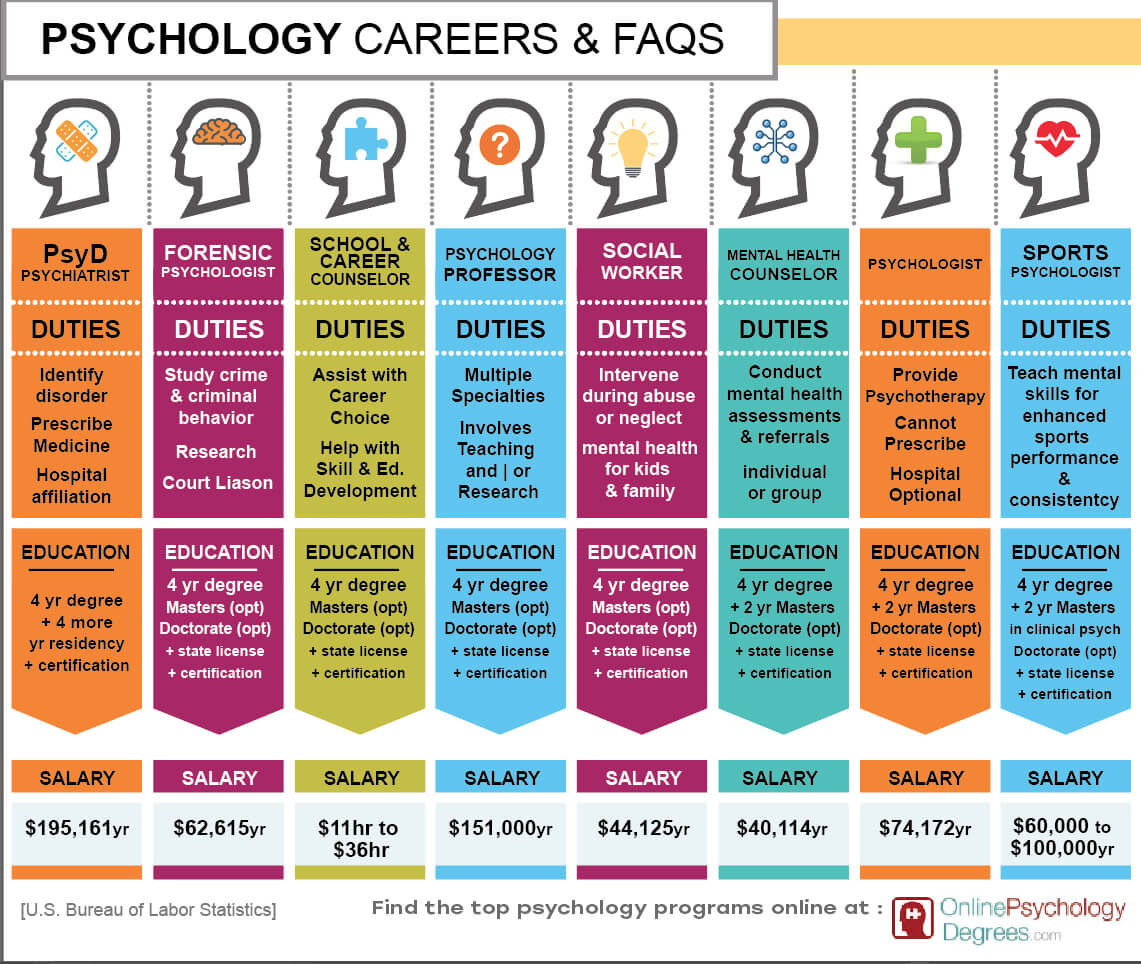
Counseling vs. Social Work vs. Clinical Psychology
Students selecting a graduate pathway often weigh counseling against allied mental health professions. While clinical duties overlap significantly, core training philosophies differ:
Mental Health Disciplines
- Counseling (M.S./M.A.)
- Focus: Human development, counseling theory, & wellness.
- Social Work (MSW)
- Focus: Social justice, case management, community systems.
- Psychology (Ph.D./Psy.D)
- Focus: Psychological testing, psychometrics, neurological assessment, research.
- Counseling (M.S./M.A.)
Professional Counseling (M.A. / M.S. in CMHC): Rooted in wellness, preventive intervention, human growth, dynamic developmental transitions, and individual or group therapy techniques.
Clinical Social Work (Master of Social Work / MSW): Emphasizes person-in-environment frameworks, social justice, resource navigation, policy, and systemic advocacy alongside psychotherapy (leading to LCSW status).
Clinical or Counseling Psychology (Ph.D. or Psy.D.): Focuses heavily on psychological testing, complex psychometrics, neuro-assessment, and quantitative research methods. Standard practice requires a doctoral degree and extensive clinical psychology residency.
License Portability and the Interstate Counseling Compact
Historically, moving a clinical counseling practice across state lines required applying for licensure by endorsement, satisfying distinct regional requirements, and sometimes taking additional examinations or completing supplemental coursework.
The Counseling Compact
To streamline cross-state practice and support telehealth adoption, states established the Counseling Compact.
Key aspects of the Counseling Compact include:
- Privilege to Practice: Fully licensed counselors holding an unencumbered license in a member state can apply for a privilege to practice in other participating compact states without applying for full local licensure.
- Home State Requirement: Clinicians must hold an active license in their primary state of residence, which must be an active member of the compact.
- Telehealth and Continuity of Care: Enables therapists to maintain continuous treatment with clients who relocate or travel within member states, significantly expanding rural and underserved access to mental health care.
Clinicians located in non-compact states must still submit traditional endorsement applications, which require submitting official transcripts, verifying supervision forms, and proving equivalent state exam performance.
Frequently Asked Questions
What is the difference between an LPC and an LMHC?
LPC (Licensed Professional Counselor) and LMHC (Licensed Mental Health Counselor) are equivalent master's-level licenses; the distinction is primarily state nomenclature. For example, Texas and Pennsylvania issue the LPC credential, whereas New York, Massachusetts, and Florida issue the LMHC credential. Both require equivalent 60-credit graduate education, clinical internships, and post-graduate supervised clinical hours.
Can I get licensed with an online master’s degree in counseling?
Yes, provided the online master’s degree program is regionally accredited and meets state licensing board rules. Enrolling in an online program accredited by CACREP ensures the curriculum and residency/fieldwork components satisfy national standards. Online students must arrange local clinical field sites (practicum and internship) that meet board supervisor criteria.
How long does it take to complete a counseling degree and obtain independent licensure?
Completing a master’s degree typically takes 2 to 3 years of full-time graduate study. Earning full independent licensure requires an additional 2 to 4 years of post-graduate supervised practice. The total timeline from starting a master’s program to receiving an unrestricted LPC or LMHC license is generally 4 to 7 years.
What happens if my master’s program is not CACREP-accredited?
If a program lacks CACREP accreditation, state licensing boards conduct a detailed course-by-course review to verify that the degree meets statutory curriculum and fieldwork criteria. Graduates may need to complete post-graduate bridge courses to satisfy credit hour deficits, and obtaining cross-state endorsement or participating in interstate compact agreements may be more challenging.
What is the difference between direct and indirect hours during supervision?
Direct hours refer to face-to-face time spent providing therapeutic interventions to clients, individuals, couples, or groups (in person or via secure telehealth). Indirect hours include collateral work such as writing progress notes, attending case consultations, developing treatment plans, participating in administrative tasks, and attending clinical supervision.
Next Steps for Prospective Counseling Candidates
To begin pursuing a career in clinical mental health counseling:
- Verify State Board Rules: Request the official rules and statutes from the behavioral health licensing board in the state where you intend to practice. Confirm their specific requirements for credit hours, degree accreditation, and post-graduate supervision.
- Evaluate Program Accreditation: Filter prospective graduate programs using official accreditation databases from CACREP or COAMFTE to ensure your degree transfers smoothly across state lines.
- Plan Fieldwork Logistics: Connect with university field placement coordinators to review local clinical placement options, site requirements, and supervisor credential verification process before beginning coursework.
Image Gallery