Why English Prefixes and Suffixes Matter for Campus Writing
English prefixes and suffixes are essential tools for campus writing because they allow students to expand their vocabulary, improve precision in academic arguments, and decode complex terminology across disciplines. Mastering these mo...
English prefixes and suffixes are essential tools for campus writing because they allow students to expand their vocabulary, improve precision in academic arguments, and decode complex terminology across disciplines. Mastering these morphemes enables writers to construct nuanced sentences, effectively communicate technical concepts, and demonstrate the sophisticated linguistic command expected in university-level assignments and research papers.
Contents
Understanding Affixes in an Academic Context
In the realm of higher education, writing demands more than just basic communication; it requires precision, formal register, and the ability to synthesize information from diverse fields. Prefixes—morphemes attached to the beginning of a word—and suffixes—those attached to the end—function as the building blocks of academic vocabulary. By understanding how these units alter meaning, a student can transform a simple root word into a precise academic term, thereby elevating the quality of their prose.
For example, the root word "structure" can be expanded into "restructure," "structural," "structurally," or "destructured." Each variation carries a distinct functional weight that changes how an author presents an argument. When a student grasps these patterns, they stop relying on a limited set of vocabulary and start utilizing the modular nature of the English language to convey complex relationships, causes, and effects.
Enhancing Precision and Specificity
Academic writing often requires distinguishing between subtle shades of meaning. General or vague language is a common pitfall that can weaken a thesis or obscure a student's analytical depth. Prefixes and suffixes provide the necessary tools to sharpen these definitions without needing to consult a dictionary for every synonym.
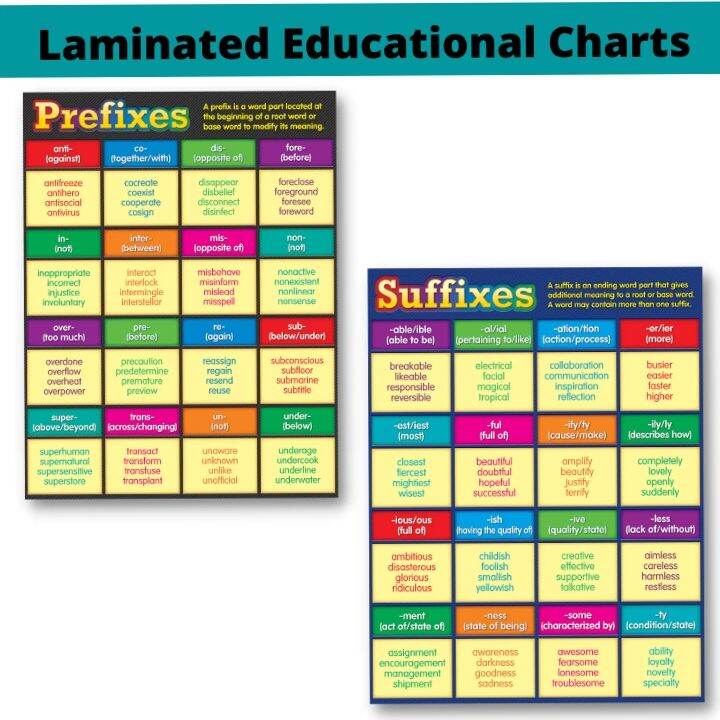
Consider the prefix "sub-" (meaning under or below). In a sociology paper, distinguishing between "subculture" and "culture" is vital. Or consider the prefix "inter-" (meaning between). Distinguishing between "disciplinary" and "interdisciplinary" studies is a foundational requirement for modern research. By using these prefixes correctly, students show that they understand the hierarchical or relational nuances of their subject matter.
Common Academic Affixes and Their Functional Roles
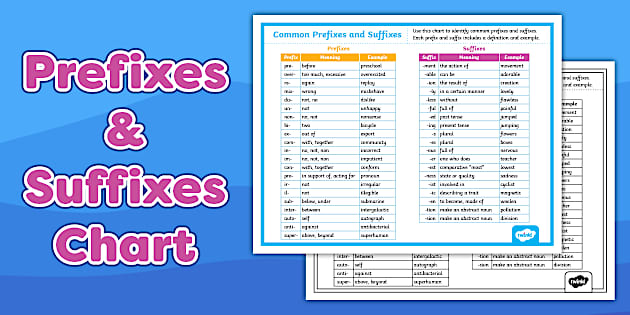
| Affix Type | Example Affix | Effect on Root Word | Academic Example |
|---|---|---|---|
| Prefix | Trans- | Across or beyond | Transdisciplinary |
| Prefix | Macro- | Large scale | Macroeconomics |
| Prefix | Pseudo- | False or deceptive | Pseudoscience |
| Suffix | -ism | Belief or doctrine | Constructivism |
| Suffix | -ology | Study of | Anthropology |
| Suffix | -ity | State or quality | Validity |
Decoding Technical Vocabulary
One of the greatest challenges in university writing is the influx of field-specific jargon. Whether in the sciences, humanities, or business, technical terms often look intimidating. However, because much of academic English is derived from Latin and Greek roots, prefixes and suffixes act as a "decoder ring" for students.
If a student encounters the term "phytoremediation" in an environmental science paper, they can break it down: "phyto-" (plant) and "-mediation" (the act of resolving). Even without having memorized the word, the student can deduce that the paper discusses using plants to remediate or clean up an environment. This ability to deconstruct complex language reduces the "cognitive load" during research, allowing the student to spend more time synthesizing ideas rather than struggling to understand the basic terminology of their sources.
Improving Sentence Flow and Formal Register
The use of suffixes is particularly critical when adjusting the register of a sentence to meet academic standards. Academic writing generally favors nominalization—the process of turning verbs or adjectives into nouns—which often makes writing sound more objective and authoritative.
Suffixes like "-tion," "-ment," "-ness," and "-ity" are essential for this purpose.
- Verb-heavy (Informal): "The researchers analyzed the data, which helped them understand the problem better."
- Nominalized (Formal): "The analysis of the data facilitated an improved understanding of the problem."
By using the suffix "-sis" (analysis) and "-ment" (improvement/understanding), the writer shifts the focus from the act of doing to the concept itself. This is a hallmark of sophisticated academic writing. It allows the writer to maintain a third-person, objective tone that is essential for peer-reviewed papers and formal campus assignments.
Strategies for Integrating Affix Knowledge into Daily Writing
To leverage prefixes and suffixes effectively, students should adopt a proactive approach to vocabulary development. It is not enough to memorize lists; one must integrate these elements into the writing process.
- Analyze Source Texts: When reading academic journals, highlight unfamiliar words and identify the prefixes and suffixes. Ask yourself how the affix changes the base word's function.
- Practice Nominalization: Review your draft and identify sentences that feel overly conversational. Can you replace a verb-heavy phrase with a noun formed by a suffix?
- Check for Consistency: Ensure that your use of prefixes and suffixes is consistent with the standard terminology of your specific department. Technical fields often have preferred ways of modifying terms.
- Proofread for "Affix Overload": While suffixes like "-ization" (e.g., globalization) can make a paper sound academic, using them excessively can lead to "noun-heavy" sentences that are difficult to read. Aim for a balance between descriptive verbs and structured nouns.
Frequently Asked Questions
Why do some words seem to have multiple prefixes?
Multiple prefixes occur when a word has been modified in stages. For example, in "incomprehensible," you have "in-" (not), "com-" (together), and "prehend" (to grasp). Each prefix serves a different function in the word's evolutionary history. When analyzing, look at the word from the outside in to identify the primary negation or modifier.
Are there exceptions to affix rules in academic writing?
Yes. English is famously inconsistent. Some words that look like they have a prefix do not actually use one in the modern sense (e.g., "resemble" is not "re-" + "semble"). Always verify the etymology if you are unsure of the word's true meaning, especially when using high-level vocabulary in a research thesis.
How does knowing prefixes help with reading comprehension?
Knowing common prefixes allows for "morphological analysis." When you identify a prefix like "pro-" (forward) or "anti-" (against), you can predict the direction of an author's argument before you even finish the sentence, which significantly speeds up research reading during high-pressure semesters.
Does the use of suffixes change the grammatical role of a word?
Yes, and this is crucial for sentence structure. Suffixes like "-ly" often create adverbs, while "-able" creates adjectives and "-tion" creates nouns. Understanding these changes helps you avoid common grammatical errors like using an adjective where an adverb is required to modify a verb, ensuring your writing is grammatically precise.
Mastering Language as a Scholarly Tool
For the 2026 academic year and beyond, the ability to communicate with precision remains the most valuable skill for any student. Prefixes and suffixes are not merely grammatical nuances; they are the tools of logic. By consciously utilizing these morphemes, you gain the ability to categorize information, define complex concepts, and maintain the formal register required by your professors.
Next time you are drafting a paper, focus on one section and specifically look for opportunities to replace weak phrasing with morphologically precise terms. By doing so, you will find that your writing not only meets the requirements of campus assignments but also clearly articulates the depth of your academic insight.
Image Gallery