The Thailand Revolution of 1932: Examining the End of Absolute Monarchy
The Thailand Revolution of 1932 was a pivotal bloodless coup on June 24 that transitioned the nation from an absolute monarchy to a constitutional monarchy. Led by the Khana Ratsadon (People's Party), this event fundamentally reorganiz...
The Thailand Revolution of 1932 was a pivotal bloodless coup on June 24 that transitioned the nation from an absolute monarchy to a constitutional monarchy. Led by the Khana Ratsadon (People's Party), this event fundamentally reorganized the Thai state, introducing the country's first constitution and establishing the framework for modern governance.
Contents
As of 2026, the 1932 Revolution remains the most significant political transformation in modern Thai history. While the transition ended centuries of absolute royal rule, it also initiated a complex era of political shifts, military interventions, and constitutional evolution. Understanding the 1932 Revolution requires an analysis of the socio-economic pressures of the time, the intellectual motivations of the "Promoters," and the specific legal changes that redefined the relationship between the monarch and the people.
The Socio-Economic Climate Leading to 1932
The roots of the 1932 Revolution were deeply embedded in the changing global and domestic landscape of the early 20th century. Under the reign of King Prajadhipok (Rama VII), the Kingdom of Siam (as Thailand was then known) faced severe financial instability. The global Great Depression had a devastating impact on Siam’s economy, which was heavily dependent on rice exports. As international demand plummeted, the government faced a massive deficit.
King Prajadhipok attempted to address the crisis by cutting government spending, which included reducing the salaries of civil servants and military officers and laying off many officials. These austerity measures created significant resentment among the emerging middle class and the educated bureaucracy. Many of these individuals had been educated in Europe, particularly in France and England, where they were exposed to Western democratic ideals, republicanism, and the concept of a nation-state where power resided with the people rather than a single sovereign.
The internal pressure was compounded by a growing sense that the absolute monarchy was an "anachronism" in a modernizing world. While the Chakri Dynasty had successfully navigated the era of Western colonialism, the younger generation of elites felt that the concentration of power within the royal family hindered progress. They sought a system where merit and professional expertise outweighed royal lineage.
The Formation of the Khana Ratsadon
The revolution was orchestrated by a secretive group known as the Khana Ratsadon, or the People's Party. The group was composed of two primary factions: civilian bureaucrats and military officers. The "Promoters" of the revolution first met in Paris in 1927 to plan the overthrow of the absolute monarchy.
Key figures in the Khana Ratsadon included:
- Pridi Banomyong: A brilliant law professor and the primary civilian ideologue. He drafted the group's economic and social manifestos.
- Phraya Phahol Pholphayuhasena: The military leader of the group and the man who would eventually become Thailand’s second Prime Minister.
- Plaek Phibunsongkhram: A rising star in the military whose influence would define Thai politics for decades.
- The Four Musketeers: Senior military officers (including Phraya Phahol and Phraya Songsuradet) who provided the tactical muscle necessary to execute the coup without a large-scale civil war.
The group was united by the Six Principles, a manifesto designed to modernize Siam:
- Maintaining the supreme power of the people.
- Maintaining national security.
- Maintaining the economic welfare of the people.
- Ensuring the people have equal rights.
- Ensuring the people have liberty and freedom.
- Providing the people with a full education.
The Events of June 24, 1932
The coup was executed with remarkable precision and almost no bloodshed. In the early morning hours of June 24, while King Prajadhipok was vacationing at the Klai Kangwon Palace in Hua Hin, the military faction of the Khana Ratsadon moved into Bangkok.
The Promoters used a clever ruse, claiming they were conducting a military exercise, to gather troops at the Ananta Samakhom Throne Hall. Once the troops were assembled, Phraya Phahol stood atop a tank and read the People's Party Manifesto to the crowd, officially declaring the end of the absolute monarchy. Simultaneously, civilian members of the group detained key members of the royal family and high-ranking ministers to prevent any immediate counter-coup.
The manifesto was remarkably bold, criticizing the monarchy for economic mismanagement and the lack of political rights. It stated that the "People's Party" did not wish to seize the throne for themselves but intended to establish a government that served the interests of the entire nation under a constitution.
King Prajadhipok’s Response and the First Constitution
Upon receiving news of the coup in Hua Hin, King Prajadhipok faced a difficult choice: fight back, which could lead to a bloody civil war, or accept the demands of the Khana Ratsadon. In an act that many historians credit with saving the monarchy as an institution, the King famously replied:
"I have received the letter in which you invite me to return to Bangkok as a constitutional monarch. For the sake of peace; and in order to avoid useless bloodshed; and because I have already considered making this change myself, I am willing to cooperate."
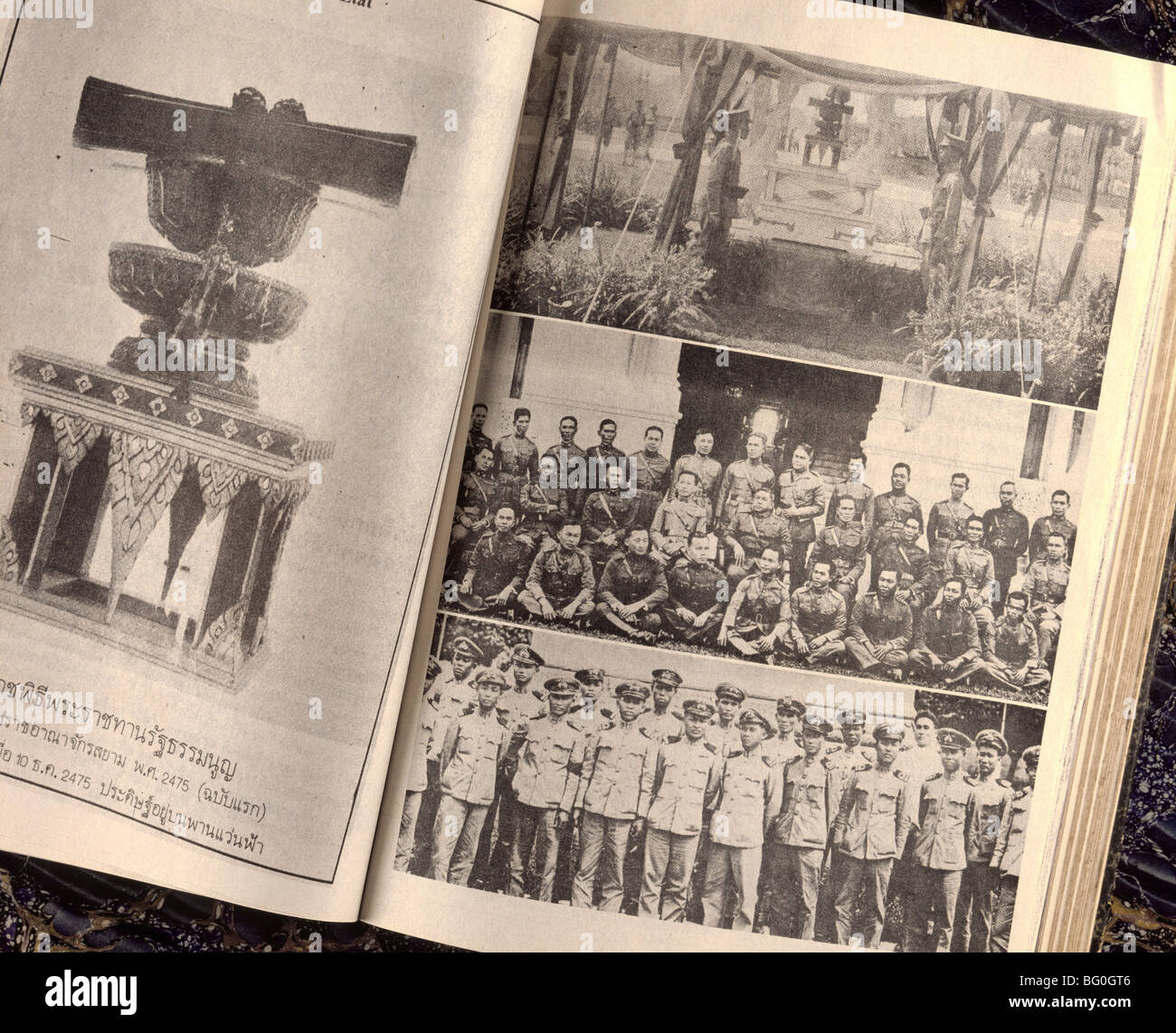
On June 27, 1932, the King signed the Temporary Constitution of Siam. This document stripped the monarch of most executive powers, transferring them to the People’s Committee (the cabinet) and the House of Representatives. A more "permanent" constitution was later promulgated on December 10, 1932, which sought to balance the power of the new political elite with the traditional prestige of the monarchy. This date, December 10, remains a public holiday in Thailand known as Constitution Day.
Comparison of Governance: Pre-1932 vs. Post-1932
| Feature | Absolute Monarchy (Pre-1932) | Constitutional Monarchy (Post-1932) |
|---|---|---|
| Source of Sovereignty | The Monarch (Divine Right/Lineage) | The People (via the Constitution) |
| Legislative Power | The Monarch and appointed Royal Council | The National Assembly (Partially elected) |
| Executive Power | The Monarch and royal ministers | Prime Minister and the Cabinet |
| Judicial System | Subject to royal prerogative | Independent courts under the Law |
| Succession | Determined by the Monarch/Palace Law | Regulated by Constitution and Law |
| Citizen Rights | Subject to the King's will | Defined by Constitutional Principles |
The Aftermath and Political Instability
While the revolution was successful in its immediate goal, it did not lead to a stable democracy. The alliance between the civilian and military factions of the Khana Ratsadon soon fractured. Pridi Banomyong’s radical economic plan, known as the "Yellow Cover Dossier," which proposed the nationalization of land and labor, was labeled "communist" by conservatives and some military members. This led to Pridi’s temporary exile and the first of many political crises.
The following years were marked by a power struggle between those who wanted a more liberal, parliamentary democracy and those who favored an authoritarian, military-led modernization. By 1938, Plaek Phibunsongkhram rose to power, steering the country toward a nationalist and militaristic path, which would eventually lead to the renaming of the country from Siam to Thailand in 1939.
The Long-term Legacy in 2026
Looking back from 2026, the 1932 Revolution is viewed as a complex "unfinished" project. While it ended the era of absolute rule, Thailand has since experienced over 20 constitutions and numerous successful and attempted coups. The tension between the "People's Party" ideals of 1932 and the traditional power structures remains a central theme in contemporary Thai politics.
The revolution did, however, succeed in expanding education and creating a more professionalized bureaucracy. It also fundamentally changed the Thai identity, moving it toward a sense of citizenship within a nation-state rather than being subjects of a crown.
Frequently Asked Questions
Was the 1932 Revolution violent?
No, the 1932 Revolution is often described as a "bloodless coup." The Khana Ratsadon strategically detained key royal officials and military commanders early in the morning, which prevented any coordinated armed resistance. There were no major battles or significant casualties during the transition.
Why did King Prajadhipok agree to the coup?
The King was already considering a move toward a more constitutional form of government, although he wanted it to be a gradual transition. Facing a fait accompli in Bangkok and wanting to avoid a civil war that would weaken the nation in the face of foreign interests, he chose to accept the role of a constitutional monarch.
What were the "Six Principles" of the People's Party?
The Six Principles were the ideological foundation of the revolution: Independence, Internal Security, Economic Welfare, Equality, Liberty, and Education. These principles were intended to transform Siam into a modern, equitable state that prioritized the well-being of all citizens over the interests of the royal elite.
How did the revolution affect the name of the country?
While the 1932 Revolution did not immediately change the name, it set the stage for the nationalist policies of the late 1930s. In 1939, under the leadership of Phibunsongkhram (one of the original 1932 Promoters), the government officially changed the name from Siam to Thailand to emphasize a "Thai-centric" national identity.
Is the 1932 Revolution still relevant in modern Thai politics?
Yes, very much so. In recent years, the 1932 Revolution has become a symbol for pro-democracy movements in Thailand. The "People's Party" plaque, which was installed at the site of the announcement in 1932, has become a significant political icon, and the ideals of the Six Principles continue to be cited by those seeking constitutional reform.
Practical Recommendation for Researchers
For those seeking to study the 1932 Revolution in depth, it is recommended to consult the National Archives of Thailand and the works of historians such as Thongchai Winichakul and Chris Baker. Many original documents, including the first constitution and the People's Party Manifesto, provide essential primary-source evidence of the Promoters' intentions. Researchers should also look into the "Pridi Banomyong Institute" for resources specifically related to the civilian intellectual contributions to the revolution.
Image Gallery