Understanding Warranty in Health and Life Insurance: Legal Principles and Policyholder Obligations
In the context of health and life insurance, a warranty is a strict contractual promise or a statement of fact made by the insured that must be literally and technically true. Unlike a standard representation, any breach of an insuranc...
In the context of health and life insurance, a warranty is a strict contractual promise or a statement of fact made by the insured that must be literally and technically true. Unlike a standard representation, any breach of an insurance warranty—regardless of whether the breach is material to the risk or caused the loss—historically allowed insurers to void coverage or discharge liability.
Contents
The legal landscape of insurance warranties has undergone significant evolution. While the term "warranty" in common retail settings refers to a guarantee of product quality, in the insurance sector, it is a pillar of the doctrine of uberrimae fidei (utmost good faith). By 2026, modern regulations in many jurisdictions have softened the traditional "automatic discharge" rule to protect consumers, yet the fundamental requirement for accuracy in life and health disclosures remains a critical component of policy validity.
The Legal Definition of Warranty in Insurance
In insurance law, a warranty is more than a mere statement; it is a condition precedent to the insurer’s liability. When an applicant for life or health insurance "warrants" a fact—such as their smoking status, history of chronic illness, or current blood pressure—they are effectively agreeing that the entire validity of the contract depends on the absolute truth of that statement.
Affirmative vs. Promissory Warranties
Warranties in health and life policies generally fall into two categories:
- Affirmative Warranties: These relate to facts existing at the time the contract is formed. For example, a life insurance applicant warrants that they have never been diagnosed with Type 2 diabetes. If this statement is found to be false at the time the policy was signed, the warranty is breached from the outset.
- Promissory (Continuing) Warranties: These are promises that a certain state of affairs will continue or that the insured will perform (or refrain from) a specific action during the life of the policy. In health insurance, a promissory warranty might involve a commitment to notify the insurer of any change in residence or employment if those factors impact the underlying risk profile.
Warranty vs. Representation: The Critical Distinction
Understanding the difference between a warranty and a representation is vital for any policyholder. This distinction often determines whether a claim is paid or denied when a discrepancy in the application is discovered.
Representations
A representation is a statement made by the applicant to the best of their knowledge and belief. To void a policy based on a misrepresentation, the insurer typically must prove two things:
- Materiality: The fact must be important enough that the insurer would have changed the premium or declined the risk if they had known the truth.
- Substantial Truth: Representations only need to be "substantially" true. If an applicant says they weigh 180 pounds but they actually weigh 182, this is unlikely to be considered a material misrepresentation that voids a policy.
Warranties
A warranty, conversely, demands literal truth. Traditionally, the insurer did not need to prove materiality. If a fact was warranted and found to be untrue, the insurer could technically avoid the contract even if the inaccuracy was trivial. While 2026 consumer protection laws in many regions (such as the UK, parts of the EU, and several US states) now require a degree of materiality even for warranties, the legal threshold for a warranty remains much higher and more rigid than for a representation.
Warranties in Life Insurance: The "Basis of the Contract"
Historically, life insurance companies used "basis of the contract" clauses to convert all statements made in an application into warranties. By signing the application, the consumer agreed that every answer—down to the spelling of a distant relative's name—formed the "basis" of the legal agreement.
The Shift Toward Consumer Protection
By 2026, most developed insurance markets have banned or severely limited "basis of the contract" clauses for consumer policies. Regulators like the National Association of Insurance Commissioners (NAIC) in the United States and the Financial Conduct Authority (FCA) in the UK have pushed for a "pro-consumer" interpretation.
Under current 2026 guidelines, if a life insurance applicant makes an honest mistake that is not material to the risk, the insurer is generally prohibited from voiding the entire policy. However, if the "warranty" concerns a core risk factor—such as cardiovascular health or terminal illness history—the breach remains a powerful tool for insurers to deny claims.
Warranties in Health Insurance: Compliance and Disclosure
In health insurance, warranties often revolve around eligibility and the disclosure of pre-existing conditions. Because health insurance involves frequent claims (unlike life insurance, which usually involves one), the application of warranties is a constant factor in claims processing.
Key Areas of Health Insurance Warranties:
- Tobacco Use: Often warranted as a binary "Yes/No." A breach here often leads to a retroactive premium adjustment or denial of specific respiratory-related claims.
- Occupational Risk: In certain high-risk health plans, the insured may warrant that they do not engage in "hazardous activities" (e.g., professional skydiving) without prior disclosure.
- Residence and Jurisdiction: Health insurance rates and legal protections are often tied to a specific state or country. Warranting one’s primary residence is a standard requirement.
Legal Consequences of Breaching a Warranty
In the 2026 legal environment, the consequences of a breach depend heavily on whether the breach was innocent, negligent, or fraudulent.
| Type of Breach | Common Consequence (2026 Standards) | Impact on Claim |
|---|---|---|
| Innocent/Honest Mistake | Policy remains in force; possible premium adjustment. | Claim usually paid in full. |
| Negligent (Careless) | Insurer may apply "proportionate remedies" (paying a percentage of the claim). | Claim partially paid. |
| Fraudulent (Deliberate) | Policy is voided ab initio (from the beginning); premiums may be forfeited. | Claim denied entirely. |
| Breach of Promissory Warranty | Coverage is suspended for the duration of the breach. | Claim denied if loss occurred during breach. |
The "Suspensive Condition" Concept
One of the most significant shifts in modern insurance law is treating warranties as suspensive conditions. If a policyholder breaches a warranty (for example, by failing to maintain a required health check-up schedule), the insurer’s liability is suspended only for the period the policyholder is in breach. If the policyholder corrects the breach before a loss occurs, the insurer’s liability is typically reinstated.
How Courts Interpret Warranties in 2026
When a dispute over an insurance warranty reaches a court or an ombudsman, the judicial approach generally favors the policyholder under the principle of contra proferentem. This means that if the wording of a warranty is ambiguous, the court will interpret it in the way most favorable to the insured.
Courts also look for:
- Clear Incorporation: Was the warranty clearly brought to the applicant's attention, or was it buried in the fine print?
- Causal Connection: While not always required by strict law, many modern courts are reluctant to allow insurers to deny a claim for a breach of warranty that has absolutely no connection to the loss (e.g., denying a heart attack claim because the insured lied about a broken toe ten years ago).
Best Practices for Policyholders
To ensure that a life or health insurance policy remains valid and enforceable, applicants should treat every question as if it were a warranted statement of fact.
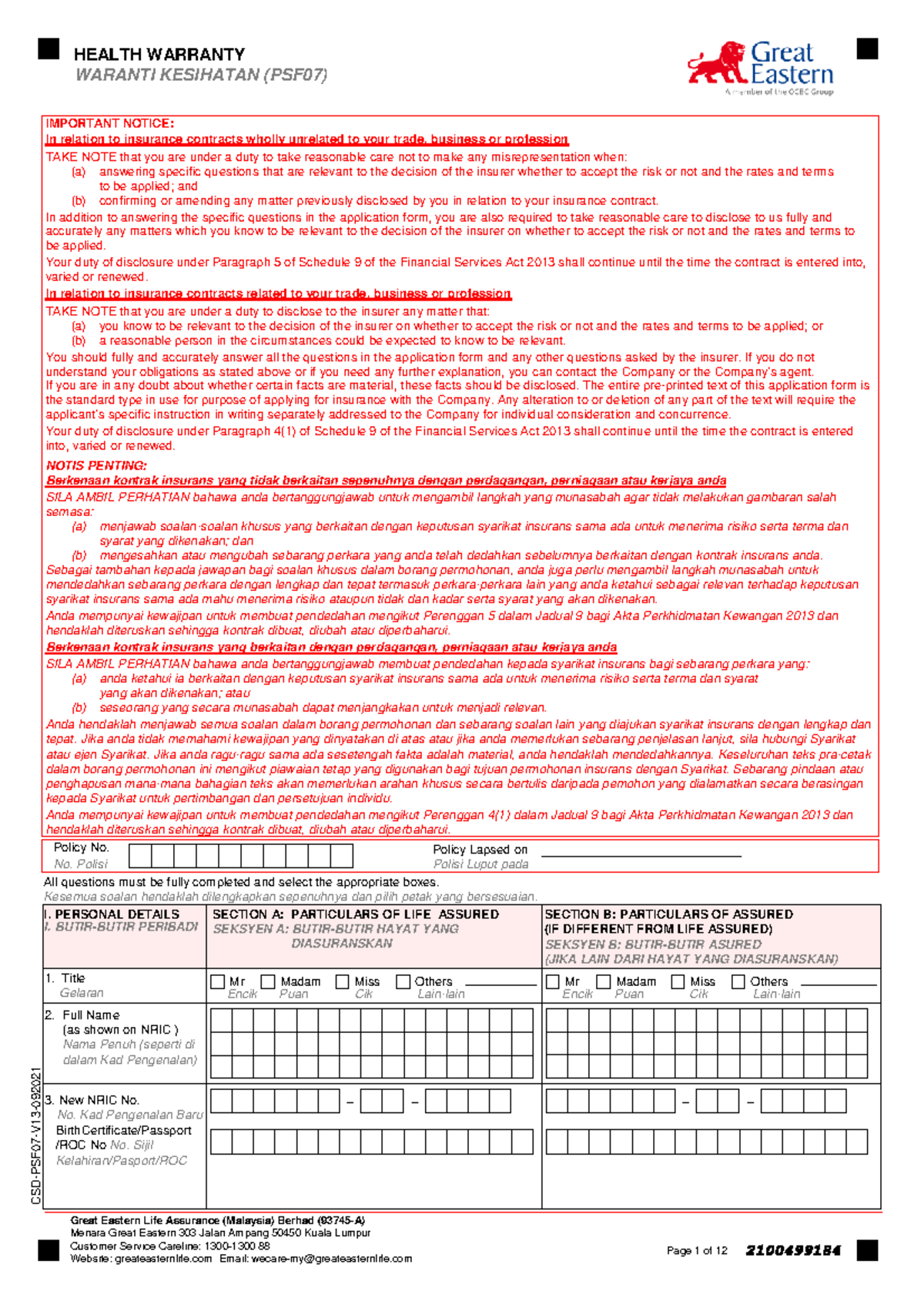
- Review the Declaration of Truth: Always read the final "Declaration" or "Statement of Fact" page before signing. This is where most warranties are legally "anchored."
- Disclose, Don't Guess: If you are unsure about a medical date or a specific diagnosis, state that you are unsure or provide a range. This prevents the statement from being treated as a definitive (and potentially false) warranty.
- Update the Insurer: If your health status or lifestyle changes significantly during the application process but before the policy is issued, you have a continuing duty to disclose those changes.
- Keep Records: Maintain copies of the medical records you used to fill out the application to prove that your statements were made in good faith and based on available data.
Frequently Asked Questions
Can an insurer cancel my life insurance policy if I accidentally breached a warranty?
In 2026, most jurisdictions do not allow an insurer to cancel a policy for a purely accidental, non-material breach of warranty. They may instead adjust the death benefit or the premium to what it would have been had the truth been known. However, if the breach involves a material fact (like a major heart condition), the policy may be voidable.
Does a "warranty" mean the same thing in insurance as it does for a car?
No. A car warranty is a promise by the manufacturer to repair the vehicle. An insurance warranty is a promise by you to the insurance company that the information you provided is 100% accurate.
What is the "Incontestability Clause" and how does it affect warranties?
Most life insurance policies include an Incontestability Clause (typically lasting two years). After this period, the insurer generally cannot void the policy for misstatements or breaches of warranty unless they can prove the insured committed deliberate fraud.
If I start smoking after I get my life insurance, have I breached a warranty?
This depends on the policy wording. Most life insurance policies are "locked in" at the time of issuance regarding smoking status (an affirmative warranty). However, some health insurance policies may include a promissory warranty requiring you to update them on lifestyle changes that affect risk.
Can an insurance company use "Basis of Contract" clauses today?
In most consumer-facing insurance markets in 2026, "Basis of Contract" clauses are legally prohibited. Regulations now require insurers to distinguish between representations and warranties clearly, ensuring consumers are not penalized for minor, irrelevant errors.
Final Recommendation
When navigating the complexities of health and life insurance, the safest path is to assume that every statement you make regarding your health, history, and lifestyle is a warranty. Even as 2026 regulations provide a safety net against "gotcha" tactics by insurers, the integrity of the contract still rests on the accuracy of your disclosures. If you are dealing with a high-value policy or complex medical history, consider having an insurance broker or legal professional review your application to ensure all warranted facts are precisely documented.
Image Gallery