Understanding Fundamental Scientific Principles and Their Applications
Scientific principles are the bedrock of our understanding of the universe, serving as consistent, evidence-based descriptions of how natural phenomena behave. These principles, ranging from the laws of thermodynamics to the theory of...
Scientific principles are the bedrock of our understanding of the universe, serving as consistent, evidence-based descriptions of how natural phenomena behave. These principles, ranging from the laws of thermodynamics to the theory of evolution, provide a predictive framework that allows scientists and engineers to model systems, solve complex problems, and advance technological innovation.
Contents
At their core, scientific principles are observations that have been tested and verified across a wide range of conditions. Unlike hypotheses, which are tentative explanations for an observation, principles—often formalized as laws or theories—represent the consensus of the scientific community based on repeated experimentation. When you observe a specific physical outcome, such as an object falling or energy transferring from one state to another, you are witnessing the application of these foundational rules. By mastering these concepts, you can better navigate the modern technological world, assess the credibility of new research, and understand the limits of physical systems.
The Nature of Scientific Laws vs. Theories
A common point of confusion in public discourse is the distinction between a scientific law and a scientific theory. These terms have specific technical definitions that are distinct from how they are used in everyday conversation.
Scientific Laws
A scientific law is a concise, often mathematical description of an observed phenomenon. Laws do not explain why something happens; rather, they describe what happens with high precision. For example, Newton’s Law of Universal Gravitation describes the force between two masses, but it does not describe the mechanism of gravity itself. Laws are generally limited to a specific set of conditions and are universally accepted within those parameters.
Scientific Theories
A scientific theory is an overarching explanation that integrates laws, hypotheses, and verified facts to explain a wide range of natural phenomena. A theory is not a "guess"; it is the highest form of scientific knowledge. For instance, the Theory of General Relativity explains the mechanism of gravity by describing the curvature of spacetime, incorporating both the mathematical predictions of laws and a conceptual model of how the universe functions.
Key Principles of Physics and Energy
The physical world operates under strict constraints that govern how matter and energy interact. Understanding these is essential for anyone interested in fields ranging from engineering to environmental science.
The Laws of Thermodynamics
The laws of thermodynamics are perhaps the most rigid constraints in the physical universe.
- The First Law (Conservation of Energy): Energy cannot be created or destroyed, only transferred or converted from one form to another. This means that in any closed system, the total energy remains constant.
- The Second Law (Entropy): In any energy transfer, the total entropy (disorder) of a system will increase over time. This principle dictates that no energy conversion process is 100% efficient; some energy is always lost as heat.
- The Third Law: As the temperature of a system approaches absolute zero, the entropy of a perfect crystal approaches zero. This provides a fundamental limit on how cold a system can become.
Conservation of Momentum
This principle states that the total momentum of a closed system remains constant if no external forces act upon it. In practical terms, this allows engineers to predict the outcomes of collisions, whether in automotive safety testing or in the design of high-energy particle accelerators.
Scientific Principles in Biological Systems
Biological systems are not exempt from physical laws; instead, they represent complex applications of those laws under evolutionary pressure.
- Evolution by Natural Selection: Proposed by Charles Darwin, this principle states that individuals with traits better suited to their environment are more likely to survive and reproduce. This is the mechanism that explains the diversity of life on Earth.
- The Cell Theory: This states that all living organisms are composed of one or more cells, that the cell is the basic unit of structure and organization in organisms, and that all cells arise from pre-existing cells.
- Homeostasis: Living systems possess the inherent drive to maintain a stable internal environment despite external fluctuations. This involves complex feedback loops—a classic principle in both biology and control systems engineering.
Comparing Scientific Frameworks
The following table categorizes several foundational principles, highlighting their primary domain and the scope of their application.
| Principle | Primary Domain | Nature | Practical Application |
|---|---|---|---|
| Conservation of Energy | Physics | Law | Power plant efficiency |
| Natural Selection | Biology | Theory | Medicine and antibiotic resistance |
| Gravity (General Relativity) | Physics | Theory | GPS satellite calibration |
| Cell Theory | Biology | Law/Concept | Medical diagnostics and research |
| Entropy | Thermodynamics | Law | Energy consumption modeling |
Methodology: How Principles Are Verified
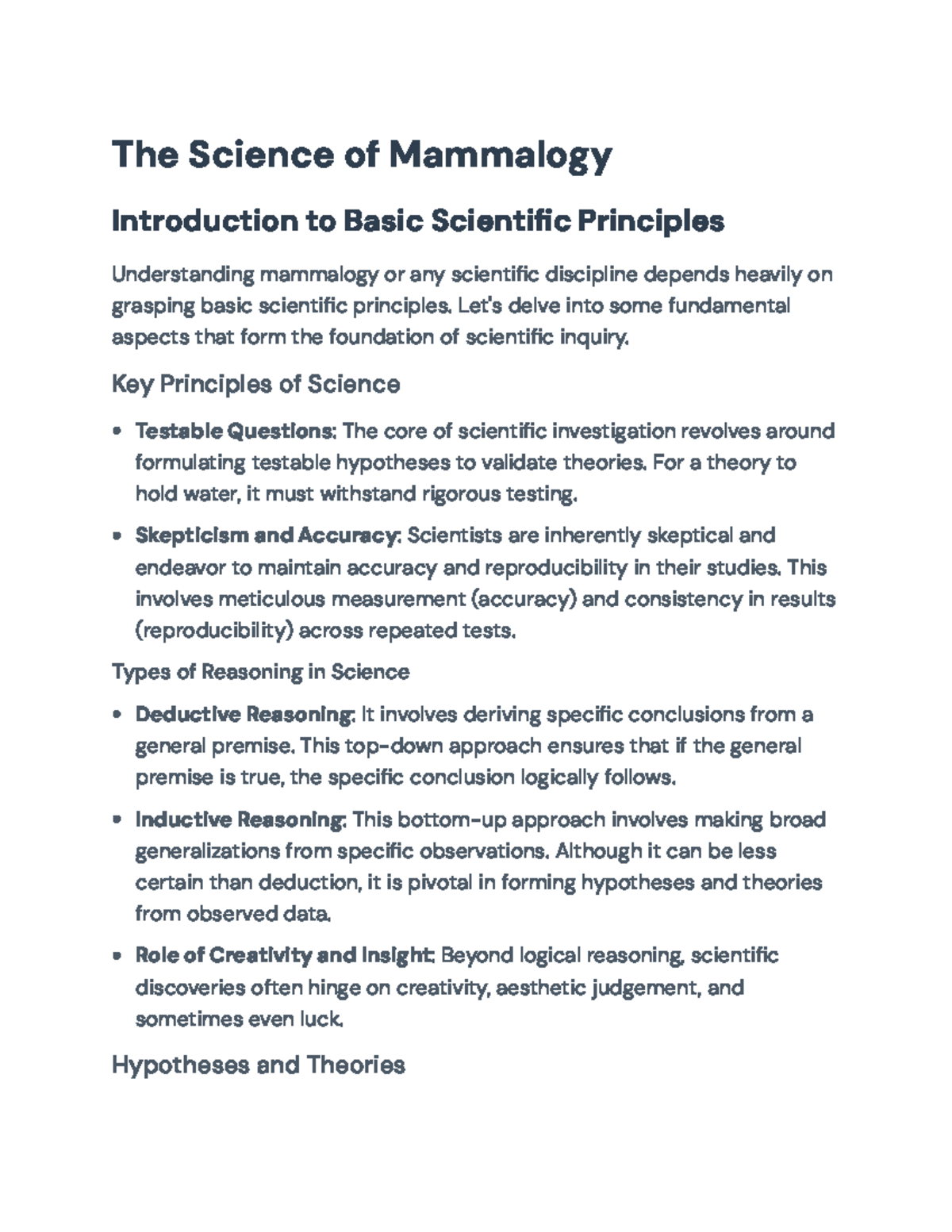
Scientific principles are not established by decree; they are refined through the scientific method. This iterative process ensures that as new evidence emerges, our understanding of the universe becomes more accurate.
- Observation: Identifying a phenomenon that warrants explanation.
- Hypothesis Formulation: Creating a testable statement that explains the observation.
- Experimentation: Designing a controlled experiment to test the hypothesis.
- Data Analysis: Evaluating whether the evidence supports the hypothesis or contradicts it.
- Peer Review: Submitting findings to the scientific community to check for biases, errors, or faulty logic.
- Replication: Independent teams must be able to achieve the same results to validate the principle.
Common Misconceptions and Limitations
It is important to recognize that even well-established scientific principles can have limitations.
- Newtonian vs. Quantum Mechanics: Newton’s laws of motion are highly accurate for macroscopic objects at standard speeds. However, they fail to explain the behavior of subatomic particles, where quantum mechanics is required.
- The Problem of Induction: Science relies on the belief that the future will resemble the past. While this has served us well, it remains a philosophical limitation of the scientific method that we cannot prove the future will always behave according to past observations.
- Scale Dependence: Some principles only apply to specific scales. For example, fluid dynamics behave differently at a micro-scale than they do in large-scale oceanography.
Frequently Asked Questions
Can scientific principles change over time?
Yes, but they rarely disappear. Instead, they are usually "refined." Einstein’s theory of relativity did not prove Newton wrong; it showed that Newton’s laws were a special case that worked perfectly for most human-scale speeds but required adjustment for velocities approaching the speed of light.
Why is gravity called a theory and a law?
Gravity is described by the Law of Universal Gravitation (which provides the math for how strong the pull is) and by the Theory of General Relativity (which explains the nature of spacetime curvature). They serve different purposes within the same subject.
How do I know if a scientific claim is legitimate?
Legitimate scientific claims are published in peer-reviewed journals, are backed by transparent data, and are generally supported by a broad consensus of experts in that specific field. Avoid claims that rely on anecdotal evidence or that claim to "overturn" fundamental laws without rigorous, replicable data.
Is the scientific method the only way to gain knowledge?
The scientific method is the gold standard for understanding the physical universe because it is objective and repeatable. However, it is not designed to address subjective questions such as ethics, art, or personal meaning, which fall outside the scope of scientific inquiry.
Next Steps for Further Learning
To deepen your understanding of these principles, start by identifying the specific domain of interest—such as energy, mechanics, or biology—and seek out authoritative textbooks or university-level open-courseware. For those looking to verify current scientific consensus on specific topics, refer to the documentation provided by national institutions like the National Academy of Sciences or peer-reviewed journals such as Nature or Science. By engaging with the primary literature, you can move beyond introductory summaries and grasp the nuance of how these principles are currently applied in 2026.
Image Gallery