How to Start an LLC in Idaho: A Complete Step-by-Step Guide
To start a Limited Liability Company (LLC) in Idaho, you must select a distinguishable business name, appoint an Idaho registered agent, and submit a Certificate of Organization to the Idaho Secretary of State through the online SosBiz...
To start a Limited Liability Company (LLC) in Idaho, you must select a distinguishable business name, appoint an Idaho registered agent, and submit a Certificate of Organization to the Idaho Secretary of State through the online SosBiz portal. The state filing fee is $100 online. Afterwards, you should secure an Employer Identification Number (EIN) from the IRS, create an internal Operating Agreement, and comply with state and local tax obligations.
Contents
Overview & Costs of Forming an LLC in Idaho
Forming an LLC in Idaho provides personal asset protection, flexible tax structures, and operational simplicity for business owners. The Idaho Secretary of State oversees entity registrations through its online management system, SosBiz.
While registering an LLC is relatively straightforward, business owners must fulfill statutory obligations under the Idaho Uniform Limited Liability Company Act (Idaho Code Title 30, Chapter 25). Understanding upfront formation fees, recurring compliance costs, and state filing deadlines ensures your business maintains its legal standing and asset protection privileges.
| Action Item | Required Form / Portal | Fee | Frequency |
|---|---|---|---|
| LLC Name Reservation (Optional) | Application for Reservation of Legal Name | $20 (Online) / $40 (Paper) | One-time (4 months) |
| Certificate of Organization | Form L-1 (SosBiz Online) | $100 (Online) / $120 (Paper) | One-time |
| Registered Agent | Registered Agent Designation | $0 (Self) or $100–$300/yr (Service) | Annual recurring |
| Employer Identification Number (EIN) | IRS Online Application | $0 | One-time |
| Idaho Business Tax Registration | Idaho State Tax Commission (TAP) | $0 | One-time |
| Idaho Annual Report | SosBiz Online Filing | $0 | Annual (Due by end of formation month) |
Disclaimer: This guide is provided for informational purposes only and does not constitute formal legal, accounting, or tax advice. For specific legal guidance regarding corporate structures or complex tax scenarios, consult an attorney licensed in Idaho or a Certified Public Accountant.
Step 1: Choose a Name for Your Idaho LLC
Selecting an compliant name is the first formal requirement when establishing an LLC in Idaho. The statutory naming rules set forth by the Idaho Secretary of State must be strictly followed to avoid application rejection.
Idaho Name Requirements
Under Idaho Code § 30-21-301, your business name must meet specific structural criteria:
- LLC Designator: The name must contain a recognized entity designator, such as "Limited Liability Company," "Limited Company," or abbreviations like "LLC," "L.L.C.," "LC," or "L.C." The word "Limited" may be abbreviated as "Ltd.," and "Company" may be abbreviated as "Co."
- Distinguishability: The name must be distinguishable from all existing active business entities registered with the Idaho Secretary of State, including reserved names, corporations, limited partnerships, and registered trade names.
- Restricted Words: Words that imply a professional or financial license—such as "Bank," "Trust," "Engineer," "Attorney," or "University"—require additional documentation, professional licensing proof, or explicit approval from governing regulatory boards.
- Prohibited Terms: The name cannot include words that imply association with federal, state, or local government agencies (e.g., "FBI," "Treasury," "Idaho Dept of Commerce").
How to Check Name Availability
Before filing registration documents, search the [Idaho Secretary of State SosBiz Business Search](https://sosbiz.idaho.gov/ Search Engine) database. Enter your proposed business name to determine whether identical or confusingly similar entities exist.
When searching, account for designator variations, punctuation, and slight spelling differences. If another entity operates under a name too close to yours in sound or visual appearance, the filing office will reject your filing to prevent public confusion.
Optional Name Reservation and Trade Names (DBAs)
- Name Reservation: If your ideal business name is available but you are not yet ready to file your Certificate of Organization, you can reserve the name for four months by submitting an Application for Reservation of Legal Name online for $20 ($40 if submitted by paper).
- Assumed Business Name (DBA): If your LLC plans to conduct business under a name other than its official legal entity name, you must file a Certificate of Assumed Business Name with the Idaho Secretary of State. The filing fee is $25 online.
Step 2: Appoint an Idaho Registered Agent
Idaho law requires every registered business entity to maintain a registered agent with a continuous physical presence in the state.
Duties of an Idaho Registered Agent
The primary legal role of a registered agent is to accept service of process, legal summonses, official government communications, and state tax notices on behalf of your LLC. The agent is statutorily obligated to forward these legal records promptly to the LLC’s management team.
Registered Agent Eligibility Rules
Pursuant to Idaho law, your registered agent must meet the following criteria:
- Commercial or Non-Commercial Identification: The agent can be an individual resident of Idaho or a commercial registered agent service authorized to transact business in Idaho.
- Physical Street Address: The registered agent must maintain a physical street address in Idaho (known as the Registered Office). P.O. Boxes, commercial mail receiving agencies, or virtual addresses that lack physical staffing are not permitted.
- Availability: The agent must be available at the registered physical address during regular business hours to receive hand-delivered legal notices.
Who Should Serve as Registered Agent?
- Acting as Your Own Agent: As an LLC founder, manager, or member, you can serve as your own registered agent if you reside in Idaho and maintain regular office hours at an Idaho physical address. While this eliminates service provider fees, it makes your physical address part of the public record and requires your availability at that location during business hours.
- Hiring a Commercial Registered Agent: Utilizing a commercial registered agent service costs between $100 and $300 annually. This approach protects your personal privacy by keeping your personal street address off public state databases, prevents legal notices from being served in front of clients or employees, and ensures compliance if you work remotely or travel frequently.
Step 3: File the Idaho Certificate of Organization
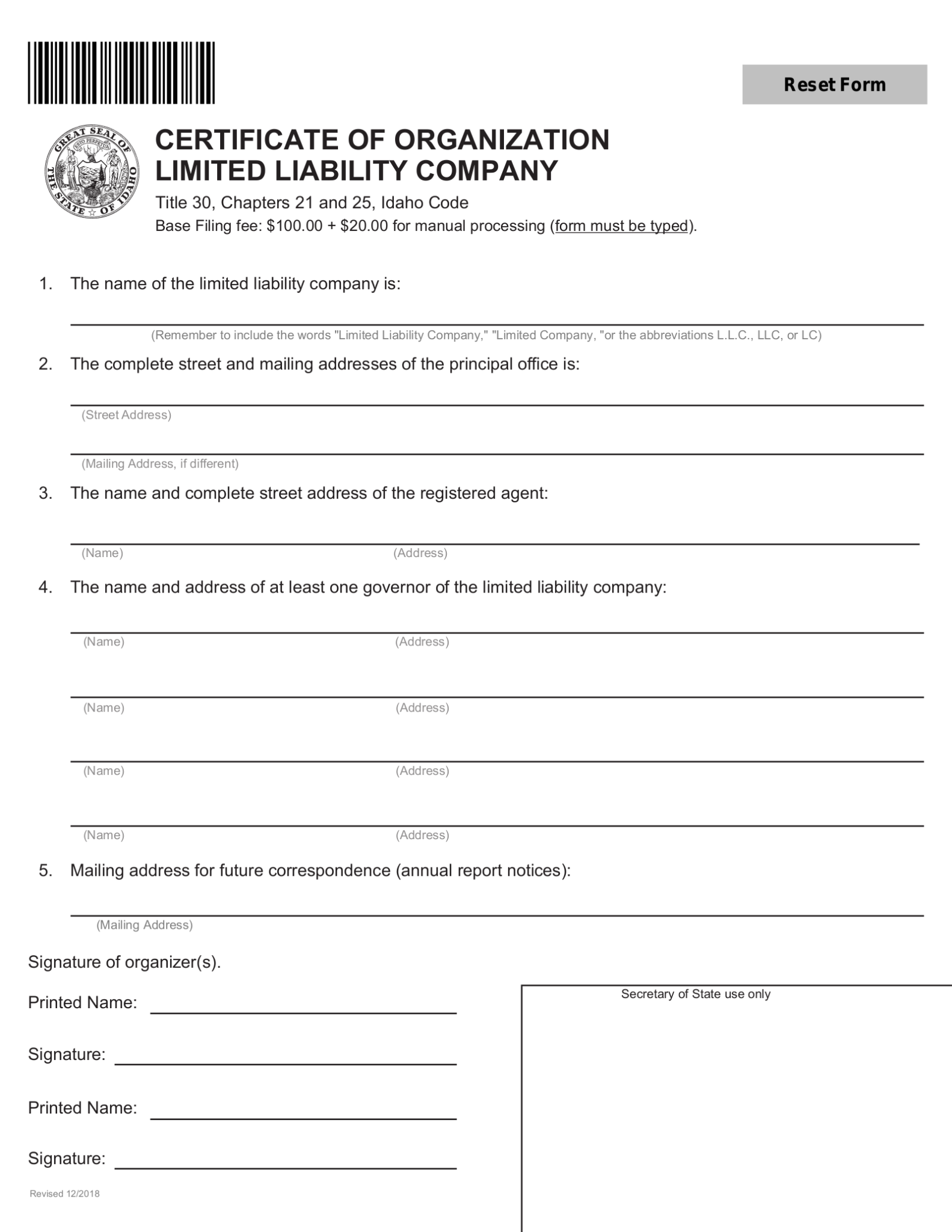
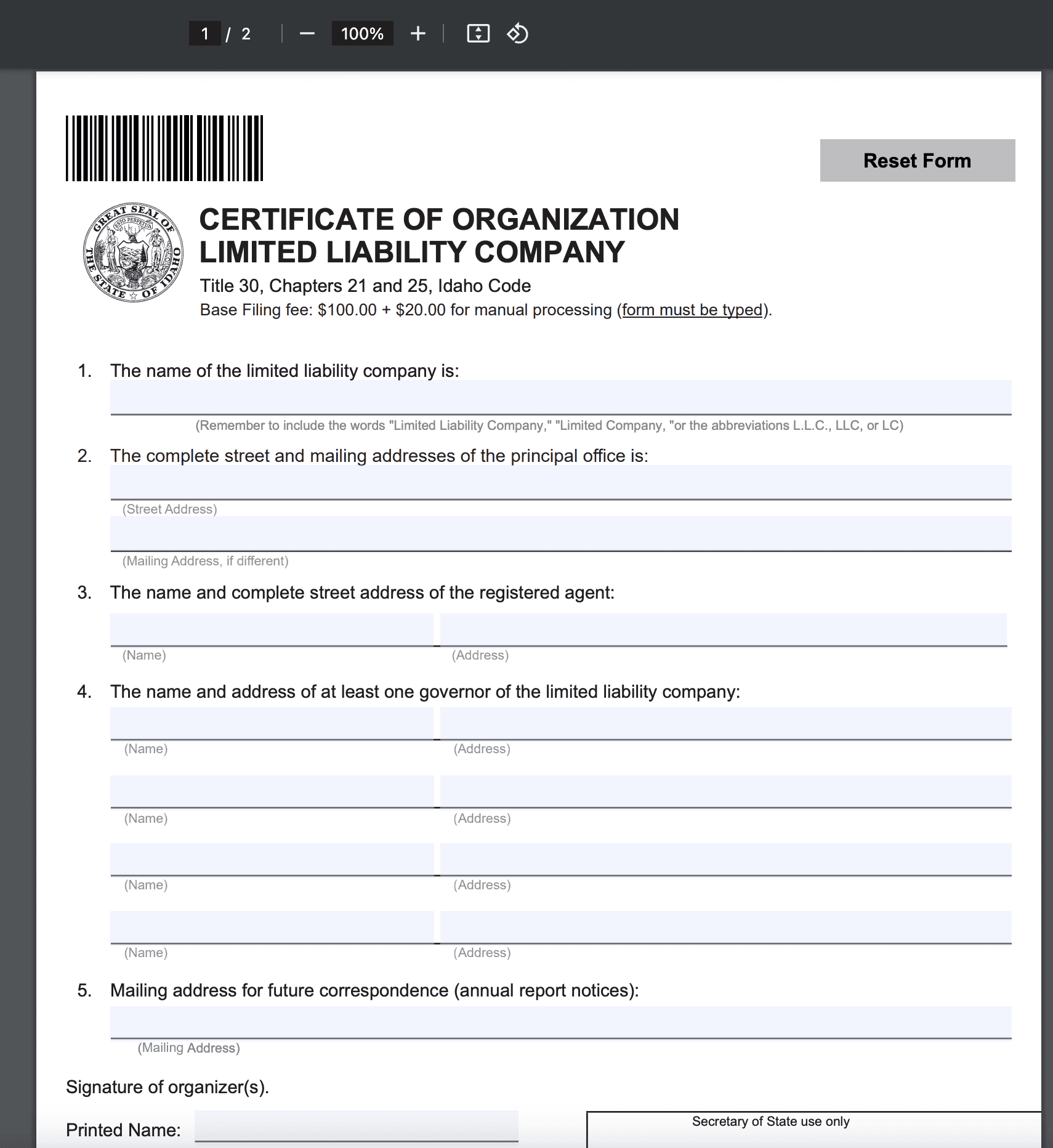
The Certificate of Organization (Form L-1) is the legal document that officially creates your LLC in Idaho upon approval by the Idaho Secretary of State.
- Draft Certificate of Org (L-1)
- LLC Legal Name
- Registered Agent Details
- Principal Office Address
- Governor/Member Information
- Submit Online via SosBiz Portal
- Pay $100 State Filing Fee
- Idaho SOS Reviews & Approves
- Official Entity Created
Required Information on Form L-1
When completing the Certificate of Organization via the Idaho SosBiz portal, prepare the following information:
- LLC Name: The exact legal name including the required designator.
- Principal Office Address: The street address where the LLC’s primary records are maintained (can be inside or outside Idaho).
- Mailing Address: The primary address where official correspondence should be sent.
- Registered Agent Details: The full name and physical Idaho street address of the non-commercial or commercial registered agent.
- Governors / Managers / Members: The names and mailing addresses of at least one governor (a member or manager responsible for directing the LLC).
- Organizer Details: The name and signature of the person submitting the formation document (does not have to be an owner or member).
Filing Fees and Processing Times
- Online Filing (Recommended): Submitted through the SosBiz platform. The filing fee is $100. Processing is typically automated and completed within 1 to 3 business days.
- Paper Filing: Submitted by mail or hand delivery. The base filing fee increases to $120 (due to a $20 manual processing charge). Processing can take up to 2 to 3 weeks.
- Expedited Service: Expedited processing is available for paper filings for an additional $40 fee, reducing processing times to 24 hours. Online filings do not require separate expedited fees because they are processed electronically.
Step 4: Draft an Idaho LLC Operating Agreement
An Operating Agreement is an internal legal agreement that governs the financial, managerial, and operational rights and duties of an LLC's owners (members).
Although Idaho law does not require you to file an Operating Agreement with the Secretary of State, drafting one is a critical governance step for both single-member and multi-member LLCs.
Why an Operating Agreement is Essential
- Preserves Limited Liability Protection: An Operating Agreement establishes that the LLC is a legally separate corporate entity distinct from its individual owners. This separation helps preserve the corporate veil, protecting personal assets from business liabilities and legal judgments.
- Overrides Default State Laws: Without an Operating Agreement, your LLC operates under default statutory rules set by the Idaho Uniform Limited Liability Company Act. These statutory defaults may not match your operational preferences, profit distribution goals, or management arrangements.
- Clarifies Ownership Structure: For multi-member entities, the agreement details initial capital contributions, ownership percentages, profit and loss allocations, voting thresholds, and procedures for adding or removing members.
- Satisfies External Requirements: Financial institutions, commercial lenders, title companies, and real estate buyers often require a copy of your Operating Agreement to verify signing authority before opening bank accounts or executing major agreements.
Key Clauses to Include
- Capital Contributions: Documentation of initial cash investments, property contributions, or services provided by each member.
- Distribution and Allocation: Rules governing when and how business profits and losses are distributed to owners.
- Management Structure: Specification of whether the company is Member-Managed (owners directly manage daily business) or Manager-Managed (owners appoint designated managers to run operations).
- Voting Rights and Decisions: Clear definition of voting percentages needed for routine business operations versus major corporate events (e.g., selling assets, taking on debt, dissolving the business).
- Buyout and Transfer Provisions: Guidelines handling what happens if a member dies, retires, becomes incapacitated, or seeks to transfer their ownership interest to a third party.
Step 5: Obtain an EIN & Register for Idaho State Taxes
Once the state approves your Certificate of Organization, you must register your business with tax authorities at both federal and state levels.
Apply for an IRS Employer Identification Number (EIN)
An EIN, or Federal Tax Identification Number, acts as the business equivalent of a Social Security Number. It is required to open commercial bank accounts, hire employees, build business credit, and file federal tax returns.
You can apply for an EIN directly through the official IRS Online EIN Portal. The application process is free, and the number is issued immediately upon completing the online application. Single-member LLCs without employees can technically use a founder's Social Security Number for certain federal reporting, but obtaining a separate EIN is best practice to reduce identity theft risks and maintain privacy.
- Obtain EIN from IRS (IRS.gov Portal)
- Register with Idaho State Tax Commission via TAP Portal
- Sales & Use Tax Perm. (If selling goods)
- State Income / Tax Withholding Account
Register with the Idaho State Tax Commission
Idaho LLCs that make retail sales of tangible personal property, hire workers, or engage in regulated trades must register with the Idaho State Tax Commission.
- Taxpayer Access Point (TAP): Business owners should create an account on TAP, Idaho’s online business tax management platform.
- Idaho Sales and Use Tax: Idaho imposes a statewide sales tax rate of 6% on retail transactions involving tangible goods and certain services. If your business sells goods in Idaho, you must apply for a Sales Tax Permit via TAP.
- State Income and Withholding Tax: LLCs with paid employees must establish an Idaho state income tax withholding account and register for state unemployment insurance through the Idaho Department of Labor.
- Pass-Through Entity Taxation: By default, single-member LLCs are treated as disregarded entities for tax purposes, while multi-member LLCs are treated as partnerships. Idaho honors standard federal pass-through taxation rules. Additionally, Idaho offers an optional Pass-Through Entity (PTE) Tax, allowing eligible pass-through businesses to pay state income tax at the entity level, which may offer federal tax benefits for owners claiming state tax deductions.
Step 6: Maintain Your LLC: Annual Reports and Compliance
Forming your LLC creates your entity, but maintaining continuous legal status requires adhering to annual filings and local permitting rules.
Filing the Idaho Annual Report
Every LLC registered in Idaho must file an Annual Report with the Idaho Secretary of State.
- Due Date: The report must be submitted by the last day of the anniversary month of your LLC's initial formation. For instance, if your LLC was officially approved on March 15, your annual report is due by March 31 every subsequent year.
- Filing Fee: Idaho charges $0 for filing the Annual Report online via the SosBiz portal.
- Penalties: Failing to submit your annual report on time leads to administrative dissolution. If administratively dissolved, your LLC loses its legal liability protections and must file for reinstatement, paying administrative restoration fees.
Local Licensing and Permits
Idaho does not mandate a single blanket statewide business license. However, local county and municipal governments frequently enforce local licensing requirements based on your operational address:
- City Licenses: Municipalities such as Boise, Meridian, Nampa, and Idaho Falls require local general business permits, safety inspections, or home occupation permits if operating from a residential property.
- Specialized Professional Licensing: Businesses involved in construction, cosmetology, healthcare, legal services, plumbing, or electrical trades must maintain professional licensure through the Idaho Division of Occupational and Professional Licenses (DOPL).
Opening a Dedicated Business Bank Account
To preserve corporate liability protections, never commingle personal and business funds. Open a dedicated commercial checking account for your LLC immediately after receiving your approved Certificate of Organization and EIN.
Bring the following documents to your financial institution:
- Approved Idaho Certificate of Organization (Form L-1).
- Federal EIN Confirmation Letter (CP 575 or 147C).
- Executed LLC Operating Agreement.
- Government-issued identification for all participating account signers.
Frequently Asked Questions
How long does it take to get an LLC approved in Idaho?
Online filings submitted via the Idaho SosBiz portal are usually processed within 1 to 3 business days. If you submit paper forms by mail, processing takes 2 to 3 weeks unless you pay an additional $40 fee for 24-hour expedited service.
How much does an LLC cost in Idaho?
The mandatory state filing fee to submit a Certificate of Organization online is $100 ($120 for paper applications). Idaho does not charge a fee for mandatory annual reports. Optional expenses include commercial registered agent services ($100–$300/year) and name reservations ($20 online).
Can I act as my own registered agent in Idaho?
Yes. Any individual resident of Idaho who is at least 18 years old and maintains a physical street address in the state can serve as the LLC's registered agent. However, your address will be published in public records, and you must remain physically available at that location during business hours to accept legal notices.
Does Idaho require an LLC Operating Agreement?
Idaho law does not mandate filing an Operating Agreement with the Secretary of State. However, creating one internally is strongly advised. It formalizes ownership percentages, establishes management rules, overrides default state statutes, and protects your personal asset protection standing.
What happens if I fail to file my Idaho Annual Report?
If you miss the deadline—which falls on the last day of your LLC's formation anniversary month—the Idaho Secretary of State will mark your LLC delinquent. Continued non-compliance will lead to administrative dissolution, stripping the company of its active business status and liability protection.
How are LLCs taxed in Idaho?
By default, Idaho LLCs benefit from pass-through taxation. Business profits and losses pass directly to members' personal tax returns, subject to federal self-employment taxes and Idaho personal income taxes. LLCs can also elect to be taxed as S-Corporations or C-Corporations if doing so fits their financial strategy.
Next Steps for Your Idaho Business
Once you have completed state registration and tax onboarding, ensure your business maintains strong financial and legal compliance practices:
- Log In to SosBiz: Set up calendar reminders 30 days ahead of your annual report due date (the end of your formation anniversary month).
- Open Your Business Checking Account: Keep personal and commercial finances fully separate to maintain legal liability protection.
- Register on Taxpayer Access Point (TAP): Set up your state tax portal account for smooth sales tax, withholding, and corporate filing compliance.
- Obtain Local Permits: Check with your municipal city clerk and county administration offices to secure local business permits before launching public operations.
Image Gallery