Understanding the IICRC Mold Remediation Technician Supervisor Certification
As of 2026, the IICRC does not offer a single course titled "Mold Remediation Technician Supervisor." Instead, supervisory competency is achieved by completing the Applied Microbial Remediation Technician (AMRT) certification, which re...
As of 2026, the IICRC does not offer a single course titled "Mold Remediation Technician Supervisor." Instead, supervisory competency is achieved by completing the Applied Microbial Remediation Technician (AMRT) certification, which requires the Water Damage Restoration Technician (WRT) as a prerequisite. Professionals seeking the highest level of supervisory recognition typically pursue the Master Water Restorer (MWR) designation.
Contents
The restoration industry relies heavily on the Institute of Inspection, Cleaning and Restoration Certification (IICRC) to set the "Standard of Care." For mold remediation, this standard is encapsulated in the IICRC S520, a procedural document that defines how professional mold remediation should be performed. While many technicians hold basic certifications, the transition to a supervisory or specialist role requires a deep understanding of microbiology, containment physics, and legal liability.
The Foundation: Why WRT is the Mandatory Prerequisite
Before a professional can sit for the microbial remediation exam, they must first master water damage restoration. In the context of 2026 industry standards, the relationship between water and mold is inseparable. Mold cannot grow without a moisture source; therefore, a supervisor who cannot identify the root cause of a water intrusion cannot effectively oversee a permanent mold solution.
The Water Damage Restoration Technician (WRT) course provides the technical baseline. It covers the categories of water (ranging from "clean" to "grossly contaminated") and the classes of evaporation. A supervisor must understand these concepts to determine if a mold project is also a specialized water loss. For instance, if a mold colony is found in a crawlspace with standing Category 3 (black) water, the remediation protocols shift significantly. The WRT prerequisite ensures that every "supervisor-level" technician understands psychrometry—the science of drying—which is essential for preventing mold recurrence after the remediation is complete.
The Applied Microbial Remediation Technician (AMRT) Certification
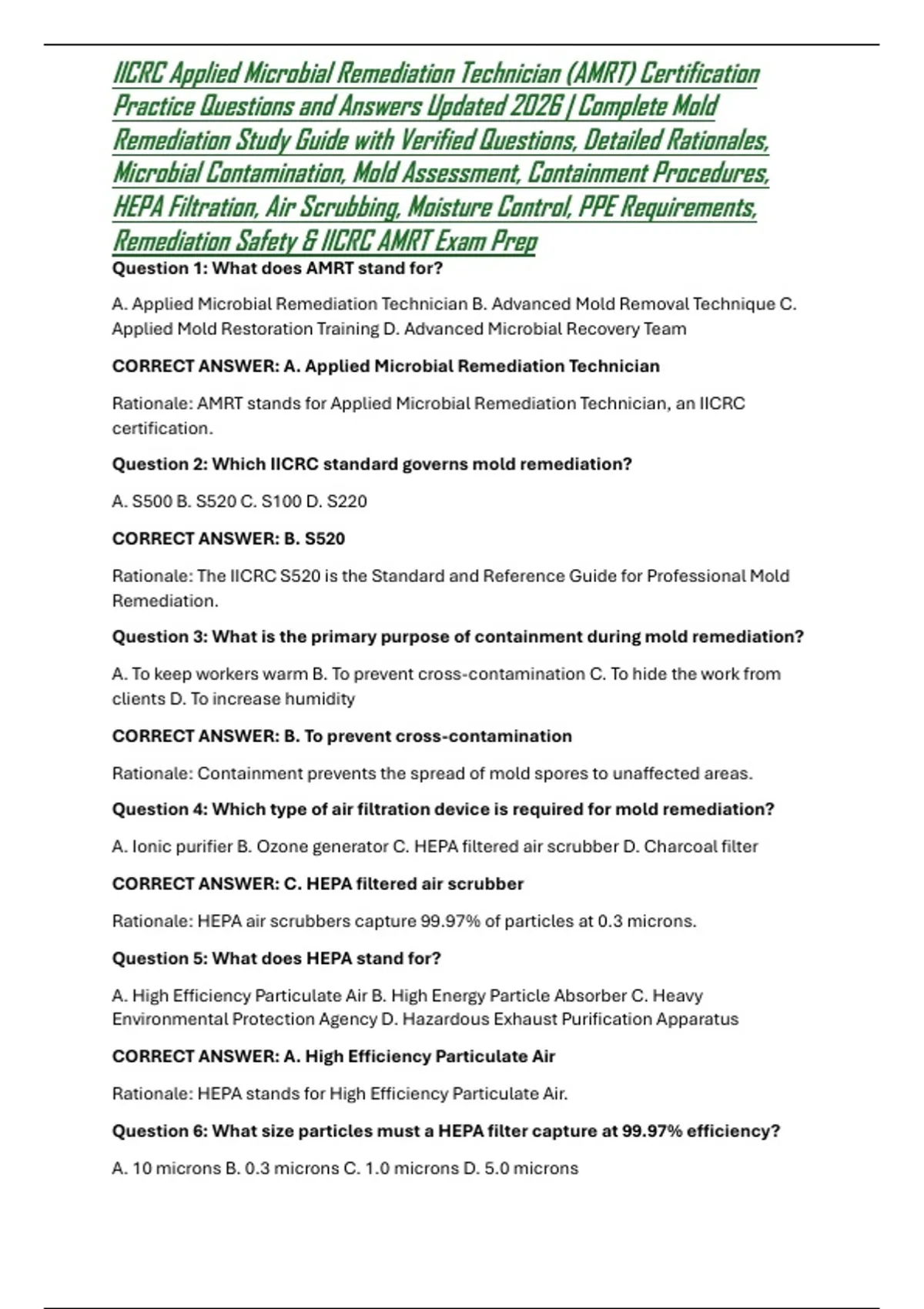
The AMRT is the industry-standard certification for those who perform and lead mold remediation projects. While the title includes "Technician," the curriculum is designed to produce individuals capable of managing a crew and ensuring compliance with the S520 Standard.
Advanced Containment and Pressure Differentials
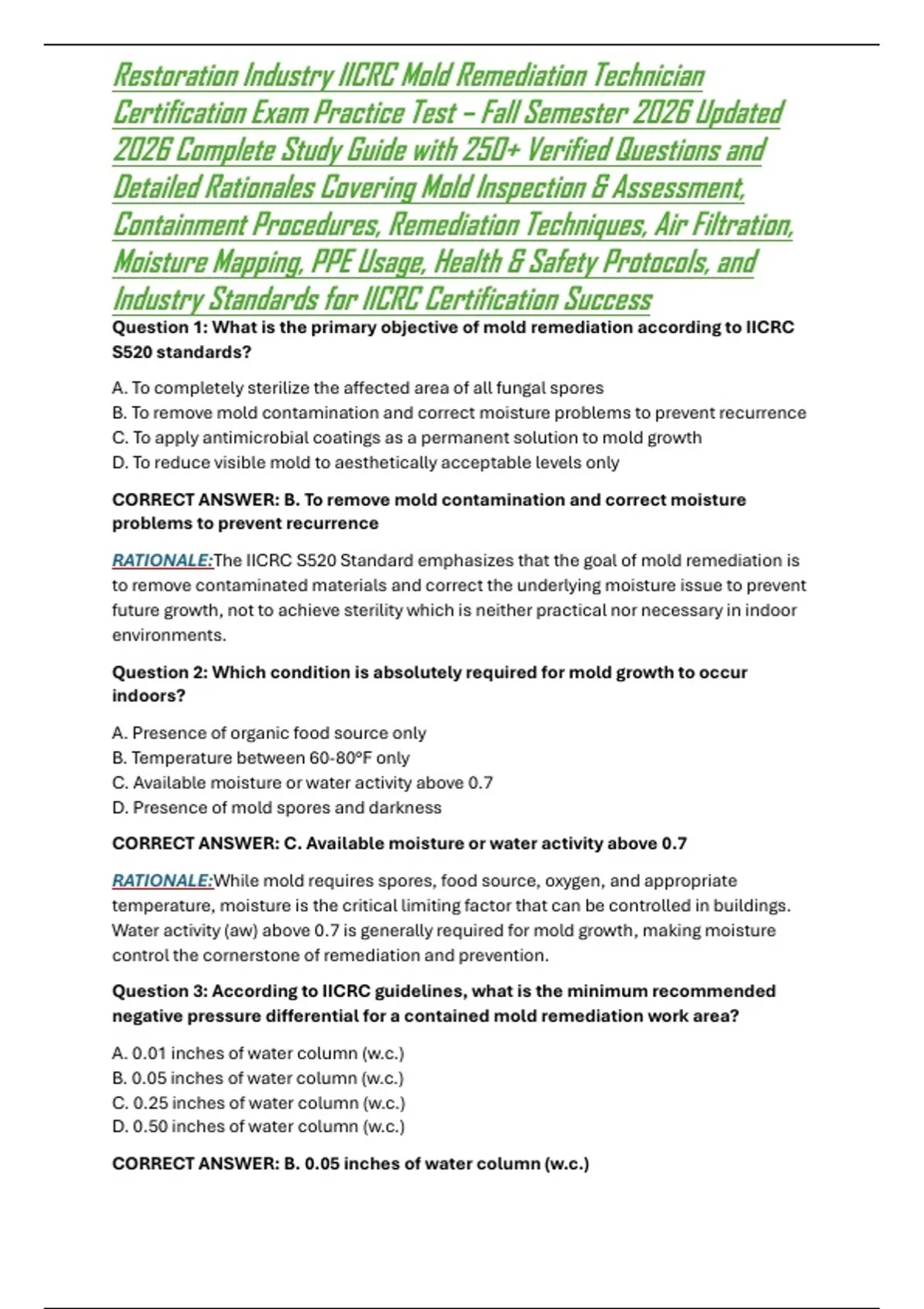
A primary responsibility of a supervisor is the design and maintenance of containment systems. In 2026, the use of High-Efficiency Particulate Air (HEPA) filtration is mandatory, but the supervisor must calculate the required Air Changes per Hour (ACH). The AMRT course teaches technicians how to create "negative pressure" environments to ensure that mold spores disturbed during cleaning do not migrate to unaffected areas of the building.
Supervisors must be able to use digital manometers to verify that a pressure differential of at least -0.02 inches of water column (in. WC) is maintained. This technical precision is what separates a certified supervisor from a general contractor. If containment fails, the supervisor is the individual responsible for the resulting cross-contamination and potential legal liability.
Microbiology and the Science of Fungi
To lead a team, one must understand the "enemy." The AMRT certification covers the life cycle of common indoor molds such as Stachybotrys chartarum, Aspergillus, and Penicillium. Understanding how these organisms reproduce via spores and how they utilize cellulose-based building materials as food is critical.
A supervisor uses this knowledge to determine the "Condition" of the environment. According to the S520, there are three conditions:
- Condition 1 (Normal Ecology): An indoor environment that may have settled spores but is otherwise healthy.
- Condition 2 (Settled Spores): An area with an accumulation of spores that resulted from a nearby mold source but does not have active growth.
- Condition 3 (Actual Growth): An area with active, visible, or hidden mold growth and associated spores.
The supervisor's role is to move a building from Condition 3 or 2 back to Condition 1.
Path to Mastery: The Master Water Restorer (MWR) Designation
For those looking for the literal "Supervisor" equivalent in the IICRC hierarchy, the Master Water Restorer (MWR) is the pinnacle. This is not a single class but a designation earned after years of field experience and the completion of several certifications.
To become an MWR in 2026, a professional typically must hold:
- WRT (Water Damage Restoration Technician)
- AMRT (Applied Microbial Remediation Technician)
- ASD (Applied Structural Drying Technician)
- Health and Safety Technician (HST)
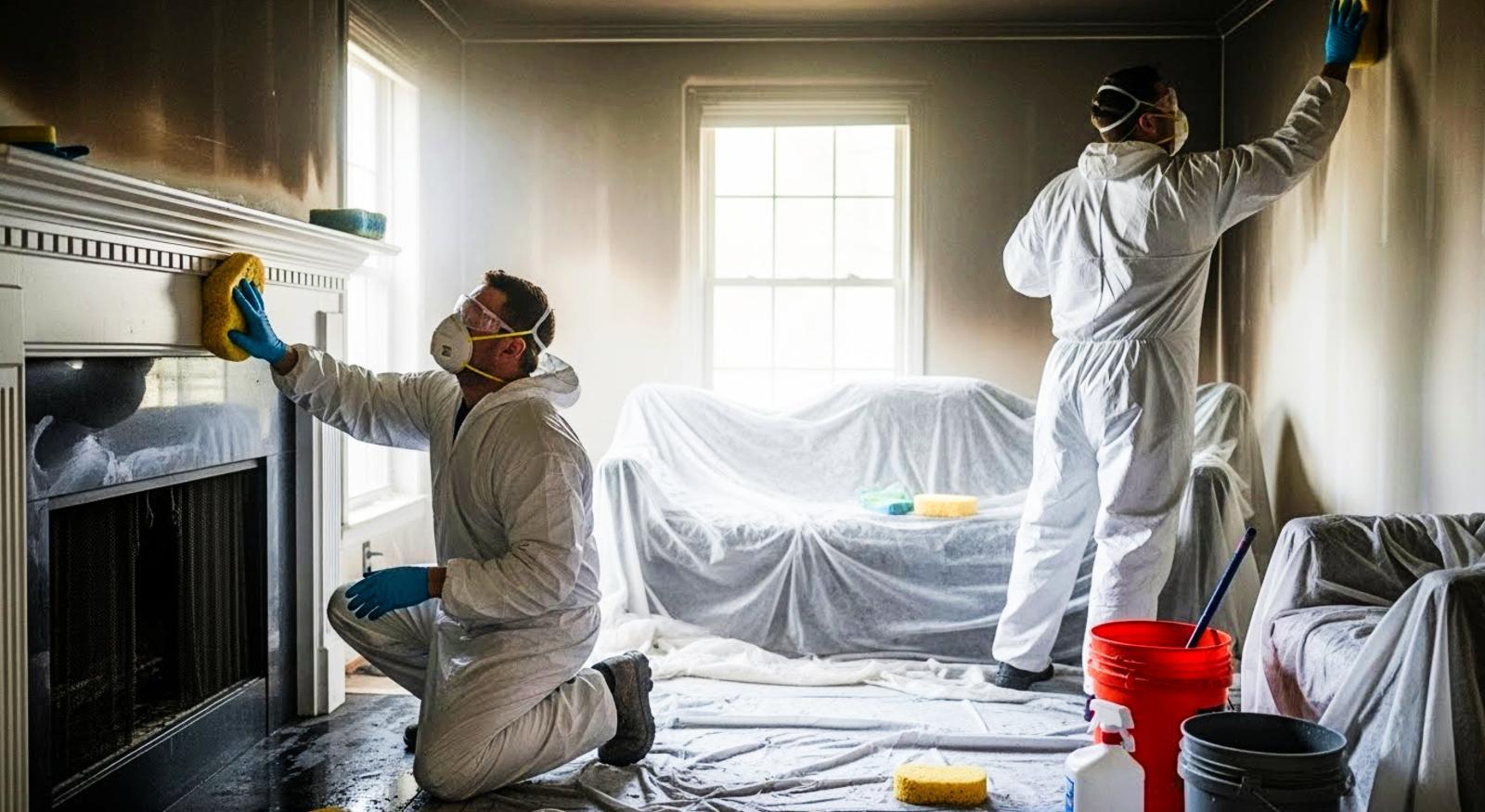
The inclusion of the Health and Safety Technician (HST) certification is vital for supervisors. It covers OSHA-mandated safety protocols, including respiratory protection programs, ladder safety, and bloodborne pathogens. A supervisor overseeing a mold project must ensure that every crew member is properly fit-tested for their respirator and that all Personal Protective Equipment (PPE)—such as Tyvek suits and nitrile gloves—is used and disposed of according to biohazard protocols.
The Role of the IICRC S520 Standard
The IICRC S520 is the "Standard for Professional Mold Remediation" and serves as the legal and technical backbone for any supervisor. While the AMRT certification provides the skills, the S520 provides the rules.
A supervisor’s primary task is to ensure the project remains "defensible." This means that if a property owner claims the mold was not properly removed, the supervisor can produce documentation showing that every step taken followed the S520. Key areas of the S520 that supervisors must master include:
- Mechanical Removal: The S520 emphasizes that mold must be physically removed, not just "killed" with biocides. Dead mold spores can still be allergenic or toxic. Supervisors must oversee techniques like HEPA vacuuming, wire brushing, or media blasting (using dry ice or baking soda).
- Post-Remediation Verification (PRV): A supervisor must know how to prepare a site for a third-party Indoor Environmental Professional (IEP). The supervisor performs a "pre-PRV" inspection to ensure the containment is dust-free and the moisture content of building materials is within acceptable limits before the official testing occurs.
Comparison of Mold-Related Certifications and Roles
The following table outlines the differences between various certifications that contribute to a supervisory skill set in the mold remediation industry as of 2026.
| Certification/Designation | Prerequisite | Primary Focus | Industry Role |
|---|---|---|---|
| WRT | None | Moisture physics, extraction, and drying equipment. | Foundation for all water/mold work. |
| AMRT | WRT | Containment, microbial removal, and PPE. | Lead Technician / Project Supervisor. |
| ASD | WRT | Advanced structural drying in complex environments. | Specialist for large-scale losses. |
| HST | None | OSHA compliance and worker safety. | Safety Officer / Senior Supervisor. |
| MWR (Master) | Multiple | Cumulative expertise in water and mold. | Project Manager / Company Owner. |
Costs, Timelines, and Renewal Requirements in 2026
Achieving a supervisory-level status is a significant investment in both time and money. For a professional starting from scratch in 2026, the timeline to become fully "supervisory-ready" (holding WRT and AMRT) is approximately six to twelve months, depending on course availability and field experience.
- Course Costs: The WRT and AMRT courses generally cost between $600 and $1,200 each, depending on the training provider and whether the course is held in-person or via a live-streamed format.
- Exam Fees: As of 2026, the IICRC charges approximately $80 to $100 per exam. These exams are proctored and can be taken at testing centers or through online proctoring services.
- Continuing Education (CEU): To maintain certifications, IICRC professionals must earn 14 hours of continuing education credits every two years. This ensures that supervisors stay current with changes to the S520 standard and advancements in remediation technology.
The Importance of Third-Party Licensing
It is crucial to distinguish between IICRC certification and state licensing. In many jurisdictions, such as Florida, Texas, and New York, a "Mold Remediation Supervisor" or "Contractor" must hold a state-issued license. While these states often recognize the IICRC AMRT as a qualifying credential for the technical portion of the license, they may also require additional exams on state-specific laws and mold assessment.
Furthermore, a supervisor should understand the ethical boundary between remediation and assessment. The IICRC S520 strongly recommends that the company performing the remediation should not be the same company performing the post-remediation testing. This avoids a conflict of interest and protects the supervisor from claims of "grading their own homework."
Practical Implementation: The Supervisor's Checklist
A certified supervisor manages the project from initial site arrival to final clearance. Their workflow generally follows this sequence:
- Work Plan Development: Based on an IEP's initial assessment, the supervisor drafts a scope of work.
- Safety Briefing: Conducting "tailgate" meetings to discuss chemical hazards and PPE requirements.
- Containment Setup: Verifying the integrity of plastic barriers and the placement of Air Scrubbers.
- Controlled Demolition: Overseeing the removal of non-salvageable materials (like moldy drywall or insulation) while maintaining negative pressure.
- Source Cleaning: Directing the mechanical cleaning of semi-porous materials (like wood framing).
- Final Cleaning: Implementing a "top-down" cleaning approach of all surfaces within the containment.
- Verification: Conducting a visual inspection with a high-lumen flashlight to ensure no dust or debris remains before the IEP arrives for air sampling.
FAQs
Can I take the AMRT course without holding a WRT certification?
No. The IICRC requires the Water Damage Restoration Technician (WRT) certification as a formal prerequisite for the AMRT. This is because mold remediation is almost always a result of a water intrusion, and a technician must understand how to dry a structure to prevent the mold from returning.
Is the IICRC mold certification valid internationally?
Yes, the IICRC is a global organization. While specific regulations vary by country and state, the IICRC standards (like the S520) are recognized and utilized by insurance companies and restoration professionals worldwide, including in the United States, Canada, the UK, and Australia.
How does a supervisor handle "hidden" mold?
A supervisor is trained to recognize the signs of hidden mold, such as musty odors or moisture patterns behind vinyl wallpaper. In 2026, supervisors often use thermal imaging cameras and moisture meters to identify potential growth areas inside wall cavities without immediately performing invasive demolition.
Does the AMRT certification cover asbestos or lead?
The AMRT focuses specifically on microbial growth. However, a supervisor is trained to recognize when a building contains materials that might contain asbestos or lead. They are instructed to stop work and have the materials tested by a licensed professional before proceeding with mold remediation to avoid hazardous dust exposure.
What is the difference between a mold remediator and a mold assessor?
A mold remediator (the role covered by IICRC AMRT) is the individual who performs the actual cleaning and removal of mold. A mold assessor (often an IEP) is a consultant who identifies the type of mold, the extent of the problem, and performs the final testing to prove the area is clean.
Final Recommendation
For professionals aiming to become a supervisor in the mold remediation field in 2026, the most effective path is to first secure the WRT and AMRT certifications. Following these, focus on mastering the IICRC S520 Standard. Practical experience is the only way to truly understand the nuances of containment and airflow, so seeking a mentorship under a Master Water Restorer is highly recommended. Always verify your local state or provincial licensing requirements, as these legal mandates often supersede voluntary certifications.
Image Gallery