What the Online HR Program Provides: A Comprehensive Curriculum and Career Impact Guide
An online Human Resources program provides a structured curriculum covering talent acquisition, compensation management, employment law, and strategic organizational development, typically delivered through a flexible digital learning...
An online Human Resources program provides a structured curriculum covering talent acquisition, compensation management, employment law, and strategic organizational development, typically delivered through a flexible digital learning management system. These programs equip students and working professionals with the theoretical knowledge and practical competencies required to manage workforce operations, navigate labor regulations, and drive enterprise performance in modern corporate environments.
Contents
Navigating the landscape of modern business education requires a clear understanding of what digital academic and professional training platforms actually deliver. As remote work models and globalized labor markets redefine the corporate landscape, the demand for structured, accessible human resources education has accelerated. Whether pursued through a university degree, a specialized certificate, or a professional credentialing platform, an online human resources (HR) program provides a comprehensive framework designed to transform foundational business theories into actionable workplace competencies.
Understanding the full scope of these programs helps prospective students, career switchers, and corporate leaders evaluate whether a specific curriculum aligns with their professional goals. This guide explores the core functional areas, technical deliverables, structural delivery methods, and career outcomes associated with modern online HR programs.
The Core Curriculum: Foundational Pillars of Modern HR Education
At the heart of any reputable online HR program is a rigorous curriculum designed to address the multifaceted nature of workforce management. Unlike general business administration degrees that touch on human resources only tangentially, dedicated HR programs dive deep into the legal, psychological, and structural frameworks that govern the employer-employee relationship.
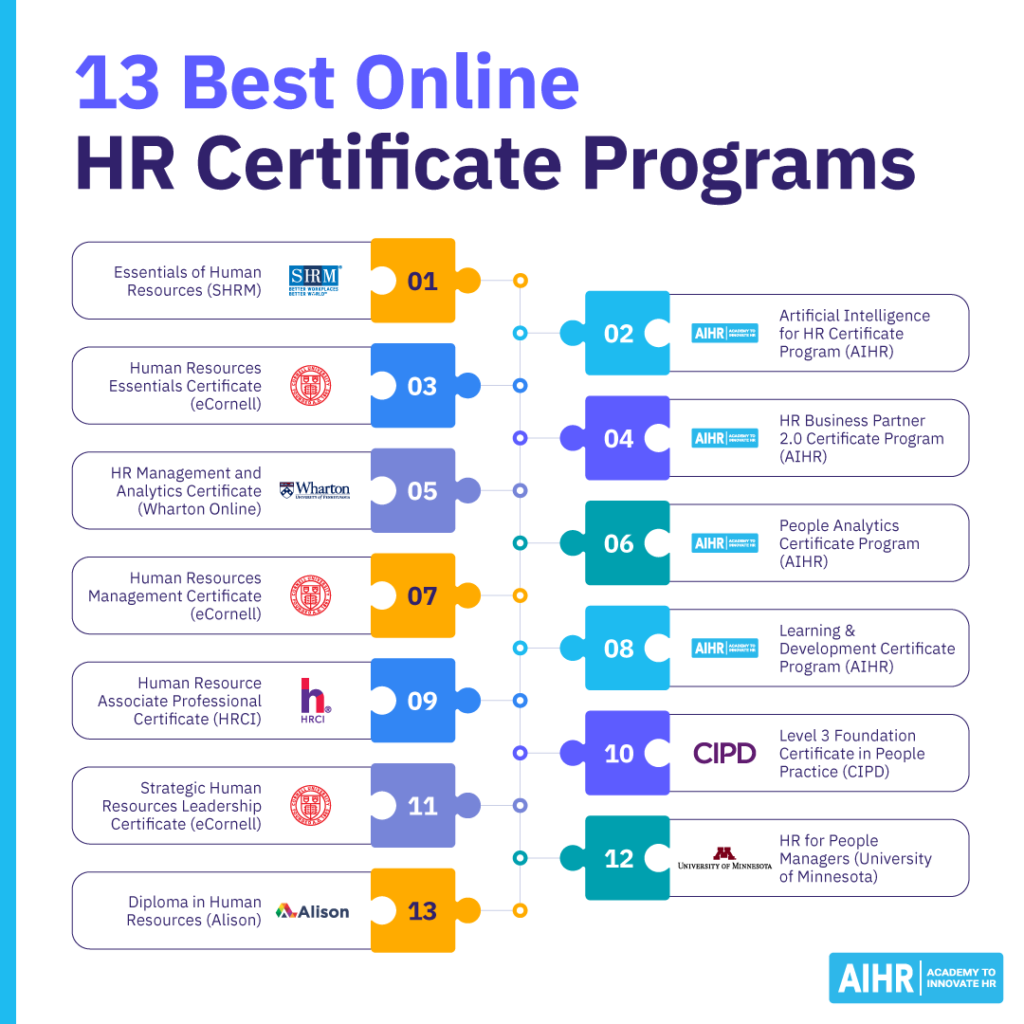
Educational institutions typically model their online human resources courses around professional standards established by major industry bodies, such as the Society for Human Resource Management (SHRM) or the Chartered Institute of Personnel and Development (CIPD). This alignment ensures that what the online HR program provides matches the operational realities faced by practitioners in the field.
CORE ONLINE HR CURRICULUM PILLARS
- Talent Acquisition
- Recruitment, Onboarding, ATS Tools
- Total Rewards
- Compensation, Benefits Administration
- Labor Relations
- Employment Law, Compliance, Mediation
- People Analytics
- Metrics, Workforce Planning, ROI
Talent Acquisition and Workforce Planning
Finding, vetting, and retaining top-tier talent is one of the primary functions of any human resources department. Online programs teach students how to design comprehensive recruitment strategies that leverage digital channels, social recruiting platforms, and Applicant Tracking Systems (ATS).
Coursework in this area typically covers:
- Writing inclusive job descriptions that attract diverse pools of candidates.
- Designing structured behavioral and technical interview processes to minimize unconscious bias.
- Developing onboarding frameworks that accelerate time-to-productivity for new hires.
- Forecasting labor shortages and surpluses through quantitative workforce planning techniques.
Compensation, Benefits, and Total Rewards
Managing total rewards requires a delicate balance between organizational fiscal responsibility and employee market competitiveness. Online HR curricula provide deep dives into how compensation structures are researched, built, and maintained.
Students learn to analyze salary survey data, establish internal equity pay bands, and design incentive programs that drive performance. Furthermore, these courses explore complex benefit packages, including health insurance options, retirement plans (such as 401(k) structures), wellness initiatives, and fringe benefits, ensuring graduates understand the legal and tax implications of various reward structures.
Employment Law and Regulatory Compliance
One of the most critical elements of any online HR program is its legal component. Human resources professionals must operate within a complex web of federal, state, and local labor regulations. Programs provide targeted instruction on legislative frameworks governing the workplace.
Depending on the jurisdiction of the institution, students study core legal principles related to:
- Equal employment opportunity and anti-discrimination statutes (e.g., Title VII, ADA, ADEA).
- Wage and hour laws, including classifications of exempt and non-exempt employees under regulations like the Fair Labor Standards Act (FLSA).
- Family and medical leave administration, occupational safety standards, and wrongful termination liabilities.
- Documentation standards and risk mitigation strategies to prevent costly litigation.
People Analytics and Data-Driven Decision Making
Modern human resources has evolved from an administrative function into a strategic, data-driven discipline. Online programs increasingly integrate quantitative training to help students interpret workforce metrics.
Learners explore how to collect, analyze, and present data related to turnover rates, cost-per-hire, training effectiveness, and employee engagement scores. By utilizing HR analytics software and visualization tools, graduates learn to translate raw data into actionable insights for executive leadership, bridging the gap between human capital management and corporate financial performance.
Program Delivery Models, Formats, and Technical Infrastructure
The primary advantage of an online HR program lies in its delivery model. Designed for maximum flexibility, these programs cater heavily to working professionals who need to balance ongoing employment with continuous education. Understanding the technical and structural components of these virtual classrooms clarifies how learning is actually administered.
Asynchronous vs. Synchronous Learning Environments
Online education platforms generally utilize one of two primary delivery formats, or a hybrid combination of both:
- Asynchronous Learning: This model provides maximum flexibility. Course materials, recorded lectures, reading assignments, and discussion boards are accessible 24/7. Students complete assignments and exams within broad weekly or modular deadlines without needing to log in at specific times. This format is ideal for working adults balancing full-time careers or personal responsibilities.
- Synchronous Learning: This structure requires students to log in at scheduled times for live virtual lectures, real-time debates, and collaborative group workshops. It fosters a more traditional classroom environment, encouraging immediate peer interaction and direct engagement with faculty members.
Learning Management Systems (LMS) and Virtual Tools
An online HR program relies heavily on sophisticated Learning Management Systems—such as Canvas, Blackboard, or Moodle—to centralize the educational experience. Within these platforms, what the online HR program provides includes digital textbooks, multimedia case studies, automated quiz modules, and secure proctoring software for examinations.
Additionally, leading programs integrate enterprise-grade software simulations. Students may gain hands-on experience using simulated HR information systems (HRIS), payroll processing software, and performance management dashboards. This exposure ensures that graduates possess not only theoretical knowledge, but also tangible software literacy prized by prospective employers.
Comparison of Online HR Program Types
Different educational goals require different program structures. The table below outlines the primary types of online HR programs, their typical duration, target audience, and primary deliverables.
| Program Type | Typical Duration | Primary Target Audience | Key Deliverables & Outcomes |
|---|---|---|---|
| Undergraduate Degree (BS/BA) | 2 to 4 years | High school graduates or career starters | Foundational business knowledge, general education credits, comprehensive HR major grounding. |
| Graduate Degree (MS/MBA-HR) | 1.5 to 3 years | Mid-level professionals seeking leadership roles | Advanced strategic management, leadership training, capstone research project, alumni network access. |
| Professional Certificate | 3 to 12 months | Experienced professionals or career switchers | Targeted skill acquisition, industry-recognized digital badges, resume enhancement. |
| Exam Prep Courses | 8 to 16 weeks | Practitioners preparing for SHRM or HRCI certification | Exam blueprints, practice tests, structured study plans, targeted content review. |
Career Outcomes and Professional Credentialing Support
Investing time and financial resources into an online HR program naturally raises questions about return on investment and career progression. A quality program does not stop at delivering lectures; it actively prepares students for professional certification and career advancement.
Preparing for Industry Certifications
While academic degrees provide broad theoretical foundations, professional certifications validate practical expertise. Many online HR programs explicitly design their curriculum to align with the eligibility requirements and body of knowledge for premier industry credentials, such as:
- SHRM-CP / SHRM-SCP: Certified Professional and Senior Certified Professional credentials offered by the Society for Human Resource Management.
- PHR / SPHR: Professional in Human Resources and Senior Professional in Human Resources administered by the HR Certification Institute (HRCI).
Programs often integrate exam review modules, provide access to practice question banks, or offer institutional discounts on exam fees, significantly lowering the barrier to entry for credentialing.
Career Services and Networking in Virtual Spaces
A common misconception about online education is that it isolates the student. However, reputable online HR programs provide robust virtual career services designed to bridge the gap between education and employment.
Students typically gain access to:
- Virtual career fairs connecting candidates with national and international corporate recruiters.
- One-on-one resume reviews, LinkedIn profile optimization workshops, and mock interview coaching.
- Global alumni networks and specialized LinkedIn groups that facilitate professional networking, mentorship matching, and internal job referrals.
Cost Considerations and Return on Investment
Evaluating an online HR program requires a clear-eyed assessment of financial commitments. Tuition rates vary wildly depending on whether the institution is a public state university, a private nonprofit college, or a for-profit online university.
Tuition Structures and Hidden Fees
When calculating the true cost of an online HR program, students must look beyond baseline per-credit-hour tuition rates. Additional expenses often include:
- Technology fees associated with accessing the learning management system and virtual lab environments.
- Digital or physical textbook purchases, case study licensing fees, and software access keys.
- Graduation fees and optional proctoring service charges for remote examinations.
Assessing the Financial Return
Despite these costs, the return on investment for specialized HR education can be substantial. According to data from the U.S. Bureau of Labor Statistics, employment of human resources specialists and managers is projected to grow faster than the average for all occupations, driven by the ongoing need for organizations to navigate complex regulatory environments, manage talent retention, and adapt to evolving remote work structures. Completing a targeted program positions candidates for higher earning potential, leadership promotions, and specialized roles within compensation, talent analytics, and organizational development.
Frequently Asked Questions
Are online HR degrees respected by employers compared to traditional degrees?
Yes. Modern employers rarely differentiate between online and on-campus degrees, provided the program is issued by an accredited institution. Accreditation by bodies recognized by the U.S. Department of Education—such as the Association to Advance Collegiate Schools of Business (AACSB) or regional accreditors—ensures that the curriculum meets rigorous academic standards.
Do online HR programs include practical, hands-on experience?
While traditional internships are harder to structure in fully online formats, many programs incorporate experiential learning elements. These include live case studies, virtual corporate consulting projects, simulations using actual HRIS software, and collaborative group presentations that mirror real-world workplace challenges.
Can I work full-time while completing an online HR program?
Yes. The vast majority of online HR programs are explicitly structured with the working professional in mind. Asynchronous delivery models allow students to complete coursework during evenings and weekends, making it entirely feasible to maintain full-time employment while pursuing a degree or certificate.
What technical requirements do I need for an online HR program?
Students typically need a reliable high-speed internet connection, a modern laptop or desktop computer capable of running video conferencing software (such as Zoom or Microsoft Teams), and standard productivity suites for document creation and data analysis. Some advanced analytics courses may also require downloading specialized statistical software or spreadsheet add-ins.
How do I choose between a general HR degree and a specialized certificate?
Choose a degree program if you are starting your career, need foundational business knowledge, or require a formal degree credential for executive-level promotions. Choose a targeted professional certificate if you already possess a degree or relevant business experience and need to rapidly upskill in a specific area like talent analytics or employment law.
Conclusion and Next Actions
An online HR program provides a structured, flexible pathway to mastering the legal, strategic, and operational facets of workforce management. By delivering comprehensive training in talent acquisition, total rewards, labor law, and people analytics, these programs prepare professionals to tackle complex organizational challenges.
To take the next step, evaluate your career objectives and current credential level. Research accredited institutions that align with your scheduling needs, review their specific curriculum mappings against industry certification standards, and reach out to admissions advisors to clarify tuition structures, financial aid options, and technical prerequisites before enrollment.
Image Gallery