10 Largest Malls in the World: Global Giants of Retail and Entertainment in 2026
As of 2026, the largest mall in the world by Gross Leasable Area (GLA) is the Iran Mall in Tehran, boasting over 21 million total square feet and a GLA of approximately 14.5 million square feet. It is followed by IOI City Mall in Malay...
As of 2026, the largest mall in the world by Gross Leasable Area (GLA) is the Iran Mall in Tehran, boasting over 21 million total square feet and a GLA of approximately 14.5 million square feet. It is followed by IOI City Mall in Malaysia and the South China Mall in Dongguan.
Contents
The landscape of global retail has undergone a massive transformation. While e-commerce dominates many sectors, these physical "mega-malls" have successfully transitioned into lifestyle hubs, integrating vast entertainment districts, luxury residential units, and cultural landmarks to maintain high foot traffic. Determining the "largest" mall often depends on whether one measures by Gross Leasable Area (GLA)—the space available for tenants to generate income—or Total Floor Area, which includes parking, mechanical rooms, and administrative offices. This guide focuses on GLA as the primary metric for commercial scale.
1. Iran Mall (Tehran, Iran)
The Iran Mall remains the undisputed champion of scale. Located in northwest Tehran near Chitgar Lake, this architectural marvel is more than just a shopping center; it is a city within a city. In 2026, it continues to serve as a primary cultural and economic hub for the region.
The mall’s design integrates traditional Persian architecture with modern engineering. One of its most famous features is the Jondishapur Library, a massive multi-story space housing over 67,000 volumes, designed with intricate woodwork that mimics classic European and Persian libraries.
Beyond retail, the Iran Mall features a dedicated "Car Showroom" that acts as a museum for automotive history, a grand hotel, and the "Didar Garden," which uses indoor climate control to maintain a lush, traditional Persian garden environment regardless of the weather outside. From a technical perspective, the mall’s infrastructure includes its own power substation and water treatment facilities to sustain its massive operations.
2. IOI City Mall (Putrajaya, Malaysia)
Following its Phase 2 expansion, IOI City Mall in Putrajaya has solidified its position as the largest mall in Southeast Asia and the second-largest globally. By 2026, it has become the gold standard for "experiential retail" in the region.
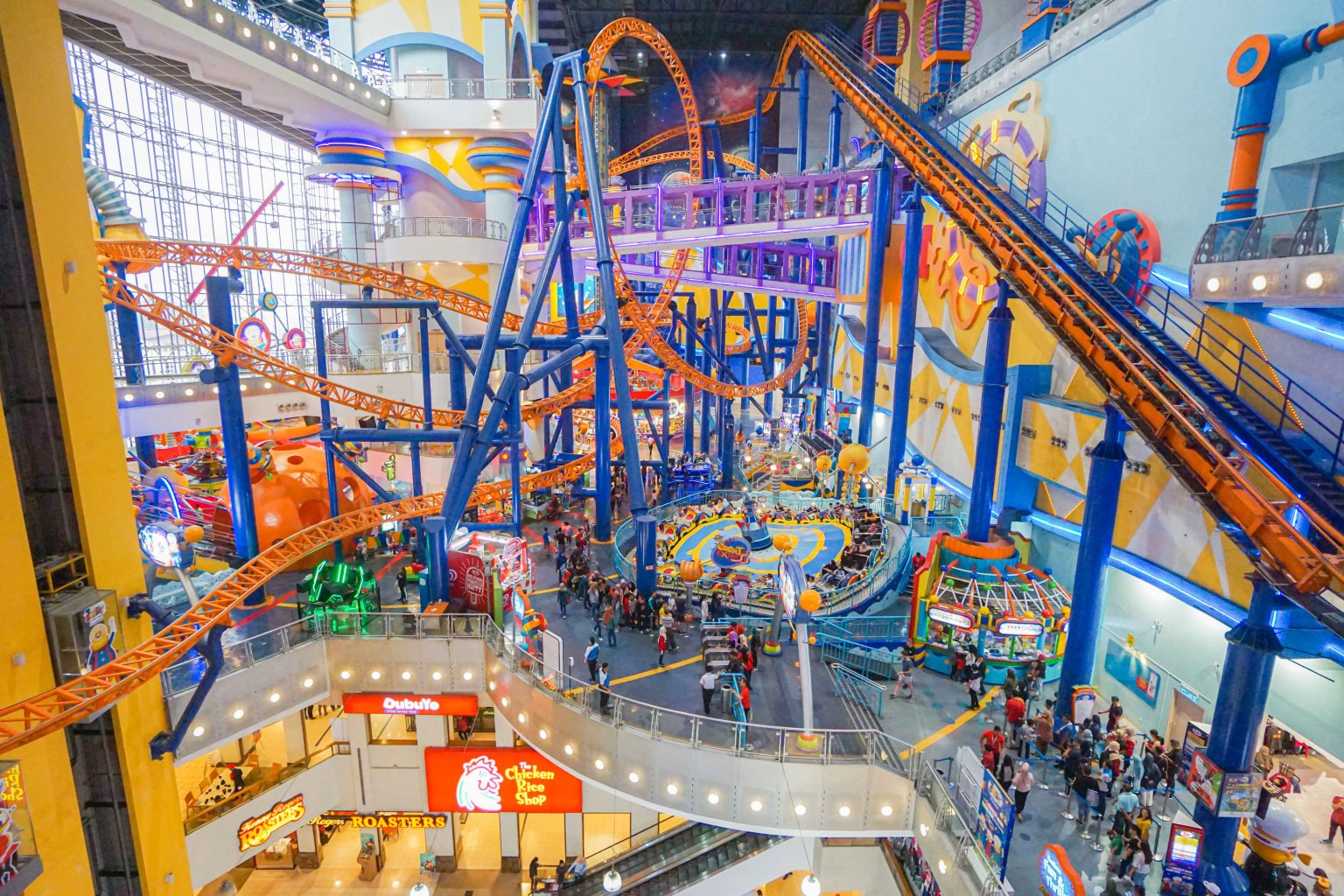
What sets IOI City Mall apart is its focus on high-energy attractions. It houses the District 21 apocalypse-themed adventure park and the IOI City Farm, an indoor "edutainment" park featuring plants and small animals. The mall’s layout is designed to facilitate massive crowds, with wide boulevards and integrated smart-parking systems that utilize AI to direct drivers to the nearest available spot. Its GLA exceeds 8.8 million square feet, making it a critical asset in Malaysia's tourism and retail portfolio.
3. South China Mall (Dongguan, China)
The South China Mall is perhaps the most famous example of retail resilience. Once labeled a "ghost mall" shortly after its opening due to high vacancy rates, it has seen a dramatic resurgence by 2026. Managed through aggressive restructuring and a shift toward the middle-class consumer, the mall now operates at high capacity.
The mall is divided into seven zones modeled after international cities and regions, including Amsterdam, Venice, and Paris. It features a 2.1-kilometer canal with gondolas and a massive indoor-outdoor roller coaster. The technical challenge for South China Mall has always been its location; however, improved transit links to Guangzhou and Shenzhen have finally integrated this 7.1 million square foot giant into the Pearl River Delta’s economic fabric.
4. SM Tianjin (Tianjin, China)
The SM Tianjin mall is a testament to the "Golden Age" of Chinese retail architecture. Spanning over 6 million square feet of GLA, the mall's footprint is shaped like a giant blossom when viewed from above.
This facility is strategically located within the Tianjin Airport Economic Area, serving not just the city of Tianjin but the broader Beijing-Tianjin-Hebei megalopolis. It houses five distinct buildings, each named after one of the five traditional Chinese elements: Earth, Fire, Water, Metal, and Wood. This compartmentalization allows the mall to manage climate control and foot traffic more efficiently, as each "leaf" of the blossom can operate semi-independently during off-peak hours.
5. Golden Resources Mall (Beijing, China)
Often referred to as the "Great Mall of China," the Golden Resources Mall in Beijing held the title of the world's largest mall from 2004 to 2005. While it has been surpassed in sheer square footage, it remains a titan in the industry.
In 2026, the mall continues to benefit from its location near the heart of Beijing. The primary challenge for Golden Resources has always been accessibility. Unlike newer malls designed with integrated subway hubs, this mall originally relied on road traffic. Recent infrastructure upgrades in Beijing have added dedicated transit lines that feed directly into the complex, maintaining its relevance in an increasingly competitive market. It offers approximately 6 million square feet of GLA.
6. CentralWestGate (Nonthaburi, Thailand)
Located in the Nonthaburi province just outside Bangkok, CentralWestGate is Thailand’s largest shopping complex. It was designed to capitalize on the "Western Gateway" of the Bangkok metropolitan region, where major highways and the MRT Purple Line converge.
CentralWestGate is known for its "Super Regional Mall" concept, housing over 500 stores and 200 restaurants. One of its unique features is the integration of an IKEA store directly into the mall's ecosystem, creating a seamless flow between home furnishings and general retail. Its GLA stands at roughly 5.9 million square feet, focusing heavily on family-oriented entertainment and large-scale events.
7. SM City North EDSA (Quezon City, Philippines)
As the oldest mall on this list, SM City North EDSA has undergone numerous expansions and renovations to maintain its top-tier status. By 2026, it serves as the ultimate transport-oriented development (TOD) in Metro Manila.
The mall is a sprawling complex consisting of several distinct areas: the City Center, The Annex, The Block, and the North Towers. It is also a pioneer in sustainable retail, featuring one of the largest rooftop solar power installations in the world for a commercial building. With a GLA of approximately 5.4 million square feet, it remains a vital artery for the millions of commuters passing through the EDSA corridor daily.
8. SM Megamall (Mandaluyong, Philippines)
Located in the Ortigas Center business district, SM Megamall is a cornerstone of Philippine retail culture. Its Phase E expansion and the addition of the "Mega Tower" have pushed its GLA to over 5.1 million square feet.
The mall is divided into two main buildings connected by a bridge. Building A focuses on cinema, bowling, and food, while Building B houses the higher-end retail outlets. SM Megamall is famous for the Mega Fashion Hall, which brought international "fast-fashion" giants to the Philippines. Its technical strength lies in its ability to manage extreme density; on weekends, the mall’s population can rival that of a mid-sized city.
9. SM Mall of Asia (Pasay, Philippines)
The SM Mall of Asia (MOA) is unique for its waterfront location overlooking Manila Bay. It is not just a mall but a massive tourist destination including an arena, a convention center, and an outdoor theme park.
In 2026, MOA’s GLA is approximately 5 million square feet, following the completion of its latest rooftop expansion and the integration of the "IKEA Pasay City" (the largest IKEA in the world). The mall’s layout is designed to maximize the view of the famous Manila Bay sunset, with open-air walkways and a giant Ferris wheel known as the MOA Eye. From a civil engineering perspective, the mall is built on reclaimed land and features advanced drainage systems to mitigate coastal flooding.
10. CentralWorld (Bangkok, Thailand)
Rounding out the top ten is CentralWorld, located in the heart of Bangkok’s Ratchaprasong district. CentralWorld is the ninth-largest shopping complex in the world by GLA, offering approximately 4.6 million square feet of space.
CentralWorld differentiates itself through its focus on luxury and lifestyle. It houses a massive department store (ZEN), a high-tech cinema complex, and an 80,000-square-meter office tower. The mall's central plaza is a global landmark for New Year’s Eve celebrations, often compared to Times Square in New York. Its recent renovations have focused on "Green Retail," incorporating natural light and indoor vegetation to reduce the carbon footprint of the massive air conditioning systems required for the Thai climate.
Comparison of the World's Largest Malls (2026)
| Mall Name | Location | GLA (Approx. Sq Ft) | Primary Feature |
|---|---|---|---|
| Iran Mall | Tehran, Iran | 14,500,000 | Cultural Library & Gardens |
| IOI City Mall | Putrajaya, Malaysia | 8,800,000 | Indoor Adventure Parks |
| South China Mall | Dongguan, China | 7,100,000 | International Themed Zones |
| SM Tianjin | Tianjin, China | 6,000,000 | Five Elements Design |
| Golden Resources Mall | Beijing, China | 6,000,000 | Traditional Mega-Retail |
| CentralWestGate | Nonthaburi, Thailand | 5,900,000 | Regional Transit Hub |
| SM City North EDSA | Quezon City, PH | 5,400,000 | Solar-Powered Infrastructure |
| SM Megamall | Mandaluyong, PH | 5,100,000 | High-Density Urban Retail |
| SM Mall of Asia | Pasay, PH | 5,000,000 | Waterfront Entertainment |
| CentralWorld | Bangkok, Thailand | 4,600,000 | Luxury & Lifestyle Focus |
Frequently Asked Questions
Is the Dubai Mall the largest mall in the world?
While the Dubai Mall is often cited as the largest, it typically ranks lower when measuring strictly by Gross Leasable Area (GLA). It has a massive total floor area (over 12 million square feet), but much of that is dedicated to non-retail space like the Dubai Aquarium, the VR Park, and massive internal circulation areas. In terms of pure shopping space, malls like the Iran Mall and IOI City Mall are significantly larger.
Why are most of the world's largest malls located in Asia?
The concentration of mega-malls in Asia is driven by several factors: rapid urbanization, a growing middle class with increasing disposable income, and tropical climates that make air-conditioned indoor spaces more attractive than outdoor shopping streets. In countries like the Philippines and Thailand, malls serve as essential community centers where people socialize, exercise, and access government services.
How is Gross Leasable Area (GLA) calculated?
GLA is the total floor area designed for tenant occupancy and exclusive use, including basements, mezzanines, or upper floors. It is measured from the center line of joint partitions and from outside wall faces. It specifically excludes public areas like elevator shafts, stairwells, and public restrooms, making it the most accurate metric for a mall’s commercial capacity.
What is the biggest mall in North America?
In 2026, the West Edmonton Mall in Canada and the American Dream Mall in New Jersey remain the largest in North America. However, even these giants are significantly smaller than the top ten malls in Asia, with West Edmonton Mall offering around 3.8 million square feet of GLA, which would place it outside the global top ten.
Are these malls still relevant in the age of e-commerce?
Yes, but their roles have changed. Successful mega-malls have moved away from being simple "product warehouses" and have become destination centers. By offering experiences that cannot be replicated online—such as indoor theme parks, high-end dining, and integrated medical clinics—they have maintained their relevance.
Recommendations for Visitors and Investors
For travelers, visiting these malls requires significant planning; many, like the Iran Mall or SM Mall of Asia, are so large they cannot be fully explored in a single day. Wear comfortable footwear and utilize the mall's digital directories.
For commercial real estate investors, these malls represent a shift toward multi-use integration. The most successful assets in 2026 are those that have diversified their revenue streams by incorporating office spaces, hotels, and luxury residential towers into the retail footprint. When evaluating the "largest" malls, look beyond the square footage and analyze the foot traffic conversion and the diversity of the tenant mix.
Image Gallery