Workers Compensation in Tuscarawas County, Ohio: A Comprehensive Guide for Employers and Injured Workers
Navigating the workers' compensation system in Tuscarawas County, Ohio, requires understanding state-level mandates governed by the Ohio Bureau of Workers' Compensation (BWC) alongside localized administrative resources. Whether you ar...
Navigating the workers' compensation system in Tuscarawas County, Ohio, requires understanding state-level mandates governed by the Ohio Bureau of Workers' Compensation (BWC) alongside localized administrative resources. Whether you are an employer managing payroll and premium obligations in cities like New Philadelphia or Dover, or an employee recovering from a workplace injury, understanding filing procedures, statutory timelines, and dispute resolution mechanisms is essential for protecting your rights and financial stability.
Contents
Understanding the Ohio Workers' Compensation Framework
Workers' compensation in Ohio operates under a monopolistic state-fund model managed primarily by the Ohio Bureau of Workers' Compensation (BWC), with claims adjudicated by the Ohio Industrial Commission. Unlike states where private insurance carriers issue policies, almost all private and public employers in Tuscarawas County must either obtain coverage directly through the Ohio BWC or qualify as a self-insuring employer meeting specific net-worth and administrative requirements.
The system is designed as a no-fault insurance program. This means that injured workers do not need to prove that their employer was negligent to receive benefits, provided the injury arose out of and in the course of employment. In exchange for this guaranteed medical coverage and wage replacement, Ohio employers enjoy immunity from most civil tort lawsuits filed by employees injured on the job.
For businesses operating in Tuscarawas County—spanning manufacturing hubs in New Philadelphia, retail centers in Dover, and agricultural operations throughout rural townships—maintaining active BWC coverage is a legal requirement. Failure to secure coverage can result in severe financial penalties, stop-work orders, and personal liability for business owners if an uninsured workplace accident occurs.
Key Stakeholders and Administrative Resources
Managing a claim or an employer account in Tuscarawas County involves coordinating with several key entities at both the state and regional levels.
Ohio Bureau of Workers' Compensation (BWC)
The BWC is the administrative arm that processes applications, collects premiums, manages employer accounts, and pays medical providers for approved claims. While policy administration is centralized at the state level, the BWC maintains regional service offices and partners with local health care providers and Managed Care Organizations (MCOs).
Managed Care Organizations (MCOs)
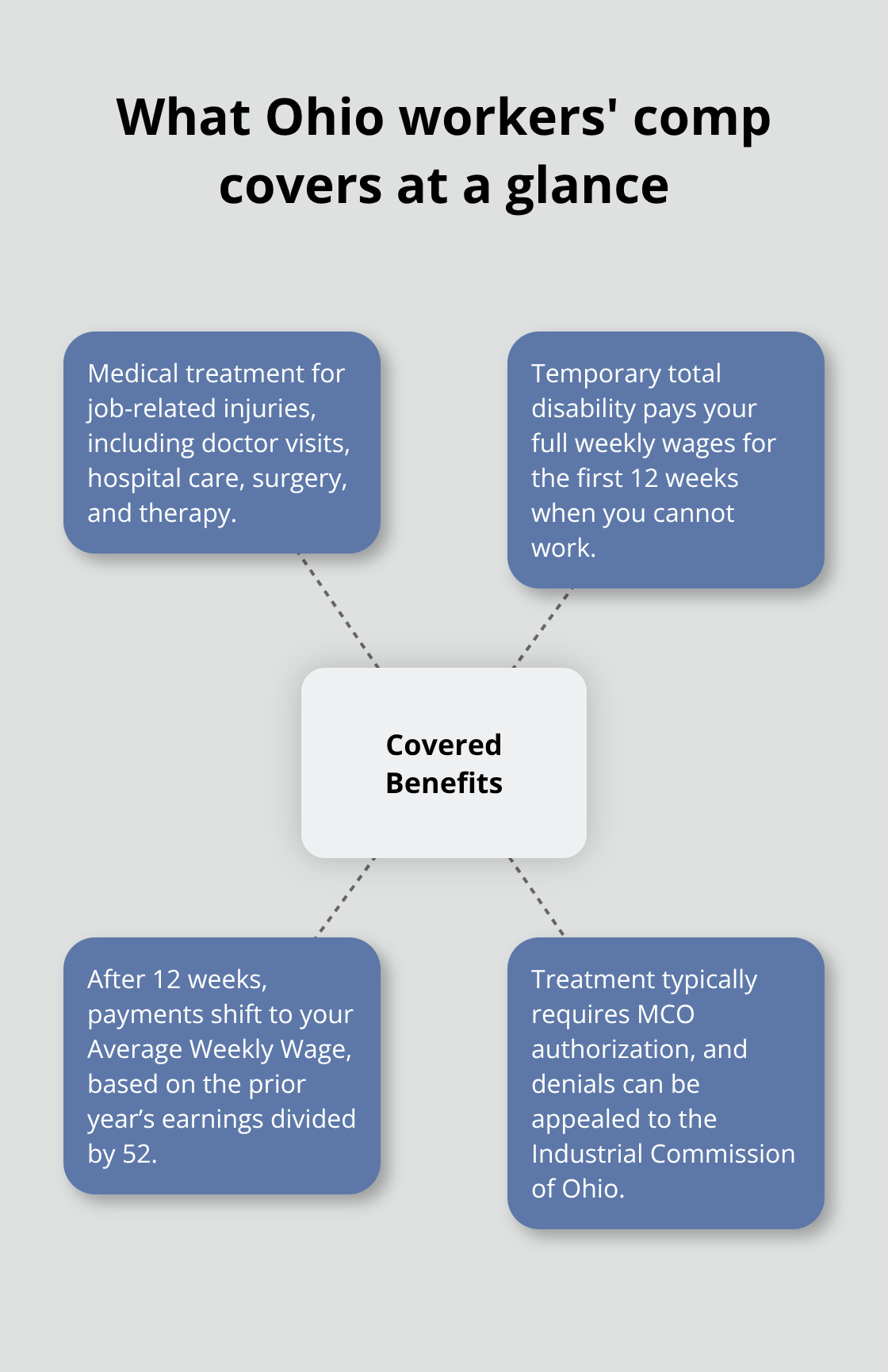
Every Ohio employer must partner with a certified MCO. MCOs do not determine whether a claim is allowed or denied—that is the role of the BWC—but they manage the medical treatment plans, coordinate medical provider networks, and assist with return-to-work strategies. Injured workers in Tuscarawas County must select an MCO-certified medical provider for initial and ongoing treatment to ensure bills are covered under the claim.
The Industrial Commission of Ohio (IC)
When a claim dispute arises—such as a denied application, a disagreement over the extent of disability, or a contested settlement—the Industrial Commission of Ohio handles the administrative hearing process. Hearings for Tuscarawas County claimants are typically coordinated through the nearest regional IC district office, though many hearings are conducted virtually or telephonically.
Step-by-Step Guide for Injured Workers
If you sustain a workplace injury while employed in Tuscarawas County, taking prompt, methodical action is critical to ensure your claim is processed efficiently.
| Step | Action Required | Description & Timeline |
|---|---|---|
| 1 | Seek Medical Attention | Obtain immediate medical care for severe injuries. Inform the healthcare provider that the injury occurred on the job and request a First Report of Injury (FROI) form or assistance filing electronically. |
| 2 | Notify Your Employer | Inform your supervisor or HR department in writing as soon as possible. While Ohio law allows up to one year to file a formal claim, early notification prevents administrative delays and disputes regarding how the injury occurred. |
| 3 | File the Claim | File a First Report of Injury (FROI) online through the Ohio BWC portal, via phone, or by submitting a paper form. You can also ask your employer or treating physician to submit the claim on your behalf. |
| 4 | Select Your MCO and Providers | Choose a certified Managed Care Organization and ensure your treating physicians are part of the BWC provider network to avoid out-of-pocket medical expenses. |
| 5 | Attend Examinations and Follow Treatment Plans | Comply with all prescribed medical treatments and attend any Independent Medical Examinations (IMEs) requested by the BWC, your MCO, or your employer. |
Employer Obligations and Premium Management in Tuscarawas County
Employers in Tuscarawas County must maintain compliance with BWC regulations to avoid administrative penalties and optimize their premium structures. Premium rates are calculated based on payroll size, historical injury claims experience (experience rating), and the specific industry classification code (Manual Classification).
Group-RATING and Group-RETRO Programs
Many Tuscarawas County businesses participate in group-rating or group-retrospective rating programs sponsored by local chambers of commerce, trade associations, or industry groups. These programs allow employers with similar risk profiles to pool their experience, potentially lowering their annual BWC premiums significantly compared to individual rating.
Safety Interventions and Workplace Compliance
The Ohio BWC offers various safety grants and educational resources to Tuscarawas County employers to help reduce workplace injuries. Programs such as the Safety Intervention Grant (SIG) provide financial assistance for purchasing equipment designed to eliminate or reduce ergonomic and safety hazards. Maintaining an active safety committee and adhering to OSHA and BWC safety standards are foundational to keeping claim frequencies low and controlling long-term premium costs.
Available Benefits for Injured Workers
When a claim is officially allowed by the Ohio BWC, injured workers may be entitled to several categories of compensation, depending on the severity and duration of their disability:
- Medical Benefits: Full coverage of all necessary and reasonable medical treatments, hospital services, prescription medications, and durable medical equipment related to the allowed industrial injury or occupational disease.
- Temporary Total Disability (TTD): Wage-replacement benefits paid when an employee is completely disabled from work for a temporary period or cannot return to their former position while accommodating a temporary restriction and the employer cannot offer work within those limits.
- Wage Loss Compensation: Benefits designed to bridge the income gap if an injured worker returns to work at a lower-paying job due to permanent restrictions resulting from the injury.
- Permanent Partial Disability (PPD): Awards granted for the permanent loss of function or body parts resulting from the workplace accident, determined after the worker reaches Maximum Medical Improvement (MMI).
- Permanent Total Disability (PTD): Ongoing wage replacement for workers whose injuries permanently and completely prevent them from engaging in any sustained remunerative employment.
Dispute Resolution and Appeals Process
Not all workers' compensation claims are approved initially. If the Ohio BWC denies a claim or a specific medical request, the injured worker or employer has the right to appeal.
- District Hearing Officer (DHO): The first level of formal appeal is heard by a District Hearing Officer of the Industrial Commission. Both parties present evidence, medical records, and testimony.
- Staff Hearing Officer (SHO): If a party disagrees with the DHO order, an appeal can be filed to a Staff Hearing Officer for a de novo review.
- Industrial Commission Appeal: A discretionary appeal to the full Industrial Commission in Columbus.
- Court of Common Pleas: If administrative remedies are exhausted and a party remains dissatisfied, an appeal may be filed in the Tuscarawas County Court of Common Pleas (located in New Philadelphia, Ohio) within designated statutory deadlines. Given the complexities of court appeals, legal representation is frequently utilized at this stage.
Frequently Asked Questions
How long do I have to file a workers' compensation claim in Ohio?
Under Ohio law, an injured worker generally has one year from the date of injury to file a formal claim with the BWC. For occupational diseases, the timeline is typically six months from the date of diagnosis by a licensed physician or two years from disability retirement, though specific statutory exceptions apply.
Can my employer fire me for filing a workers' compensation claim in Ohio?
No. Ohio Revised Code Section 4123.90 prohibits employers from discharging, demoting, or retaliating against an employee simply because they filed a workers' compensation claim or instituted proceedings under the workers' compensation act. However, employers may still enforce neutral attendance and termination policies unrelated to the protected claim filing.
What happens if my claim is denied by the BWC?
If your claim is denied, you will receive an order detailing the reasoning. You have the right to file an appeal within 14 days of the receipt of the order. It is vital to act quickly, gather supporting medical evidence, and request a hearing before the Industrial Commission of Ohio.
Do I need a lawyer for my Tuscarawas County workers' compensation case?
While simple claims involving minor medical treatment often proceed smoothly without legal representation, contested claims, permanent disability applications, or denied claims frequently benefit from the guidance of an attorney certified in Ohio workers' compensation law.
Are employers required to carry workers' compensation in Ohio?
Yes. With very few exceptions (such as certain independent contractors who meet specific statutory criteria), almost every employer with one or more employees in Ohio must maintain active workers' compensation coverage through the BWC or achieve self-insurance status.
Conclusion and Next Actions
Successfully navigating the workers' compensation system in Tuscarawas County requires strict adherence to statutory deadlines, precise documentation of medical treatments, and proactive communication between employers, employees, MCOs, and the BWC. Injured workers should prioritize immediate medical evaluation and timely claim submission, while business owners must maintain active coverage and foster safe working environments to minimize administrative risk. For specific case evaluations or complex disputes, consult the official Ohio Bureau of Workers' Compensation portal or seek qualified legal counsel licensed in the state of Ohio.
Image Gallery