What Is AR in Business: A Comprehensive Guide to Augmented Reality
Augmented reality (AR) in business refers to the integration of interactive digital overlays—such as 3D models, data visualizations, and real-time instructions—onto the physical environment through devices like smartphones, tablets, an...
Augmented reality (AR) in business refers to the integration of interactive digital overlays—such as 3D models, data visualizations, and real-time instructions—onto the physical environment through devices like smartphones, tablets, and specialized smart glasses, optimizing operational efficiency, customer engagement, and remote collaboration.
Contents
The commercial application of augmented reality has shifted from experimental novelty to an indispensable enterprise technology. Across sectors like retail, manufacturing, logistics, and healthcare, organizations deploy spatial computing tools to transform how employees train, how products are designed, and how consumers interact with merchandise. Understanding the mechanics, operational requirements, and strategic value of this technology is critical for business leaders evaluating modern digital transformation initiatives.
Defining Augmented Reality in the Enterprise Context
To understand augmented reality in business, it is vital to distinguish it from virtual reality (VR) and mixed reality (MR). While virtual reality creates an entirely enclosed, simulated digital environment, augmented reality enhances the real-world environment by superimposing contextual computer-generated information into the user's field of vision. Mixed reality bridges the two by allowing digital objects to interact in real time with physical space, though enterprise terminology often groups AR and MR under the broader umbrella of spatial computing.
In a commercial setting, AR functions through three core technological capabilities:
- Spatial Mapping and Tracking: Computer vision algorithms analyze physical surroundings, identifying surfaces, edges, and lighting conditions to anchor digital assets securely in real space.
- Contextual Data Overlay: Enterprise databases, internet of things (IoT) sensor feeds, and artificial intelligence models feed relevant data directly into the visual interface.
- Interactive Control: Users interact with virtual elements through hand gestures, voice commands, or touch inputs, enabling hands-free operation in complex work environments.
By marrying digital intelligence with physical workflows, companies eliminate the friction of shifting attention between physical tasks and 2D screens, driving unprecedented speed and accuracy in daily operations.
Core Business Use Cases and Sector Applications
The versatility of AR allows it to address distinct operational bottlenecks across varied industries. Rather than serving as a one-size-fits-all tool, enterprise AR is tailored to specific functional departments.
| Industry | Primary AR Application | Operational Benefit |
|---|---|---|
| Retail & E-Commerce | Virtual try-on and room visualization | Decreased return rates, higher conversion |
| Manufacturing | Assembly guidance and quality control | Reduced error rates, faster onboarding |
| Logistics | Vision-picked order fulfillment | Optimized picking routes, labor savings |
| Field Service | Remote expert assistance | First-time fix rate improvement |
Retail, E-Commerce, and Marketing
Retailers leverage augmented reality to bridge the gap between digital storefronts and physical consumer desires. E-commerce platforms integrate AR features that allow shoppers to project 3D models of furniture into their living rooms or virtually "wear" apparel and cosmetics using smartphone cameras. This visualization minimizes purchase hesitation, reduces product return rates caused by sizing or fit discrepancies, and drives higher customer conversion rates.
Manufacturing and Assembly
On the factory floor, AR smart glasses and tablets project step-by-step assembly instructions directly onto complex machinery or workpieces. Technicians no longer need to look away to consult paper manuals or desktop monitors. This continuous line-of-sight instruction significantly reduces assembly errors, accelerates production timelines, and shortens the training curve for new or temporary manufacturing staff.
Logistics, Warehousing, and Supply Chain
Order fulfillment centers utilize heads-up displays to guide warehouse workers through optimal picking routes and highlight exact item locations on storage shelves. Vision-picking technology eliminates the need to carry physical clipboards or handheld barcode scanners, freeing workers' hands and drastically increasing daily throughput speed while lowering inventory tracking discrepancies.
Field Service and Remote Maintenance
When field technicians encounter unfamiliar equipment failures, they can establish a secure, live video feed through AR headwear. A remote expert at headquarters can see the technician's exact perspective and draw digital annotations directly onto the technician's field of view to guide complex troubleshooting, reducing travel expenses and eliminating equipment downtime.
Implementation Prerequisites and Infrastructure Requirements
Adopting augmented reality in business requires careful preparation across software architecture, hardware procurement, and network infrastructure. Deploying consumer-grade AR applications is vastly different from integrating enterprise-grade spatial solutions that must interface with legacy enterprise resource planning (ERP) and product lifecycle management (PLM) systems.
Hardware Selection
Organizations must evaluate whether smartphones, tablets, or dedicated wearable headsets best serve their workforce.
- Mobile Devices (iOS and Android): Ideal for customer-facing retail applications, marketing campaigns, and occasional supervisory checks. They require no new hardware investment since consumers and employees already own compatible devices.
- Smart Glasses and Headsets (e.g., Microsoft HoloLens, Magic Leap, RealWear): Essential for industrial, warehouse, and field service environments where workers require hands-free operation and high durability.
Software Architecture and 3D Asset Management
Building AR experiences requires specialized content management systems capable of handling heavy 3D assets (such as CAD files converted to lightweight formats like USDZ or GLTF). Companies must establish a pipeline for managing, updating, and securing these digital assets. Furthermore, integration middleware must connect AR applications securely to corporate databases, inventory management software, and customer relationship management (CRM) platforms via secure APIs.
Network and Connectivity Standards
Real-time spatial tracking, high-definition remote assistance, and large 3D asset downloads demand low latency and robust bandwidth. Enterprise environments must audit their Wi-Fi infrastructure—transitioning to Wi-Fi 6 or private 5G networks where necessary—to prevent lag that can cause visual jitter, user disorientation, or system disconnects during critical operations.
Cost Considerations and Return on Investment (ROI)
Evaluating the financial viability of enterprise AR requires looking beyond initial software development and hardware procurement costs to analyze long-term operational efficiencies.
| Cost Category | Estimated Investment Range | Description |
|---|---|---|
| Hardware Procurement | $1,000 – $4,000+ per headset | Enterprise-grade smart glasses/headsets |
| Software Licensing | $30 – $300+ per user/month | SaaS platforms for AR content management |
| Custom Development | $20,000 – $250,000+ per project | Tailored 3D modeling and custom apps |
| Training & Integration | Variable based on scale | Employee onboarding and ERP integration |
While out-of-the-box SaaS solutions offer lower entry barriers, custom-built enterprise integrations demand significant capital investment. However, organizations frequently realize positive ROI through distinct operational savings:
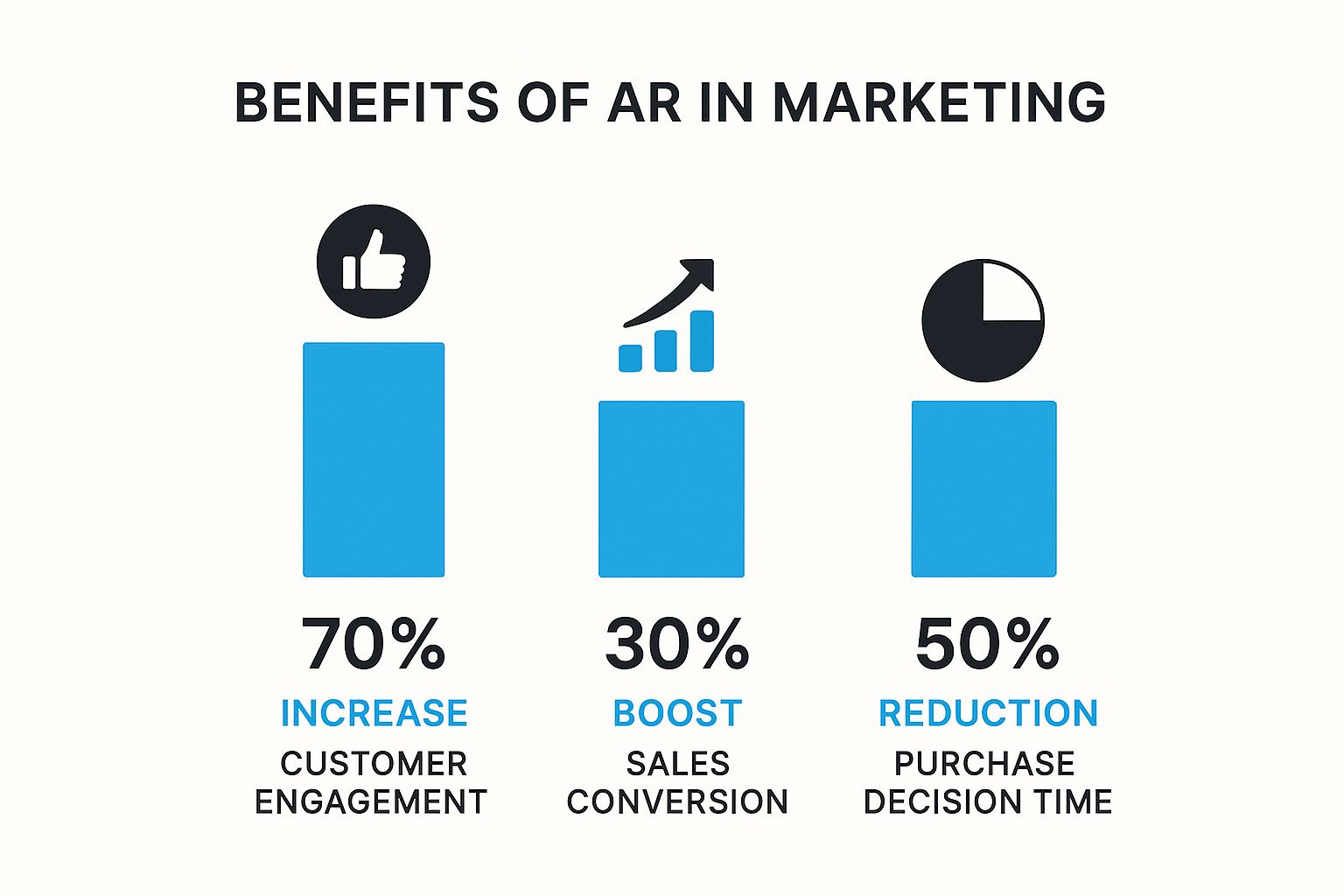
- Reduced Training Time: Manufacturing and warehouse facilities report cutting new hire onboarding times by up to 50% using visual workflows.
- Decreased Error and Scrap Rates: Precision overlays reduce costly assembly mistakes and material waste.
- Lower Travel and Maintenance Costs: Remote expert assistance eliminates unnecessary travel expenses for senior engineers dispatched to fix remote machinery.
Operational Challenges and Mitigation Strategies
Despite its clear utility, deploying augmented reality in business introduces distinct technical and human challenges that organizations must proactively manage.
User Adaptation and Motion Discomfort
Prolonged use of head-mounted displays can cause eye strain, neck fatigue, or spatial disorientation (often referred to as simulator sickness). Organizations should implement strict usage duration guidelines, schedule regular breaks for employees using headsets, and prioritize lightweight, ergonomic hardware designs.
Data Privacy and Security Vulnerabilities
AR devices capture continuous video feeds, spatial maps, and sensitive internal data of facilities. This creates severe cybersecurity risks if unauthorized actors intercept data streams. Enterprises must enforce strict end-to-end encryption, deploy mobile device management (MDM) protocols, and ensure compliance with regulatory frameworks like GDPR or HIPAA when capturing spatial data in medical or client-facing environments.
Legacy System Integration Friction
Many industrial and commercial enterprises rely on legacy database architectures that struggle to synchronize with modern 3D asset pipelines. IT departments must invest in scalable middleware or cloud-based spatial platforms that can ingest legacy CAD and inventory data without destabilizing existing enterprise software ecosystems.
Frequently Asked Questions
How does augmented reality differ from virtual reality in a business environment?
Augmented reality overlays digital elements onto the real world, allowing workers to interact with physical surroundings while receiving extra data. Virtual reality replaces the real world with a fully simulated, closed digital environment. Businesses use AR for hands-on operational support and retail visualization, whereas VR is typically reserved for immersive training simulations and virtual prototyping.
What industries benefit the most from implementing augmented reality?
Manufacturing, logistics, retail, and field service derive the highest immediate value from AR. Manufacturing and logistics benefit from hands-free assembly and picking guidance, retail uses AR for customer visualization and reduced returns, and field service relies on AR for remote expert troubleshooting.
Do employees need specialized technical skills to use business AR tools?
Modern enterprise AR applications are designed with intuitive user interfaces, often relying on voice commands, simple touch gestures, or gaze controls. While administrative staff require training to manage 3D content platforms, front-line workers can typically master consumer-grade or industrial AR devices within minutes of guided onboarding.
How do companies measure the return on investment (ROI) of AR initiatives?
Organizations measure AR ROI by tracking key performance indicators such as reduction in training time, decrease in product return rates, improvement in first-time fix rates for field service, and reduction in error or scrap rates during assembly operations.
What are the main cybersecurity risks associated with enterprise AR?
AR devices capture high-resolution video and spatial maps of physical workspaces, presenting risks of intellectual property theft and unauthorized data interception. Mitigating these risks requires secure cloud storage, strict identity and access management (IAM), and robust endpoint security protocols for all connected wearables.
Strategic Next Actions for Business Leaders
Organizations seeking to harness augmented reality should begin with a focused, low-risk pilot program rather than an enterprise-wide overhaul. Identify a single operational bottleneck—such as high onboarding costs in assembly or excessive product returns in e-commerce—and evaluate off-the-shelf SaaS AR platforms that address that specific need. Secure cross-departmental buy-in from IT, operations, and finance teams to audit existing network infrastructure and data pipelines. By starting small, measuring quantitative performance outcomes, and scaling thoughtfully, businesses can successfully integrate spatial computing to secure a lasting competitive advantage.
Image Gallery