How Agenda Setting Shapes Government Policy: The Engines of Legislative Change
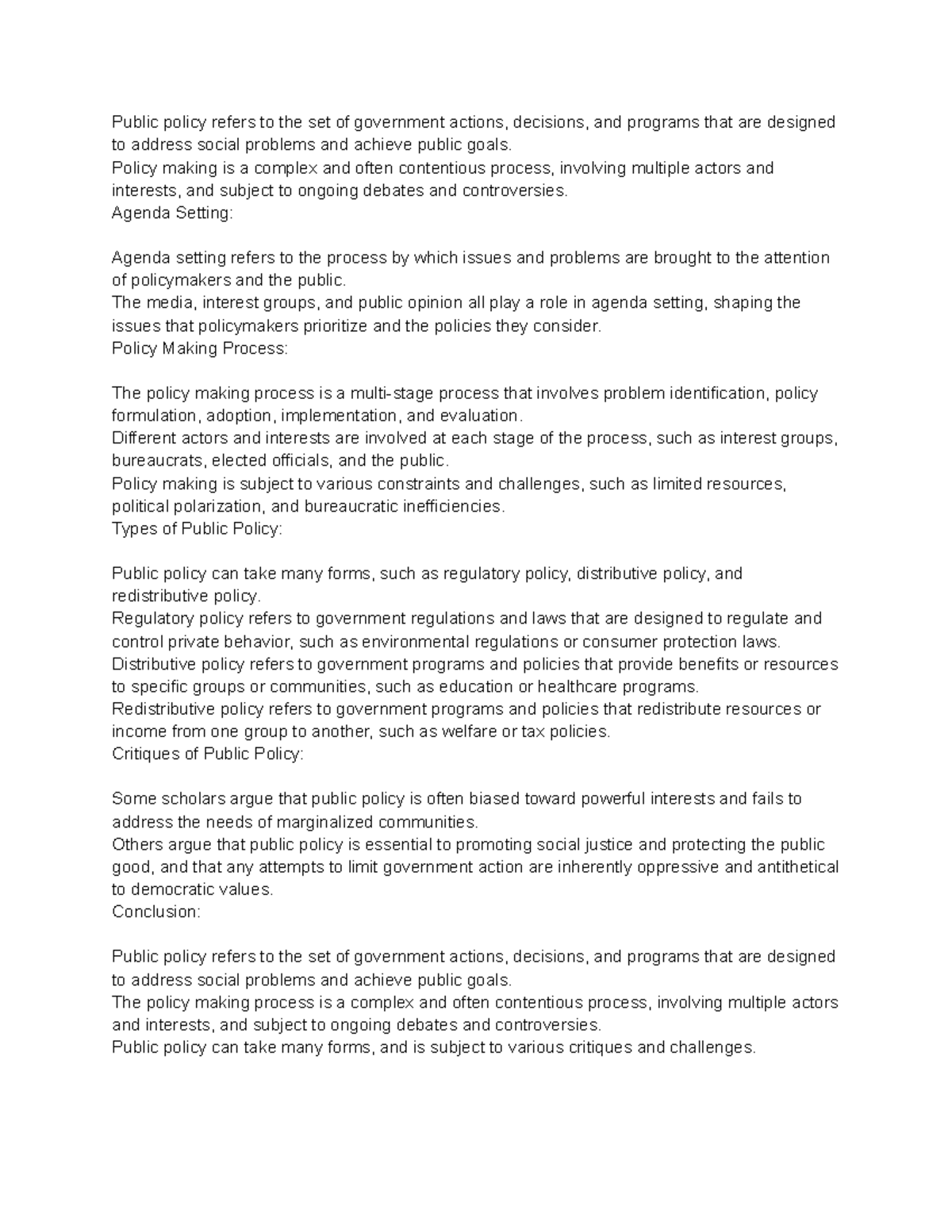
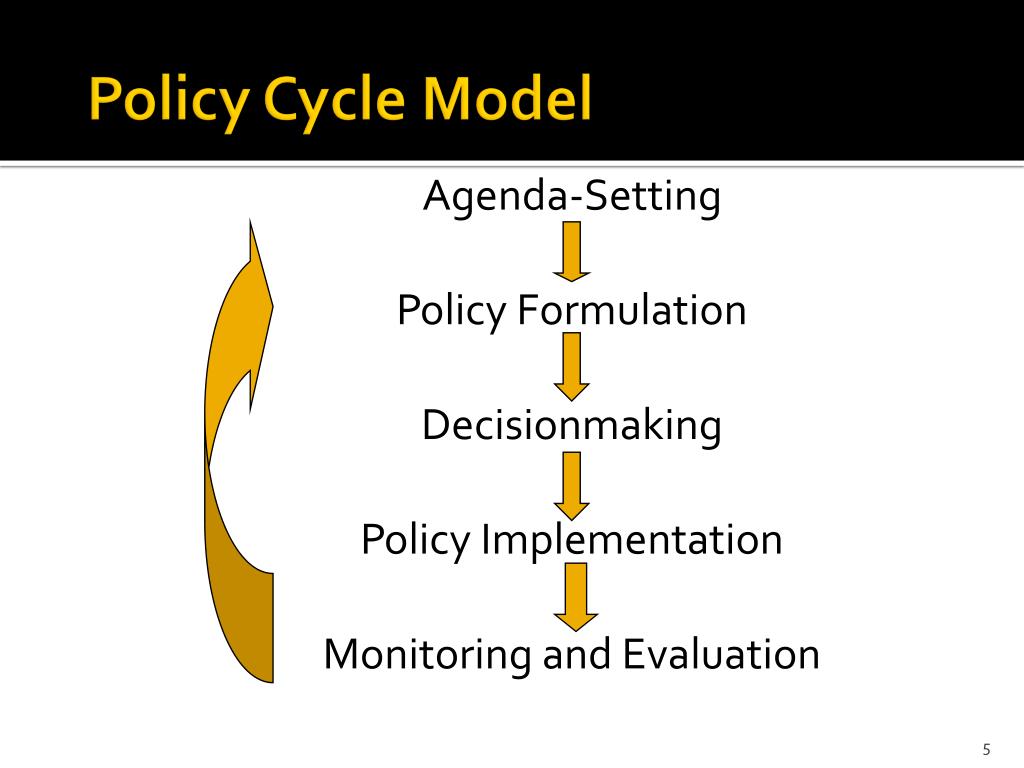
Agenda setting is the critical first stage of the policy cycle, determining which societal problems receive official government attention. By filtering vast amounts of information through media influence, interest group advocacy, and p...
Agenda setting is the critical first stage of the policy cycle, determining which societal problems receive official government attention. By filtering vast amounts of information through media influence, interest group advocacy, and political shifts, it prioritizes specific issues, effectively dictating the direction and focus of legislative action and resource allocation in 2026.
Contents
In the complex landscape of modern governance, thousands of issues compete for the limited time, energy, and financial resources of policymakers. However, only a small fraction of these issues ever reach the floor of a legislature or the desk of an executive. This selection process—known as agenda setting—is not a random occurrence. It is a highly strategic and contested phase of the policy process where the power to define a problem is as significant as the power to solve it. Understanding how agenda setting shapes government policy requires looking at the interplay between public perception, institutional structures, and the "policy windows" that allow change to occur.
The Hierarchy of Agendas: From Public Concern to Institutional Action
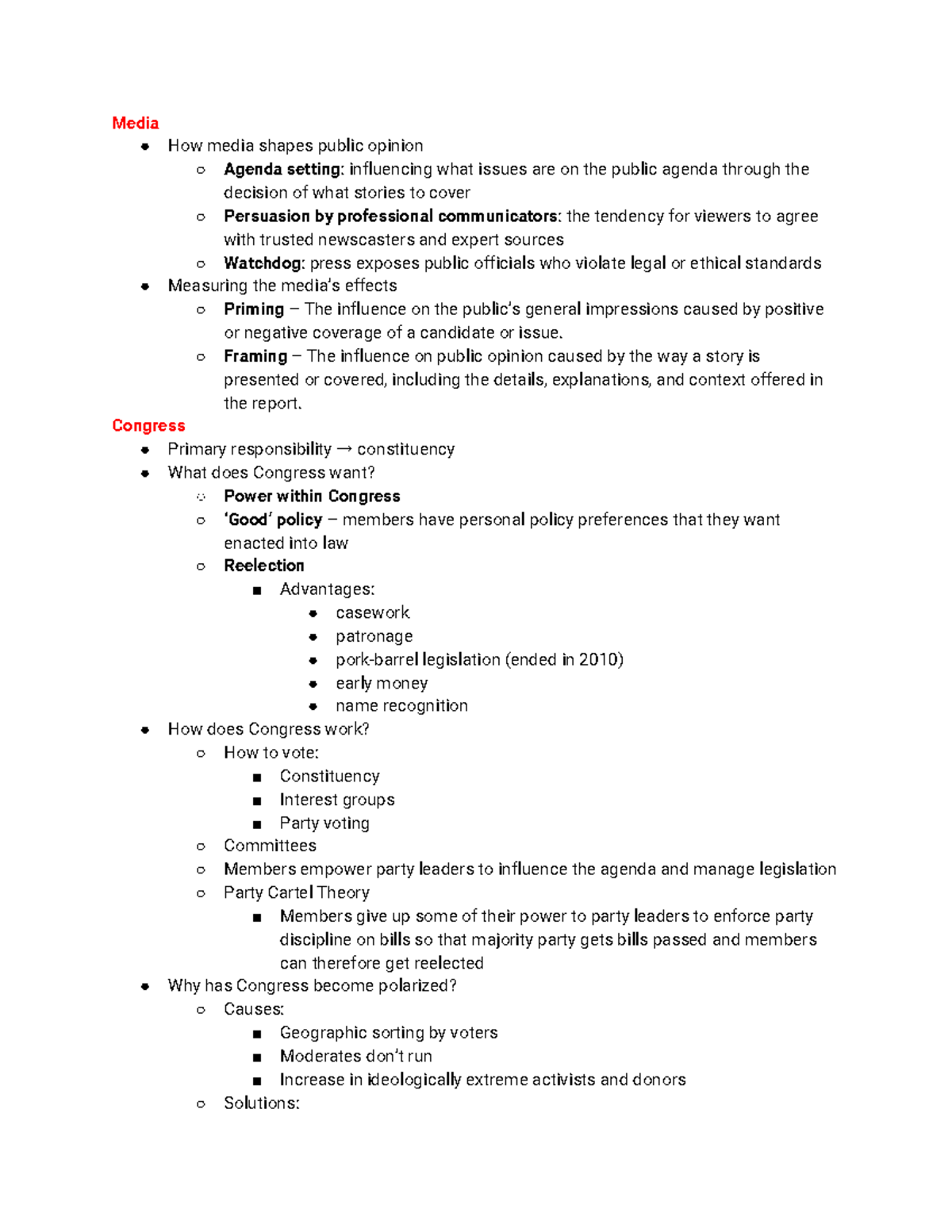
To understand how policy is shaped, one must distinguish between different levels of agendas. Not every issue discussed in a coffee shop or on social media results in a bill being drafted. Scholars typically divide the agenda-setting process into three distinct levels, each acting as a filter for the next.
The Systemic Agenda (The Public Agenda)
The systemic agenda consists of all issues that are commonly perceived by members of the political community as meriting public attention and involving matters within the legitimate jurisdiction of existing governmental authority. In 2026, the systemic agenda is heavily influenced by real-time digital discourse. An issue enters the systemic agenda when a broad consensus emerges that "something must be done." However, being on the systemic agenda does not guarantee government action; it only signifies that the public is aware and concerned.
The Institutional Agenda (The Formal Agenda)
The institutional agenda, or the formal agenda, is the list of items explicitly up for active and serious consideration by authoritative decision-makers. This includes the legislative calendar, court dockets, and administrative agency priorities. Transitioning an issue from the systemic agenda to the institutional agenda is the most difficult hurdle in the policy process. It requires "gatekeepers"—such as committee chairs, party leaders, or executive officials—to acknowledge the issue as a priority.
The Discretionary vs. Recurrent Agenda
Within the institutional framework, some items are recurrent, such as annual budget appropriations or the renewal of expiring statutes. Others are discretionary, emerging from new crises or the successful advocacy of "policy entrepreneurs." Government policy is often shaped by the tension between these "must-do" items and the "want-to-do" initiatives that define a political administration's legacy.
Kingdon’s Multiple Streams Framework: When Windows Open
One of the most influential theories for how agenda setting shapes government policy is John Kingdon’s Multiple Streams Framework. Kingdon posits that the policy process consists of three independent "streams" that must converge for an issue to move onto the formal agenda and result in policy change.
1. The Problem Stream
This stream consists of the various conditions that citizens and policymakers want addressed. Problems are identified through indicators (such as inflation rates or crime statistics), focusing events (such as a natural disaster or a high-profile technology failure), and feedback from existing programs. In 2026, data analytics play a massive role in the problem stream, as predictive modeling can highlight emerging crises before they reach a breaking point.
2. The Policy Stream
The policy stream is a "primordial soup" of ideas generated by researchers, advocates, and bureaucrats. These actors develop proposals, white papers, and draft legislation long before a problem even hits the headlines. For a proposal to be viable, it must be technically feasible and compatible with the values of the policymakers. When a problem arises, policymakers reach into this "soup" to find a ready-made solution.
3. The Politics Stream
The politics stream is composed of the "national mood," interest group pressure campaigns, and changes in government (such as elections). Even if a problem is recognized and a solution exists, policy change will not occur if the political climate is hostile. For example, a shift in legislative majority can suddenly elevate environmental issues that were previously sidelined.
The Policy Window
When these three streams—Problem, Policy, and Politics—align, a policy window opens. This is a brief opportunity during which policy entrepreneurs can push their solutions onto the formal agenda. If the window closes before action is taken, the issue often drops off the institutional agenda, regardless of its importance.
The Role of Media as a Gatekeeper and Accelerator
The media’s role in agenda setting is often described by the phrase: "The media may not tell people what to think, but it is stunningly successful in telling them what to think about." By choosing which stories to cover and how much prominence to give them, media outlets signal to both the public and policymakers what is important.
Priming and Salience
Through constant coverage, the media "primes" the public to use certain issues as a benchmark for evaluating government performance. If news cycles in 2026 are dominated by cybersecurity breaches, the public will judge the current administration based on its digital defense policies. This high salience forces policymakers to move cybersecurity from the systemic agenda to the institutional agenda to maintain political legitimacy.
The Impact of Social Media and Algorithms
In 2026, the traditional media gatekeeper role has been decentralized. Algorithmic amplification can propel a niche concern into a national crisis within hours. This "bottom-up" agenda setting can force government action on issues that institutional leaders might have preferred to ignore. However, this also leads to "agenda volatility," where issues appear and disappear so quickly that meaningful policy formulation becomes difficult.
Framing: Defining the Problem to Control the Solution
How an issue is framed determines which government agency handles it and what solutions are considered. Framing is the process of emphasizing certain aspects of a reality over others to promote a particular problem definition or moral evaluation.
For example, consider the issue of "urban mobility."
- If framed as a transportation infrastructure issue, the policy response will likely involve highway expansion and engineering contracts.
- If framed as a public health issue (focusing on emissions and sedentary lifestyles), the policy response will shift toward bike lanes, walking paths, and pollution regulation.
- If framed as an equity and access issue, the policy focus will move toward subsidized transit passes and service expansion in underserved neighborhoods.
By controlling the frame, interest groups and policy entrepreneurs shape the very nature of the government policy that eventually emerges.
Actors and Interests in the Agenda-Setting Process
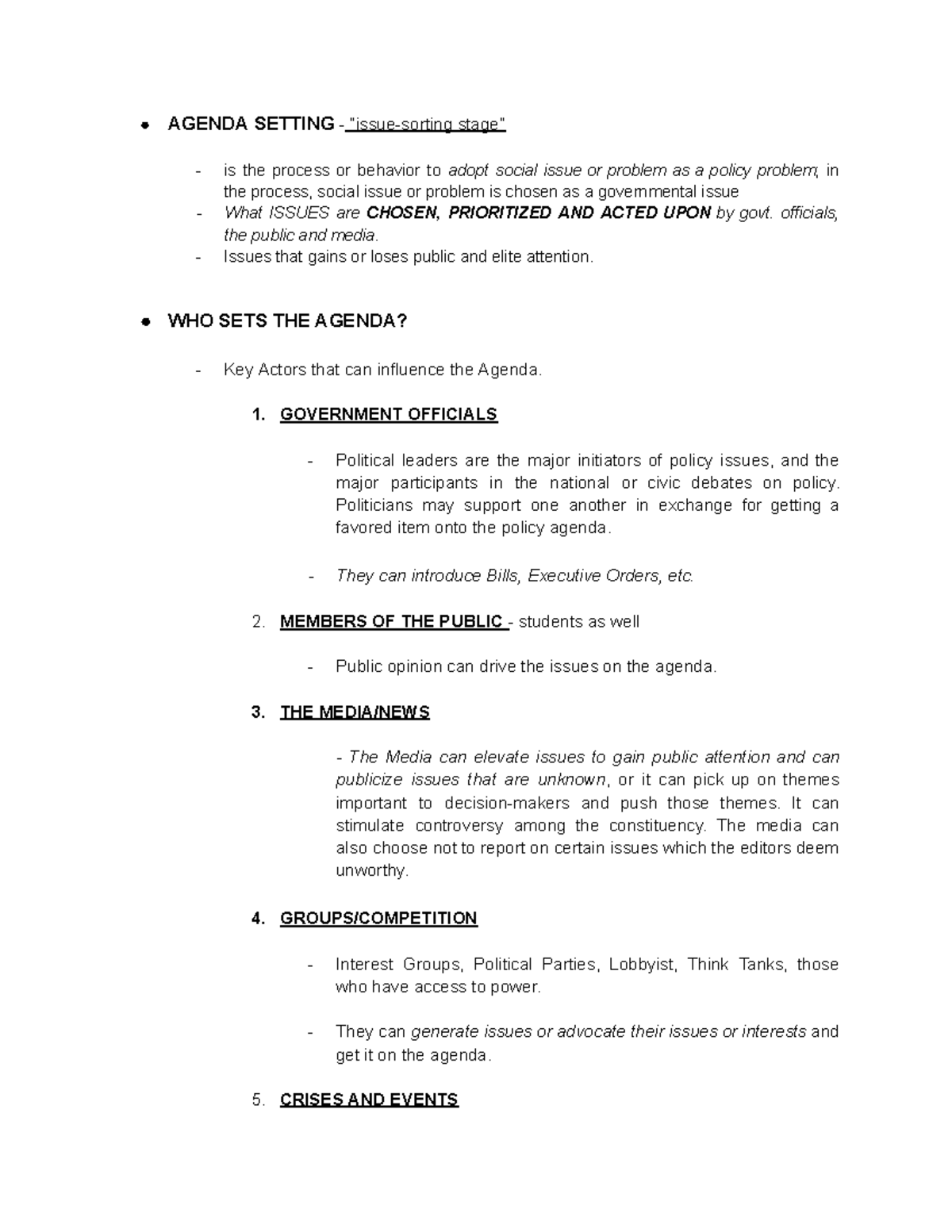
The transition from a societal problem to a government policy involves a variety of actors, each using different tools to influence the agenda.
| Actor Category | Primary Tools | Influence Mechanism |
|---|---|---|
| Elected Officials | Legislative power, Bully pulpit | Can directly place items on the formal institutional agenda. |
| Interest Groups | Lobbying, Campaign contributions | Use "inside strategies" to influence committees and "outside strategies" to mobilize the public. |
| Bureaucrats/Agencies | Technical expertise, Implementation feedback | Shape the agenda by highlighting operational failures or technical requirements in existing law. |
| Think Tanks/Academics | Research, Policy white papers | Provide the "policy stream" with viable solutions and intellectual legitimacy. |
| Media Outlets | Investigative reporting, Editorializing | Increase the salience of an issue, making it politically costly for leaders to ignore. |
| The Public | Voting, Protests, Social media mobilization | Create the "politics stream" pressure that opens or closes policy windows. |
Barriers to Agenda Access: Why Some Issues Fail
Not every important issue makes it to the policy stage. "Non-decision making" is a form of power where influential actors prevent certain issues from ever being discussed. This is often referred to as "agenda denial."
Strategies of Agenda Denial
- Death by Study: Policymakers may acknowledge a problem but assign it to a "blue-ribbon commission" or a long-term study, effectively removing it from the immediate legislative agenda.
- Jurisdictional Squabbling: Arguing over which department or committee has the authority to handle an issue can stall its progress until interest wanes.
- Symbolic Gesture: Passing a non-binding resolution or a small-scale pilot program to appease the public without committing to a comprehensive (and expensive) policy change.
- Issue Definition Attack: Opponents may argue that a problem is not a matter for the government but rather a private or individual responsibility.
Practical Steps for Shaping the Policy Agenda
For advocates, organizations, and citizens looking to influence government policy in 2026, the process requires a multi-pronged approach based on the theories of agenda setting.
- Build the Evidence Base: Ensure that the "policy stream" is ready. Before a crisis hits, have a well-vetted, technically feasible solution prepared.
- Monitor Focusing Events: Be ready to link your preferred solution to sudden, high-profile events that capture public attention.
- Form Coalitions: Broad-based coalitions increase the perceived "national mood" for change, influencing the politics stream more effectively than single-interest groups.
- Master the Frame: Use language that resonates with the current political climate. In 2026, framing issues through the lens of national security, economic resilience, or technological leadership is often more effective than purely ideological frames.
Frequently Asked Questions
How long does it usually take for an issue to move from the public agenda to the formal agenda?
There is no fixed timeline. Some issues, triggered by "focusing events" like a major economic crash or a public health emergency, can move through the levels in days. Others, such as social reforms or long-term environmental goals, can languish on the systemic agenda for decades before a policy window opens.
Can the government control the agenda, or is it always reactive?
It is a mix of both. Governments are proactive when they use the "bully pulpit" to champion new initiatives (the discretionary agenda). However, they are also inherently reactive, as they must respond to crises, economic shifts, and the recurring demands of the budget and existing statutes.
Does social media make agenda setting more democratic?
Social media has lowered the "cost of entry" for the systemic agenda, allowing marginalized groups to bring attention to issues that traditional media might ignore. However, it has also introduced challenges like misinformation and algorithmic bias, which can distort the politics stream and lead to reactive, poorly planned policies.
What happens if an issue is on the public agenda but the government ignores it?
This creates a "legitimacy gap." If the public consistently views an issue as a high priority and the institutional agenda remains stagnant, it often leads to decreased trust in government, social unrest, or significant political turnover in the next election cycle.
Why do some policies get passed but never implemented?
This is often the result of "symbolic agenda setting." Policymakers may place an issue on the formal agenda and even pass a law to satisfy public pressure, but then fail to provide the necessary funding (appropriations) or regulatory authority to the executive branch for implementation.
Final Recommendation
To effectively shape government policy, focus on the alignment of streams. Influence starts with defining the problem clearly and having a technically sound solution ready for the moment the political climate shifts. Advocates should prioritize building high public salience through strategic framing while simultaneously working within institutional "gatekeeper" circles to ensure their proposal is the first one reached for when the policy window opens.
Image Gallery