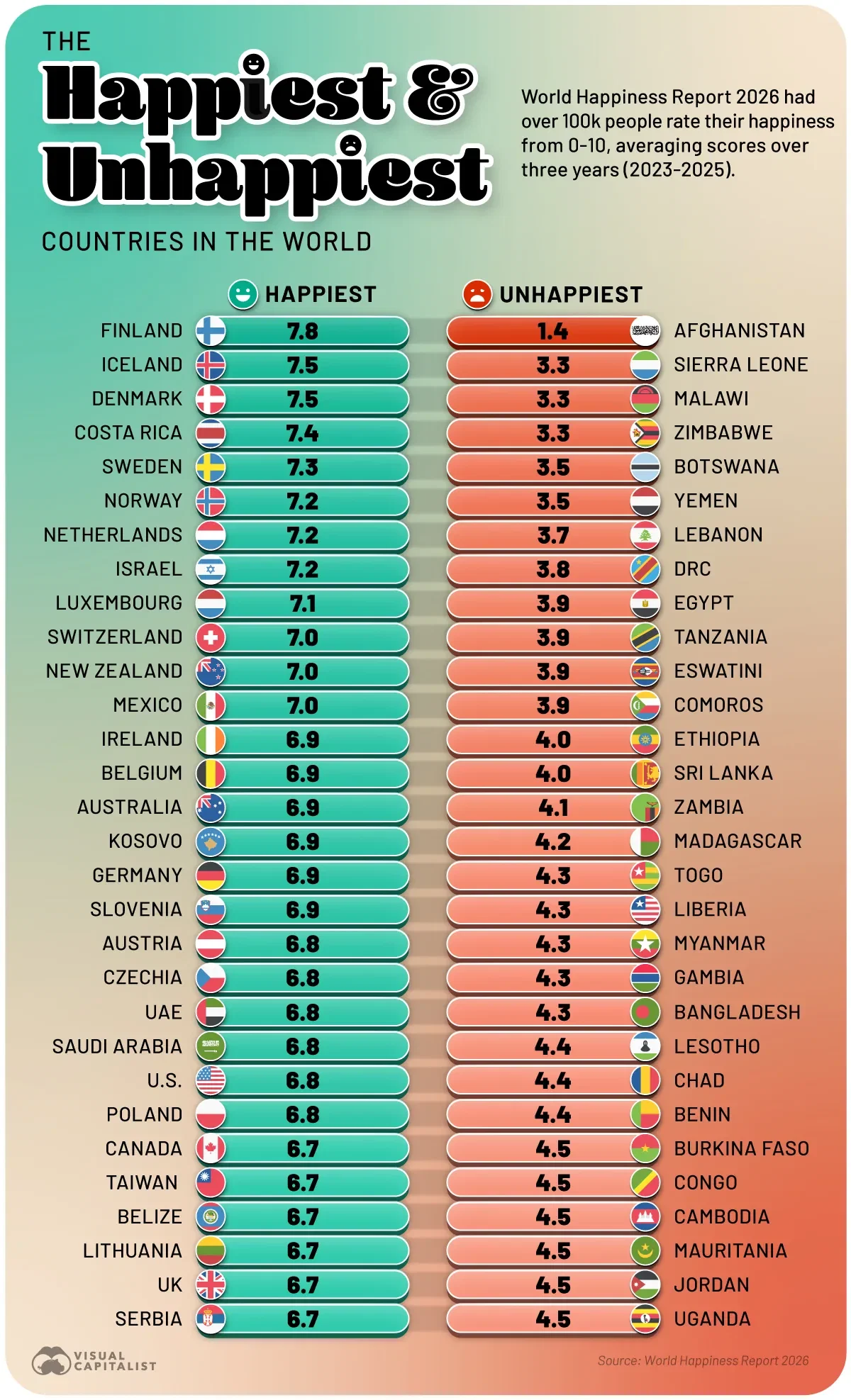
Why the Unhappiest Countries Matter for You
The well-being of the world’s most distressed nations directly influences your personal economic stability, physical security, and the global cost of living. In an interconnected 2026 economy, local despair often translates into supply...
The well-being of the world’s most distressed nations directly influences your personal economic stability, physical security, and the global cost of living. In an interconnected 2026 economy, local despair often translates into supply chain disruptions, migration pressures, and geopolitical volatility that affects the prices you pay and the safety of your digital and physical borders.
Contents
The World Happiness Report and various global well-being indices for 2026 continue to highlight a widening "happiness gap" between the world’s most and least stable nations. While it is tempting to view the suffering of distant populations as isolated events, the reality of modern globalization ensures that the "unhappiness" of a nation—often characterized by systemic corruption, lack of economic opportunity, and social distrust—acts as a catalyst for events that eventually reach your doorstep. Understanding this connection is essential for navigating the risks and responsibilities of a global citizen.
The Economic Butterfly Effect: Why Despair Impacts Your Wallet
The primary way the unhappiest countries affect you is through economic interconnectedness. Many nations that consistently rank at the bottom of happiness indices are also critical hubs for raw materials or geographic chokepoints for global trade. When a population is deeply unhappy, it is often a precursor to civil unrest, strikes, or total state failure.
For instance, consider the extraction of critical minerals required for the high-tech devices and electric vehicles that dominate the 2026 market. Many of these resources are located in regions struggling with extreme poverty and low life satisfaction. When political instability—driven by a dissatisfied populace—halts production, the supply of these minerals dries up, causing a spike in prices for electronics and energy in developed nations. You pay the "unhappiness tax" every time you buy a new smartphone or pay a utility bill influenced by global supply constraints.
Furthermore, unhappy nations rarely contribute to global consumer demand. Economic growth requires stable, happy populations that can participate in the market. When large swaths of the global population are stuck in a cycle of survival, global innovation slows down, and potential markets for domestic products remain closed. This limits the growth potential of international investment portfolios, including retirement funds and personal stock holdings.
Global Health Security and the Risk of Neglected Despair
Public health is perhaps the most visceral reason why the unhappiest countries matter for you. Chronic unhappiness is frequently tied to the collapse of public institutions, including healthcare and sanitation. Areas where the government fails to provide basic happiness and security often become breeding grounds for infectious diseases.
History has shown that a localized outbreak in a high-distress region can become a global pandemic in a matter of weeks. In 2026, as international travel remains at peak levels, the health of a citizen in a low-ranking happiness nation is inextricably linked to your own health. When people are unhappy and distrustful of their government, they are less likely to participate in vaccination programs or follow health protocols, allowing pathogens to mutate and spread.
By ignoring the structural causes of unhappiness in these regions—such as lack of clean water, poor nutrition, and mental health crises—the international community leaves a "blind spot" in the global immune system. Investing in the well-being of these populations is not just an act of charity; it is a fundamental strategy for global biosurveillance and pandemic prevention.
Migration Pressures and Social Infrastructure
The correlation between low happiness scores and high outward migration is undeniable. People do not flee their homes because they want to; they flee because the environment has become unbearable. High levels of unhappiness, often caused by lack of freedom and economic stagnation, drive millions to seek better lives in more stable countries.
For the resident of a stable nation, this manifests in several ways:
- Taxation and Resource Allocation: Managing sudden influxes of refugees requires significant public funding for housing, healthcare, and processing.
- Political Polarization: In many developed nations, the debate over how to handle migration from "unhappy" regions has led to extreme social and political division, affecting the quality of local governance.
- Labor Market Shifts: While migration can solve labor shortages, rapid and unplanned shifts can strain local infrastructure and social services in the short term.
Addressing the "unhappiness" at the source is the only sustainable way to manage global migration. When people have a sense of purpose, safety, and a future in their own countries, the pressure on international borders decreases, leading to more predictable and manageable social growth for everyone.
The Security Cost of Global Inequality
Unhappiness is a primary driver of radicalization. When individuals feel they have no stake in the current global order—when they are chronically unhappy and marginalized—they become vulnerable to recruitment by extremist groups or criminal syndicates. These organizations thrive in the "unhappiness vacuum" where the state has failed to provide meaning or security.
In 2026, the reach of these groups is not limited by geography. Cybercrime, human trafficking, and international terrorism are the exports of high-distress regions. A cyberattack on your local bank or a disruption in global shipping lanes can often be traced back to regions where the lack of legitimate opportunity has turned the population toward illicit activities. Your digital safety is, in many ways, dependent on the level of social cohesion and satisfaction in countries halfway across the globe.
Comparing Indicators: How Unhappiness Resonates Globally
The following table illustrates how specific indicators of national unhappiness create direct consequences for individuals in stable, high-happiness countries.
| Indicator of Unhappiness | Primary Cause | Direct Impact on "You" |
|---|---|---|
| High Corruption | Lack of institutional trust | Increased costs for international business and higher prices for consumers. |
| Low Social Support | Isolation and weak community | Increased demand for international aid and higher migration pressures. |
| Economic Instability | Hyperinflation or lack of jobs | Supply chain disruptions and volatility in global investment markets. |
| Lack of Freedom | Authoritarianism or systemic oppression | Geopolitical tension, trade wars, and potential for military conflict. |
| Poor Health Access | Failing public infrastructure | Increased risk of global disease transmission and antibiotic resistance. |
The Moral and Psychological Burden
Beyond the practical and economic reasons, the unhappiest countries matter because of our shared humanity. In a world of instant communication, we are constantly exposed to the suffering of others. Research in 2026 suggests that "empathy fatigue" and the psychological weight of global inequality can impact the mental well-being of those in even the happiest nations.
Living in a world where extreme misery is common creates a sense of systemic guilt and anxiety. It challenges the ethical foundations of global trade and policy. If your lifestyle is supported by the labor of people living in the unhappiest conditions on earth, the sustainability of that lifestyle is both ethically and practically questionable. Improving global happiness creates a more harmonious psychological environment for everyone, reducing the "well-being inequality" that fuels global resentment.
FAQs
Can we just isolate ourselves from the unhappiest countries?
In the modern era, total isolation is impossible. Our economies are too deeply integrated through the internet, global finance, and shared resources. Attempting to isolate often leads to "blind spots" in security and health that eventually cause more damage when a crisis inevitably leaks across borders.
Is happiness a luxury or a necessity for a nation's stability?
Happiness, as measured by social scientists, is a necessity. It is a proxy for the functionality of a state. It includes things like trust in government, the absence of corruption, and the ability to live without fear. When these are missing, a nation becomes inherently unstable, which poses a risk to global order.
How does the World Happiness Report gather its data?
The report primarily uses the Gallup World Poll, which asks residents in over 140 countries to rate their own lives on a scale of 0 to 10. This is then analyzed alongside variables like GDP per capita, social support, healthy life expectancy, freedom, and levels of corruption.
Does foreign aid actually help increase happiness in these regions?
Foreign aid is effective when it is targeted toward building "social capital" and institutional trust. Projects that focus on education, healthcare infrastructure, and anti-corruption measures have a higher success rate in long-term happiness improvement than simple cash transfers, which can sometimes be diverted by corrupt officials.
How can I personally track the impact of global unhappiness?
You can monitor global indices such as the World Happiness Report and the Fragile States Index. Additionally, paying attention to the origins of your consumer goods and the geopolitical health of those regions can give you a clearer picture of your personal "risk profile" regarding global unhappiness.
Practical Recommendations for 2026
To mitigate the risks associated with global unhappiness, individuals and businesses should adopt a proactive stance. First, diversify your personal or business supply chains. Relying on a single region that ranks low on stability and happiness is a high-risk strategy. Second, support ethical consumerism. By choosing products that are certified for fair labor and ethical sourcing, you contribute to the economic well-being of workers in high-distress areas, which is a foundational step toward increasing their national happiness. Finally, stay informed about global health and security trends. Understanding that a crisis in a "low-happiness" nation is a leading indicator for global volatility allows you to make better decisions regarding your investments, travel, and personal safety.
Image Gallery