The Difference Between Distributor and Wholesaler Explained for Your Business
A distributor works as a direct partner to manufacturers, managing marketing, channel strategy, and regional sales for specific brand lines. A wholesaler buys goods in bulk from manufacturers or distributors and resells them in smaller...
A distributor works as a direct partner to manufacturers, managing marketing, channel strategy, and regional sales for specific brand lines. A wholesaler buys goods in bulk from manufacturers or distributors and resells them in smaller quantities to retailers. While both sit between producers and buyers, their contracts, sales focus, and services differ significantly.
Contents
Supply Chain Architecture: Where Distributors and Wholesalers Fit
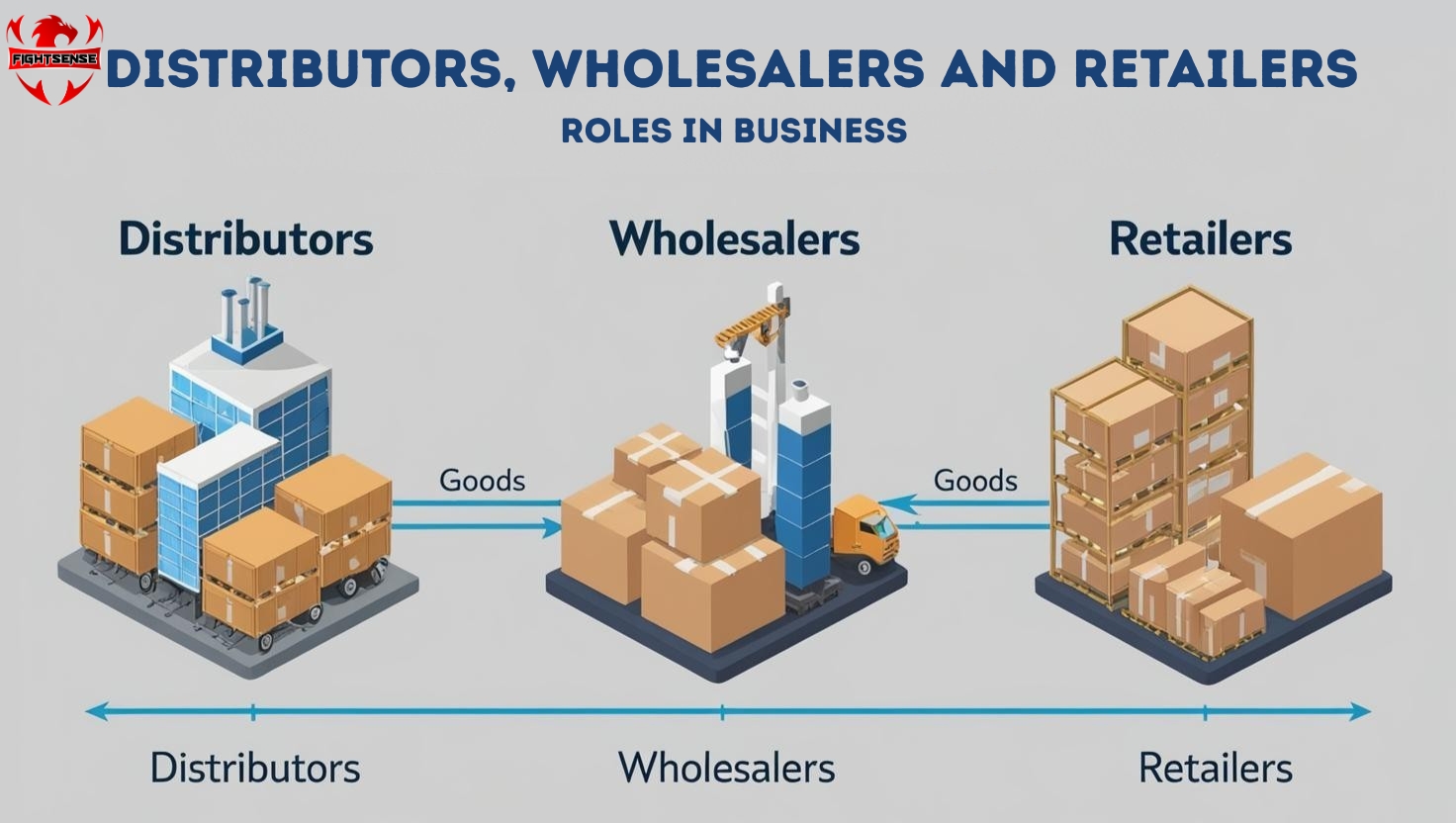
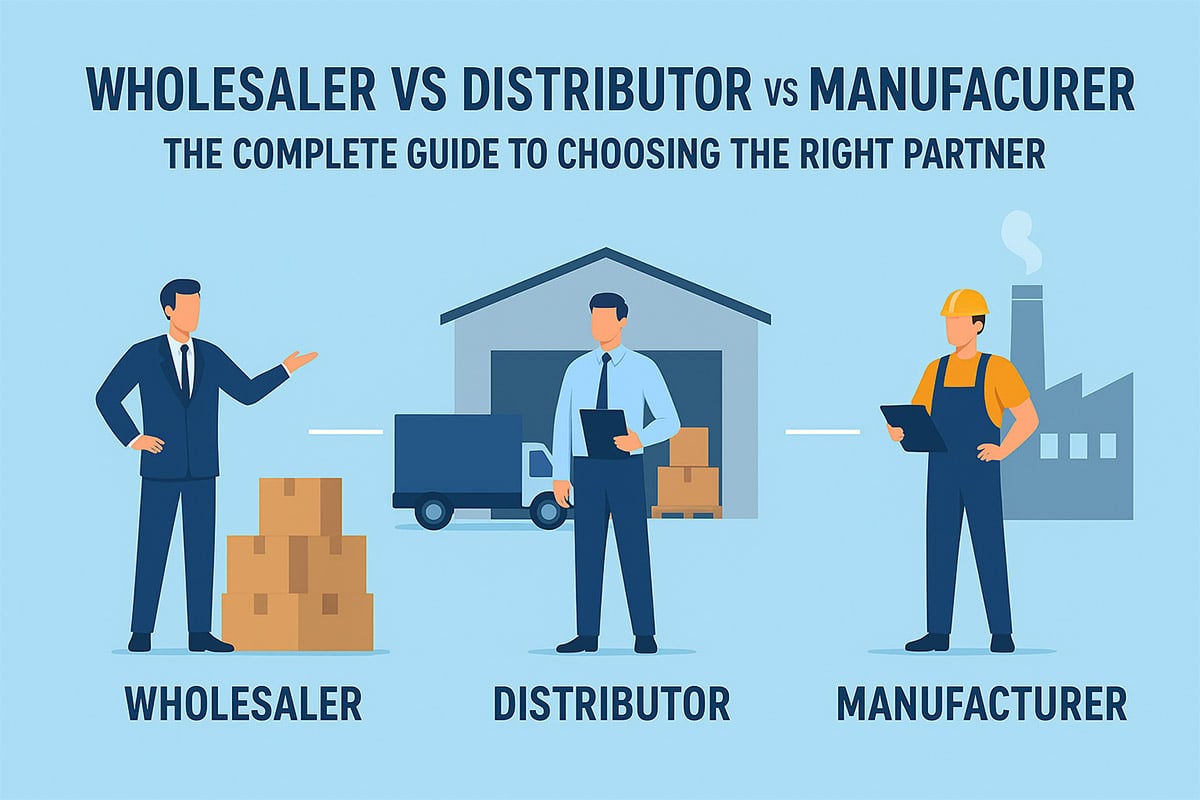
Every physical product moving from raw production to an end consumer relies on a structured distribution network. Understanding the flow of inventory, capital, and risk requires looking at the traditional supply chain sequence:
- Manufacturer / Producer: Formulates, designs, and manufactures goods at scale.
- Distributor: Establishes direct commercial relationships with manufacturers to manage market entry, regional logistics, brand strategy, and trade channels.
- Wholesaler: Purchases broad arrays of inventory in large batches from distributors or producers, aggregates products across multiple brands, and breaks bulk for smaller buyers.
- Retailer / Merchant: Acquires curated stock from wholesalers or distributors to sell directly to consumers via physical or digital storefronts.
- End Consumer: Purchases individual units for personal or operational use.
While this sequence looks linear on paper, modern supply networks frequently adapt. Some manufacturers bypass distributors to sell straight to wholesalers, while large retail conglomerates occasionally procure directly from distributors or original equipment manufacturers (OEMs).
Selecting the right commercial partner requires understanding how distributors and wholesalers function, how they generate profit, and how their contractual obligations impact your business strategy.
What Is a Distributor?
A distributor operates as an strategic extension of the manufacturer within a designated market or geographic territory. Rather than functioning simply as a passive warehouse, a distributor takes an active role in building product demand, expanding merchant coverage, managing technical support, and protecting brand equity.
- Manufacturer
- Distributor
- Holds territorial rights & contracts
- Conducts active marketing & sales outreach
- Provides warranty support & technical training
- Wholesaler
- Aggregates brands
- Breaks bulk orders
- Enterprise Buyer
- Large retail chains
- Industrial clients
- Distributor
Core Responsibilities of a Distributor
- Territorial Alignment and Exclusive Rights: Distributors frequently hold exclusive or semi-exclusive distribution agreements for defined regions, countries, or market segments. In exchange for exclusivity, they commit to strict sales targets set by the manufacturer.
- Active Marketing and Brand Representation: Unlike passive intermediaries, distributors run promotional campaigns, sponsor industry trade shows, manage regional field sales teams, and create marketing materials tailored to local markets.
- Technical Support and Product Training: In sectors such as industrial machinery, medical devices, auto parts, and consumer electronics, distributors train retail sales staffs, handle warranty claims, process product recalls, and maintain spare parts inventories.
- Channel Development: Distributors actively solicit new wholesale, retail, and commercial enterprise accounts, building network density for the manufacturer's product line.
How Distributors Make Money
Distributors generate revenue primarily by purchasing inventory from manufacturers at deeply discounted wholesale price tiers and selling it to down-market channels at contracted margins. Because distributors incur heavy operational expenses—such as maintaining dedicated field sales reps, regional warehousing, and specialized logistics—their gross margins per unit are structured to support intensive business development activities.
In some business models, distributors act on a sales agency or brokerage framework, earning performance-based commissions on orders placed through established corporate channels.
What Is a Wholesaler?
A wholesaler is an intermediary focused on buying large quantities of goods, holding that inventory, and breaking it down into smaller, manageable commercial orders for retailers, commercial contractors, and local institutions. Where a distributor prioritizes deep brand alignment and market growth for a select vendor list, a wholesaler prioritizes operational efficiency, product selection variety, and localized fulfillment speed.
Core Responsibilities of a Wholesaler
- Bulk Breaking: Wholesalers purchase products in full truckloads, ocean containers, or master cartons, then split these shipments into smaller case quantities that independent retailers can purchase without straining their working capital.
- Broad Catalog Curation: Rather than representing a single manufacturer exclusively, a wholesaler maintains stock across dozens or hundreds of competing brands within a specific industry category (e.g., plumbing supplies, dry groceries, or office goods).
- Inventory Buffering and Short-Term Logistics: Wholesalers reduce lead times for local businesses by maintaining immediate stock in regional distribution centers. Retailers can order small replenishment lots for quick delivery rather than waiting weeks for direct manufacturing runs.
- Trade Credit Provision: Wholesalers frequently offer trade credit terms—such as Net 30 or Net 60 payment windows—to vetted retail accounts, effectively financing inventory for smaller merchants while bearing the underlying credit risk.
How Wholesalers Make Money
Wholesalers earn profit on the spread between high-volume purchase pricing and smaller-quantity resale pricing. Their financial efficiency hinges on inventory turnover velocity and warehousing density rather than high per-unit profit margins. A successful wholesaler keeps holding costs low, optimizes warehouse pick-and-pack operations, and maintains reliable cash flow across thousands of recurring purchase orders.
Key Operational and Strategic Differences
To evaluate which model fits your operational model, examine how distributors and wholesalers contrast across critical business functions:
| Operational Dimension | Distributor | Wholesaler |
|---|---|---|
| Primary Focus | Brand growth & market extension | Fulfillment & inventory velocity |
| Product Portfolio | Focused / Selective brand lines | Broad / Multi-brand competitive |
| Territory Rights | Often exclusive per region | Rarely exclusive |
| Target Customer | Wholesalers, chains, enterprise | Retailers, independent merchants |
| Value-Added Services | Marketing, support, training | Warehousing, bulk breaking |
1. Manufacturer Relationship and Contractual Binding
Distributors maintain formal, long-term legal agreements with manufacturers that specify minimum purchase requirements, strict territory boundaries, pricing guidelines, and brand compliance policies.
Wholesalers typically operate on commercial merchant terms. While they maintain standard account arrangements with vendors, they are rarely bound to exclusive brand representation agreements and can freely stock competing product lines alongside one another.
2. Product Portfolio Scope
A distributor’s catalog is intentionally focused, reflecting the specific manufacturers they represent. They specialize deeply in those product lines to provide high-touch sales rep support and technical expertise.
Conversely, a wholesaler builds a broad product catalog designed to give retail buyers a one-stop procurement source. A building supplies wholesaler, for example, will stock competing brands of fasteners, adhesives, and hand tools side by side.
3. Sales Strategy and Demand Creation
Distributors generate market demand through proactive outbound sales campaigns, trade advertising, direct account pitching, and dealer enablement programs.
Wholesalers generally rely on inbound demand created by brand awareness or existing retail need. Their sales teams prioritize order fulfillment speed, account order frequency, account retention, and inventory availability over cold-prospect outreach.
4. Minimum Order Quantities (MOQs) and Pricing
Distributors enforce high Minimum Order Quantities (MOQs) designed for bulk buyers, large retail chains, or secondary stocking entities. Their pricing tiers reward major volume commitments.
Wholesalers establish lower MOQs, making inventory accessible to independent retailers and smaller commercial businesses that cannot absorb high volume commitments or hold excess stock in warehouse facilities.
Comparison Matrix: Distributor vs. Wholesaler
| Functional Feature | Distributor | Wholesaler |
|---|---|---|
| Primary Counterparty | Manufacturer / Producer | Distributor or Manufacturer |
| Primary Downstream Customer | Wholesalers, Large Chains, Commercial Users | Independent Retailers, E-commerce Sellers, Service Providers |
| Territorial Exclusivity | Common (Contractually Defined) | Rare / Non-Existent |
| Sales Force Direction | Outbound field sales, channel development | Inbound account management, catalog sales |
| Inventory Breadth | Narrow & deep (focused brand portfolio) | Wide & varied (multiple competing brands) |
| Marketing Obligations | High (co-op advertising, demos, trade shows) | Low (focused on catalog placement & promotions) |
| Customer Support Role | Technical training, warranty servicing, claims | Basic order tracking, return authorizations |
| Logistical Specialty | Regional freight movement, bulk storage | Order consolidation, pick-and-pack, local delivery |
| Working Capital Focus | Managing long lead-time inventory risk | Maximizing inventory turnover rate |
Strategic Guide: Which Partner Does Your Business Need?
Determining whether to work with a distributor or a wholesaler depends on where your business sits in the supply chain and your operational priorities.
- Are You a Manufacturer or a Buyer?
- Manufacturer
- Needs market entry, brand control, and field marketing?
- Distributor
- Buyer
- Needs stock variety, low MOQs, and fast local delivery?
- Wholesaler
- Manufacturer
If You Are a Manufacturer
- Partner with a Distributor if: You are launching a product line in a new region, require specialized sales teams to explain your product's technical advantages, or want to protect brand integrity through controlled pricing guidelines. Distributors give you a single point of contact to scale into hundreds of retail doors without managing individual merchant relationships yourself.
- Partner directly with a Wholesaler if: Your product is a standardized commodity, consumer demand is established, and your primary goal is maximizing retail door count through automated wholesale catalog placement without spending capital on specialized sales support.
If You Are a Retailer or E-Commerce Business
- Buy from a Distributor if: You operate a specialized retail business, carry complex or high-ticket inventory (such as high-end electronics, power equipment, or specialized medical goods), and require direct vendor sales collateral, warranty backup, and staff product training.
- Buy from a Wholesaler if: You run a retail storefront requiring diverse, multi-brand inventory in small batch sizes. Wholesalers let you maintain low inventory holding costs by ordering small replenishment lots as items sell through your point-of-sale system.
Legal, Financial, and Contractual Frameworks
Engaging either partner type requires establishing clear commercial terms to protect cash flow and legal standing.
Pricing Rules and MAP Compliance
Distributors are usually contractually required to enforce Minimum Advertised Price (MAP) guidelines established by manufacturers. This prevents predatory price slashing across online marketplaces that damages brand value. Wholesalers, while generally subject to standard resale price policies, monitor MAP compliance less strictly due to their diversified inventory lines.
Payment Terms and Credit Lines
Both entities rely heavily on trade credit terms to sustain operations. Manufacturers often extend 60-day or 90-day credit windows to distributors to offset long transit times and high storage volumes. Wholesalers, operating on tighter turnover schedules, typically offer Net 30 terms to retailers, sometimes extending 2% early-payment discounts for accounts settled within 10 days (2/10 Net 30 terms).
Freight and Risk Allocation
Supply agreements must clearly outline where product ownership and transport risks transfer:
- FOB Origin (Free On Board): Ownership and financial risk shift to the buyer once the freight is loaded onto the transport vehicle at the origin warehouse.
- FOB Destination: The seller maintains ownership, risk, and transit insurance responsibilities until the delivery truck arrives and unloads at the buyer’s facility.
Distributors often handle complex international freight, customs clearance, and import compliance obligations. Wholesalers typically work with domestic freight logistics and localized short-haul delivery networks.
Frequently Asked Questions
Can a single company act as both a distributor and a wholesaler?
Yes. Hybrid model enterprises are common in complex industries such as beverage distribution, auto parts, and specialty electronics. A business may act as an exclusive regional distributor for select international brands while simultaneously operating a general wholesale division that supplies local retailers with non-exclusive items.
How do minimum order quantities (MOQs) compare between distributors and wholesalers?
Distributors maintain significantly higher MOQs—often measured in full pallet loads, container counts, or substantial dollar thresholds—because they handle high-volume shipments directly from manufacturers. Wholesalers establish lower MOQs, often allowing buyers to purchase single master cartons or mixed-product cases to support small-scale retail operations.
Who handles product warranties and defective item returns?
Distributors manage formal warranty returns, technical claims, and product defect processing on behalf of the manufacturer. Wholesalers generally handle immediate return processing for goods damaged in transit, but direct customers to the distributor or original manufacturer for long-term technical support and warranty claims.
Why do some manufacturers skip distributors to sell directly to wholesalers?
Manufacturers with established brand recognition, standardized packaged consumer goods, or direct-to-retail sales reps may bypass distributors to trim intermediary margins. By selling directly to wholesalers, the manufacturer retains greater pricing control while relying on the wholesaler solely for warehousing, order picking, and localized physical distribution.
Which partner offers better profit margins for a retail business?
Direct pricing from a distributor is generally lower per unit than a wholesaler's pricing, but accessing distributor rates requires purchasing large volumes that strain working capital. Wholesalers charge a slightly higher price per unit, but their lower minimum order thresholds reduce inventory carrying costs, capital lockup, and excess stock risks for small-to-midsize retailers.
Practical Next Steps for Your Channel Strategy
To determine the ideal commercial path for your company, conduct a complete inventory and capital evaluation:
- Map Your Distribution Requirements: Calculate your current working capital, available warehouse storage capacity, and target inventory turnover rate.
- Review Manufacturer Requirements: If you are a manufacturer, decide whether your product demands technical support, active outbound sales, and brand protection (choose a distributor) or fast market distribution and catalog depth (choose a wholesaler).
- Audit Vendor Terms: Compare vendor proposals by assessing unit margins alongside Minimum Order Quantities (MOQs), shipping costs, payment terms, and return allowances.
- Draft Written Agreements: Work with commercial legal counsel to establish contracts covering territorial protection, Minimum Advertised Price (MAP) policies, credit terms, and liability limits before issuing or accepting purchase orders.
Image Gallery