Warrants versus Options: Key Differences, Mechanics, and Investment Impact
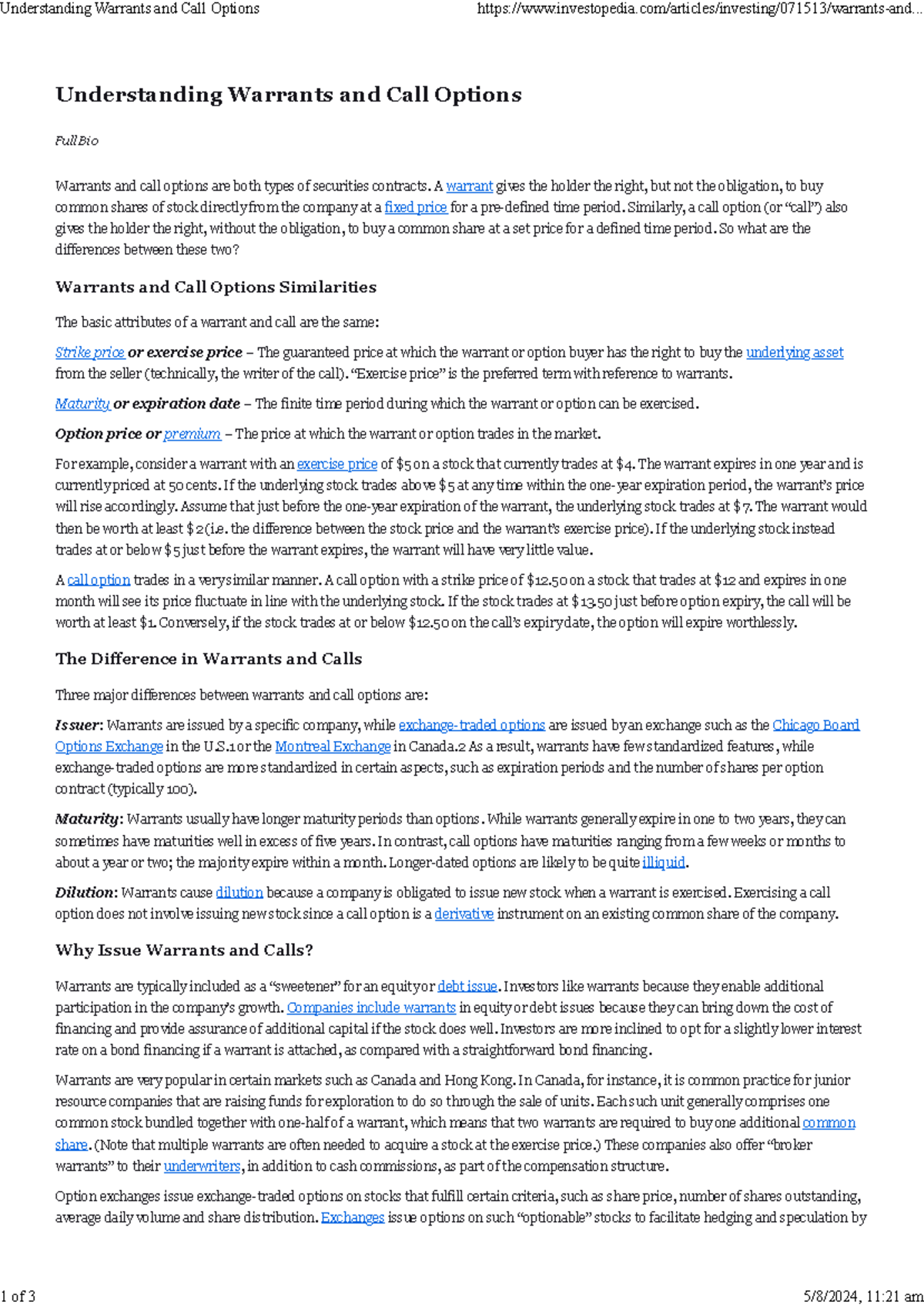
Stock warrants and stock options both give investors the contractual right to purchase or sell an underlying stock at a specified price within a designated timeframe. However, warrants are issued directly by corporations to raise capit...
Stock warrants and stock options both give investors the contractual right to purchase or sell an underlying stock at a specified price within a designated timeframe. However, warrants are issued directly by corporations to raise capital, resulting in share dilution upon exercise. In contrast, options are standardized derivative contracts created and traded between secondary market investors without altering a company's share count.
Contents
Fundamental Definitions: Understanding Options and Warrants
While both financial instruments operate as leveraged derivatives—granting asymmetric exposure to price movements of an underlying equity—their origin, structural mechanics, and purpose in financial markets differ significantly.
Exchange-Traded Options Explained
An option is a standardized derivative contract created by public market participants rather than the issuing corporation. The most common exchange-traded equity options are cleared through organizations like the Options Clearing Corporation (OCC) in the United States.
There are two primary types of options:
- Call Options: Grant the buyer the right, but not the obligation, to buy 100 shares of an underlying stock at a specified strike price before or at expiration.
- Put Options: Grant the buyer the right, but not the obligation, to sell 100 shares of an underlying stock at a specified strike price before or at expiration.
Because options are standardized contracts traded on open secondary exchanges (such as the Chicago Board Options Exchange), one market participant buys a contract written by another participant. The company whose stock underlies the option receives no cash, issues no new shares, and plays no role in the transaction.
Equity Warrants Explained
A warrant is an equity derivative issued directly by a public or private company. When an investor exercises a call warrant, they purchase shares directly from the issuing entity at a predetermined price (the exercise price).
Corporations issue warrants for strategic financial purposes:
- Sweeteners for Debt Financing: Companies issuing corporate bonds or preferred stock frequently attach warrants to lower the coupon interest rate required by lenders.
- SPAC Offerings: Special Purpose Acquisition Companies (SPACs) routinely issue public units containing both common shares and fractional warrants to attract initial investor capital.
- Reorganization and Restructuring: Companies emerging from bankruptcy or corporate restructuring often grant warrants to existing creditors or stakeholders as compensation.
Unlike standard exchange-traded call options, exercising a warrant forces the corporation to issue brand-new common shares. The exercise price paid by the warrant holder flows directly onto the company's balance sheet as equity capital.
Warrants versus Options: Side-by-Side Comparison
The core distinction between warrants and options lies in whether the instrument is a corporate capital-raising tool or an investor-to-investor trading contract.
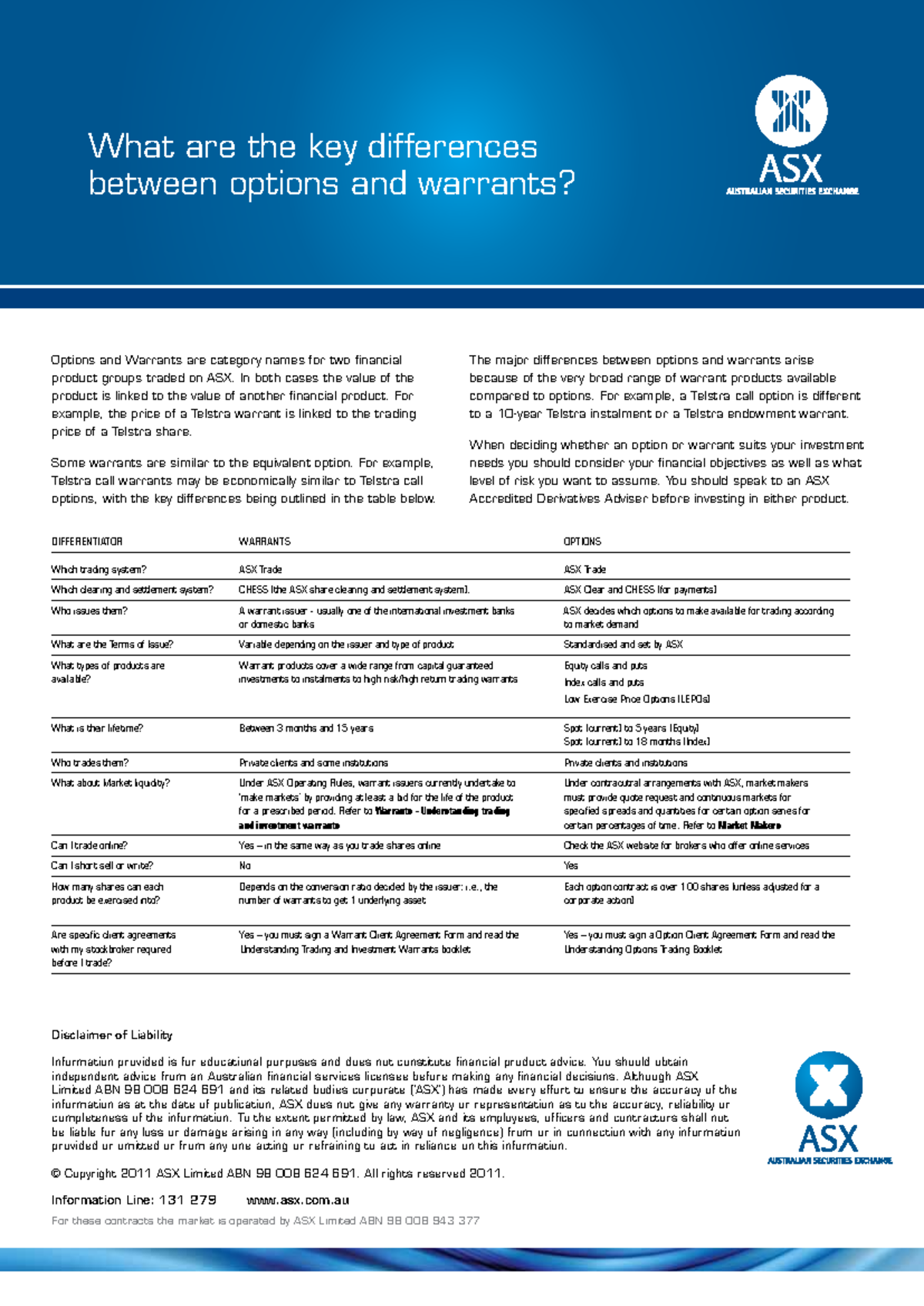
| Dimension | Stock Option | Stock Warrant |
|---|---|---|
| Issuing Entity | Market participants / Clearinghouses | The underlying corporation |
| Share Creation | None (existing shares change hands) | New shares are minted upon exercise |
| Dilution Effect | Non-dilutive | Dilutive to existing shareholders |
| Cash Proceeds Recipient | The seller (writer) of the option contract | The issuing corporation |
| Lifespan / Expiration | Short to medium term (typically 1 day to 2.5 years) | Long term (typically 2 to 10+ years) |
| Contract Standardization | Fully standardized (100 shares per contract, uniform strikes) | Company-defined terms (varies per issuance agreement) |
| Secondary Market Trading | Public exchanges (e.g., CBOE, Nasdaq) | Public exchanges or Over-the-Counter (OTC) |
| Put Availability | Widely available (Put options are standard) | Rare (Most warrants are call-style instruments) |
Key Differences Analyzed
Understanding how warrants and options function in practice requires evaluating four key structural dimensions: issuance, dilution, longevity, and contract terms.
[Option Exercise] --> Investor A buys existing shares from Investor B (No company involvement) [Warrant Exercise] --> Investor buys newly issued shares directly from Company (Company receives cash, share count increases)
1. Issuer and Cash Proceeds
When an investor buys an exchange-traded option, the counterparty is another trader or market maker. The premium paid for the option goes directly to the option seller (writer). If the option is exercised, the option seller must deliver existing shares from their account or purchase them in the open market. The issuing company receives zero capital from option trades.
When an investor exercises a warrant, the transaction is executed directly with the issuing company. The investor pays the exercise price to the corporation's treasury, providing the company with immediate cash proceeds. This makes warrants an important capital-raising mechanism for growth-stage businesses or firms looking to reduce borrowing costs.
2. Share Dilution and Capital Structure Effects
Because exercising an option merely transfers existing shares between two private parties, it has no impact on a company's shares outstanding, earnings per share (EPS), or capital structure.
Conversely, exercising a warrant requires the company to issue new equity shares. This increases the total outstanding share count, which dilutes the ownership percentage of existing common shareholders and reduces basic earnings per share. Equity analysts carefully adjust for this potential share creation by tracking diluted earnings per share, incorporating unexercised in-the-money warrants into their financial models.
3. Expiration Dates and Lifespan
Standard exchange-traded options have relatively short lifespans. Standard monthly or weekly options expire within days, weeks, or months. Long-Term Equity Anticipation Securities (LEAPS) extend option maturities up to approximately 2.5 to 3 years.
Warrants are designed for longer horizons. It is common for equity warrants to have maturity periods ranging from 2 to 5 years, with some corporate debt-attached warrants extending to 10 years or longer. This extended lifespan gives holders a long window for the company's equity value to exceed the warrant exercise price.
4. Standardization vs. Custom Terms
Option contracts are rigidly standardized by clearing institutions like the OCC to facilitate liquidity. In North America, one equity option contract almost always covers exactly 100 shares of stock, with standardized strike price intervals and uniform expiration cycles.
Warrant terms are defined individually by the issuing company's warrant agreement:
- A single warrant might entitle the holder to purchase 1 share, 0.5 shares, or multiple shares.
- Warrants may include adjustment clauses for stock splits, dividends, or corporate restructuring.
- Companies may include callability provisions, allowing the firm to force warrant redemption if the common stock trades above a target threshold for a specified number of consecutive trading days.
Pricing and Valuation Considerations
Both options and warrants derive their intrinsic and time value from the price of the underlying equity, volatility, time to expiration, risk-free interest rates, and expected dividend yields.
The Black-Scholes Model Adaptation
The standard Black-Scholes option pricing model calculates the theoretical value of exchange-traded options based on five primary inputs:
$$\text{Option Value} = f(S, K, T, r, \sigma)$$
Where:
- $S$ = Current stock price
- $K$ = Strike price
- $T$ = Time until expiration
- $r$ = Risk-free interest rate
- $\sigma$ = Implied volatility
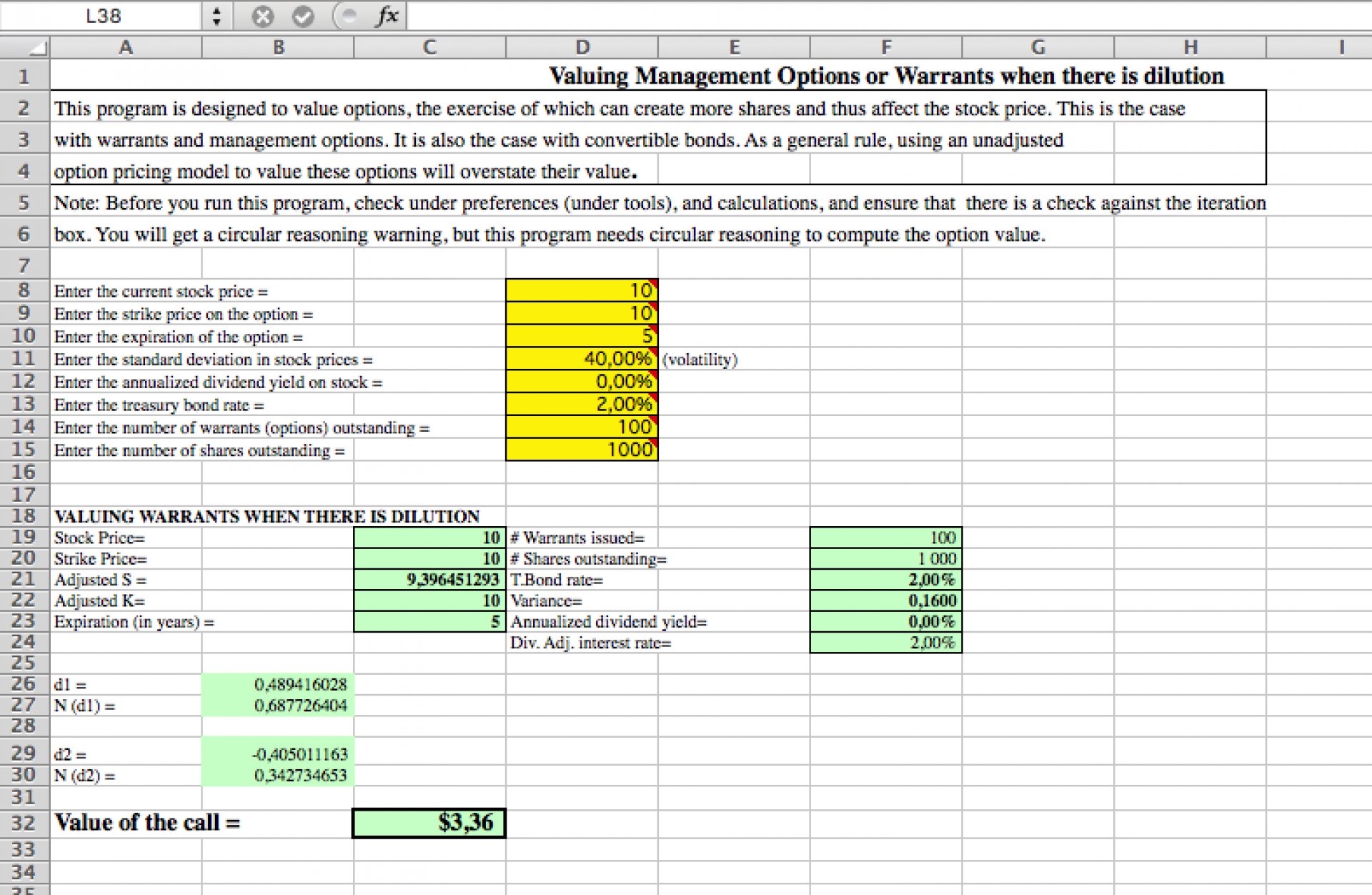
However, applying the standard Black-Scholes model directly to corporate warrants produces an overestimation of value. Because exercising a warrant creates new shares and dilutes the value of existing equity, valuation formulas must incorporate a dilution adjustment factor:
$$\text{Warrant Value} = \left( \frac{N}{N + M} \right) \times \text{Black-Scholes Option Value}$$
Where $N$ represents the existing number of outstanding shares and $M$ represents the number of new shares created if all warrants are exercised. The factor $\frac{N}{N + M}$ accounts for the post-exercise dilution of company value across a larger total share base.
Tax Implications for Investors
Tax treatments for options and warrants depend on the investor's jurisdiction, holding period, and how the contract was acquired.
Options Taxation
For investors trading standard equity options on public exchanges in the United States, tax rules fall under the guidelines established by the Internal Revenue Service (IRS) via Publication 550:
- Purchased Options: If a purchased option expires worthless, the loss is treated as a capital loss on the expiration date. If exercised, the premium paid is added to the cost basis of the acquired stock.
- Section 1256 Contracts: Non-equity options (such as broad-based index options) receive broad 60/40 tax treatment (60% long-term, 40% short-term capital gains regardless of holding period). Standard single-stock options do not qualify for Section 1256 treatment and follow standard short-term or long-term capital gains rules based on holding length.
Warrants Taxation
- Publicly Traded Warrants: Buying a detachable public warrant on the open market and selling it later generates a capital gain or loss based on the holding period.
- Exercise of Warrants: Exercising a warrant does not trigger an immediate taxable gain for the investor. Instead, the exercise price paid plus the original cost basis of the warrant forms the cost basis for the newly issued shares. The holding period for long-term capital gains begins on the exercise date, not the original warrant purchase date.
Disclaimer: Tax laws differ significantly by region and individual financial circumstances. Investors should consult a qualified tax professional before executing transactions.
Frequently Asked Questions
Can retail investors buy and sell stock warrants?
Yes. Many corporate warrants are publicly listed on major exchanges (such as the NYSE or Nasdaq) or over-the-counter (OTC) markets under unique ticker symbols (often ending in ".WS" or "+"). Retail investors can trade these detachable warrants through standard brokerage accounts.
What happens to a warrant if the issuing company goes bankrupt?
In corporate bankruptcy or liquidation, common shareholders and warrant holders sit at the bottom of the capital structure. Because warrants are contingent equity claims, they typically become worthless during a reorganization unless specific rights are negotiated as part of the bankruptcy proceedings.
Are employee stock options (ESOs) the same as warrants?
Employee stock options share features with warrants because both are granted directly by the corporation and can result in share dilution upon exercise. However, ESOs are non-transferable compensation contracts granted to employees, whereas warrants are financial instruments that can often be detached and traded publicly between third parties.
Why do companies issue units containing both stock and warrants?
Companies issue combined units—most notably during Initial Public Offerings (IPOs) or SPAC launches—to incentivize investors to commit early capital. The attached warrant acts as a financial bonus, offering upside potential if the company prospers while limiting initial equity dilution for the firm until the exercise criteria are met.
Actionable Takeaways for Investors and Financial Analysts
- Check for Dilution Potential: When evaluating a company with active warrants (such as a recent SPAC or a company emerging from debt restructuring), review the diluted share count in regulatory filings with agencies like the U.S. Securities and Exchange Commission to measure potential earnings dilution.
- Monitor Redemption Provisions: If trading corporate warrants, read the underlying warrant agreement carefully. Note any forced redemption clauses that allow the company to call the warrants early if the common stock trades above a specific price threshold.
- Choose Options for Short-Term Hedging: Use exchange-traded options when looking for short-term leverage, downside protection (puts), or standardized liquidity, as options do not carry warrant-specific redemption risk or corporate structure constraints.
Image Gallery