Understanding Basic Paper Sizes: ISO, North American, and Technical Standards Guide
A basic paper size refers to any standard physical dimension used for printing, writing, and packaging. Globally, paper sizes are categorized into two primary systems: the international ISO 216 standard (utilizing the A, B, and C serie...
A basic paper size refers to any standard physical dimension used for printing, writing, and packaging. Globally, paper sizes are categorized into two primary systems: the international ISO 216 standard (utilizing the A, B, and C series based on a metric aspect ratio) and the North American standard (including US Letter, Legal, Tabloid, ANSI, and Architectural sizes defined in inches).
Contents
Paper dimensions affect everything from document printing, graphic design layout, and publication binding to international shipping costs and office equipment compatibility. Navigating these specifications requires understanding how measurements are structured across standard series, how aspect ratios influence scaling, and how regional preferences dictate global manufacturing.
The Two Dominant Global Systems: ISO 216 vs. North American Standards
Worldwide paper standardize on two main systems: ISO 216 (used across Europe, Asia, Latin America, and Oceania) and the North American system (defined by the American National Standards Institute, used primarily in the United States, Canada, and parts of Mexico).
- Global Paper Size Systems
- ISO 216 Standard
- Based on metric units
- Aspect Ratio: 1:√2
- Used in EU, Asia, LATAM
- Series:
- A Series
- B Series
- C Series
- North American System
- Based on imperial units
- Diverse aspect ratios
- Used in USA, CAN, MEX
- Series:
- Loose Leaf
- ANSI
- ARCH
- ISO 216 Standard
The fundamental difference between these two systems lies in mathematical geometry. The international ISO 216 system relies on a consistent geometric aspect ratio of $1:\sqrt{2}$ (approximately 1:1.4142), known as the Lichtenberg ratio. This mathematical ratio means that when an ISO sheet is folded or cut cleanly in half across its longest edge, the resulting two sheets maintain exact proportional aspect ratios to the original sheet.
By contrast, traditional North American sizes evolved from legacy manual paper-making molds, resulting in varying aspect ratios across sizes such as Letter ($8.5 \times 11$ inches), Legal ($8.5 \times 14$ inches), and Ledger ($11 \times 17$ inches). Because these traditional sizes do not maintain a uniform geometric ratio, scaling a design from US Letter to Legal or Ledger distorts proportions unless cropped or repositioned manually.
The ISO 216 Standard: A, B, and C Series Explained
The International Organization for Standardization (ISO) established the ISO 216 standard in 1975, based on the German DIN 476 standard published in 1922. The ISO system divides paper into three complementary series: A for main documents, B for posters and books, and C for envelopes.
The A Series: Primary Document Dimensions
The ISO A series forms the baseline for administrative, technical, and commercial publishing in most countries.
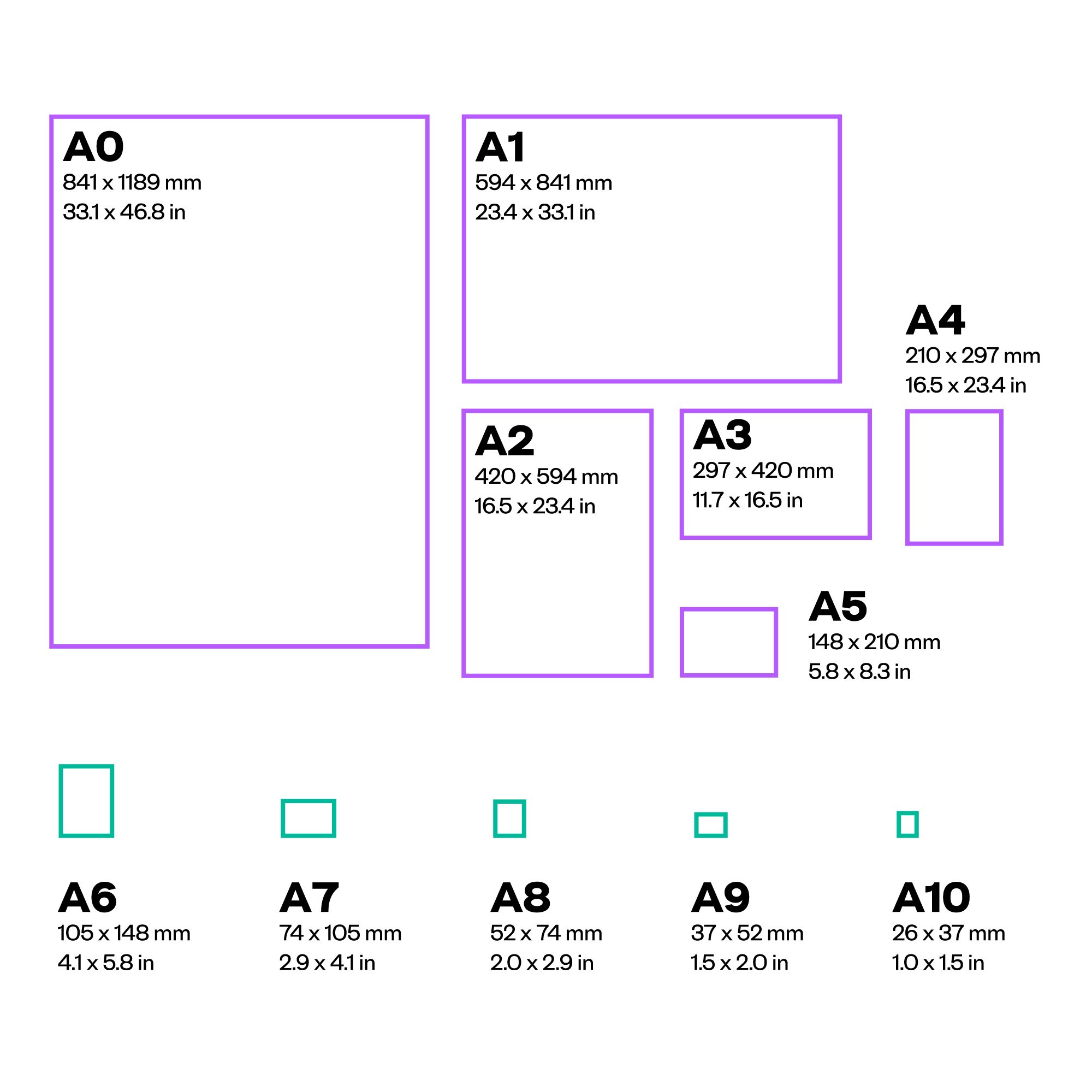
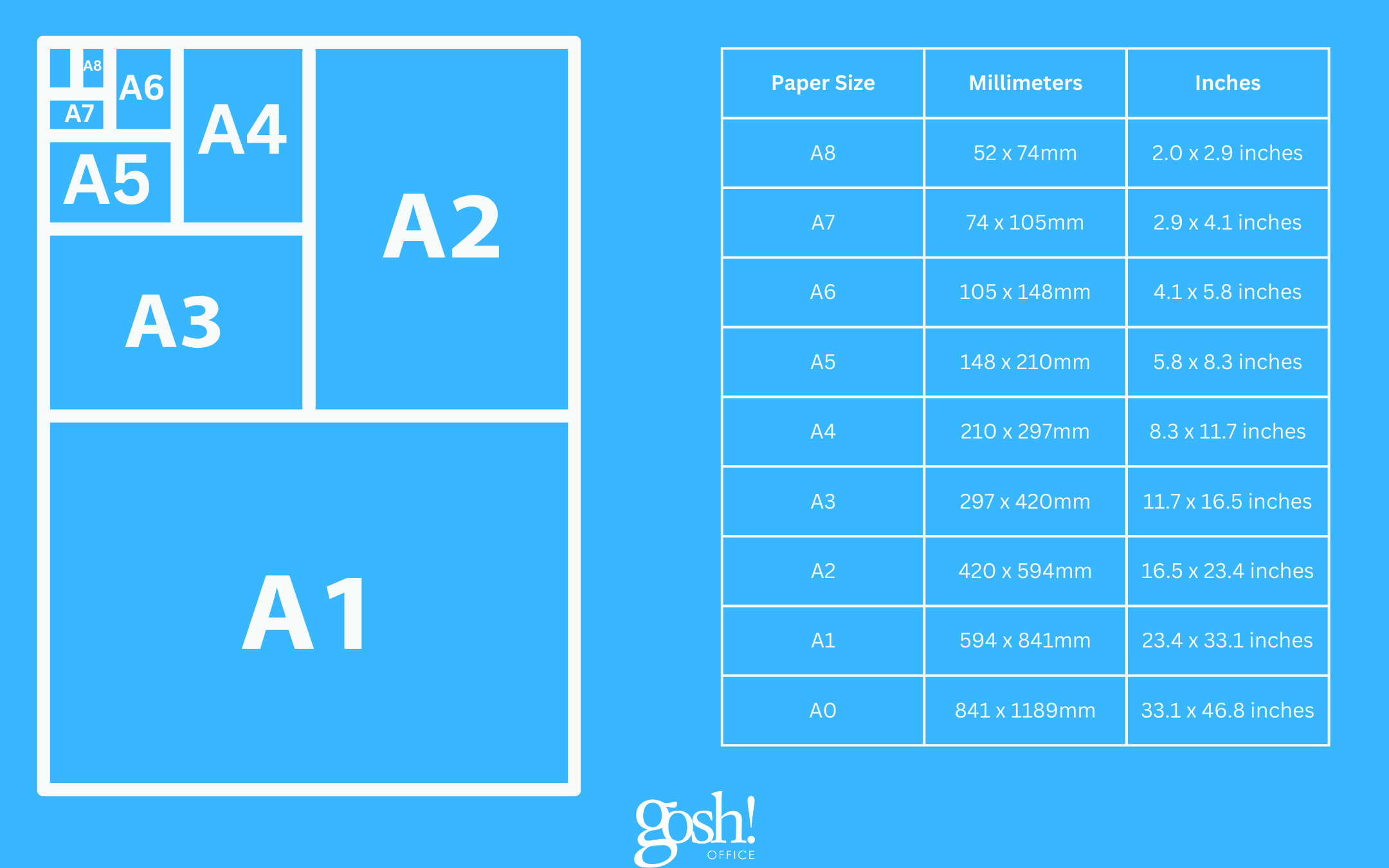
- A0 is the root sheet of the series. By specification, an A0 sheet has an exact area of $1\text{ m}^2$ with dimensions of $841 \times 1189\text{ mm}$ ($33.11 \times 46.81\text{ inches}$).
- A1 is created by cutting A0 in half across its longest dimension, yielding $594 \times 841\text{ mm}$.
- A2 measures $420 \times 594\text{ mm}$.
- A3 measures $297 \times 420\text{ mm}$, commonly used for small posters, broadsheet prints, and large ledger layouts.
- A4 measures $210 \times 297\text{ mm}$ ($8.27 \times 11.69\text{ inches}$) and serves as the standard standard letter format across most of the world outside North America.
- A5 measures $148 \times 210\text{ mm}$, ideal for notebooks, flyers, and paperback literature.
- A6 to A10 descend progressively in size down to small identity cards, micro-labels, and stamps.
Because every step down cuts the surface area precisely in half while retaining identical proportions, enlargement and reduction on photocopiers or digital prepress software require simple percentage scalings (e.g., scaling A4 up to A3 requires a $141%$ magnification factor, matching $\sqrt{2}$).
The B Series: Alternative and Special Printing Sizes
The ISO B series provides intermediate dimensions between consecutive A series sheets. The geometric mean of $A(n)$ and $A(n-1)$ determines the dimensions of $B(n)$. For instance, B1 is geometrically halfway in area between A0 and A1.
- B0 measures $1000 \times 1414\text{ mm}$.
- B1 measures $707 \times 1000\text{ mm}$.
- B2 measures $500 \times 707\text{ mm}$.
- B4 measures $250 \times 353\text{ mm}$.
- B5 measures $176 \times 250\text{ mm}$.
The B series is widely utilized in commercial book publishing, passport manufacturing, posters, and print presses where paper trimmings must accommodate full-bleed print runs before final finishing to A series formats.
The C Series: Envelope Dimensions
The ISO C series defines envelope sizes designed specifically to enclose ISO A series documents cleanly. The geometric mean between the corresponding A series sheet and B series sheet determines the size of $C(n)$.
- C4 ($229 \times 324\text{ mm}$) accommodates an unfolded flat A4 sheet.
- C5 ($162 \times 229\text{ mm}$) holds an A4 sheet folded in half once (or an unfolded A5 sheet).
- C6 ($114 \times 162\text{ mm}$) accepts an A4 sheet folded into quarters.
- DL (Dimension Lengthwise) measures $110 \times 220\text{ mm}$. Although technically outside the formal geometric C series definition, DL is the standard commercial envelope format designed to house an A4 sheet folded horizontally into equal thirds.
North American Paper Sizes: Letter, Legal, ANSI, and Architectural
North America uses standardized imperial measurements. The American National Standards Institute (ANSI) formalized these historic formats into structured systems (ANSI/ASME Y14.1) for drafting, engineering, and commercial workflows.
| ANSI / Commercial Series | Architectural Series |
|---|---|
| ANSI A (Letter): 8.5 x 11 in | ARCH A: 9 x 12 in |
| ANSI B (Ledger): 11 x 17 in | ARCH B: 12 x 18 in |
| ANSI C: 17 x 22 in | ARCH C: 18 x 24 in |
| ANSI D: 22 x 34 in | ARCH D: 24 x 36 in |
| ANSI E: 34 x 44 in | ARCH E: 36 x 48 in |
Commercial Office Formats
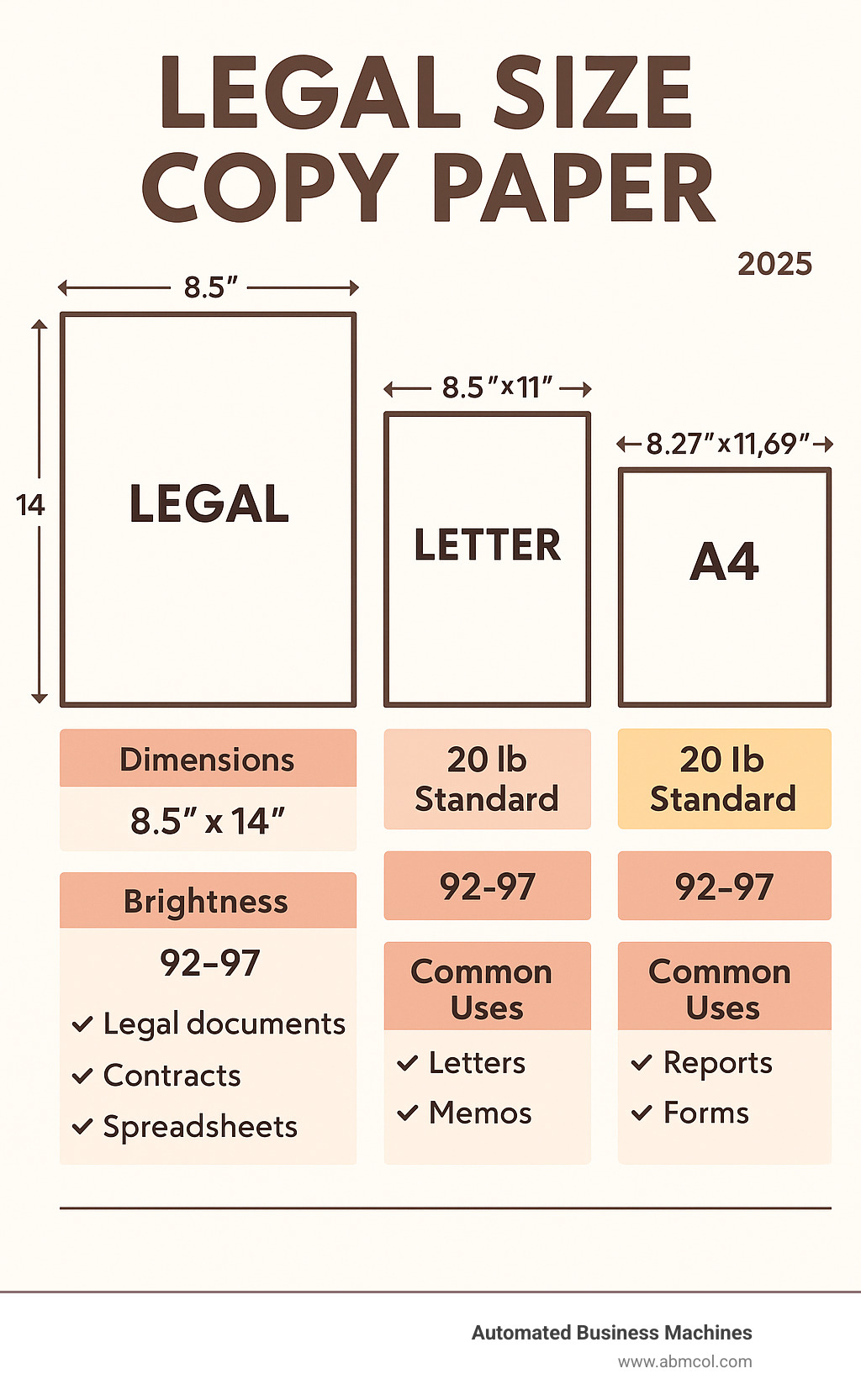
- US Letter: $8.5 \times 11.0\text{ inches}$ ($215.9 \times 279.4\text{ mm}$). This is the standard sheet size across the US, Canada, and parts of Central and South America for everyday documentation, office printing, and correspondence.
- US Legal: $8.5 \times 14.0\text{ inches}$ ($215.9 \times 355.6\text{ mm}$). Sharing the exact width of US Letter, Legal adds three inches of height for extended legal agreements, accounting spreadsheets, and contract forms.
- US Ledger / Tabloid: $11.0 \times 17.0\text{ inches}$ ($279.4 \times 431.8\text{ mm}$). Referred to as Tabloid in portrait orientation and Ledger in landscape orientation, this sheet is equivalent to two US Letter pages placed side-by-side.
- Executive: $7.25 \times 10.5\text{ inches}$ ($184.15 \times 266.7\text{ mm}$). A legacy format used for corporate stationery, smaller notebooks, and personal letterheads.
ANSI Standard Engineering Sizes (ANSI/ASME Y14.1)
In 1995, ANSI formally standardized engineering drawing formats by adopting ANSI A through ANSI E, matching traditional office sheet sizes into a scalable engineering blueprint framework.
- ANSI A: $8.5 \times 11.0\text{ inches}$ ($216 \times 279\text{ mm}$) – identical to US Letter.
- ANSI B: $11.0 \times 17.0\text{ inches}$ ($279 \times 432\text{ mm}$) – identical to Ledger/Tabloid.
- ANSI C: $17.0 \times 22.0\text{ inches}$ ($432 \times 559\text{ mm}$).
- ANSI D: $22.0 \times 34.0\text{ inches}$ ($559 \times 864\text{ mm}$).
- ANSI E: $34.0 \times 44.0\text{ inches}$ ($864 \times 1118\text{ mm}$).
Unlike the ISO system, ANSI alternate sheets alternate between two distinct aspect ratios: $1:1.294$ ($8.5/11$) and $1:1.545$ ($11/17$). Halving an ANSI B sheet yields an ANSI A sheet, but scaling between ANSI sizes can require margin readjustments to prevent stretching or clipping graphics.
Architectural Sizes (ARCH Series)
Architects, contractors, and construction engineers use the Architectural (ARCH) paper series. These sheets feature whole-inch aspect ratios ($4:3$ or $3:2$) designed to fit standard drafting boards and large-format plotters without full-bleed trim wastage.
- ARCH A: $9.0 \times 12.0\text{ inches}$ ($229 \times 305\text{ mm}$) – aspect ratio $3:4$.
- ARCH B: $12.0 \times 18.0\text{ inches}$ ($305 \times 457\text{ mm}$) – aspect ratio $2:3$.
- ARCH C: $18.0 \times 24.0\text{ inches}$ ($457 \times 610\text{ mm}$) – aspect ratio $3:4$.
- ARCH D: $24.0 \times 36.0\text{ inches}$ ($610 \times 914\text{ mm}$) – aspect ratio $2:3$, widely used for architectural blue prints and construction site plan sets.
- ARCH E: $36.0 \times 48.0\text{ inches}$ ($914 \times 1219\text{ mm}$) – aspect ratio $3:4$.
- ARCH E1: $30.0 \times 42.0\text{ inches}$ ($762 \times 1067\text{ mm}$) – aspect ratio $5:7$.
Master Paper Size Comparison Table
The following reference table provides exact physical dimensions in millimeters and inches across ISO, North American, ANSI, and Architectural standards:
| Format Standard | Paper Designation | Dimensions (Millimeters) | Dimensions (Inches) | Primary Application / Use Case |
|---|---|---|---|---|
| ISO A | A0 | $841 \times 1189\text{ mm}$ | $33.11 \times 46.81\text{ in}$ | Technical drawings, large posters, maps |
| ISO A | A1 | $594 \times 841\text{ mm}$ | $23.39 \times 33.11\text{ in}$ | Flip charts, architectural sketches, posters |
| ISO A | A2 | $420 \times 594\text{ mm}$ | $16.54 \times 23.39\text{ in}$ | Medium posters, fine art prints, diagrams |
| ISO A | A3 | $297 \times 420\text{ mm}$ | $11.69 \times 16.54\text{ in}$ | Small posters, ledger prints, folded brochures |
| ISO A | A4 | $210 \times 297\text{ mm}$ | $8.27 \times 11.69\text{ in}$ | Global standard office documents, forms, reports |
| ISO A | A5 | $148 \times 210\text{ mm}$ | $5.83 \times 8.27\text{ in}$ | Books, notepad journals, promotional flyers |
| ISO A | A6 | $105 \times 148\text{ mm}$ | $4.13 \times 5.83\text{ in}$ | Postcards, pocket books, instruction cards |
| ISO B | B4 | $250 \times 353\text{ mm}$ | $9.84 \times 13.90\text{ in}$ | Sheet music, book binding, Japanese office default |
| ISO B | B5 | $176 \times 250\text{ mm}$ | $6.93 \times 9.84\text{ in}$ | Composition books, literature manuals |
| ISO C (Envelope) | C4 | $229 \times 324\text{ mm}$ | $9.02 \times 12.76\text{ in}$ | Flat unfolded A4 document mailers |
| ISO C (Envelope) | C5 | $162 \times 229\text{ mm}$ | $6.38 \times 9.02\text{ in}$ | Half-folded A4 or flat A5 greeting envelopes |
| ISO C (Envelope) | DL Envelope | $110 \times 220\text{ mm}$ | $4.33 \times 8.66\text{ in}$ | Standard tri-folded A4 corporate letters |
| North American | US Letter | $215.9 \times 279.4\text{ mm}$ | $8.50 \times 11.00\text{ in}$ | Standard North American business stationery |
| North American | US Legal | $215.9 \times 355.6\text{ mm}$ | $8.50 \times 14.00\text{ in}$ | Legal contracts, accounting forms |
| North American | Ledger / Tabloid | $279.4 \times 431.8\text{ mm}$ | $11.00 \times 17.00\text{ in}$ | Newspapers, newsletters, double-page spreads |
| North American | Executive | $184.15 \times 266.7\text{ mm}$ | $7.25 \times 10.50\text{ in}$ | Corporate letterheads, small stationery |
| ANSI Standard | ANSI C | $432 \times 559\text{ mm}$ | $17.00 \times 22.00\text{ in}$ | Large schematic diagrams, engineering layouts |
| ANSI Standard | ANSI D | $559 \times 864\text{ mm}$ | $22.00 \times 34.00\text{ in}$ | Full-scale engineering blue prints |
| Architectural | ARCH C | $457 \times 610\text{ mm}$ | $18.00 \times 24.00\text{ in}$ | Medium construction plan sets |
| Architectural | ARCH D | $610 \times 914\text{ mm}$ | $24.00 \times 36.00\text{ in}$ | Standard full-size architectural plan sets |
Paper Size vs. Paper Weight: Understanding GSM and Basis Weight
Physical dimensions define paper length and width, but paper weight specifies thickness, density, and tactile feel. Selecting basic paper size requires matching dimensions with the correct paper weight to prevent printer jams and ink bleed-through.
Paper weight is measured using two distinct methodologies:
- Grams per Square Meter (GSM): The international metric standard established alongside ISO 216. GSM measures the exact weight in grams of a single sheet of paper scaled to one square meter ($1\text{ m}^2$, identical to an ISO A0 sheet). Because GSM measures a fixed, normalized surface area, higher numbers always mean thicker paper regardless of sheet size.
- Basis Weight (Pounds / lbs): The traditional North American system. Basis weight defines the weight in pounds of a full ream (typically 500 sheets) of paper at its un-cut uncut stock size (referred to as the parent sheet or basis size). Because uncut parent sheets vary depending on paper type (e.g., Bond, Text, Cover, Index), a 20 lb Bond paper is significantly thinner than a 20 lb Cover paper.
For reliable cross-referencing between metric GSM and North American basis weight, consult the ANSI/ASME standards documentation or standard printing industry conversion charts.
| 50 - 70 GSM | 75 - 90 GSM | 100 - 130 GSM | 170 - 350 GSM |
|---|---|---|---|
| Newsprint, lightweight receipt rolls | Standard office copy paper, US Letter/A4 stock | High-quality brochures, letterheads | Business cards, covers, postcards, heavy stock art |
- 50–70 GSM: Newsprint, low-cost paperback books, carbonless forms.
- 75–90 GSM: Standard desktop copier paper (typically 20 lb Bond / 75 GSM or 24 lb Bond / 90 GSM used for everyday US Letter and A4 printing).
- 100–130 GSM: Premium letterhead, glossy magazine pages, double-sided color prints.
- 170–250 GSM: Thin cardstock, brochure covers, poster prints.
- 300–350+ GSM: Heavy cardstock, premium business cards, book covers, packaging boxes.
Practical Applications: Selecting the Right Paper Size for Desktop & Professional Printing
Setting up desktop software or sending files to commercial prepress operators requires selecting paper dimensions that account for hardware bleed limits and document distribution channels.
- Prepress Page Layout Setup
- Bleed Area
- Trim Box
- Safe Margin
- Printable Content
- Safe Margin
- Trim Box
- Bleed Area
1. Document Exchange and International Distribution
When designing PDFs or reports intended for international audiences, layout formatting issues frequently arise between US Letter ($215.9 \times 279.4\text{ mm}$) and ISO A4 ($210 \times 297\text{ mm}$).
- US Letter is $5.9\text{ mm}$ ($0.23\text{ in}$) wider than A4.
- ISO A4 is $17.6\text{ mm}$ ($0.69\text{ in}$) taller than US Letter.
To create documents that print cleanly without auto-scaling distortion across both North American and international office printers, maintain minimum top and bottom margins of $0.75\text{ inches}$ ($19\text{ mm}$) and left/right side margins of $0.75\text{ inches}$.
2. Bleed, Trim, and Oversized Formats
Commercial printing presses cannot apply ink to the extreme physical edge of a sheet without leaving white borders due to slight paper shifts during feeding. Printers overcome this by printing onto oversized parent sheets (such as SRA4 or SRA3) and trimming them down to target A4 or A3 sizes.
- SRA3 (Supplementary Raw Format A3) measures $320 \times 450\text{ mm}$.
- When preparing graphics designed to extend to the trimmed edge (full-bleed printing), add a $3\text{ mm}$ ($0.125\text{ in}$) bleed extension outside your document's trimmed boundaries in layout software like Adobe InDesign or Illustrator.
Frequently Asked Questions
What is the difference between A4 and US Letter size?
A4 measures $210 \times 297\text{ mm}$ ($8.27 \times 11.69\text{ inches}$) and is defined by the international ISO 216 metric standard. US Letter measures $215.9 \times 279.4\text{ mm}$ ($8.5 \times 11.0\text{ inches}$) and is defined by imperial standards in North America. A4 is taller and narrower, whereas US Letter is shorter and wider.
Why is ISO 216 paper based on the square root of 2?
The $1:\sqrt{2}$ aspect ratio ensures that whenever an ISO sheet is folded or cut in half along its width, the ratio of length to width remains identical. This geometric property allows scaling up or down (e.g., A4 to A3 or A4 to A5) without changing proportions, stretching text, or re-centering page artwork.
Which envelope fits an A4 paper without folding it?
A C4 envelope ($229 \times 324\text{ mm}$) accommodates an unfolded flat sheet of A4 paper. If you fold an A4 sheet into horizontal thirds, it fits inside a standard DL envelope ($110 \times 220\text{ mm}$).
What is the standard paper size for architectural blueprints?
In North America, the standard full-size architectural plan sheet is ARCH D, measuring $24 \times 36\text{ inches}$ ($610 \times 914\text{ mm}$). In countries using metric standards, architectural sets typically use ISO A1 ($594 \times 841\text{ mm}$) or ISO A0 ($841 \times 1189\text{ mm}$).
What does "GSM" mean in paper specifications?
GSM stands for Grams per Square Meter. It measures paper weight and density by calculating how much a single one-square-meter sheet of that paper weighs. Standard desktop copy paper ranges between 75 and 90 GSM, while premium cardstock generally ranges between 250 and 350 GSM.
Practical Recommendation
When selecting basic paper sizes for digital files, commercial print runs, or daily administrative tasks, use this systematic approach:
- Identify Target Region: Select US Letter ($8.5 \times 11\text{ in}$) for audiences in the United States, Canada, or Mexico. Select ISO A4 ($210 \times 297\text{ mm}$) for all other international destinations.
- Verify Hardware Compatibility: Ensure desktop printer paper trays are adjusted to the exact paper dimensions via the mechanical sliding margins. Incorrect tray registration leads to crooked printing, double feeds, or internal jams.
- Prepare Prepress Bleeds: When printing full-color designs to the paper edge, set up layout files with a $3\text{ mm}$ ($0.125\text{ in}$) bleed perimeter on oversized stock (such as ANSI B or SRA3) before trimming down to final target dimensions.
Image Gallery