Mastering Physics Fundamentals: A Guide to Using a Worksheet on Wave Basics
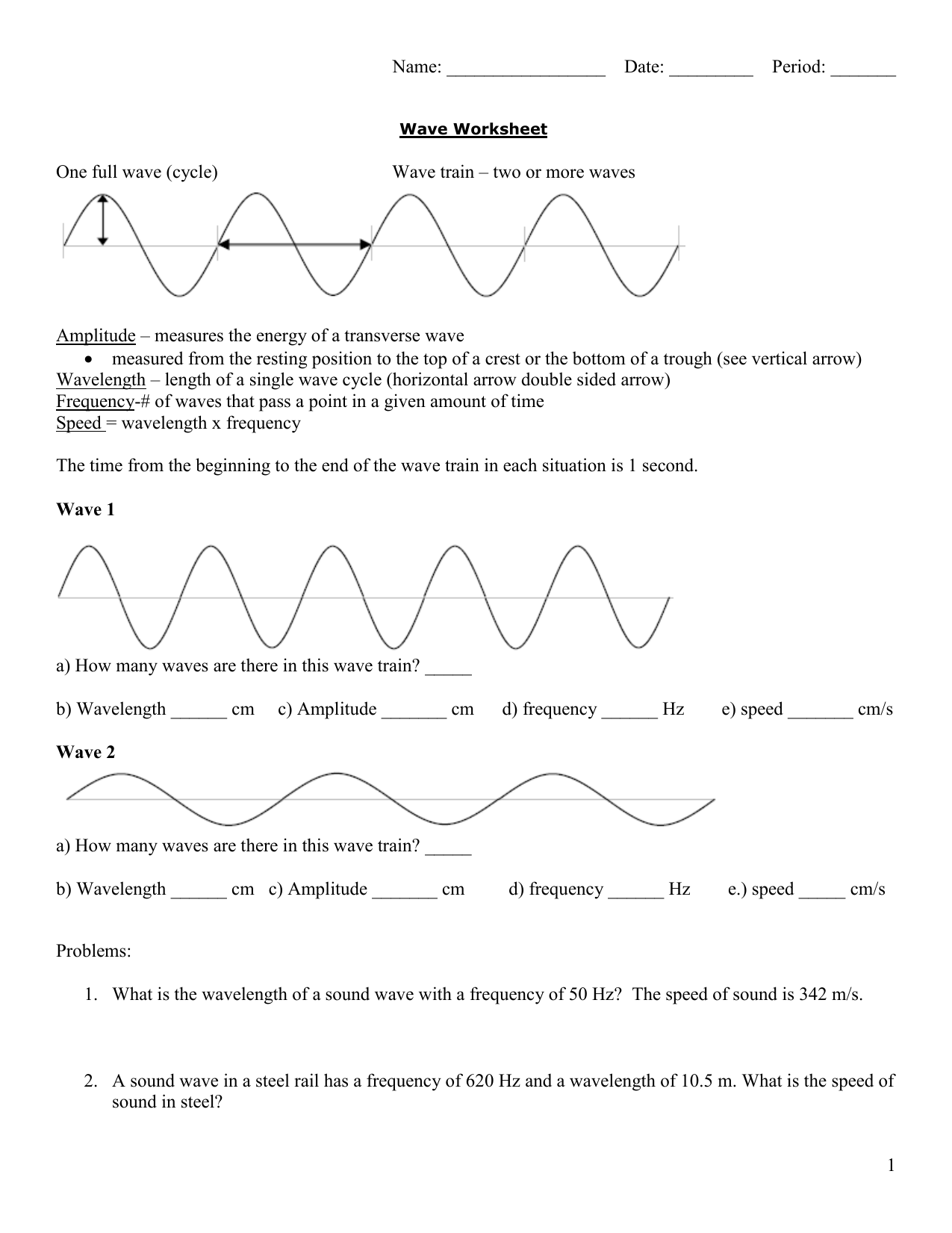
A worksheet on wave basics serves as a structured educational tool designed to reinforce the core principles of wave mechanics, including frequency, wavelength, amplitude, and velocity. By engaging with these problems, students bridge...
A worksheet on wave basics serves as a structured educational tool designed to reinforce the core principles of wave mechanics, including frequency, wavelength, amplitude, and velocity. By engaging with these problems, students bridge the gap between theoretical physics concepts and the quantitative calculations necessary to describe energy transfer through various media.
Contents
The Educational Value of Wave Basics Worksheets
Physics is a discipline that demands both conceptual understanding and mathematical precision. A worksheet on wave basics provides a scaffolded approach to learning, moving from definitions to complex problem-solving. These documents typically emphasize the relationship between wave properties, helping students grasp how energy propagates without the permanent displacement of matter.
When students work through these exercises, they are not merely memorizing formulas; they are learning to interpret the physical world. The process of calculating the period of a wave based on its frequency, or determining wave speed using the universal wave equation, solidifies the understanding of how environment and source influence wave behavior. Educators use these worksheets to assess student readiness for more advanced topics like optics, quantum mechanics, or acoustic engineering.
Essential Components of a Wave Mechanics Worksheet
A comprehensive worksheet should cover several distinct areas to ensure a well-rounded understanding of the subject. If you are developing or selecting a worksheet, look for the following pillars of wave study:
1. Defining Wave Anatomy
The foundation of any study on waves lies in identifying the parts of the wave. The worksheet should prompt the user to label diagrams, distinguishing between crests, troughs, compression, and rarefaction. Understanding these spatial identifiers is critical when later applying them to longitudinal versus transverse wave models.
2. The Universal Wave Equation
The primary mathematical task in any introductory wave worksheet is the application of the formula: v = f × λ
Where:
- v is the wave speed (measured in meters per second, m/s).
- f is the frequency (measured in Hertz, Hz).
- λ (lambda) is the wavelength (measured in meters, m).
A well-structured worksheet will provide varying combinations of these variables—for example, asking a student to solve for wavelength when given the speed and frequency—to ensure algebraic fluency.
3. Frequency and Period Reciprocity
The relationship between frequency and period is often a point of confusion for beginners. The worksheet must include exercises demonstrating that the period (T) is the reciprocal of the frequency (f), expressed as T = 1/f. Recognizing that frequency represents "cycles per second" while period represents "seconds per cycle" is fundamental to analyzing periodic motion.
Comparative Analysis of Wave Types
Understanding the distinction between different wave classifications is essential for solving problems involving mechanical waves versus electromagnetic waves.
| Wave Characteristic | Mechanical Waves | Electromagnetic Waves |
|---|---|---|
| Medium Required | Yes (e.g., air, water, solids) | No (can travel through vacuum) |
| Propagation Speed | Varies by medium density/elasticity | Constant in a vacuum (c ≈ 3 × 10⁸ m/s) |
| Example | Sound, Seismic waves | Light, Radio, X-rays |
| Primary Variable | Damped by medium energy loss | Subject to polarization and refraction |
Practical Guidance for Solving Wave Problems
To maximize the effectiveness of a worksheet on wave basics, students should follow a systematic approach to every problem. This reduces errors and reinforces best practices in scientific calculation.
- Identify Known Variables: Read the problem statement carefully and list every value provided. Note the units—if a wavelength is given in centimeters, convert it to meters before beginning calculations to maintain SI unit consistency.
- State the Formula: Before plugging in numbers, write out the algebraic expression being used. This practice helps prevent errors in variable placement.
- Perform Unit Analysis: Ensure the resulting units make physical sense. For instance, if you are solving for frequency, your final answer should be in 1/s, or Hertz.
- Evaluate for Reasonability: Physics problems often involve real-world quantities. If you calculate the speed of a sound wave as being faster than the speed of light, it is a clear indicator that a calculation error has occurred.
Common Pitfalls and Troubleshooting
Even with clear instructions, students often encounter specific hurdles when learning wave mechanics. Recognizing these early can prevent frustration.
- Misinterpreting Graphs: When looking at a displacement-distance graph, students often confuse the amplitude (the distance from the equilibrium position to a crest) with the peak-to-trough height. Ensure the worksheet provides clear visual cues to differentiate these values.
- Unit Mismatch: The most frequent cause of incorrect answers is failing to convert prefixes. If a frequency is provided in kilohertz (kHz) or a wavelength in millimeters (mm), the student must convert these to standard Hertz and meters before applying the universal wave equation.
- The "Speed" Confusion: Students often confuse wave speed (the velocity of the energy transfer) with the speed of individual particles within the medium. Clarifying that particles oscillate while the wave pulse advances is a necessary step for conceptual maturity.
Frequently Asked Questions
What is the difference between frequency and pitch? Frequency is a physical measurement of how many wave cycles pass a point per second. Pitch is the human auditory perception of that frequency. While they are directly correlated, pitch is subjective, whereas frequency is objective and measurable.
Why does the speed of sound change in different materials? Wave speed depends on the elasticity and density of the medium. In more rigid, elastic materials like steel, waves travel faster because particles are more tightly coupled, allowing for more efficient energy transfer between them compared to less dense gases like air.
Does amplitude affect the speed of a wave? In an ideal mechanical wave, the speed is determined by the medium, not by the amplitude or frequency. Amplitude primarily dictates the energy (or intensity) carried by the wave, but it does not dictate how fast the wavefront propagates through the material.
Can a wave carry matter from one place to another? No. Waves are a method of energy transfer. The particles of the medium oscillate around a fixed equilibrium position, but they do not travel with the wave. This is clearly demonstrated by a buoy in the ocean; it moves up and down as waves pass, but it does not move forward with the wave crest.
How do I verify my answers on a worksheet? The best way to verify answers is to re-run the calculation in reverse. If you calculated wavelength as v/f, then multiply your result by f to see if it returns the original v. Additionally, using standard reference tables for the speed of sound in various media can help you check if your answers are physically plausible.
Next Steps for Students and Educators
For students, the next action should be to apply these concepts to a physical observation. Find a ripple in a pool or the vibration of a guitar string and attempt to estimate its frequency or wavelength based on the principles mastered in the worksheet.
For educators, ensure that any worksheet used includes an answer key with detailed, step-by-step solutions rather than just final values. Providing the process allows students to identify where their logic may have diverged from the correct method, transforming the worksheet from a simple test into a true learning instrument. Consistency in notation and rigorous adherence to SI units will prepare students for the demands of advanced physics and engineering curricula.
Image Gallery