The Realistic Cost to Install Solar Panels in a Home
The realistic net cost to install a residential solar panel system in 2026 typically ranges between $14,000 and $21,000 after applying the 30% Federal Residential Clean Energy Credit. Before incentives, gross costs for a standard 8-kil...
The realistic net cost to install a residential solar panel system in 2026 typically ranges between $14,000 and $21,000 after applying the 30% Federal Residential Clean Energy Credit. Before incentives, gross costs for a standard 8-kilowatt (kW) system average $22,000 to $26,000, varying based on equipment selection, roof complexity, electrical panel upgrades, and local labor rates.
Contents
Disclaimer: Solar installation costs, local utility tariffs, and tax incentives vary significantly by region and individual property conditions. The financial projections in this article are provided for informational purposes; consult a licensed solar contractor and a certified tax professional before making financial commitments.
Average Solar Panel System Costs by System Size
Calculating the true cost of home solar requires distinguishing between gross installation costs (the sticker price quoted by contractors) and net costs (the final out-of-pocket expenditure after federal tax credits and state incentives).
Solar system capacities are rated in kilowatts of Direct Current (kW DC) power. The average American home uses roughly 8,500 to 10,500 kilowatt-hours (kWh) of electricity per year, which generally requires an 8 kW to 10 kW solar array depending on local solar exposure (irradiance). Pricing is typically benchmarked on a cost-per-watt ($/W) basis, which averages between $2.85 and $3.25 per watt for equipment and installation across the United States.
| System Size (kW DC) | Typical Home Size / Energy Profile | Average Gross Cost | 30% Federal Tax Credit (ITC) | Estimated Net Out-of-Pocket Cost |
|---|---|---|---|---|
| 5 kW | 1,000–1,400 sq. ft. / Low energy consumption | $14,500 – $16,250 | -$4,350 – -$4,875 | $10,150 – $11,375 |
| 8 kW | 1,500–2,200 sq. ft. / Average energy consumption | $22,800 – $26,000 | -$6,840 – -$7,800 | $15,960 – $18,200 |
| 10 kW | 2,400–3,200 sq. ft. / Above-average usage (EV/HVAC) | $28,500 – $32,500 | -$8,550 – -$9,750 | $19,950 – $22,750 |
| 12 kW | 3,500+ sq. ft. / High usage, pool, multiple EVs | $34,200 – $39,000 | -$10,260 – -$11,700 | $23,940 – $27,300 |
Note: Table estimates reflect average direct-ownership installations prior to additional state-level rebates or local solar renewable energy certificate (SREC) monetization.
Key Factors Determining Solar Installation Costs
Two homes of identical square footage can receive vastly different contractor quotes. Solar installation pricing depends on a combination of hardware decisions, structural requirements, and soft costs associated with localized labor and utility compliance.
1. Panel Efficiency and Module Technology
Photovoltaic (PV) modules are available in different silicon configurations and efficiency tiers:
- Monocrystalline Panels: Built from single-crystal silicon, these panels deliver high efficiency (typically 20% to 23%) and long warranties (25–30 years). They carry a higher initial cost but maximize energy generation per square foot, making them the standard choice for residential rooftops.
- Polycrystalline Panels: Manufactured from melted fragments of silicon, these panels offer lower efficiency (15% to 17%) and lower costs. Due to declining price gaps and spatial constraints on residential roofs, their market share has contracted significantly.
- Premium N-Type / TOPCon Technologies: Advanced cell architectures like Tunnel Oxide Passivated Contact (TOPCon) offer lower temperature degradation and higher efficiency ratings, commanding a 10% to 20% price premium over standard monocrystalline modules.
2. Inverter Topologies
Inverters convert the direct current (DC) produced by panels into grid-compliant alternating current (AC) used by home appliances. The choice of inverter architecture impacts both system performance and upfront equipment costs:
- String Inverters: A single central inverter converts electricity from multiple panels wired together in series ("strings"). While it represents the most economical option upfront ($1,500–$2,500), string performance is bottlenecked if a single panel experiences shading or debris accumulation.
- Microinverters: Installed directly beneath individual PV modules, microinverters optimize power conversion at every panel independently. According to the National Renewable Energy Laboratory (NREL), microinverters increase hardware costs by $1,000 to $2,500 per installation compared to string systems, but they eliminate single-point operational failures and simplify multi-pitch roof monitoring.
- String Inverters with Power Optimizers: A hybrid solution where DC-to-DC optimizers are attached to individual panels to condition power before sending it to a central inverter. This provides panel-level tracking at a mid-range price point.
3. Electrical Infrastructure and Main Service Panel Upgrades
Solar installations must integrate safely into your home's main electrical panel (load center).
- Standard Connection: If your existing breaker panel has adequate busbar capacity (typically 200 amps), connection costs remain nominal.
- Main Service Panel (MSP) Upgrade: Older homes with 100-amp or 125-amp panels often require an upgrade to 200 amps to handle the backfed solar current safely under the National Electrical Code (NEC). An MSP upgrade adds $1,500 to $3,500 to the total project cost.
4. Roof Architecture and Structural Integrity
Installers evaluate several physical roof characteristics during site assessments:
- Roof Material: Standard asphalt shingle roofs are the straightforward choice for mounting racking systems. Tile, slate, standing-seam metal, or flat roofs require specialized mounting hardware, flashings, and structural penetrations that increase labor costs by $1,000 to $3,000.
- Pitch and Orientation: South- and west-facing roofs with 25° to 45° angles provide optimal irradiance in the Northern Hemisphere. Steeper pitches require specialized safety rigging, while flat roofs necessitate tilted racking hardware, both adding to labor expenses.
- Structural Rafter Enhancement: Older homes may require additional structural framing or sistering of rafters to support the dead load of solar modules and racking (approximately 3 to 4 lbs per square foot).
5. Soft Costs, Permitting, and Local Labor Rates
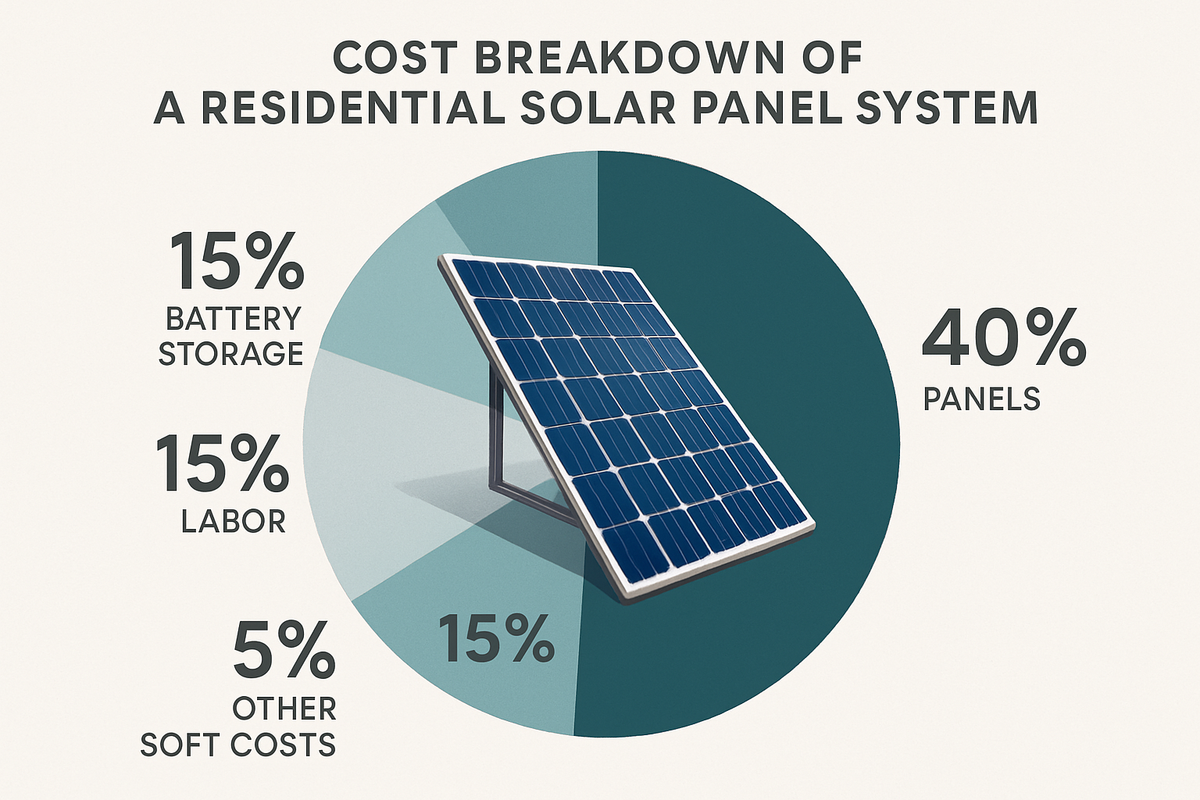
According to data from the U.S. Department of Energy, "soft costs"—which include customer acquisition, permitting, utility interconnection approval, structural engineering stamps, and supply chain logistics—account for over 50% of total residential solar installation expenses. High-cost-of-living metropolitan areas or municipalities with complex permitting requirements add to labor billing rates.
Battery Storage Add-Ons: Costs and Integration
Adding energy storage systems (solar-plus-storage) increases self-consumption efficiency and provides back-up power during utility outages.
- Solar Array (Generates DC Electricity)
- Hybrid/Micro Inverter (DC-to-AC Conversion)
- Home Electrical Subpanel/Load
- Bidirectional Utility Smart Meter
- Battery Storage Bank (10–15 kWh Capacity)
- Home Electrical Subpanel/Load
A standard residential lithium-iron-phosphate (LFP) battery unit with a usable capacity of 10 kWh to 15 kWh costs between $10,000 and $15,000 installed, before tax incentives.
Adding battery storage is financially strategic under specific billing structures:
- Time-of-Use (TOU) Rates: Utilities charge significantly higher rates during peak evening hours. Battery systems store solar energy produced during the afternoon and discharge it during peak billing windows.
- Net Billing / Reduced Export Credit Regimes: Under frameworks like California's NEM 3.0 policy, utilities pay substantially lower rates for excess solar energy exported to the grid. Storing excess production on-site in a battery yields greater economic value than selling it back at reduced wholesale rates.
Financial Incentives, Tax Credits, and Rebates
Financial incentives reduce out-of-pocket costs and improve the net return on investment for residential PV installations.
- Gross Solar System Installation ($24,000)
- Less: Local Utility Rebates/Grants (-$1,000)
- Adjusted Cost Basis for Tax Basis ($23,000)
- Less: 30% Federal Clean Energy Credit (-$6,900)
- Final Out-of-Pocket Expenditure ($16,100)
The 30% Federal Residential Clean Energy Credit
Under Section 25D of the Internal Revenue Code, updated via the Inflation Reduction Act, eligible homeowners can claim a 30% tax credit on the total gross cost of a solar photovoltaic and battery storage installation.
Key parameters outlined by the Internal Revenue Service (IRS):
- Applicability: Applies to equipment, racking, wiring, labor, permitting fees, and battery storage units with a capacity rating of 3 kilowatt-hours or greater.
- Non-refundable Credit Structure: The credit reduces your federal income tax liability dollar-for-dollar. If your tax liability is lower than the credit amount, the remaining balance can be carried forward to subsequent tax years.
- Ownership Requirement: The taxpayer must own the system (purchased via cash or a solar loan). Leased systems or PPAs do not qualify the homeowner for the federal tax credit; the third-party system owner retains the tax benefit.
State and Utility Incentives
Depending on your geographic location, additional state or local programs may lower out-of-pocket costs:
- Solar Renewable Energy Certificates (SRECs): In states with Renewable Portfolio Standards (RPS), homeowners earn one SREC for every 1 megawatt-hour (MWh) of electricity generated, which can be sold on open exchange markets for recurring income.
- State Income Tax Credits: Select states offer state-level tax credits that stack on top of federal incentives.
- Property and Sales Tax Exemptions: Many states exempt the added capital value of a solar array from residential property property tax reassessments and exempt equipment purchases from state sales tax.
State-by-state incentive rules are tracked in detail by the Database of State Incentives for Renewables & Efficiency (DSIRE).
Upfront Purchase vs. Financing Options
How you finance your system directly impacts your total lifetime savings, payback period, and eligibility for tax credits.
Financial Structure Comparison:
- Cash Purchase
- Lowest Total Lifetime Cost
- Maximum ROI
- 30% ITC Eligible
- No Interest Expenses
- Solar Loan (Financed Ownership)
- Zero Upfront Cost Options
- 30% ITC Eligible
- Monthly Loan Payment Offset
- Incurs Interest Fees
- Third-Party Ownership (Lease / PPA)
- No Equipment Ownership
- Installer Retains ITC
- Fixed Monthly Fee/Rate
- Complex Home Transfer
1. Cash Purchase
Paying for the system upfront yields the highest long-term return on investment (ROI).
- Pros: Eliminates interest expenses, dealer fees, and monthly debt service; owner claims all eligible federal and local tax incentives immediately.
- Cons: Requires significant initial capital commitment.
2. Solar Loans (Unsecured vs. Secured)
Solar loans allow homeowners to spread capital costs over 5 to 25 years while retaining system ownership.
- Unsecured Personal/Solar Loans: Fast approval processes without leveraging home equity, but they carry higher interest rates (typically 6% to 11%).
- Home Equity Lines of Credit (HELOCs) / Cash-Out Refinancing: Secured against property equity, offering lower interest rates. Interest may be tax-deductible if funds are explicitly used for substantial home improvements (consult a CPA).
- Dealer Fees: Caution is warranted with low-APR dealer financing. Lenders often add hidden "origination fees" or "dealer fees" ranging from 10% to 30% of the principal, embedding financial costs directly into the initial equipment quote.
3. Solar Leases and Power Purchase Agreements (PPAs)
Under third-party ownership (TPO) structures, a solar company installs and owns the panels on your roof.
- Solar Lease: You pay a fixed monthly rental fee to use the hardware regardless of total generation.
- PPA: You purchase the power generated by the rooftop array at a fixed per-kWh rate, usually set below local utility retail tariffs.
- Trade-Offs: TPO models eliminate upfront costs and maintenance responsibilities. However, you forfeit the 30% federal tax credit, total lifetime financial returns are significantly reduced, and selling a home with an active solar contract can complicate real estate transfers.
Payback Period and Long-Term ROI Analysis
The payback period represents the time required for cumulative electricity bill savings to equal the net upfront investment cost.
Sample Payback Timeline (Net System Cost: $16,800):
- Year 01: $2,100 Cumulative Savings
- Year 03: $6,300 Cumulative Savings
- Year 05: $10,500 Cumulative Savings
- Year 08: $16,800 Payback Break-Even Point
- Year 15: Net Positive Cash Flow ($14,700+ Net Profit)
- Year 25: Net Positive Cash Flow ($35,000+ Lifetime ROI)
Payback Calculation Example
Consider an 8 kW system installed on a suburban home:
- Gross System Cost: $24,000
- 30% ITC Value: -$7,200
- Net Investment Cost: $16,800
- Annual Production: 11,000 kWh
- Blended Retail Utility Rate: $0.21 / kWh
- First-Year Electricity Bill Offsets: $2,310 (11,000 kWh × $0.21)
Assuming annual utility rate inflation of 3.5% and standard PV panel degradation of 0.5% per year, the calculated payback period is approximately 6.8 to 7.5 years.
Given modern tier-1 panel production warranties of 25 years, the system provides 17+ years of pure net savings after reaching financial break-even, generating tens of thousands of dollars in lifetime utility savings.
Common Hidden Costs and How to Avoid Them
Unexpected expenses during solar integration usually stem from initial site assessment omissions. Watch out for these common variables:
- Roof Replacement Demands: Installing solar on an aging roof (15+ years old) is a costly mistake. If the roof must be replaced midway through the solar system's 25-year lifecycle, you will pay $1,500 to $3,000 in labor fees to have the array uninstalled and reinstalled to accommodate roofing repairs. Always replace or repair an aging roof before panel installation.
- Tree Trimming and Obstruction Removal: Mature trees causing partial roof shading lower annual system yields. Professional arborists charge $800 to $2,500 for selective limb pruning or tree removals to maximize solar exposure.
- Utility Interconnection and Metering Fees: While basic interconnection application fees are modest ($50 to $300), older localized grid transformers may require upgrading by the utility provider, which can occasionally lead to unexpected grid infrastructure charges.
- Critter Guard Protection: Birds and squirrels frequently nest under warm solar arrays, damaging wiring harnesses and microinverters. Installing mesh critter guards adds $500 to $1,200, but prevents costly electrical repairs.
Frequently Asked Questions
How much do solar panels cost for an average 2,000-square-foot home?
For an average 2,000-square-foot home using roughly 9,000 to 10,000 kWh of electricity annually, an 8 kW system is typically required. The average gross cost ranges between $22,800 and $26,000. After applying the 30% federal tax credit, the net out-of-pocket cost drops to $15,960–$18,200.
Do solar panels increase home property taxes?
In most states, solar panel installations add substantial equity value to a home without triggering an increase in real estate property taxes. Dozens of states have passed property tax exemption statutes that prevent local tax assessors from re-evaluating property values based on added residential renewable energy infrastructure.
What is the lifespan of modern home solar panels?
Tier-1 monocrystalline panels feature operational lifespans of 25 to 30 years or more. Most manufacturers guarantee that panels will still generate at least 80% to 85% of their original nameplate power capacity at year 25. Central string inverters may require replacement once after 12 to 15 years, whereas microinverters are typically warrantied for 25 years.
Can I install a solar panel system myself to save on labor?
While DIY solar kits exist, self-installation is generally discouraged for residential grid-tied systems. DIY installs carry serious risks involving high-voltage DC electricity, structural roof leaks, and potential local building code violations. Additionally, most utility companies require certified master electricians to sign off on grid interconnection agreements, and many hardware manufacturers void their product warranties unless equipment is installed by licensed contractors.
Is adding a battery storage system strictly necessary?
No, a battery storage system is optional for grid-tied solar arrays. If your utility offers favorable 1-to-1 net energy metering (NEM), the power grid acts as a virtual battery, crediting you for excess generation. However, if your utility operates under Time-of-Use (TOU) rates, uses reduced export credits, or if you require emergency backup during power outages, adding a battery system is financially and operationally advantageous.
Practical Action Plan for Homeowners
To ensure you secure an accurate, cost-effective residential solar installation:
- Audit Energy Usage: Gather your past 12 months of electricity bills to establish your average annual baseline consumption in kilowatt-hours (kWh).
- Inspect Roof Condition: Ensure your roof has at least 15 to 20 years of remaining structural life before soliciting solar installation bids.
- Solicit Multiple Quotes: Obtain detailed, itemized bids from at least three reputable local and regional solar contractors. Compare quotes based on cost-per-watt ($/W), equipment brand tiers, microinverter vs. string topologies, and long-term workmanship warranties.
- Check Dealer Fees: If using solar financing, compare loan options carefully. Ask contractors for both cash purchase prices and financed prices to reveal hidden financing origination fees embedded in low-APR loan quotes.
- Verify Incentives and Permits: Confirm that your installer manages local municipal permitting, structural engineering stamps, and utility interconnection paperwork on your behalf. Consult a tax professional to confirm your eligibility for the 30% Federal Residential Clean Energy Credit.
Image Gallery