The Life of John Kennedy's Wife Jacqueline: From First Lady to Publishing Icon
Jacqueline Kennedy Onassis was an iconic American First Lady, cultural diplomat, historic preservationist, and book editor. Beyond her marriage to President John F. Kennedy from 1953 until his 1963 assassination, she modernized White H...
Jacqueline Kennedy Onassis was an iconic American First Lady, cultural diplomat, historic preservationist, and book editor. Beyond her marriage to President John F. Kennedy from 1953 until his 1963 assassination, she modernized White House cultural diplomacy, preserved American historical architecture, and led a distinguished two-decade publishing career in New York City.
Contents
Early Life and Education: The Shaping of Jacqueline Bouvier
Jacqueline Lee Bouvier was born on July 28, 1929, in Southampton, New York, to Wall Street stockbroker John Vernou "Black Jack" Bouvier III and socialite Janet Norton Lee. Raised in an affluent environment characterized by equestrian sports and literary arts, she developed an early devotion to horseback riding, classic literature, and foreign languages.
Her intellectual formation took place at prestigious institutions. After attending the Holton-Arms School and Miss Porter's School, she enrolled at Vassar College in 1947. During her junior year, she studied abroad at the Sorbonne through the University of Paris, an experience that deepened her passion for French culture, history, and international arts. She completed her undergraduate studies at George Washington University, earning a Bachelor of Arts degree in French Literature in 1951.
Upon graduation, Bouvier secured a position as the "Inquiring Camera Girl" for the Washington Times-Herald. In this role, she roamed the nation's capital photographing and interviewing citizens and prominent political figures on topical social and policy questions. Her journalistic work honed her keen observational skills and provided her with direct insight into the political atmosphere of Washington, D.C.
Marriage to John F. Kennedy and Political Life
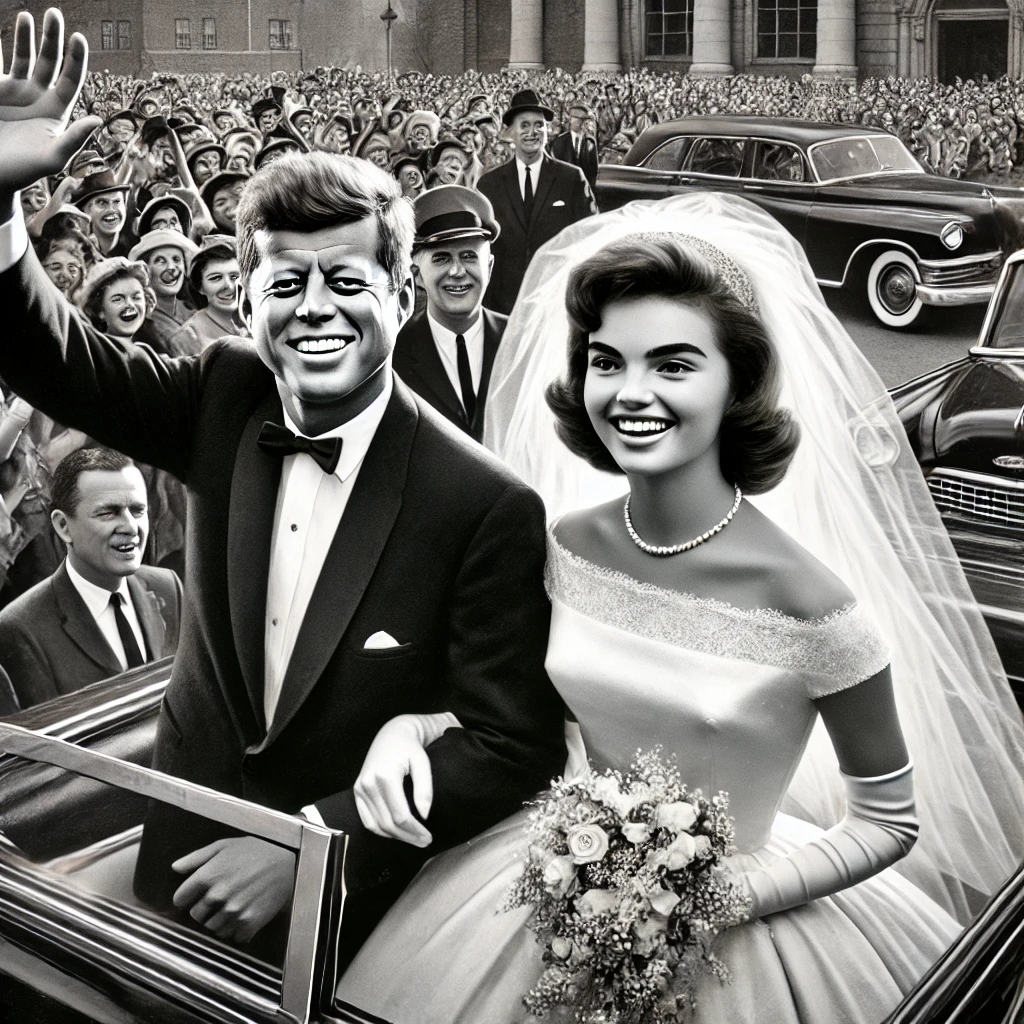
Jacqueline Bouvier met John Fitzgerald Kennedy, then a promising U.S. Representative from Massachusetts, at a dinner party hosted by mutual friends in May 1952. Following Kennedy's election to the United States Senate later that year, their relationship flourished, leading to their marriage on September 12, 1953, at St. Mary's Church in Newport, Rhode Island.
- Jacqueline Bouvier + John F. Kennedy (m. 1953)
- Arabella Kennedy (Stillborn, 1956)
- Caroline Bouvier Kennedy (b. 1957)
- John F. Kennedy Jr. (1960–1999)
- Patrick Bouvier Kennedy (b./d. 1963)
During the early years of their marriage, Senator Kennedy suffered severe health complications due to chronic back problems, undergoing major spinal surgeries. During his recovery, Jacqueline actively assisted him in compiling historical research and editing manuscripts, which culminated in his Pulitzer Prize-winning book, Profiles in Courage (1956).
The couple faced significant personal grief during this era. Jacqueline suffered a miscarriage in 1955 and gave birth to a stillborn daughter, Arabella, in 1956. Their fortunes turned with the birth of Caroline Bouvier Kennedy in 1957, followed by John F. Kennedy Jr. in late November 1960, just weeks after Kennedy won the U.S. presidential election. A third child, Patrick Bouvier Kennedy, died shortly after premature birth in August 1963.
The White House Years: Restoration and Cultural Diplomacy (1961–1963)
When John F. Kennedy was inaugurated as the 35th President of the United States in January 1961, 31-year-old Jacqueline Kennedy became one of the youngest First Ladies in American history. She rejected the idea that the First Lady was merely a political hostess, instead focusing on transforming the White House into a national museum of historical significance and a showcase for American arts.
Historic Restoration of the Executive Mansion
Disturbed by the generic, mid-century furnishings in the White House, Jacqueline initiated a major restoration project to return the mansion's interior to its historic 19th-century authenticity. She recruited top art historians, curators, and collectors to form the Fine Arts Committee for the White House.
To formalize this effort, she established the White House Historical Association, which secured private funding and non-profit oversight for executive mansion acquisitions, ensuring that public taxes were not utilized for art purchases. In September 1961, Congress passed public legislation declaring White House furniture as historic property, preventing former presidents from removing items.
On February 14, 1962, Jacqueline led a televised tour of the restored White House broadcast by CBS and viewed by over 80 million Americans. The tour earned a special Trustees Award from the Academy of Television Arts & Sciences and solidified her reputation as an authority on historical preservation.
Soft Power and International Diplomacy
Jacqueline's mastery of languages, including French, Spanish, and Italian, transformed her into a major foreign policy asset. During the President's state visits to France, Austria, and Latin America, her diplomatic poise captivated foreign leaders. French President Charles de Gaulle remarked on her deep knowledge of French history, leading President Kennedy to famously announce to the press:
"I do not think it entirely inappropriate for me to introduce myself. I am the man who accompanied Jacqueline Kennedy to Paris."
Her patronage extended to performing arts and international diplomacy. She coordinated White House events featuring legendary artists like cellist Pablo Casals, poetry readings, and musical performances. Through her personal negotiation with French Culture Minister André Malraux, the Louvre loaned Leonardo da Vinci's Mona Lisa for exhibition at the National Gallery of Art in Washington, D.C., and the Metropolitan Museum of Art in New York in 1963.
The Assassination and the Creation of "Camelot"
On November 22, 1963, Jacqueline Kennedy was sitting beside President Kennedy in an open convertible limousine when he was assassinated in Dallas, Texas. Her calm demeanor, wearing a blood-stained pink Chanel suit aboard Air Force One as Lyndon B. Johnson was sworn into office, became an indelible symbol of national grief and resilience.
In the days that followed, she personally planned the President's state funeral, modeling it after the solemn proceedings surrounding Abraham Lincoln's burial. Her decision to walk behind the funeral caisson from the White House to St. Matthew's Cathedral demonstrated incredible fortitude, unifying a grieving nation.
One week after the assassination, Jacqueline gave a historic interview to journalist Theodore H. White for Life magazine. In this conversation, she invoked the musical storyline of Camelot, framing the Kennedy administration as a brief, idealist era in American politics:
"Don't it always seem to go, that you don't know what you've got 'til it's gone... There'll be great Presidents again, but there'll never be another Camelot again."
The Post-Kennedy Eras: Marriage to Aristotle Onassis and Return to Privacy
In the years following her husband's death, Jacqueline worked to preserve his official record, overseeing the establishment of the John F. Kennedy Presidential Library and Museum in Boston. However, as public scrutiny intensified and political violence escalated in the United States—marked by the 1968 assassination of her brother-in-law, Robert F. Kennedy—she sought protection and privacy for her children outside the country.
In October 1968, she married Greek shipping magnate Aristotle Onassis on his private island of Skorpios. While the marriage surprised the American public and triggered intense tabloid coverage, it provided her and her children with personal safety and financial security. She divided her time between Greece, Paris, New York, and Martha's Vineyard until Aristotle Onassis passed away in March 1975.
Literary Career and Historic Preservation in New York City (1975–1994)
Following the death of Aristotle Onassis, Jacqueline returned to New York City to establish an independent professional identity in book publishing. In 1975, she joined Viking Press as a consulting editor and later moved to Doubleday as a senior editor, a position she held until her death.
- Professional Focus (1975–1994):
- Doubleday & Viking Press Senior Editor (Biographies, Arts, History)
- Architectural Conservation (Grand Central Terminal Landmark Ruling)
- Archival & Legacy Oversight (JFK Library & Museum Leadership)
Over her two-decade publishing career, Jacqueline edited dozens of notable books spanning biography, photography, art history, and literature, working closely with authors such as Michael Jackson, Carly Simon, and Egyptian Nobel laureate Naguib Mahfouz. Her colleagues described her as a hardworking, detail-oriented editor who read manuscripts carefully, wrote detailed editorial letters, and avoided special treatment.
Simultaneously, she emerged as a leading voice in urban conservation. Working with the Municipal Art Society of New York, she spearheaded the campaign to save Grand Central Terminal from demolition. Her public activism culminated in the landmark 1978 U.S. Supreme Court case Penn Central Transportation Co. v. New York City, which upheld municipal landmark protection laws and saved the historic architectural icon for future generations.
Life Milestones and Historical Timeline
The following structural table outlines the core distinct phases, formal roles, and historical contributions throughout the life of Jacqueline Kennedy Onassis.
| Era / Life Phase | Timeline | Primary Roles & Titles | Major Historical Contributions & Achievements |
|---|---|---|---|
| Early Formative Years | 1929–1953 | Student, Photojournalist | Earned French Literature degree; served as "Inquiring Camera Girl" at Washington Times-Herald. |
| Senate Spouse & Motherhood | 1953–1960 | Spouse of U.S. Senator | Assisted with research for Profiles in Courage; established family residence in Washington. |
| First Lady of the U.S. | 1961–1963 | First Lady of the United States | Directed historic restoration of the White House; established White House Historical Association; hosted cultural diplomacy events. |
| Tragedy & National Mourning | 1963–1968 | Presidential Widow, Philanthropist | Organized Lincoln-inspired presidential state funeral; framed the "Camelot" historical legacy; supported JFK Presidential Library. |
| The Onassis Era | 1968–1975 | Private Citizen, International Figure | Relocated to Europe for security and privacy; maintained international philanthropic pursuits. |
| Publishing & Architectural Legacy | 1975–1994 | Senior Editor at Doubleday, Preservationist | Spearheaded successful legal battle to save Grand Central Terminal; edited historical and literary books; advanced arts advocacy. |
Health, Passing, and Eternal Legacy
In early 1994, Jacqueline was diagnosed with non-Hodgkin lymphoma, an aggressive form of cancer. She managed her illness privately while continuing her editorial work at Doubleday.
Jacqueline Kennedy Onassis passed away in her sleep at her Manhattan apartment on May 19, 1994, at the age of 64. On May 23, 1994, she was buried alongside President John F. Kennedy and their two deceased infants at Arlington National Cemetery in Virginia. President Bill Clinton delivered a eulogy at her funeral service, praising her dignity, grace, and enduring dedication to American culture and history.
Historical research maintained by the Library of Congress confirms her continued rank among the most influential First Ladies in American history, praised for transforming the presidency into a focal point of artistic and architectural heritage.
Frequently Asked Questions
What was Jacqueline Kennedy Onassis's maiden name?
Jacqueline's maiden name was Jacqueline Lee Bouvier. Her parents were stockbroker John Vernou Bouvier III and Janet Norton Lee. She was known as Jacqueline Bouvier before her marriage to John F. Kennedy in 1953.
Why did Jacqueline Kennedy decide to restore the White House?
Jacqueline restored the White House because she viewed the President's residence as a critical symbol of American democracy and history. Upon moving in, she found the mansion furnished with modern, non-historical reproductions. She created the Fine Arts Committee for the White House and established the White House Historical Association to curate authentic period antiques and preserve historical artwork for the public.
How many children did Jacqueline and John F. Kennedy have?
Jacqueline and John F. Kennedy had four children, though only two survived infancy. Their first daughter, Arabella, was stillborn in 1956. Caroline Kennedy was born in 1957, and John F. Kennedy Jr. was born in 1960. Their fourth child, Patrick Bouvier Kennedy, was born prematurely in August 1963 and died two days later.
Why did Jacqueline marry Aristotle Onassis in 1968?
Jacqueline married Greek shipping businessman Aristotle Onassis in October 1968 to secure privacy and personal security for her children. Following the political assassination of her brother-in-law, Senator Robert F. Kennedy, in June 1968, she feared for her family's safety in the United States and sought the security that Onassis's wealth and private European estates could offer.
What career did Jacqueline pursue in her later life?
In her later life, Jacqueline worked as a professional book editor in New York City for nearly two decades. She joined Viking Press in 1975 and later served as Senior Editor at Doubleday from 1978 until her death in 1994, specializing in biographical, historical, and cultural art books.
Recommended Next Steps for Historians and Visitors
For researchers, students, and citizens looking to further explore the life and historical impact of Jacqueline Kennedy Onassis, consider taking the following actions:
- Visit the JFK Presidential Library: Explore the permanent exhibitions in Boston, Massachusetts, which house Jacqueline's official papers, diplomatic gifts, fashion designs, and audiovisual records.
- Review the White House Historical Association Archives: Access digital publications and virtual tours detailing her historical restoration of the Executive Mansion.
- Explore Grand Central Terminal Preservation Historical Markers: Visit Grand Central Terminal in New York City to view the Jacqueline Kennedy Onassis Foyer, honoring her landmark victory in architectural preservation.
Image Gallery