Do National Guard Members Get VA Loans?
Yes, members of the National Guard are eligible for the VA home loan program. Service in the National Guard qualifies for home loan benefits provided by the Department of Veterans Affairs, provided the service member meets specific tim...
Yes, members of the National Guard are eligible for the VA home loan program. Service in the National Guard qualifies for home loan benefits provided by the Department of Veterans Affairs, provided the service member meets specific time-in-service requirements or performs qualifying active-duty service. These loans are designed to assist eligible personnel in purchasing, building, repairing, or adapting a home for personal occupancy with favorable financial terms.
Contents
Understanding VA Loan Eligibility for National Guard Members
The Department of Veterans Affairs (VA) extends home loan benefits to National Guard members as a recognition of their service to the nation. Unlike active-duty personnel who often qualify after a short, continuous period of service, eligibility for National Guard members is generally tied to a longer cumulative commitment or specific types of active-duty orders.
In 2026, the primary path to eligibility for most National Guard members is through the completion of six years of honorable service in the Selected Reserve or the National Guard. However, this is not the only way to qualify. If you have served fewer than six years, you may still be eligible if you have performed a certain amount of qualifying active-duty service.
Key Eligibility Pathways
To verify your status, the VA categorizes eligibility based on the nature and duration of your service. It is critical to understand which category applies to your career, as the documentation required for the Certificate of Eligibility (COE) will differ accordingly.
1. The Six-Year Requirement
The most common path for traditional National Guard members is the completion of six years of service in the Selected Reserve. You must have received an honorable discharge, be currently serving, or be on the retired list. It is important to note that the VA tracks your "points" rather than just calendar years. You must ensure your records accurately reflect your drill attendance and annual training periods to meet the six-year threshold.
2. Qualifying Active-Duty Service
If you do not meet the six-year reserve requirement, you may still qualify through active-duty service. This includes:
- Title 10 Active Duty: Serving at least 90 days of cumulative active-duty service, with at least 30 of those days being consecutive. This often occurs during federal deployments or active-duty training.
- Title 32 Active Duty: Certain orders under Title 32 of the U.S. Code, such as full-time National Guard duty for the purpose of organizing, administering, recruiting, or training, or for responding to national emergencies, may count toward eligibility.
3. Service-Connected Disability
If you were discharged from the National Guard due to a service-connected disability, the standard time-in-service requirements may be waived. This is a vital provision for those whose service was cut short by injury or illness.
Documentation and the Certificate of Eligibility
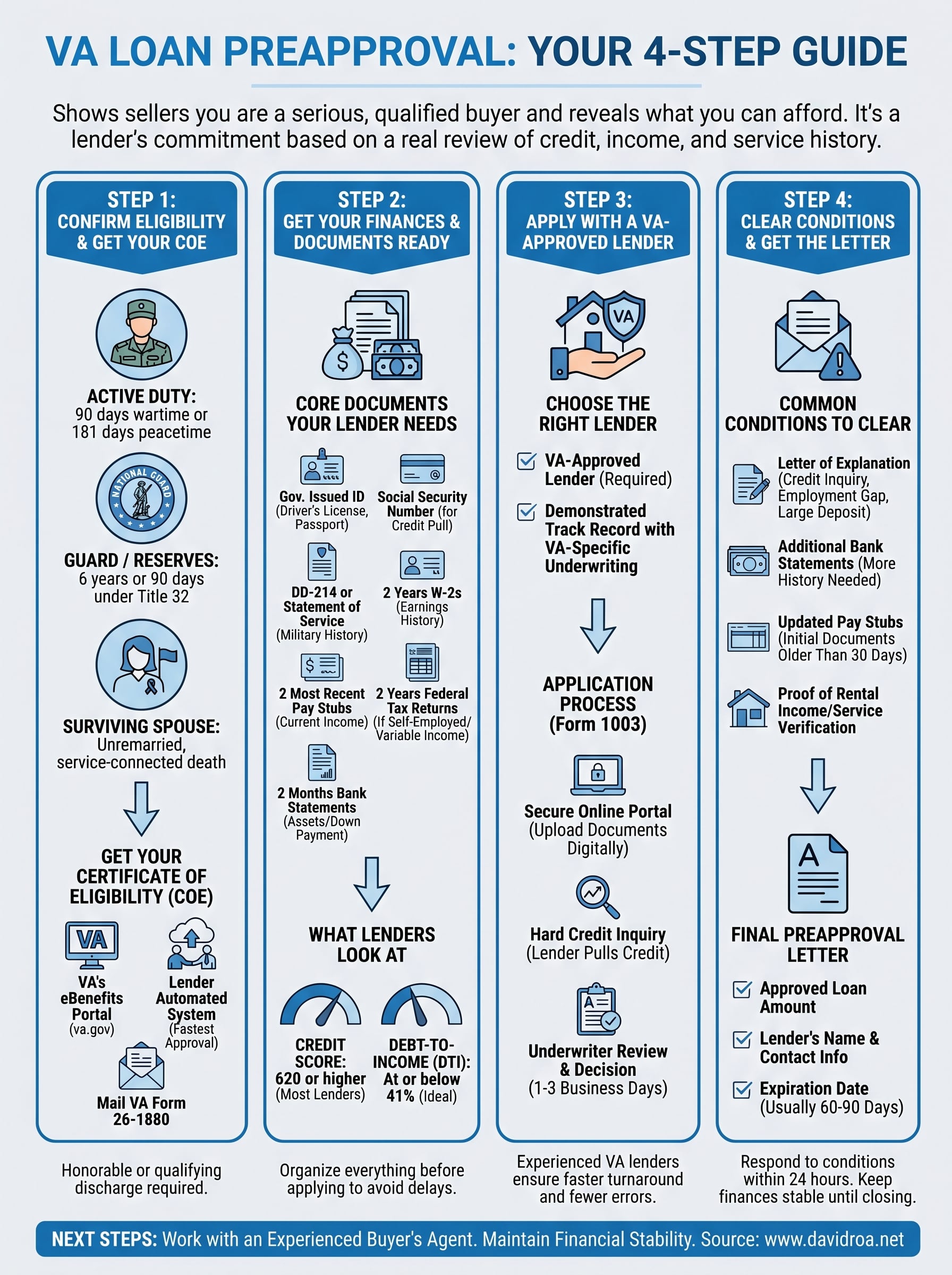
The Certificate of Eligibility (COE) is the formal document provided by the VA that proves to a mortgage lender that you meet the requirements for a VA-backed loan. Obtaining your COE is the first step in the home-buying process.
For National Guard members, the VA typically requires the NGB Form 22 (Report of Separation and Record of Service) or the NGB Form 23 (Retirement Points Accounting). These documents provide the objective evidence of your service duration and the nature of your discharge. In 2026, most lenders can pull your COE electronically through the VA’s web portal if you provide your social security number and basic service details, though keeping physical copies of your discharge paperwork is recommended for your own records.
Comparison of Loan Benefits
The VA loan program offers distinct advantages over conventional mortgage products. When comparing these options, National Guard members should focus on the lack of down payment requirements and the absence of private mortgage insurance (PMI).
| Feature | VA Loan | Conventional Loan |
|---|---|---|
| Down Payment | Generally 0% | Typically 3% to 20% |
| Mortgage Insurance | None (no PMI) | Required if <20% down |
| Funding Fee | Required (waivable for disability) | N/A |
| Interest Rates | Often lower than market | Market-based |
| Credit Requirements | Flexible, set by lender | Strict |
Financial Considerations: The Funding Fee
While VA loans offer significant savings by eliminating private mortgage insurance, they do involve a "funding fee." This is a percentage of the loan amount paid to the VA to help keep the program sustainable for future service members.
- Fee Structure: The fee percentage varies based on whether it is your first time using the benefit and the size of your down payment.
- Exemptions: You are exempt from paying the VA funding fee if you are receiving VA compensation for a service-connected disability or if you are the surviving spouse of a veteran who died in service or from a service-connected disability.
- Financing the Fee: If you are required to pay the fee, you do not need to pay it out of pocket; most lenders allow you to roll the fee into the total loan amount, though this increases the total principal you will pay interest on over time.
Common Misconceptions
"I need to be on active duty to use a VA loan."
This is a frequent misunderstanding. While active-duty members have an easier path to eligibility, the program is specifically designed to include Guard and Reserve members who have served their time in a "drilling" capacity.
"The VA provides the money for the loan."
The VA does not lend the money. Instead, the VA guarantees a portion of the loan provided by private lenders, such as banks, credit unions, or mortgage companies. This guarantee allows lenders to offer more favorable terms because the risk of loss is reduced if the borrower defaults.
"I can only use the VA loan once."
Your entitlement is a lifetime benefit. You can restore your entitlement after you have paid off a previous VA loan or if you have sold the home and the loan has been satisfied. In some cases, you may even have "partial entitlement" available if you still own a home financed with a previous VA loan.
Next Steps for Prospective Buyers
- Gather Service Records: Locate your NGB 22 or latest retirement points statement. Ensure your discharge status is categorized as "Honorable."
- Request Your COE: You can request your Certificate of Eligibility through the VA.gov portal. Many lenders can facilitate this for you during the pre-approval process.
- Find a VA-Experienced Lender: Not all lenders are equally familiar with the nuances of Guard and Reserve eligibility. Seek out lenders who specifically advertise expertise in VA loans for National Guard and Reserve personnel.
- Get Pre-Approved: Before shopping for homes, get a pre-approval letter. This establishes your budget and demonstrates to sellers that your financing is backed by the VA.
- Identify Property: Remember that the home must be your primary residence. You cannot use a VA loan to purchase an investment property or a vacation home.
Frequently Asked Questions
Does a medical discharge from the National Guard qualify me for a VA loan? Yes. If you were discharged due to a service-connected disability, you may be exempt from the standard six-year service requirement. You must provide documentation of your discharge and the disability rating from the VA.
Can my spouse use my VA loan benefit? The VA loan benefit is intended for the eligible service member. However, a spouse can be a co-borrower on the loan. If the service member passes away, certain surviving spouses may be eligible to use the benefit.
How does my credit score affect my VA loan? While the VA does not set a minimum credit score, individual lenders do. Because lenders are taking on the risk of the loan, they will review your credit history and debt-to-income ratio to ensure you can make the monthly payments.
Is there a limit on how much I can borrow with a VA loan? The VA does not set a cap on the purchase price of a home. However, the amount they will guarantee is limited. If you have "full entitlement," you can generally borrow more than the standard conforming loan limit without a down payment. If you have used your benefit before, your remaining entitlement may impact the amount you can borrow without putting money down.
Do I have to pay for an appraisal? Yes. The VA requires an appraisal to ensure the home is safe, sound, and sanitary, and to verify the fair market value. The cost of the appraisal is typically a closing cost paid by the borrower.
Recommendation: Before beginning your home search, contact a loan officer who specializes in military lending. Provide them with your service history documentation early in the process to clarify your eligibility status and determine how much you can borrow. Verify that you have your current Certificate of Eligibility in hand to avoid delays when you find the right property.
Image Gallery