SuryaJyoti Life Insurance Bonus Rate Explained: A Complete Guide for 2026
SuryaJyoti Life Insurance bonus rates represent the share of profits distributed to policyholders from the company’s life fund. In 2026, these rates are determined by annual actuarial valuations approved by the Nepal Insurance Authorit...
SuryaJyoti Life Insurance bonus rates represent the share of profits distributed to policyholders from the company’s life fund. In 2026, these rates are determined by annual actuarial valuations approved by the Nepal Insurance Authority. Policyholders receive these bonuses as an addition to their sum assured, typically calculated per thousand rupees of the total insurance coverage.
Contents
The merger between Surya Life Insurance and Jyoti Life Insurance in late 2022 created SuryaJyoti Life Insurance Company Limited (SJLIC), one of the largest private insurers in Nepal. For policyholders, the most critical aspect of a life insurance policy—beyond the death benefit—is the bonus rate. This rate determines the "profit" or "interest" earned on participating (with-profit) policies. As we navigate the financial landscape of 2026, understanding how these rates are structured, calculated, and distributed is essential for both current policyholders and prospective investors.
Understanding the SuryaJyoti Life Insurance Merger and Bonus Allocation
The formation of SuryaJyoti Life was a landmark event in the Nepalese insurance sector. When two major entities merge, the management of the "Life Fund" becomes a complex actuarial task. Each company brought its own set of assets, liabilities, and existing policyholder obligations.
In 2026, SuryaJyoti continues to manage "legacy policies"—those issued by Surya Life or Jyoti Life before the merger—alongside new "SuryaJyoti" branded products. It is important to note that bonus rates may vary slightly between these legacy plans and new unified plans until the actuarial pools are fully harmonized. The bonus is derived from the surplus generated by the company's investments and operational efficiencies. After the company's financial accounts are audited and the actuary performs a valuation, a portion of the surplus is set aside for shareholders, and at least 90% is traditionally allocated to the policyholders' pool in the form of bonuses.
How SuryaJyoti Life Insurance Calculates Your Bonus
The bonus in a life insurance policy is not calculated like simple interest in a bank account. Instead, it follows the Simple Reversionary Bonus model. This means the bonus is calculated based on the "Sum Assured" only, not on the total of the sum assured plus previously accumulated bonuses (which would be a Compound Reversionary Bonus).
The Mathematical Formula
To calculate your annual bonus, SuryaJyoti uses the following standard formula: Annual Bonus = (Sum Assured / 1,000) × Declared Bonus Rate
For example, if you have a "SuryaJyoti Endowment Plan" with a Sum Assured of NPR 1,000,000 and the company declares a bonus rate of NPR 60 per thousand for your specific policy term:
- Calculation: (1,000,000 / 1,000) × 60
- Annual Bonus: 1,000 × 60 = NPR 60,000
This NPR 60,000 is added to your policy "pot" every year the rate is maintained. If your policy term is 20 years, and the rate stays consistent (though rates can fluctuate), you would accumulate NPR 1,200,000 in bonuses over the term, which is paid out alongside the NPR 1,000,000 sum assured at maturity.
Latest SuryaJyoti Life Insurance Bonus Rates by Plan Type (2026)
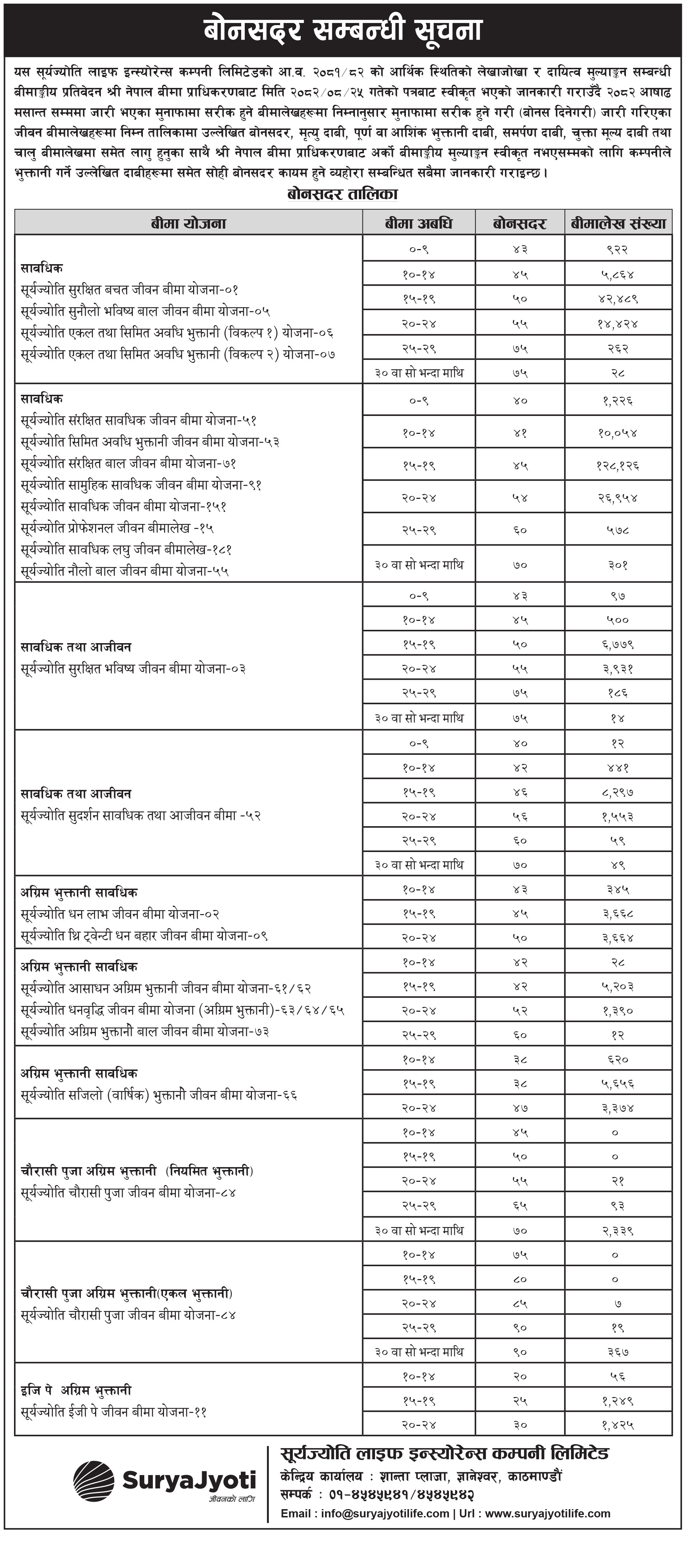
The following table outlines the estimated bonus rates for SuryaJyoti Life Insurance products based on the most recent actuarial valuations approved by the Nepal Insurance Authority. These rates apply to the various policy terms and plan categories.
| Policy Plan Category | Policy Term (Years) | Bonus Rate (Per Rs. 1,000 Sum Assured) |
|---|---|---|
| Endowment Plans | 09 - 14 Years | NPR 42 - 45 |
| 15 - 19 Years | NPR 45 - 50 | |
| 20 - 24 Years | NPR 50 - 60 | |
| 25+ Years | NPR 65 - 75 | |
| Whole Life Plans | 09 - 14 Years | NPR 50 - 55 |
| 15 - 19 Years | NPR 55 - 65 | |
| 20 - 24 Years | NPR 65 - 75 | |
| 25+ Years | NPR 75 - 90 | |
| Anticipated Endowment | 10 - 14 Years | NPR 40 - 45 |
| (Money Back Plans) | 15 - 19 Years | NPR 45 - 50 |
| 20 - 24 Years | NPR 50 - 55 | |
| Child Insurance Plans | All Terms | NPR 45 - 65 (Varies by specific plan) |
Disclaimer: These rates are subject to change based on annual actuarial valuations and approval from the Nepal Insurance Authority. Past performance does not guarantee future results.
Types of Bonuses Offered by SuryaJyoti Life
Not all bonuses are created equal. Depending on the stage of your policy, you might encounter different terminology.
1. Simple Reversionary Bonus
This is the most common type of bonus. Once declared, it is "guaranteed" to be paid at the time of maturity or death, provided the policy remains in force. It is added to the policy annually.
2. Interim Bonus
Since actuarial valuations happen after the fiscal year ends, there is often a gap between the last declared bonus and the current date. If a policy matures or a claim is made during this gap, SuryaJyoti pays an "Interim Bonus" so the policyholder doesn't lose out on the current year’s profit share.
3. Terminal Bonus
A Terminal Bonus is a one-time additional payment made at the end of a long-term policy (usually 15-20 years or more). It is not guaranteed and is paid at the discretion of the company as a reward for long-term loyalty. It serves to distribute any remaining surplus that wasn't captured in the annual reversionary bonuses.
Factors Influencing Bonus Rates in 2026
Several internal and external factors influence why SuryaJyoti might increase or decrease its bonus rates in any given year.
- Investment Income: Life insurance companies invest the premiums they collect in government bonds, bank fixed deposits, and the equity market. If the interest rates in Nepal’s banking sector are high, SuryaJyoti’s investment income increases, leading to higher bonus potential.
- Claim Ratio: If the number of death claims is lower than the actuary’s initial projections, more money stays in the Life Fund, which can be distributed as bonuses.
- Expense Management: Post-merger, SuryaJyoti has worked to reduce "management expenses" by consolidating branches and optimizing staff. Lower operational costs result in a higher surplus.
- Actuarial Valuation: The actuary assesses the future liabilities of the company. If the company’s assets significantly outweigh its future liability projections, a higher bonus is declared.
- Regulatory Guidelines: The Nepal Insurance Authority sets the rules on how much profit must be shared with policyholders and ensures that companies maintain a "Solvency Margin" to stay financially healthy.
How to Check Your Accumulated SuryaJyoti Bonus
As of 2026, SuryaJyoti Life has modernized its digital infrastructure, making it easier for policyholders to track their investments.
- SuryaJyoti Smart App: You can download the official mobile application, register with your policy number and date of birth, and view your "Bonus Statement" under the policy details section.
- Web Portal: Visit the official SuryaJyoti Life website and log into the client portal. This provides a comprehensive breakdown of premiums paid and bonuses accrued.
- SMS Service: The company often provides an SMS-based inquiry system where you can send a specific code and your policy number to receive your latest bonus status.
- Branch Visit: With one of the widest branch networks in Nepal, you can visit any SuryaJyoti office with your policy document to get a physical printout of your accumulated bonus.
Comparing Bonus Rates: What Policyholders Should Look For
When comparing SuryaJyoti’s bonus rates with other insurers in Nepal, it is a mistake to look only at the highest number. A high bonus rate on a policy with very high premiums may result in a lower "Internal Rate of Return" (IRR) than a lower bonus rate on a more affordable policy.
Furthermore, look at the consistency of the bonus. SuryaJyoti has maintained a reputation for stable bonus rates even during the economic fluctuations of the mid-2020s. Stability is often more valuable than a one-time high bonus followed by a sharp decline. You should also consider the "Whole Life" vs. "Endowment" distinction; Whole Life plans traditionally offer the highest bonus rates because the company can invest that capital for a much longer time horizon.
Frequently Asked Questions (FAQ)
What is the current bonus rate for SuryaJyoti Life Insurance in 2026?
In 2026, the bonus rates for SuryaJyoti Life generally range from NPR 40 to NPR 90 per thousand of the sum assured. The specific rate depends heavily on the type of plan (Endowment, Whole Life, or Money Back) and the duration of the policy term. Longer-term policies typically command higher rates.
Are bonus rates guaranteed every year?
No, bonus rates are not guaranteed. They are declared annually based on the company's financial performance and actuarial valuation. However, once a "Reversionary Bonus" is declared and added to your policy, it becomes a guaranteed part of the final payout at maturity or death.
Does the bonus rate change if I have an old Surya Life or Jyoti Life policy?
Yes, legacy policies issued before the merger might follow the specific bonus tracks established for those individual funds until the company fully integrates all products. You should check your specific policy statement to see which rate applies to your legacy plan.
Is the bonus taxable in Nepal?
Under current Nepali tax laws, the sum received at the maturity of a life insurance policy (which includes the sum assured and the accumulated bonus) is subject to a 5% capital gains tax on the profit (Maturity Value minus total premiums paid). It is advisable to consult a tax professional for the most current regulations in 2026.
Why does a Whole Life policy have a higher bonus than an Endowment policy?
Whole Life policies are designed to cover the insured for a longer period, often up to age 99. This allows SuryaJyoti to invest the premiums in long-term, higher-yielding assets. Because the company has more time to generate returns, they can afford to share a larger portion of the profit with these policyholders.
Practical Recommendations for Policyholders
If you are a current policyholder or looking to buy a policy in 2026, follow these steps to maximize your benefits:
- Opt for Longer Terms: If your financial goals allow, choose a policy term of 20 years or more. As shown in the rate table, the bonus jump between a 15-year term and a 25-year term can be significant.
- Keep Your Policy In-Force: Bonuses are only credited to "active" policies. If your policy lapses due to non-payment of premiums, you stop accumulating bonuses, and you may lose a portion of what was previously earned depending on the surrender value rules.
- Review Annually: Check the annual bonus declaration from SuryaJyoti every year after the fiscal year audit. This helps you track whether your retirement or savings goals are on schedule.
Image Gallery