The Ultimate Guide to NBA Playoff Records: History, Milestones, and Statistical Benchmarks in 2026
The National Basketball Association (NBA) postseason represents the ultimate test of athletic endurance, tactical adaptation, and mental fortitude. NBA playoff records chronicle the extraordinary performances of legendary franchises an...
The National Basketball Association (NBA) postseason represents the ultimate test of athletic endurance, tactical adaptation, and mental fortitude. NBA playoff records chronicle the extraordinary performances of legendary franchises and Hall of Fame players who elevated their game under the brightest spotlight, establishing milestones that define basketball excellence.
Contents
Understanding the Architecture of NBA Postseason History
The structure of the NBA playoffs has evolved dramatically since its inception, making historical context essential when evaluating single-game, series, and career records. From the early days of a modest eight-team postseason tournament to the modern 20-team configuration featuring the Play-In Tournament, the sheer volume of games played has shifted significantly.
Eras defined by different styles of play—ranging from the bruising, physical interior defense of the 1980s and 1990s to the pace-and-space, three-point revolution of the 21st century—impact how records are set and broken. Analysts evaluate postseason achievements by distinguishing between eras, recognizing that rule changes, such as the introduction of the three-point line in 1979 and modern defensive guidelines, heavily influence scoring outputs and efficiency metrics.
Understanding these benchmarks requires looking at both team dominance and individual brilliance. Historical milestones are categorized into several distinct tiers:
- Single-game performances showcasing peak individual dominance.
- Career totals accumulated through sustained excellence and deep postseason runs.
- Franchise records reflecting organizational stability and championship culture.
- Coaching and tactical milestones mapping strategic evolution.
Legendary Individual Scoring and Performance Records
Scoring the basketball when defenses are most prepared and adjustments are made game-by-game is the ultimate challenge. The record books for individual scoring are dominated by players who possessed virtually unguardable offensive arsenals.
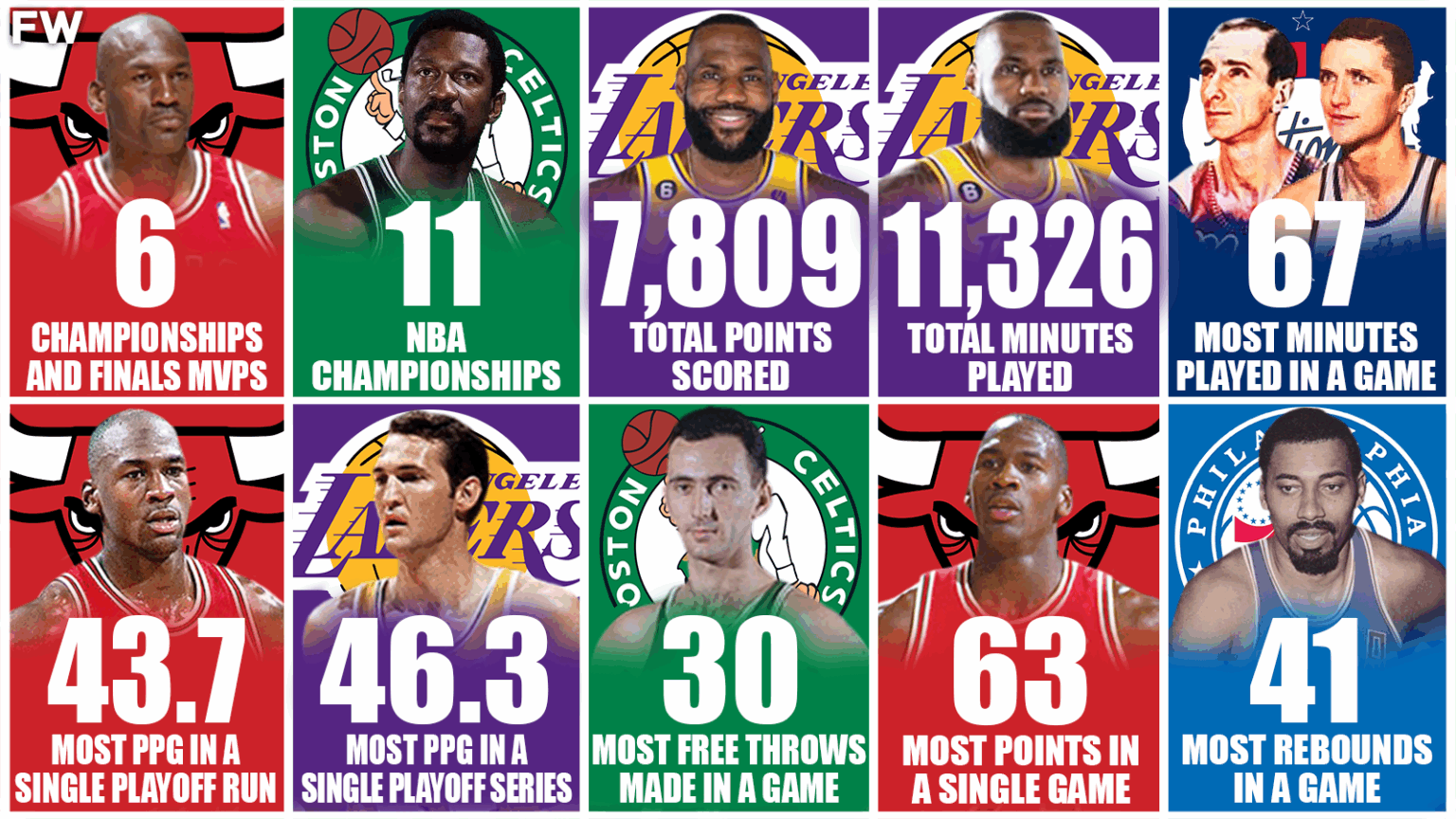
Michael Jordan holds the record for the highest points-per-game average in a single playoff series, averaging an astonishing 45.8 points against the Boston Celtics in 1986. Jordan also holds the record for the most points scored in a single playoff game, dropping 63 points on the Celtics on April 20, 1986, in a double-overtime classic. While modern players like Donovan Mitchell and Elgin Baylor have come close, Jordan's peak scoring outbursts remain the gold standard.
When examining career postseason scoring, LeBron James stands alone at the summit. Surpassing Kareem Abdul-Jabbar's long-standing records, James has accumulated the most total points in playoff history, a testament to his unprecedented longevity, durability, and consistent deep playoff runs across multiple franchises.
The table below highlights key individual single-game and series records held by basketball icons:
| Record Category | Player | Statistic | Opponent / Context | Year |
|---|---|---|---|---|
| Most Points in a Single Game | Michael Jordan | 63 Points | Boston Celtics (2OT) | 1986 |
| Most Three-Pointers in a Game | Damian Lillard | 12 Three-Pointers | Denver Nuggets (2OT) | 2021 |
| Most Assists in a Game | Magic Johnson | 24 Assists | Phoenix Suns | 1984 |
| Most Rebounds in a Game | Wilt Chamberlain | 41 Rebounds | Boston Celtics | 1967 |
| Most Blocks in a Game | Mark Eaton / Hakeem Olajuwon | 10 Blocks | Multiple Teams | 1985 / 1990 |
Franchise Dominance and Championship Dynasties
Team records in the NBA playoffs illustrate the difference between fleeting regular-season success and sustained championship contention. The Boston Celtics and Los Angeles Lakers share the pinnacle of franchise success, each capturing 18 NBA Championships, setting the benchmark for organizational excellence.
Franchise playoff records are also measured by consecutive appearances, home-court dominance, and series comeback statistics. Overcoming a 3-1 deficit in a best-of-seven series remains one of the rarest feats in professional sports, achieved only 13 times in NBA history. Iconic comebacks, such as the Cleveland Cavaliers overcoming a 3-1 deficit against the Golden State Warriors in the 2016 NBA Finals, permanently alter the historical landscape.
Key metrics evaluated when analyzing team playoff histories include:
- Series Conversion Rate: The percentage of playoff series won relative to series played.
- Sweeps Secured: The frequency with which a team eliminates opponents in four straight games.
- Road Resilience: Winning percentage in hostile away arenas during high-pressure elimination games.
Playmaker and Defensive Milestones
While scoring captures headlines, playmaking and defensive prowess dictate championship victories. Magic Johnson's career assist numbers reflect the Showtime Lakers' offensive engine, setting a standard for passing vision and tempo control that few have approached.
On the defensive end, shot-blocking and stealing records highlight the disruptive forces that alter opponent game plans entirely. Players like Bill Russell and Wilt Chamberlain grabbed rebounding totals in eras of high pace and missed shots that modern analytics suggest will likely never be touched due to rule changes and athletic evolution. Similarly, Hakeem Olajuwon's career blocks record underscores the unmatched interior presence required to anchor a championship defense.
Modern defenders face a different challenge, as floor-spacing and elite perimeter shooting demand versatile, switchable defenders rather than traditional rim protectors alone. Consequently, steals-per-game records and deflections have become vital modern indicators of elite playoff defense.
Comparing Postseason Eras: Statistics and Adjustments
Evaluating records across different decades requires acknowledging major shifts in style and officiating. The table below provides a comparative overview of how playoff basketball has transformed from the physical interior battles of the past to the perimeter-oriented game of the modern era.
| Era / Decade | Primary Offensive Focus | Average Game Pace | Defensive Scheme Predominance | Notable Record Benchmark |
|---|---|---|---|---|
| 1960s - 1970s | Post Play and Fast Breaks | Very High | Man-to-Man (Illegal Defense Rules) | Wilt Chamberlain rebounding peaks |
| 1980s - 1990s | Physical Isolation and Post-ups | Moderate | Hard Fouls, Hand-Checking, Zone Precursors | Michael Jordan high-volume scoring |
| 2000s | Half-Court Execution and Defense | Low | Heavy Trap Schemes, Slow-Paced Grinds | Low-scoring defensive battles |
| 2010s - 2026 | Spacing, Pick-and-Roll, Three-Pointers | High | Switch-Heavy Defences, Drop Coverage | Three-point volume and efficiency records |
Common Questions Regarding NBA Playoff Records
Who holds the record for the most career points in NBA playoff history?
LeBron James holds the record for the most career points scored in NBA playoff history, having surpassed 8,000 postseason points. His sustained excellence across more than two decades allows him to comfortably outpace historical legends like Michael Jordan and Kareem Abdul-Jabbar.
Has any team ever gone undefeated through an entire NBA postseason?
The Golden State Warriors recorded the best single-year playoff run in NBA history in 2017, finishing with a 16-1 record (.941 winning percentage). The only team to complete a full undefeated postseason prior to the modern four-round format was the 1983 Philadelphia 76ers, who went 12-1.
What is the record for the most points scored by a single player in an NBA Finals game?
Elgin Baylor holds the record for the most points scored in a single NBA Finals game, dropping 61 points for the Los Angeles Lakers against the Boston Celtics on April 14, 1962. Michael Jordan holds the record for the highest scoring average in a single NBA Finals series, averaging 41.0 points per game in 1993.
How many teams have successfully come back from a 3-1 deficit in the NBA playoffs?
As of 2026, teams trailing 3-1 in a best-of-seven series have successfully overcome the deficit only 13 times in NBA history. Notable instances include the 2016 Cleveland Cavaliers in the Finals and the 2020 Denver Nuggets, who accomplished the feat twice in a single postseason run.
Which coach has the most career playoff wins in NBA history?
Gregg Popovich holds the record for the most career playoff wins by a head coach in NBA history. Popovich surpassed legendary coach Phil Jackson, accumulating decades of postseason success leading the San Antonio Spurs franchise.
Strategic Execution for Postseason Success
Analyzing historical playoff records offers valuable lessons for modern franchises building championship rosters. Teams seeking to break or set new records must prioritize roster depth, elite two-way versatility, and load management to ensure peak health when series intensity reaches its maximum. Reviewing historical benchmarks provides coaches and front offices with tactical blueprints on how to manage fatigue, exploit defensive mismatches, and close out tight series on the road.
Image Gallery