Comprehensive Guide to Securing a Car Loan with Bad Credit in 2026
Navigating the auto financing market with a low credit score requires a strategic approach, a clear understanding of your current financial standing, and preparation to mitigate high interest rates. While subprime lenders specialize in...
Navigating the auto financing market with a low credit score requires a strategic approach, a clear understanding of your current financial standing, and preparation to mitigate high interest rates. While subprime lenders specialize in approving borrowers with poor credit histories, securing favorable terms in 2026 demands careful evaluation of down payments, debt-to-income ratios, and pre-approval options to avoid predatory lending practices.
Contents
Understanding Your Credit Profile and Subprime Auto Financing
Before stepping onto a dealership lot or submitting online applications, you must establish an accurate baseline of your credit health. Credit scores under 580 are typically classified as poor or subprime, which signals to traditional lenders like major banks and credit unions that you present a higher default risk. However, specialized automotive lenders look beyond a three-digit score, placing heavier emphasis on your steady employment history, monthly income, and overall ability to manage monthly debt obligations.
Subprime auto loans are widely available through specialized financing companies, buy-here-pay-here (BHPH) dealerships, and online lending marketplaces. The primary trade-off for these approvals is the cost of borrowing. Interest rates for bad credit auto loans frequently sit significantly higher than prime rates, meaning the total cost of ownership will be substantially greater over the life of the loan. Knowing your baseline empowers you to calculate realistic monthly car payments and target vehicle prices that align with your budget.
Core Prerequisites and Documentation for Subprime Loan Approval
Securing a bad credit car loan requires more thorough documentation than a standard prime loan. Because lenders perceive a higher level of risk, they require verifiable proof that you can reliably service the debt every month. Gathering these documents beforehand streamlines the approval process and prevents delays.
- Proof of Income: Lenders typically require recent, consecutive pay stubs reflecting a minimum gross monthly income (often $1,500 to $2,000 depending on the lender). Self-employed individuals must provide bank statements or tax returns.
- Proof of Residence: A current utility bill, lease agreement, or mortgage statement matching your driver's license confirms your stability of residence.
- Valid Identification: A government-issued photo ID, such as a driver's license or passport, is mandatory for identity verification.
- Personal References: Subprime lenders frequently request a list of personal references, including names, addresses, and phone numbers of friends, family members, or coworkers who can verify your contact information.
- Down Payment Verification: Proof of liquid funds via bank statements or a cashier's check showing your down payment source.
Step-by-Step Strategy to Secure and Optimize a Bad Credit Car Loan
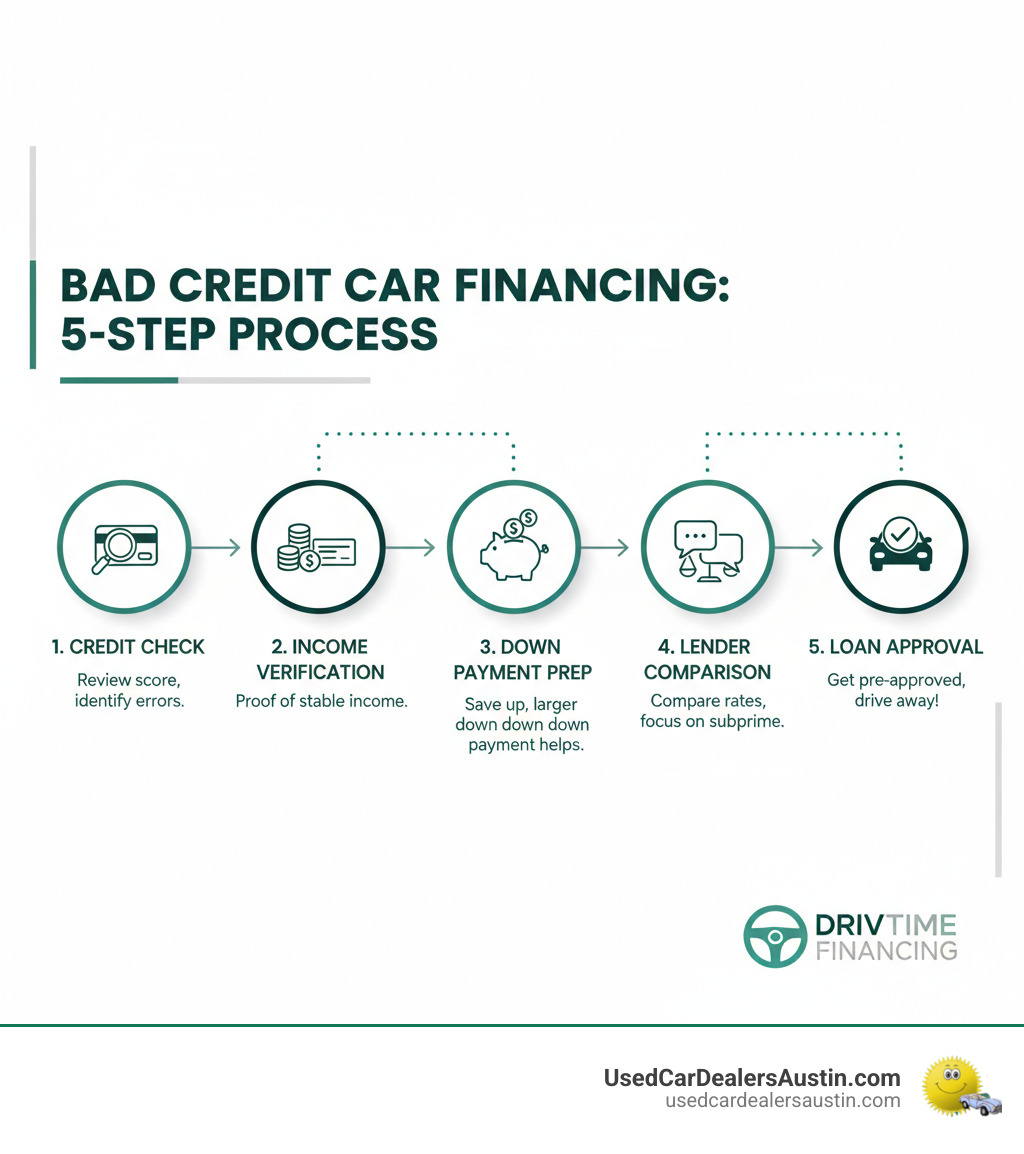
Executing a structured, step-by-step approach prevents emotional buying decisions and protects you from exploitative loan structures. Follow this workflow to maximize your approval odds and minimize financing costs.
- Pull and Review Your Credit Reports: Obtain free copies of your reports from major credit bureaus to check for errors, unpaid collections, or open judgments that could be disputed or resolved beforehand.
- Determine a Realistic Budget: Calculate your monthly debt-to-income (DTI) ratio. Ensure your projected car payment and insurance costs do not exceed 15% to 20% of your net monthly income.
- Save for a Substantial Down Payment: Aim for a down payment of at least 10% to 20% of the vehicle's purchase price, or prepare a reliable trade-in vehicle to reduce the loan-to-value (LTV) ratio.
- Secure Pre-Approval from Multiple Sources: Apply with online auto finance brokers, credit unions, and specialized subprime lenders within a 14-day window to lock in pre-approved offers without negatively impacting your credit score with excessive hard inquiries.
- Shop for a Reliable, Affordable Vehicle: Focus your search on dependable, fuel-efficient used vehicles with proven longevity, avoiding luxury models or vehicles with high maintenance costs.
- Review the Entire Contract Thoroughly: Scrutinize the annual percentage rate (APR), loan term length, total finance charges, and any mandatory add-ons like GAP insurance or extended warranties before signing.
Comparative Analysis of Financing Options for Subprime Borrowers
Evaluating where to source your auto loan can dramatically impact your financial outcome. The following table compares the primary financing channels available to borrowers with bad credit.
| Financing Source | Typical APR Range | Pros | Cons |
|---|---|---|---|
| Credit Unions | 6% - 14% | Lower interest rates, personalized customer service, flexible terms for members. | Membership requirements, strict approval criteria even for members. |
| Online Subprime Lenders | 9% - 22% | Convenient comparison shopping, fast pre-approval, specialized in bad credit. | Potential for high fees, varying degrees of lender legitimacy. |
| Dealership Financing (Captive/Third-Party) | 10% - 25%+ | One-stop shopping, access to special manufacturer promotional programs. | Markup on interest rates by dealers, high-pressure sales tactics. |
| Buy-Here-Pay-Here (BHPH) Lots | 20% - 30%+ | Guaranteed approval regardless of credit score. | Extremely high interest rates, mandatory weekly/bi-weekly in-person payments, potential GPS tracking/starter-interrupter devices. |
Financial Risks, Limitations, and Red Flags to Avoid
Entering the subprime auto market requires vigilance against predatory practices designed to trap vulnerable borrowers in cyclical debt.
- Extended Loan Terms: Be wary of lenders offering 72-to-84-month loan terms to lower monthly payments. Long terms drastically increase total interest paid and often lead to negative equity (being "upside down" on the loan).
- Packaged Add-Ons: Watch out for dealers quietly bundling GAP insurance, credit life insurance, and overpriced service contracts into the financed amount without your explicit consent.
- Yo-Yo Financing: This occurs when a dealer lets you drive off the lot with pre-approval, only to call you back days later claiming the financing fell through, forcing you to accept a higher interest rate or larger down payment.
- Excessive Prepayment Penalties: Review the loan agreement to ensure there are no penalties for paying off the loan early or making extra principal payments.
Long-Term Financial Recovery Through Auto Loans
An auto loan can serve as a powerful tool for credit rehabilitation when managed correctly. Because installment loans diversify your credit mix alongside revolving accounts like credit cards, consistent, on-time monthly payments demonstrate financial reliability to major credit scoring models. Set up automatic payments to eliminate the risk of accidental late payments. Over 12 to 24 months of perfect payment history, your credit score can improve significantly, opening the door to refinancing the high-interest auto loan into a much lower rate through a traditional bank or credit union.
Frequently Asked Questions About Bad Credit Car Loans
Can I get a car loan with a credit score under 500?
Yes, specialized subprime lenders and Buy-Here-Pay-Here dealerships approve borrowers with credit scores below 500, though you should expect significantly higher interest rates and a required down payment of 20% or more. Lenders offset the extreme risk by charging higher rates and requiring verified stable income.
Is it better to get pre-approved before visiting a car dealership?
Securing pre-approval before visiting a dealership establishes your maximum budget and provides a benchmark interest rate that prevents dealers from artificially inflating your financing costs. Walking in with pre-approved financing shifts your negotiating stance from monthly payment discussions to total vehicle purchase price negotiations.
How much of a down payment do I need for bad credit auto financing?
Aiming for a down payment of 10% to 20% of the vehicle's purchase price significantly improves your approval odds and lowers the lender's risk exposure. A larger down payment reduces the overall loan amount, which can also help secure a slightly lower interest rate.
Will applying for multiple car loans hurt my credit score?
Multiple auto loan inquiries made within a focused 14-to-45-day window are typically grouped together by credit scoring models as a single inquiry to allow consumers to shop for the best rate. However, spreading applications out over several months will result in multiple hard inquiries that can temporarily lower your score.
Can refinancing a bad credit car loan save me money later?
Refinancing a subprime auto loan after 12 to 18 months of consistent, on-time payments can dramatically lower your monthly payment and total interest charges if your credit score has improved. Ensure your current loan does not carry a prepayment penalty before pursuing a refinance option.
Practical Next Steps for Your Auto Financing Journey
Take control of your financial future today by pulling your credit report, setting a strict budget based on your take-home pay, and gathering your proof of income and residency documents. Begin by applying with trusted online auto lenders or local credit unions to secure pre-approval letters before entering any dealership showroom. Approach the process with patience and discipline to ensure you drive away in a reliable vehicle without compromising your long-term financial stability.
Image Gallery