Converting Military Spousal Life Insurance: Rules, Deadlines, and Step-by-Step Guide
Military spouses insured under Family Servicemembers' Group Life Insurance (FSGLI) can convert their coverage into a permanent commercial life insurance policy within 120 days of a qualifying event—such as military separation, divorce,...
Military spouses insured under Family Servicemembers' Group Life Insurance (FSGLI) can convert their coverage into a permanent commercial life insurance policy within 120 days of a qualifying event—such as military separation, divorce, or the member's death—without medical underwriting. Applications must be submitted directly to a participating commercial insurer.
Contents
Understanding FSGLI and the Conversion Privilege
Family Servicemembers' Group Life Insurance (FSGLI) is a civilian-administered, federally backed life insurance program managed by the Department of Veterans Affairs (VA) through the Office of Servicemembers' Group Life Insurance (OSGLI). Designed to provide financial protection for military families, FSGLI automatically offers up to $100,000 in term life insurance coverage for spouses of active duty and Ready Reserve service members insured under full-time Servicemembers' Group Life Insurance (SGLI).
When a service member separates from active duty, divorces their spouse, or experiences other qualifying changes, the spouse's entitlement to group military coverage ends. To protect spouses against losing financial security—especially those with pre-existing medical conditions who might otherwise face high premiums or coverage denials on the open market—the federal government grants a statutory right to convert FSGLI spousal coverage into an individual commercial policy.
This statutory privilege, known as the conversion right, guarantees that an eligible spouse can secure permanent individual life insurance without submitting to medical exams, blood draws, health questionnaires, or attending-physician statements. However, exercising this right requires strict adherence to administrative procedures, tight submission windows, and specific policy selection constraints established by federal regulation.
Qualifying Events and Strict Conversion Timelines
FSGLI spousal coverage does not last indefinitely. The privilege to convert FSGLI into a private commercial life insurance policy is triggered by specific administrative life events. Knowing the exact trigger date is critical because the application period is governed by a strict deadline.
Triggering Events for FSGLI Conversion
Spousal FSGLI coverage terminates—and the conversion clock begins ticking—upon the occurrence of any of the following four qualifying events:
Service Member's Separation or Retirement: The active duty or Ready Reserve service member separates, retires, or releases from military service, terminating their primary SGLI coverage.
Legal Divorce: The marriage between the service member and the insured spouse is legally dissolved by a final decree of divorce or annulment.
Death of the Service Member: The insured service member dies while serving on active duty or in the Ready Reserve.
Voluntary Termination or Reduction: The service member declines SGLI coverage, reduces their own SGLI coverage below the spouse's coverage amount, or explicitly terminates the spouse's FSGLI coverage using Service-specific administrative forms.
FSGLI Qualifying Event (Military Separation, Legal Divorce, Member Death, Cancelation)
120-Day Guaranteed Conversion Window
- No Medical Exam Required
- Standard Premium Rates (No Health Loading)
- Permanent Policy Options Only
After Day 120 Elapse
- Conversion Privilege Permanently Expires
- Commercial Policies Require Full Underwriting
- Risk of Rate Hikes or Denial Based on Health History
The 120-Day Countdown Window
From the exact date of the qualifying event, the military spouse has precisely 120 days to complete the conversion process. This 120-day timeframe is established under federal law and is enforced without exception by OSGLI and participating commercial insurers.
- Day 1 through Day 120: The spouse holds guaranteed issue rights. No medical questions can be asked, and coverage cannot be denied based on physical or mental health conditions.
- Day 121 and Beyond: The statutory conversion window permanently closes. If a spouse seeks commercial life insurance after Day 120, they must apply through standard private underwriting channels, where pre-existing conditions, tobacco use, and age directly dictate premium costs and eligibility.
Because proof of eligibility and official service documentation can take several weeks to process, military families should begin organizing conversion paperwork at least 60 days before an anticipated separation date or immediately following a divorce decree or bereavement event. For comprehensive policy guidelines, review the official VA Family Servicemembers' Group Life Insurance guide.
Step-by-Step Guide to Converting FSGLI Coverage
Converting an FSGLI policy into an individual commercial insurance product requires coordinating between military administrative records and private insurance underwriters. Following a structured procedure helps ensure coverage remains uninterrupted.
- Step 1: Gather Official Documents (DD214, Divorce/Death)
- Step 2: Select Approved Commercial Insurer
- Step 3: Select Permanent Policy Type (Whole Life)
- Step 4: Submit App & 1st Premium Payment Within 120 Days
Step 1: Obtain Required Documentation
Commercial insurance carriers require explicit proof of military service separation and prior FSGLI coverage before honoring guaranteed-issue conversion applications. The spouse or service member must compile the following document packet:
- Proof of FSGLI Coverage: A copy of the service member's most recent Leave and Earnings Statement (LES) showing FSGLI premium deductions, or a copy of SGLV Form 8286 (SGLI Election and Certificate) / SGLV Form 8286A (Family SGLI Election).
- Proof of the Qualifying Event:
- For Military Separation/Retirement: DD Form 214 (Certificate of Release or Discharge from Active Duty) showing the characterization of service and date of separation.
- For Divorce: Official certified copy of the final divorce decree or annulment paper.
- For Service Member Death: Official military casualty report (DD Form 1300) or civilian death certificate.
- For Coverage Termination: A copy of the processed SGLV 8286A terminating or reducing spousal coverage.
Step 2: Select a Participating Insurance Company
FSGLI conversions cannot be completed with just any private life insurance agent. The conversion policy must be issued by a commercial carrier listed as an approved, participating company with the Office of Servicemembers' Group Life Insurance.
Major nationwide insurers—such as Prudential, New York Life, MetLife, and Lincoln Financial—participate in the OSGLI conversion network. Spouses should contact the corporate conversion department of a participating insurer rather than a general local agent who may be unfamiliar with military conversion mandates. Detailed instructions and list updates are available on the VA SGLI and FSGLI conversion overview.
Step 3: Select an Approved Policy Structure
Under federal conversion statutes, converted policies must meet specific product parameters:
- Permissible Plan Types: The commercial policy must be a permanent form of life insurance, such as Whole Life or Universal Life.
- Prohibited Plan Types: Term life insurance, universal variable life insurance, and policies incorporating specialized disability riders or accidental death benefits are generally not eligible under guaranteed-issue conversion rules.
- Maximum Face Value: The maximum face amount of the converted policy cannot exceed the spouse's existing FSGLI coverage level prior to termination (up to $100,000).
- Minimum Face Value: The coverage amount can be lower than the original FSGLI benefit, provided it meets the commercial insurer's minimum policy issuance threshold (typically $10,000 to $25,000).
Step 4: Submit Application and First Premium Payment
The insurance application and initial premium payment must be received by the chosen commercial carrier before the end of the 120-day conversion period. Once approved, the policy takes effect immediately upon the termination of FSGLI coverage, eliminating any lapse in protection.
Technical Comparison: FSGLI Conversion vs. Open Market and VGLI
Understanding how FSGLI conversion compares to alternative life insurance options is critical when evaluating post-military financial strategy. A common source of confusion is Veterans' Group Life Insurance (VGLI); military spouses are legally ineligible for VGLI, which is strictly reserved for former service members.
| Feature / Parameter | FSGLI Commercial Conversion | Standard Private Market Policy | VGLI (Veterans' Group Life Insurance) |
|---|---|---|---|
| Eligible Individual | Military Spouse | Military Spouse or Veteran | Veteran / Service Member Only (Spouses Ineligible) |
| Medical Underwriting | None (Guaranteed Issue within 120 days) | Full (Medical exams, health history, labs) | None (If applied within 240 days of separation) |
| Policy Type Offered | Permanent (Whole Life / Universal Life) | Term, Whole Life, Universal, Variable | Five-Year Renewable Term |
| Maximum Coverage | Equal to prior FSGLI (Max $100,000) | Based on financial need and underwriting | Equal to prior SGLI (Max $500,000) |
| Pricing Structure | Standard commercial rates for attained age | Risk-based (Preferred, Standard, Substandard) | Five-year age-bracketed rate bands |
| Tobacco / Health Penalties | No health penalties during window | High premiums for pre-existing conditions | No health penalties during initial window |
| Deadline to Apply | 120 days from qualifying event | No strict deadline (subject to underwriting) | 1 year and 120 days (240 days for no-health-exam) |
Premium Costs and Financial Considerations
While guaranteed conversion provides vital protection for individuals with health issues, it is essential to evaluate the long-term financial commitments of converted policies.
Premium Calculation Mechanics
Premiums for converted policies are determined by two primary factors:
- Attained Age: The spouse's physical age on the effective date of the private policy.
- Permanent Policy Rate Tables: Commercial whole life rates are significantly higher per dollar of coverage than military group term policies.
Because conversion policies are permanent whole life products, premiums remain level for the life of the policy, building cash value over time. However, the initial monthly outlay will be noticeably higher than the active duty FSGLI premium (which costs approximately $4.50 to $24.00 per month for $100,000 depending on age).
Evaluating Healthy vs. Medically Impaired Spouses
- For Spouses with Pre-Existing Medical Conditions: FSGLI conversion is often the most cost-effective—and sometimes the only—way to secure lifelong coverage. Because the private carrier cannot apply rating surcharges or exclude conditions like diabetes, cancer history, or autoimmune disorders, guaranteed conversion provides immense value.
- For Young, Healthy Spouses: Converting to a commercial whole life policy may not be the most economical choice. Healthy spouses can often purchase a commercial 20-year or 30-year term life insurance policy on the open market for a fraction of the cost of a conversion whole life policy, while securing significantly higher coverage limits (e.g., $500,000 or $1,000,000).
Critical Pitfalls and Misconceptions to Avoid
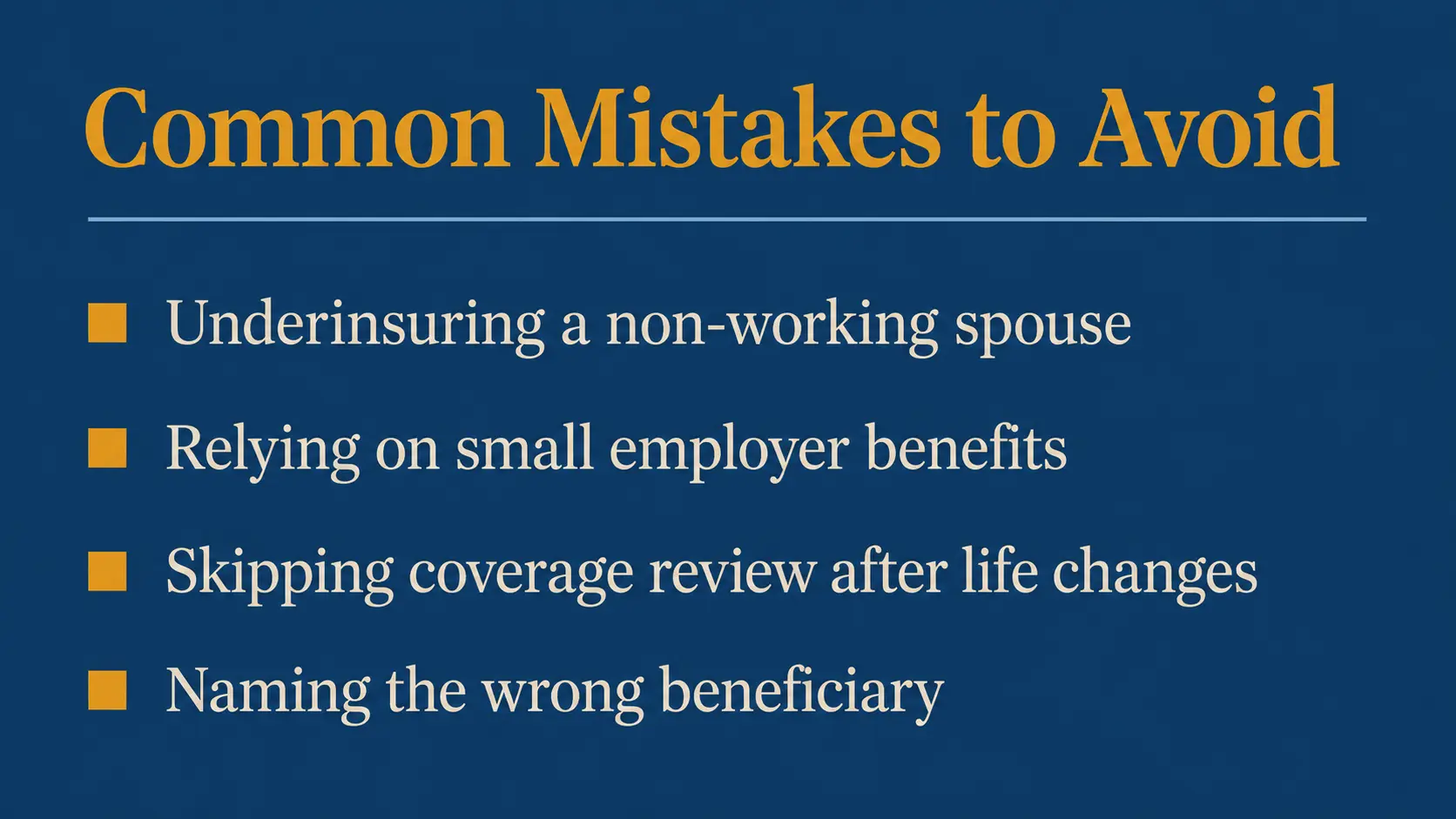
Navigating military benefits transitions often leads to missteps due to administrative complexity. Military families should guard against four primary errors:
1. Assuming Spouses Can Transfer Coverage to VGLI
A widespread misconception is that a spouse's FSGLI coverage automatically converts alongside the service member's SGLI into VGLI. VGLI does not cover spouses or dependents. When a service member transitions to VGLI, spousal FSGLI terminates entirely, leaving private commercial conversion as the sole guaranteed path for the spouse.
2. Attempting to Convert Dependent Child Coverage
Under FSGLI, dependent children are automatically covered for $10,000 at no additional cost to the service member. However, federal law specifically excludes dependent child coverage from conversion rights. When the service member separates or the child ages out, child FSGLI coverage simply expires without a conversion option.
3. Missing the 120-Day Window Due to Delayed Paperwork
Waiting for official military separation documents (such as an updated DD-214) can consume weeks. If a military branch delays delivering final records, the 120-day window does not automatically pause. Spouses should contact OSGLI and participating insurers immediately upon separation to initiate the application process using preliminary orders if necessary.
4. Selecting Term Insurance on a Conversion Application
Attempting to request a commercial term policy under the guaranteed conversion privilege will result in application rejection or standard underwriting requirements. Guaranteed conversion mandates the selection of a permanent cash-value policy form.
Frequently Asked Questions
Can military spouses convert FSGLI to VGLI upon transition?
No. Veterans' Group Life Insurance (VGLI) is strictly limited to former service members. Spouses cannot enroll in VGLI. To maintain coverage without medical underwriting, spouses must convert their FSGLI policy into an individual permanent commercial life insurance policy within 120 days of the qualifying event.
Does a military spouse need a medical exam to convert FSGLI?
No medical examination, lab work, or health questionnaire is required if the spouse submits the conversion application and initial premium payment within 120 days of the qualifying event. Conversion is guaranteed regardless of pre-existing physical or mental health conditions.
What is the maximum amount of life insurance coverage a spouse can convert?
A spouse can convert up to the total amount of FSGLI coverage they held prior to the qualifying event, capped at a maximum of $100,000 (or the service member's total SGLI coverage amount, whichever was lower). Spouses may elect to convert a lower amount if desired, subject to insurer minimums.
What happens if the 120-day FSGLI conversion deadline is missed?
If the 120-day window expires, the guaranteed-issue privilege is lost. The spouse can still apply for commercial life insurance on the open private market, but the application will require full medical underwriting, health questionnaires, and potentially physical exams. Approval and premium rates will depend entirely on the spouse's medical history.
What types of commercial insurance policies are eligible for FSGLI conversion?
FSGLI can only be converted into permanent individual life insurance policies, such as Whole Life or Universal Life, offered by participating commercial insurance companies. Term life insurance, variable policies, and policies containing specialized disability riders are not eligible under standard guaranteed conversion rules.
Actionable Next Steps for Military Families
To ensure a smooth transition of life insurance protection when leaving military service or experiencing a family change, follow this practical checklist:
- Verify Current FSGLI Benefit Levels: Check the service member's latest LES or SGLV Form 8286A to confirm exact spousal coverage amounts ($10,000 to $100,000).
- Establish the Official Trigger Date: Note the exact date of separation, divorce decree, or coverage termination. Mark the 120-day deadline clearly on your family calendar.
- Assess Health Status and Coverage Needs: If the spouse has underlying medical conditions, prioritize the guaranteed FSGLI conversion route. If the spouse is in excellent health, shop open-market private term policies simultaneously to compare costs and coverage limits.
- Contact OSGLI-Approved Insurers: Reach out directly to the conversion departments of approved commercial carriers (e.g., Prudential, New York Life) at least 60 days before military separation.
- Submit Documents Promptly: Send the completed conversion application, proof of service/event (DD-214 or divorce decree), and initial premium payment well before Day 120 to guarantee uninterrupted family financial protection.
Image Gallery