Navigating the Top Life Insurance Agent Management Software in 2026
The best life insurance agent management software serves as a centralized hub for client data, policy tracking, automated lead nurturing, and compliance reporting. By integrating Customer Relationship Management (CRM) tools with specia...
The best life insurance agent management software serves as a centralized hub for client data, policy tracking, automated lead nurturing, and compliance reporting. By integrating Customer Relationship Management (CRM) tools with specialized insurance-industry workflows, agents can streamline the transition from initial prospect contact to policy underwriting and long-term retention without sacrificing administrative accuracy.
Contents
Selecting the right software requires balancing immediate operational needs—such as lead distribution and calendar management—with long-term requirements like commission tracking and regulatory compliance. As the insurance technology landscape evolves, agency management systems (AMS) and CRMs have converged into hybrid platforms, making it critical for agents to audit their specific agency workflows before committing to a platform.
Defining the Role of Insurance Agency Management Systems
Life insurance agents operate in a high-stakes environment where data security, meticulous record-keeping, and timely follow-ups are non-negotiable. An effective agent management system acts as the digital backbone of an agency, moving beyond simple contact management to offer specialized insurance capabilities.
Unlike a generic CRM, a life insurance-specific platform understands the "life cycle" of a policy. This includes the application process, medical underwriting, policy delivery, and the annual review cycle. When a platform is built for the insurance sector, it naturally accounts for producer hierarchies, complex commission structures, and state-specific compliance mandates.
Core Components of Modern Agent Software
To evaluate software effectively, agents must look for a core set of features that address the daily friction points of the profession:
- Lead Pipeline Management: The ability to categorize leads by status—ranging from "new inquiry" to "underwriting" or "policy issued"—is essential for maintaining momentum.
- Automated Communication: Life insurance often involves long lead times. Automated email and SMS sequences ensure consistent touchpoints without manual intervention.
- Commission Accounting: Automated tracking of "as-earned" versus "advanced" commissions helps agents forecast revenue and manage agency cash flow.
- Policy and Document Storage: Secure, cloud-based storage is required to handle sensitive Personal Identifiable Information (PII) and Health Insurance Portability and Accountability Act (HIPAA) protected data.
Evaluating Top Platforms in the Current Market
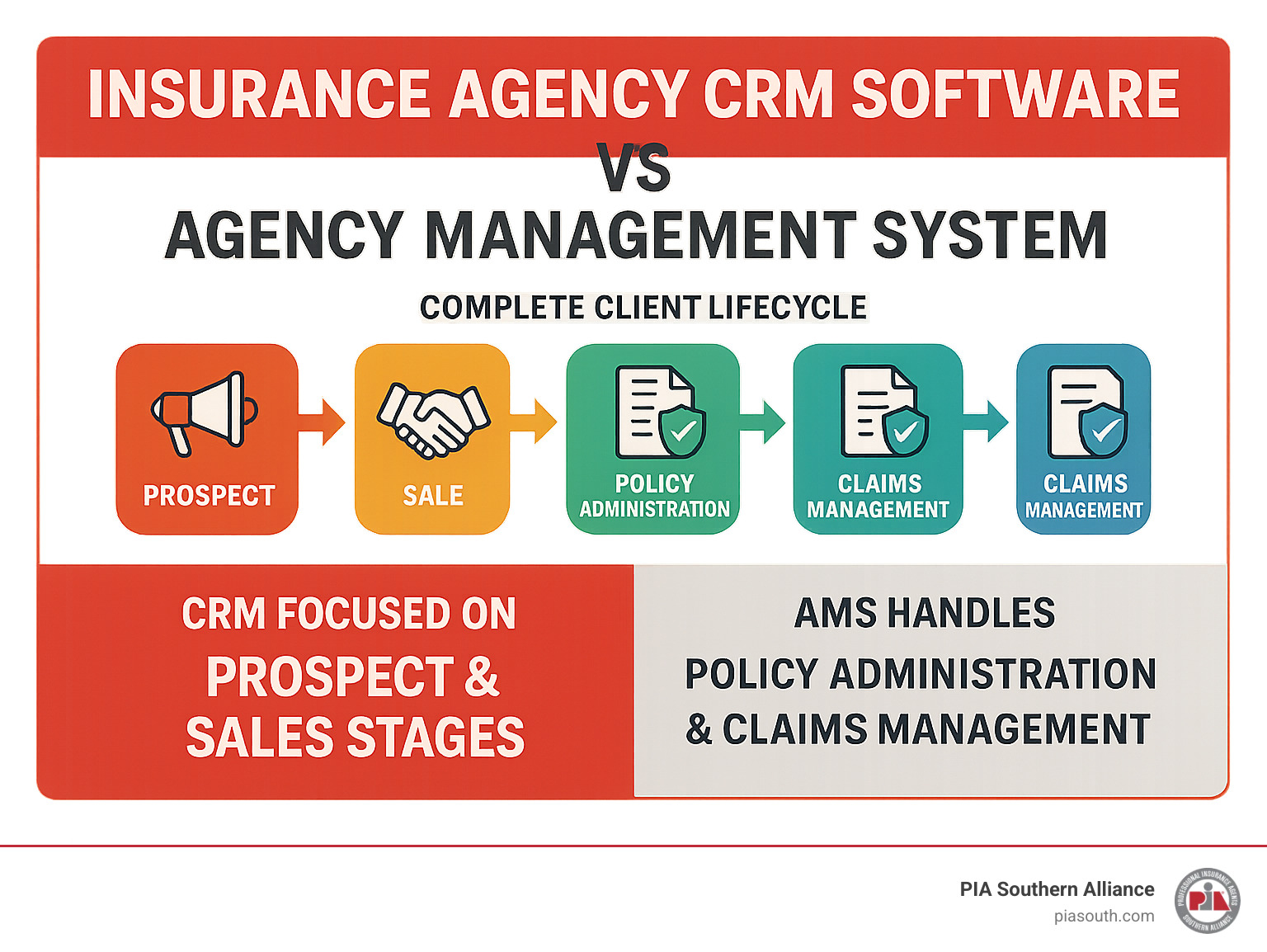
The market for agency management software has matured significantly. Agents now choose between comprehensive Enterprise Resource Planning (ERP) systems, which handle everything from accounting to policy management, and modular CRM-led solutions that prioritize lead conversion.
Comparison Table: Key Software Categories
| Feature Category | Agency-Wide Management Systems (AMS) | Sales-Focused CRMs |
|---|---|---|
| Primary Goal | Administrative efficiency & compliance | Lead conversion & sales volume |
| User Base | Large brokerages, multi-agent teams | Independent agents & small teams |
| Key Strengths | Policy lifecycle & commission tracking | Automation & prospect engagement |
| Complexity | High (Steeper learning curve) | Moderate (Quick deployment) |
| Typical Cost | Higher (Often per-user or revenue %) | Lower (Flat monthly subscription) |
Selecting the Right Software for Your Agency
Before purchasing a subscription, an agent must conduct an internal audit of their current processes. The transition to new software is often hampered not by the tool itself, but by a lack of clear data migration strategy or defined internal processes.
1. Identify Your Scale
A solo agent managing a lean practice with a focus on term life insurance will have vastly different needs than a brokerage house handling universal life products for high-net-worth clients. Solo agents should prioritize ease of use and mobile accessibility, while larger agencies must look for robust permission settings and team-based performance analytics.
2. Prioritize Integration
No software exists in a vacuum. Your management software should integrate with your email provider, your calendar, and your carrier portals where possible. If the software offers an Open API (Application Programming Interface), it allows for custom connections to other business tools, effectively future-proofing your tech stack.
3. Compliance and Data Security
Because life insurance data is sensitive, vetting the security protocols of a provider is an essential prerequisite. Ensure the platform is compliant with relevant data protection regulations and offers multi-factor authentication (MFA) as a standard feature. Review their terms of service regarding data ownership—ensure that you can export your entire client database in a standard format (like CSV or SQL) should you decide to switch providers in the future.
Common Pitfalls in Implementing Agent Software
Many agents experience "feature fatigue," where they purchase a robust system but only utilize 10% of its capabilities. This typically happens when the software is too complex for the agency’s current stage.
Another common error is failing to cleanse data before migration. Moving "dirty" data—duplicate contacts, incomplete client records, or outdated email addresses—into a new, expensive system simply recreates the same administrative burden in a new interface. Invest time in cleaning your contact list before initiating the transfer to any new management software.
Future-Proofing Your Agency Operations
Looking toward the remainder of 2026 and beyond, the trend in agent software is the integration of predictive analytics. Newer platforms are beginning to offer insights into which leads are most likely to convert based on historical performance data, and which clients are at the highest risk of "lapsing" their policies. While these features are optional, they represent the next phase of efficiency for competitive agencies.
Start by selecting a platform that covers your "must-have" list—usually commission tracking and lead management. Once your team is comfortable with the system, explore the "nice-to-have" features like advanced analytics or automated marketing campaigns.
Frequently Asked Questions
Does agent management software replace a standard CRM? For most life insurance agents, yes. An industry-specific management system is effectively a CRM that has been built with insurance-specific fields and workflows. Using a generic CRM often forces agents to create complex "workarounds" to track policy-related milestones, whereas an insurance-specific platform includes these as default features.
What is the average cost for these platforms? Pricing varies significantly based on functionality and the number of users. Most cloud-based solutions operate on a subscription basis, ranging from $50 to $300 per month for individual agents, with enterprise tiers often costing significantly more depending on the level of customization and support required.
How long does it take to migrate to a new system? A typical migration, including data cleaning and team training, takes between two and four weeks. Agencies should schedule this during a slower production period to ensure the transition does not negatively impact ongoing client service or application submissions.
Is it necessary to have mobile access for these tools? In 2026, mobile access is highly recommended. Life insurance agents frequently meet clients in their homes or offices. The ability to pull up a client’s policy status or capture a digital signature via a tablet or phone is a major competitive advantage that reduces the need to return to the office to finalize paperwork.
What should I look for in a software support team? Look for providers that offer more than just email support. Live chat, comprehensive knowledge bases with video tutorials, and dedicated account managers are indicators that the software company is invested in your long-term success rather than just a quick sale.
Recommended Next Steps
If you are currently relying on spreadsheets or disjointed tools, prioritize an audit of your top three pain points—such as slow lead response or inaccurate commission records. Once identified, request a live demonstration from at least two vendors. During the demo, specifically ask to see how the software handles your unique workflow, such as the process for submitting an application to a carrier you use frequently. This focus ensures the software is a practical tool for your business, not just a technical purchase.
Image Gallery