Understanding How Life Insurance Sleep Apnea Risk Class Works
When you apply for a life insurance policy, underwriters evaluate your medical history to determine your risk classification. If you have been diagnosed with obstructive sleep apnea, insurers pay close attention, but a diagnosis does n...
When you apply for a life insurance policy, underwriters evaluate your medical history to determine your risk classification. If you have been diagnosed with obstructive sleep apnea, insurers pay close attention, but a diagnosis does not automatically disqualify you from securing affordable coverage if the condition is properly managed and treated.
Contents
Life insurance companies evaluate sleep apnea risk class by analyzing how well the condition is controlled, whether you consistently use prescribed treatments like CPAP therapy, and if you suffer from related cardiovascular complications. Underwriters categorize applicants based on severity, compliance logs, and secondary health markers to assign a risk tier that directly dictates your premium rates.
What is Life Insurance Underwriting and Why Sleep Apnea Matters
Life insurance underwriting is the process by which an insurance carrier evaluates an applicant's health, lifestyle, and financial profile to assess the statistical probability of mortality. Based on this evaluation, the carrier assigns a risk class, which ranges from preferred plus (the healthiest category with the lowest rates) to standard or table-rated categories (higher risk with elevated premiums).
Obstructive sleep apnea (OSA) is a chronic medical condition characterized by repeated episodes of upper airway collapse during sleep, leading to breathing pauses, oxygen desaturation, and frequent micro-awakenings. Underwriters view untreated sleep apnea with caution because chronic nocturnal hypoxia and sleep fragmentation are statistically linked to severe long-term health complications. These include systemic hypertension, coronary artery disease, stroke, type 2 diabetes, and sudden cardiac death.
However, the insurance landscape has evolved significantly. Because sleep apnea is extremely common and highly manageable with modern interventions, underwriters no longer view a simple diagnosis as an automatic high-risk impairment. Instead, they focus heavily on management, compliance, and secondary health indicators.
The Factors Underwriters Examine for Sleep Apnea
When an insurance underwriter reviews your medical records regarding sleep apnea, they do not look at the diagnosis in isolation. They evaluate a specific set of clinical metrics to determine your overall risk profile. Understanding these factors can help you prepare for the medical underwriting process.
Severity and Diagnosis Method
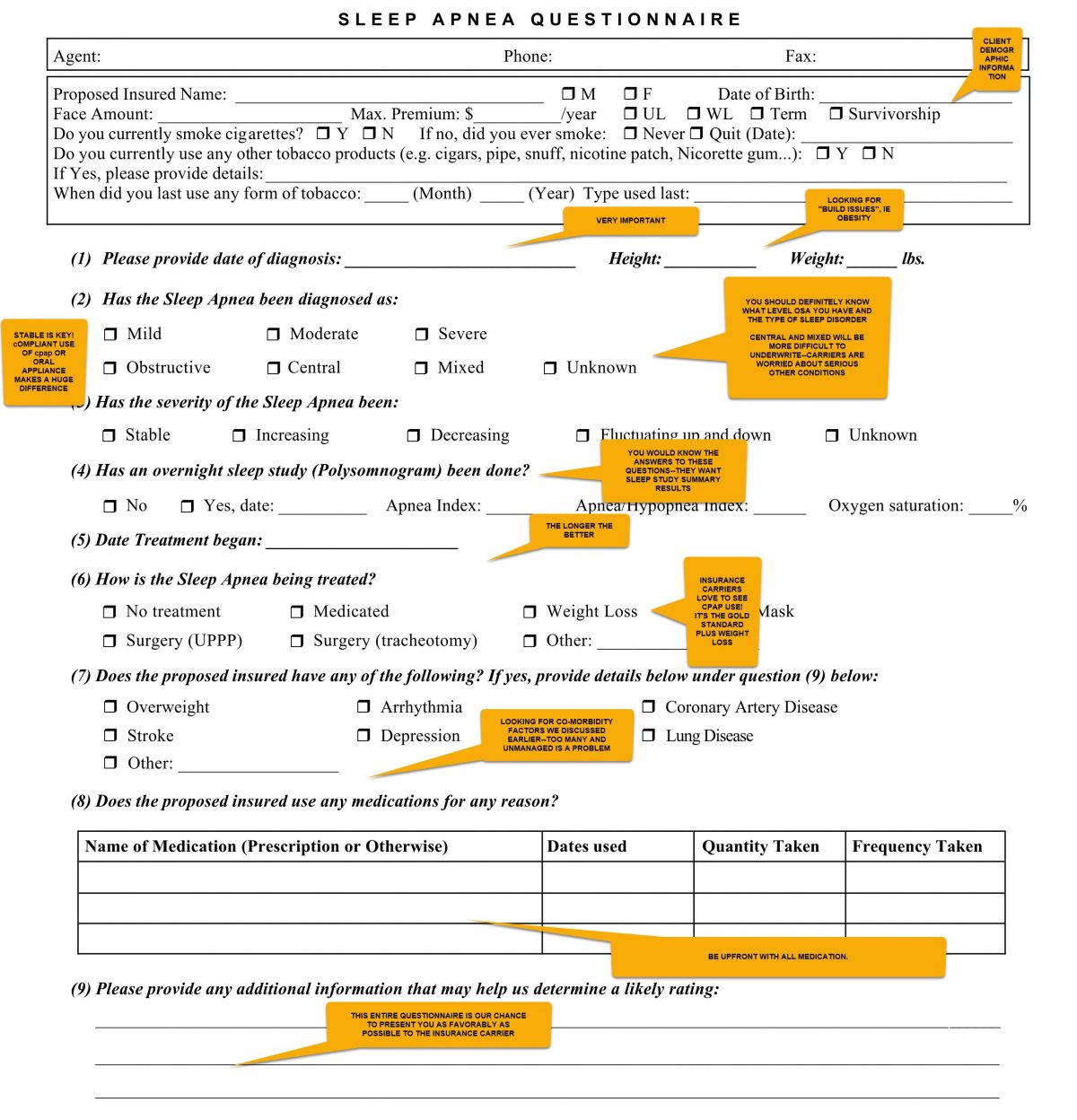
Underwriters look closely at the results of your sleep study, typically measured by the Apnea-Hypopnea Index (AHI) or the Respiratory Disturbance Index (RDI).
- Mild Sleep Apnea: An AHI between 5 and 14 events per hour.
- Moderate Sleep Apnea: An AHI between 15 and 29 events per hour.
- Severe Sleep Apnea: An AHI of 30 or more events per hour.
While severe sleep apnea carries more inherent risk, a high AHI score alone will not ruin your chances if you can demonstrate rigorous, successful treatment.
Treatment Compliance and Adherence
The single most important factor for an underwriter is how well you treat your condition. If you are prescribed Continuous Positive Airway Pressure (CPAP) therapy, an oral appliance, or have undergone surgical intervention (such as a uvulopalatopharyngoplasty or upper airway stimulation), the insurer wants to see proof of consistent use.
- CPAP Compliance: Modern CPAP machines record compliance data, often tracking your average nightly usage over the past 30 to 90 days. Showing an average usage of four or more hours per night for at least 70% of the nights demonstrates excellent compliance.
- Follow-Up Care: Underwriters look for regular visits with your primary care physician or a board-certified sleep specialist, confirming that your treatment remains effective and your symptoms are resolved.
Co-occurring Health Conditions
Sleep apnea rarely exists in a vacuum. Underwriters pay meticulous attention to comorbid conditions that frequently accompany OSA. If you have well-managed sleep apnea but also suffer from uncontrolled high blood pressure, obesity, arrhythmias (such as atrial fibrillation), or elevated cholesterol, your overall risk class will drop. Conversely, if your sleep apnea is treated and you have no secondary cardiovascular or metabolic impairments, you stand a much better chance of securing a favorable rating.
How Sleep Apnea Impacts Specific Life Insurance Risk Classes
Insurance carriers use various tier structures, though most follow a standard hierarchy. Here is how sleep apnea typically impacts your placement across these categories:
| Risk Class | Typical Requirements for Applicants with Sleep Apnea |
|---|---|
| Preferred Plus / Preferred | Rarely accessible for active sleep apnea unless it is mild, fully treated, and unaccompanied by other risk factors (like tobacco use or high BMI). Some carriers may consider preferred status if mild OSA is documented with minimal symptoms and perfect compliance. |
| Standard Plus / Standard | Highly achievable for individuals with moderate-to-severe sleep apnea who demonstrate strict, long-term compliance with CPAP therapy, show no secondary cardiovascular complications, and maintain stable overall health. |
| Substandard (Table Ratings) | Common for individuals with untreated sleep apnea, severe unmanaged symptoms, poor CPAP compliance logs, or significant comorbid conditions such as heart disease, morbid obesity, or uncontrolled hypertension. |
Common Mistakes That Hurt Your Sleep Apnea Risk Class
Navigating the life insurance medical exam and underwriting questionnaire requires precision. Several common missteps can lead to an unnecessarily poor risk classification or an outright postponement of your application.
Failing to disclose the condition on your initial application is one of the most detrimental errors. Underwriters cross-reference your application with the Medical Information Bureau (MIB) and your prescription history database. If a prescription for a CPAP machine or sleep study appears in your records without a corresponding disclosure, it raises red flags regarding truthfulness and can result in application denial.
Another frequent mistake is irregular or undocumented treatment. If you were prescribed a CPAP machine three years ago but stopped using it after a month because you found it uncomfortable, do not claim that your sleep apnea is treated. Underwriters will request compliance data from your medical provider or durable medical equipment (DME) supplier. A lack of recent usage data forces the underwriter to evaluate you as having untreated sleep apnea.
Finally, neglecting your general wellness markers—such as Body Mass Index (BMI), blood pressure, and blood glucose levels—during the application window can compound the negative impact of your sleep apnea rating.
Steps to Take Before Applying for Coverage
If you have sleep apnea and want to secure the best possible life insurance rate, proactive preparation is essential. Taking specific steps before submitting your application can demonstrate to underwriters that you are a low-risk, responsible policyholder.
- Optimize Your Treatment Compliance: Ensure you are consistently using your CPAP or alternative therapy for at least 30 to 90 days prior to your paramedical exam. Request a compliance report from your equipment provider to verify your usage metrics.
- Schedule a Follow-Up with Your Doctor: Visit your sleep specialist or primary care physician to document that your sleep apnea is stable, asymptomatic, and well-controlled under your current treatment plan.
- Control Modifiable Risk Factors: Work on stabilizing your blood pressure, maintaining a healthy diet, and managing your weight. Underwriters look at the holistic picture; improving secondary health markers can offset the underwriting penalty of a sleep apnea diagnosis.
- Work with an Independent Broker: Independent life insurance agents have access to multiple carriers. Because underwriting guidelines for sleep apnea vary wildly from one insurance company to another, an experienced broker can shop your profile to the carrier that views sleep apnea most leniently.
Frequently Asked Questions
Can I get term life insurance if I have severe sleep apnea?
Yes, you can qualify for term life insurance with severe sleep apnea. Insurance companies care far more about how the condition is managed than the raw severity score from your initial sleep study. If you use your CPAP machine consistently, show no secondary heart conditions, and maintain a stable medical history, you can secure standard or standard-plus term coverage.
What happens if I refuse to use a CPAP machine?
If you refuse prescribed treatment or are non-compliant with your CPAP therapy, insurers will typically classify your sleep apnea as untreated. Untreated moderate-to-severe sleep apnea significantly increases long-term mortality risk due to cardiovascular strain, which usually results in higher premium rates, table ratings, or temporary postponement of your application until treatment is established.
Do lifestyle changes like weight loss eliminate my sleep apnea classification?
Weight loss can dramatically improve or even resolve positional or weight-induced obstructive sleep apnea. However, to remove the classification from your insurance medical history, you must undergo a formal re-evaluation and a follow-up sleep study ordered by a physician proving that the sleep apnea has resolved and treatment is no longer required.
Do insurance companies require a new sleep study for an application?
Insurance companies rarely order a brand-new sleep study specifically for underwriting. Instead, they request your existing medical records, physician notes, and the diagnostic report from your original sleep study, alongside recent prescription and compliance histories.
Are mild sleep apnea cases rated differently than severe cases?
Mild sleep apnea cases generally receive more favorable risk classifications because the statistical risk of nocturnal hypoxia and cardiovascular stress is lower. Mild OSA that is asymptomatic or managed with a simple oral appliance may qualify for standard or standard-plus rates with select carriers, whereas severe OSA strictly requires verified positive airway pressure compliance to avoid heavy table ratings.
Next Actions and Conclusion
Securing life insurance with a sleep apnea diagnosis is entirely achievable, provided you approach the market with transparency and preparation. Gather your compliance data, maintain consistent treatment, and consult with an independent insurance professional who understands carrier-specific underwriting guidelines. To take the next step, request your medical records and CPAP compliance logs today, and reach out to a trusted broker to compare quotes tailored to your exact health profile.
Image Gallery