What Were the Latin American Revolutions? A Complete Historical Guide
The Latin American Revolutions were a series of uprisings and armed conflicts in the late 18th and early 19th centuries that resulted in the creation of independent nations across Central and South America. Primarily occurring between...
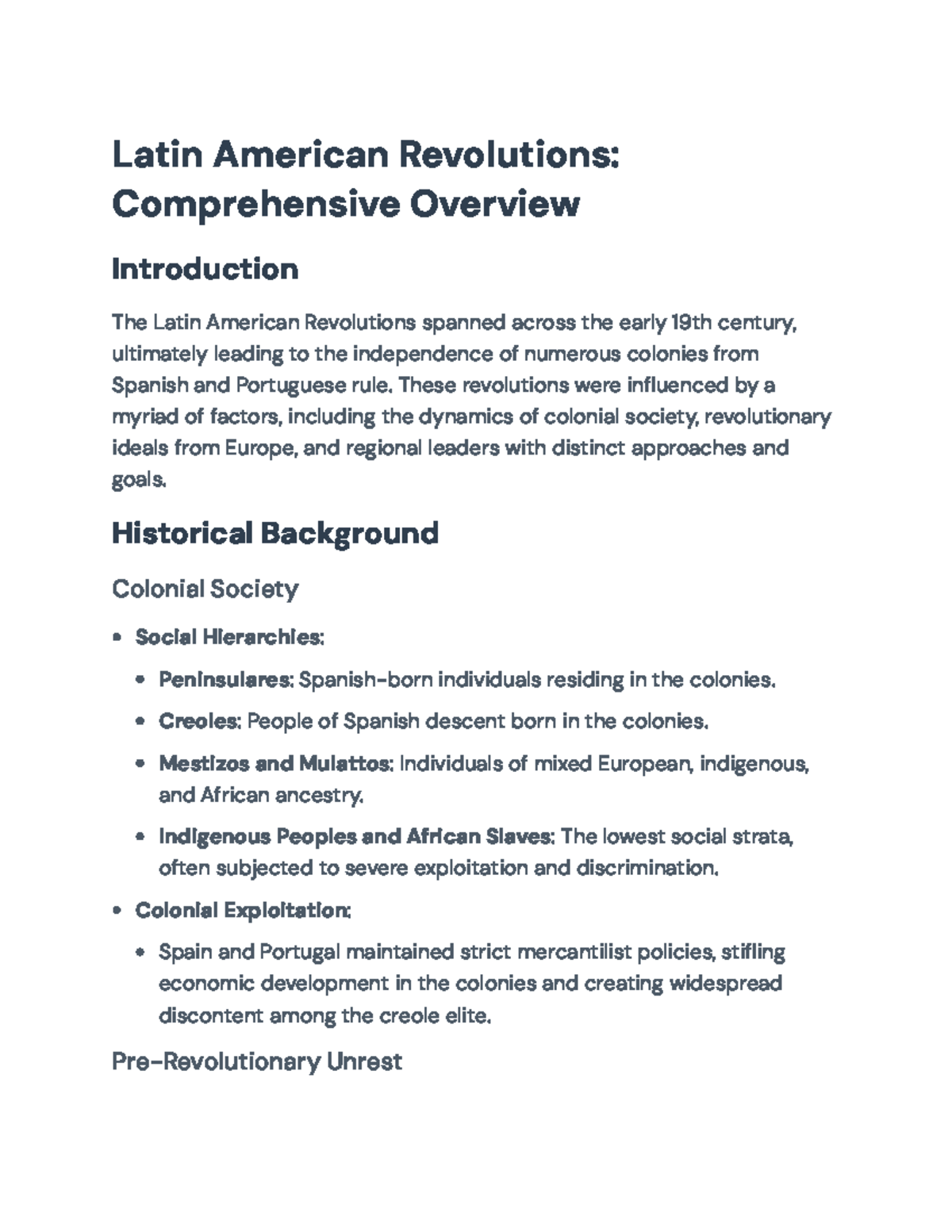
The Latin American Revolutions were a series of uprisings and armed conflicts in the late 18th and early 19th centuries that resulted in the creation of independent nations across Central and South America. Primarily occurring between 1808 and 1826, these movements ended centuries of Spanish and Portuguese colonial rule, reshaped the global map, and established new republican governments.
Contents
The Roots of Revolution: Why Did the Colonies Revolt?
The Latin American Revolutions did not occur in a vacuum. By the late 1700s, the Spanish and Portuguese empires had maintained control over their American territories for over three centuries. However, a combination of internal social friction and external intellectual shifts created a volatile environment. To understand what these revolutions were, one must first understand the systemic grievances of the people living under colonial rule.
The Enlightenment and Global Precedents
The intellectual movement known as the Enlightenment spread throughout Europe and eventually reached the Americas. Ideas regarding natural rights, popular sovereignty, and the social contract—championed by thinkers like John Locke, Montesquieu, and Jean-Jacques Rousseau—began to circulate among the educated elite in Latin America. The success of the American Revolution (1776) and the French Revolution (1789) provided concrete evidence that Enlightenment ideals could be used to overthrow monarchical tyranny and establish self-governance.
The Rigidity of the Social Caste System
Colonial society was governed by a strict racial and social hierarchy. At the top were the Peninsulares, individuals born in Spain or Portugal who held the highest government and church positions. Below them were the Criollos (Creoles), people of European descent born in the Americas. While many Criollos were wealthy landowners or merchants, they were legally barred from the highest offices and felt marginalized by the mother country.
Below the Criollos were the Mestizos (mixed European and Indigenous heritage), Mulattos (mixed European and African heritage), Indigenous peoples, and enslaved Africans. This hierarchical structure created deep-seated resentment across all lower tiers, though the initial push for independence was largely led by the Criollo elite who sought political power to match their economic status.
Economic Mercantilism and Trade Restrictions
The Spanish Crown practiced a strict policy of mercantilism, requiring colonies to trade exclusively with Spain. Colonies were often forbidden from producing goods that competed with Spanish industries and were forced to sell raw materials at low prices while buying finished goods at high prices. The Bourbon Reforms of the 18th century, intended to modernize the empire, actually tightened royal control and increased taxes, further alienating the colonial population.
The Napoleonic Catalyst: The Spark of 1808
While internal tensions were high, the immediate catalyst for the Latin American Revolutions was the Napoleonic Wars in Europe. In 1808, Napoleon Bonaparte invaded the Iberian Peninsula, deposing King Ferdinand VII of Spain and installing his brother, Joseph Bonaparte, on the throne.
This created a "crisis of legitimacy." Many colonists in the Americas refused to recognize a French-imposed king. In response, they formed local governing bodies called Juntas. Initially, these Juntas claimed to rule in the name of the deposed Ferdinand VII. However, as the Peninsular War dragged on, these temporary governments became the breeding grounds for radical independence movements. By the time Ferdinand VII was restored to the throne in 1814, he attempted to reinstate the old absolute colonial order, but the desire for autonomy had already transformed into a full-scale demand for independence.
Major Theaters of War and Key Figures
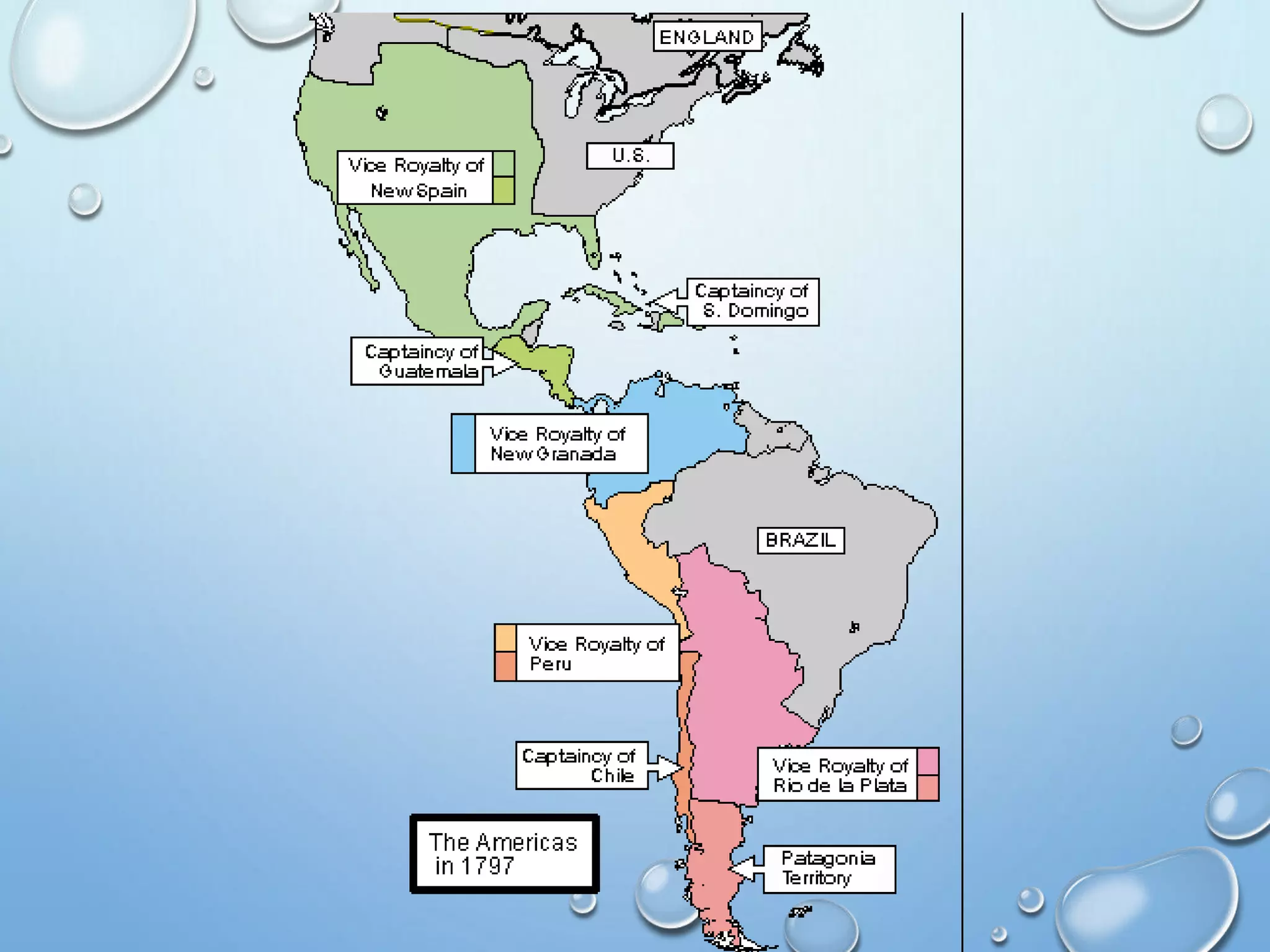
The Latin American Revolutions were not a single, unified conflict but a series of regional wars fought across the continent. These can be categorized into several major movements: the Northern Campaign, the Southern Campaign, the Mexican Struggle, and the unique path of Brazil.
The Northern Campaign: Simón Bolívar and Gran Colombia
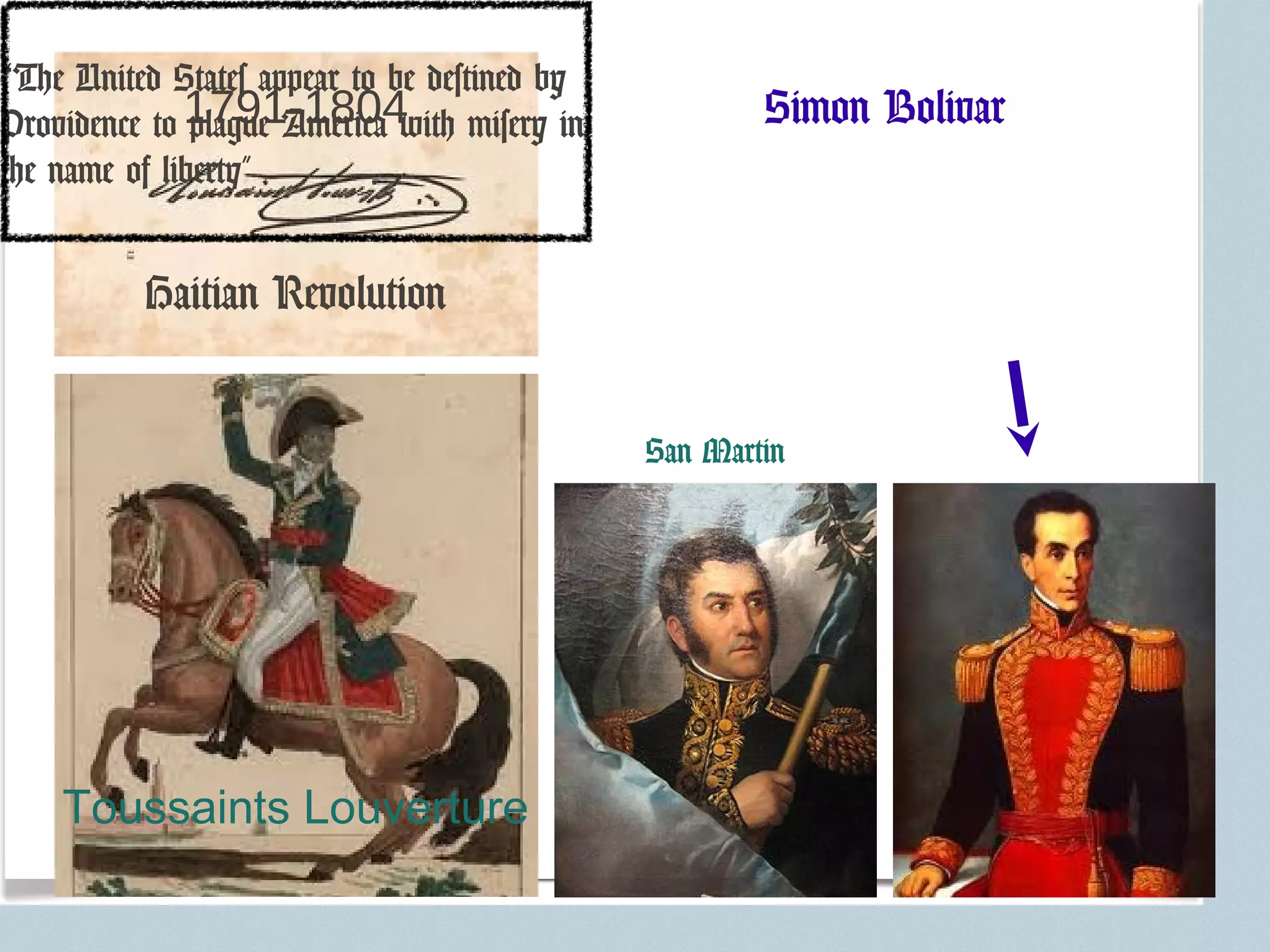
In the north (modern-day Venezuela, Colombia, Ecuador, and Panama), the movement was led by Simón Bolívar, known as "The Liberator." Bolívar was a visionary Criollo who dreamed of a unified Latin American nation. His military career was marked by dramatic shifts in fortune, including several periods of exile.
In 1819, Bolívar led a daring army across the flooded plains and over the Andes Mountains to surprise Spanish forces at the Battle of Boyacá, securing the independence of New Granada (Colombia). He later liberated Venezuela and Ecuador, forming the short-lived republic of Gran Colombia. Bolívar's influence extended further south into Peru and Upper Peru (renamed Bolivia in his honor), where he worked to extinguish the final remnants of Spanish royalist power.
The Southern Campaign: José de San Martín
In the south (modern-day Argentina, Chile, and Peru), the primary leader was José de San Martín. A professional soldier who had served in the Spanish army, San Martín returned to his native Argentina to lead the independence cause. After securing Argentina's freedom, he realized that no South American nation would be safe as long as the Spanish stronghold in Peru remained.
In 1817, San Martín executed one of the most impressive military feats in history: leading an army across the high passes of the Andes to liberate Chile. Following the victory at the Battle of Maipú, he used a newly formed navy to transport his troops to Peru. In 1821, he declared Peruvian independence in Lima.
The Mexican Path to Independence
Unlike the Criollo-led movements in South America, Mexico’s revolution began as a populist uprising. In 1810, a parish priest named Miguel Hidalgo y Costilla issued the "Grito de Dolores," calling for an end to Spanish rule, the redistribution of land, and the abolition of slavery. Hidalgo’s massive, undisciplined army of Indigenous and Mestizo peasants terrified the Criollo elite, who initially sided with the Spanish to preserve order.
After Hidalgo and his successor, José María Morelos, were executed, the movement changed. In 1821, a royalist officer named Agustín de Iturbide switched sides and brokered the Plan of Iguala. This plan united the various factions by promising independence, the supremacy of the Catholic Church, and equality between Peninsulares and Criollos. Mexico briefly became an empire under Iturbide before transitioning into a republic.
The Unique Case of Brazil
The independence of Brazil from Portugal was remarkably different and significantly less bloody. When Napoleon invaded Portugal in 1807, the Portuguese royal family fled to Rio de Janeiro, making it the seat of the empire for over a decade. When King João VI returned to Portugal in 1821, his son, Pedro I, remained in Brazil. Facing pressure from the Brazilian elite and a movement for autonomy, Pedro declared independence in 1822 with the famous "Cry of Ipiranga." Brazil became a constitutional monarchy, a status it maintained until 1889.
Summary of Major Independence Movements
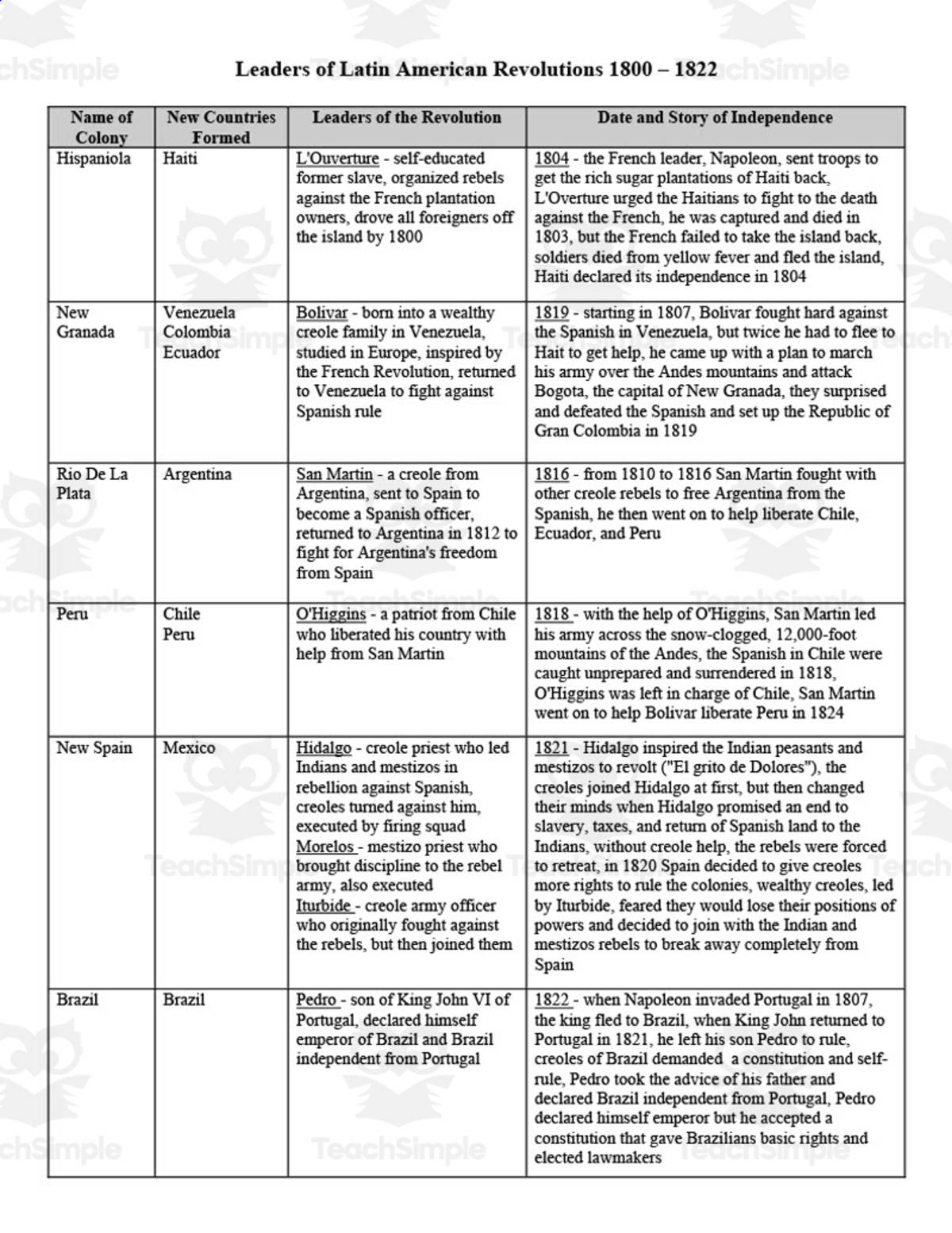
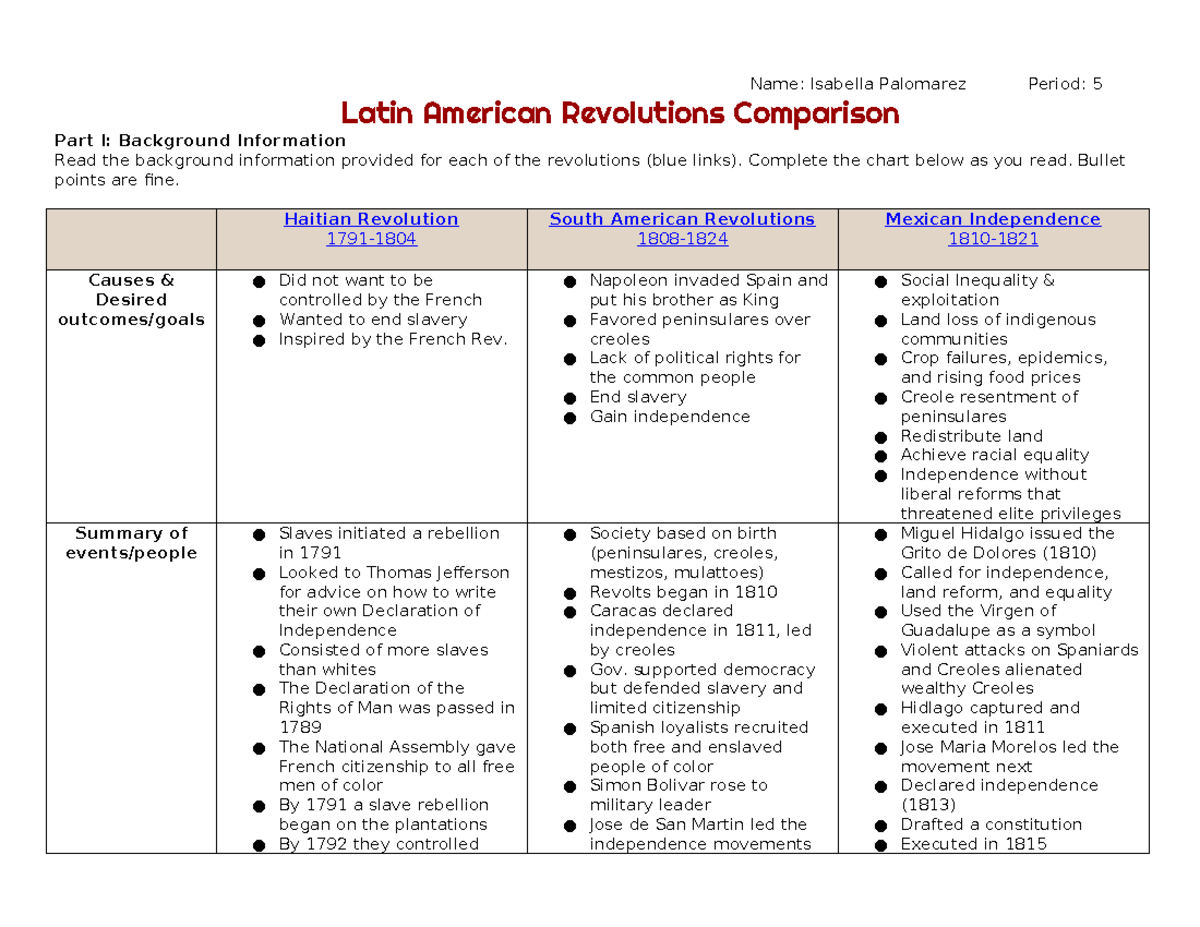
The following table summarizes the key components of the primary Latin American Revolutions:
| Region / Modern Nation | Primary Leader(s) | Key Dates | Major Turning Point | Outcome |
|---|---|---|---|---|
| Haiti | Toussaint Louverture | 1791–1804 | Slave Revolt / Defeat of Leclerc | First independent Black republic |
| Mexico | Miguel Hidalgo, Iturbide | 1810–1821 | Plan of Iguala (1821) | Independent Empire, then Republic |
| Northern South America | Simón Bolívar | 1810–1824 | Battle of Boyacá (1819) | Formation of Gran Colombia |
| Southern South America | José de San Martín | 1810–1821 | Battle of Maipú (1818) | Independence of Chile & Argentina |
| Peru | San Martín & Bolívar | 1821–1824 | Battle of Ayacucho (1824) | End of Spanish rule in South America |
| Brazil | Dom Pedro I | 1822 | Cry of Ipiranga | Independent Constitutional Monarchy |
The Aftermath: Challenges of a New Era
The successful conclusion of the wars did not lead to immediate stability. The new nations faced monumental challenges that would define their history for the next two centuries.
Political Fragmentation and Caudillismo
Bolívar’s dream of a "United States of South America" quickly dissolved. Gran Colombia split into Venezuela, Colombia, and Ecuador. The United Provinces of Central America also fragmented into five separate nations. In the vacuum left by the Spanish Crown, military strongmen known as Caudillos rose to power. These leaders often ruled through charisma and force rather than democratic processes, leading to frequent coups and civil wars throughout the 19th century.
Economic Devastation
The wars of independence were incredibly destructive. Infrastructure was ruined, mines were flooded, and livestock were decimated. Furthermore, the new nations often found themselves heavily indebted to British banks, which had provided the loans necessary to fund the revolutionary armies. This led to a new form of economic dependence, where Latin American nations exported raw materials and imported manufactured goods, largely failing to industrialize.
Social Continuity vs. Political Change
While the revolutions ended European political control and generally led to the formal abolition of the Casta system, social realities changed slowly. In many nations, the Criollo elite simply replaced the Peninsulares at the top of the social pyramid. Land ownership remained concentrated in the hands of a few, and Indigenous and Afro-descendant populations continued to face systemic discrimination and poverty.
The Role of External Powers
Great Britain and the United States played significant roles in the outcome of these revolutions. Britain, seeking to break the Spanish trade monopoly, provided financial backing and volunteer soldiers (such as the British Legions that fought with Bolívar).
In 1823, the United States issued the Monroe Doctrine. This policy stated that the Americas were no longer open to European colonization and that any attempt by European powers to interfere with the new nations would be viewed as an act of aggression against the U.S. While the U.S. lacked the military might to enforce this in 1823, it set a precedent for future diplomatic relations in the Western Hemisphere.
Frequently Asked Questions
Who was the most important leader of the Latin American Revolutions?
Simón Bolívar is widely considered the most influential figure. He was instrumental in the liberation of six modern-day nations (Venezuela, Colombia, Ecuador, Panama, Peru, and Bolivia). His political writings, such as the "Letter from Jamaica," remain foundational to Latin American political thought.
How did the Haitian Revolution influence other Latin American movements?
The Haitian Revolution (1791–1804) was the only successful slave revolt in history. It terrified slave-owning elites in places like Brazil and Cuba, making them more cautious about seeking independence. However, it also provided a refuge and support for Bolívar when his movement was at its lowest point, provided he promised to abolish slavery in the lands he liberated.
Did the revolutions bring immediate democracy to Latin America?
No. While most new nations adopted republican constitutions modeled after those of the U.S. or France, the transition to functional democracy was hindered by the rise of Caudillos, high illiteracy rates, and the lack of a tradition of self-government under Spanish rule.
Why did Brazil remain a monarchy while others became republics?
Because the Portuguese royal family lived in Brazil for 13 years, the institution of the monarchy was seen as a stabilizing force that prevented the kind of violent fragmentation seen in the Spanish colonies. The transition was led by the prince himself, which preserved the existing social order.
What was the last Spanish stronghold in South America?
The Viceroyalty of Peru, specifically the highlands of Upper Peru, was the final bastion of royalist power. The Spanish were decisively defeated by Antonio José de Sucre (Bolívar’s lieutenant) at the Battle of Ayacucho in 1824, which effectively ended the Spanish American wars of independence.
Final Recommendations for Further Study
For those looking to deepen their understanding of this pivotal era in 2026, it is highly recommended to examine the primary source documents of the period. Reading Simón Bolívar’s Angostura Address provides insight into the immense difficulty of building new governments from the ashes of colonialism. Additionally, visiting the digital archives of the National Library of Spain offers a perspective on how the mother country viewed the loss of its empire. Understanding these revolutions is essential for anyone wishing to comprehend the modern political and social landscape of Latin America.
Image Gallery