The Ultimate Guide to the Mercedes 3.0L Turbo Diesel: Engineering, Reliability, and Ownership
The Mercedes-Benz 3.0L turbo diesel engine, often referred to colloquially as the "3000 Turbo Diesel," represents a golden era of German automotive engineering characterized by over-engineered components and million-mile durability. Pr...
The Mercedes-Benz 3.0L turbo diesel engine, often referred to colloquially as the "3000 Turbo Diesel," represents a golden era of German automotive engineering characterized by over-engineered components and million-mile durability. Primarily encompassing the OM617, OM603, and OM606 engine families, these powerplants defined the luxury diesel segment for three decades, powering iconic chassis like the W123, W124, and W126. Even in 2026, these engines remain highly sought after by enthusiasts for their mechanical simplicity, ability to run on alternative fuels like HVO100, and legendary reliability that modern common-rail diesels struggle to match.
Contents
Evolution of the Mercedes 3.0L Turbo Diesel Powerplant
The "3000" designation typically refers to the 2,998cc or 3,005cc displacement found in Mercedes-Benz's most famous inline-five and inline-six diesel configurations. To understand the "Mercedes 3000 turbo diesel," one must distinguish between the three distinct generations of engines that carried this displacement.
The OM617: The Five-Cylinder Legend (1974–1991)
The OM617.95 is widely considered one of the most reliable engines ever produced. Introduced in the late 1970s, it featured an iron block and an iron cylinder head. The addition of a Garrett turbocharger transformed the 300D and 300SD from sluggish cruisers into capable highway machines. Unlike modern engines, the OM617 uses a purely mechanical fuel injection system with a Bosch M-pump, meaning the engine can theoretically run without an electrical system once started.
The OM603: The Smooth Six-Cylinder (1985–1996)
As Mercedes-Benz moved toward the W124 and W126 S-Class platforms, they introduced the OM603. This was a 3.0-liter inline-six engine that traded the OM617's "clatter" for significantly more refinement. It utilized an aluminum cylinder head to save weight, though early versions (specifically the #14 head casting) were prone to cracking if overheated. By the late 1980s, these issues were resolved, making the OM603 a favorite for those seeking a balance between old-school durability and modern smoothness.
The OM606: The "Diesel 2JZ" (1993–2001)
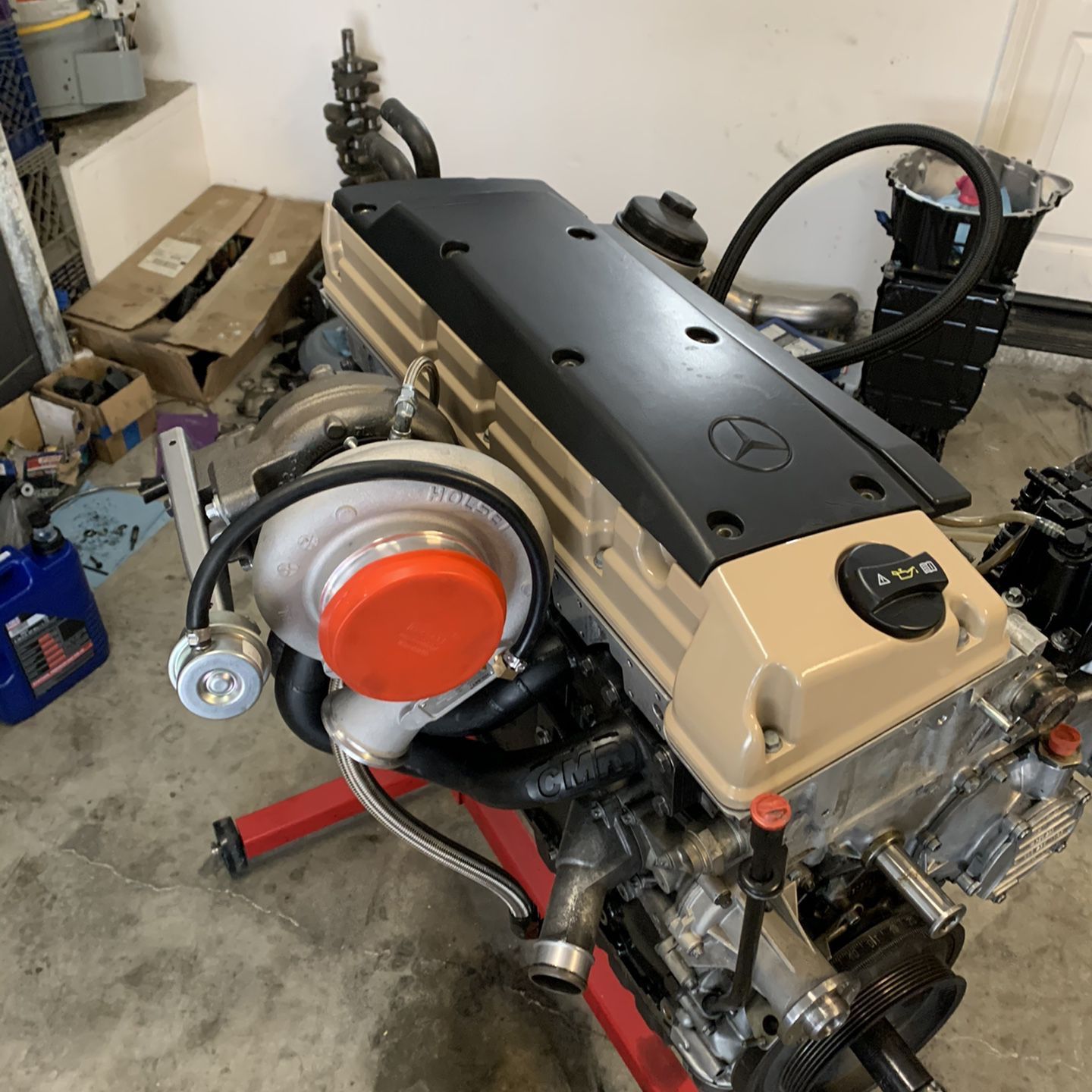
The final evolution of the 3.0L mechanical-era diesel was the OM606. This engine featured double overhead cams (DOHC) and four valves per cylinder. In its turbocharged form (OM606.962), it produced 174 horsepower in stock form but has become famous in the "Superturbo" tuning community for its ability to handle over 500 horsepower on stock internal components. It represents the pinnacle of Mercedes diesel strength before the transition to complex Common Rail Direct Injection (CDI) systems.
Key Technical Specifications Across Generations
The following table compares the three primary 3.0L turbo diesel engines found in Mercedes-Benz vehicles.
| Feature | OM617.95 (Turbo) | OM603.96 (Turbo) | OM606.96 (Turbo) |
|---|---|---|---|
| Cylinders | 5 (Inline) | 6 (Inline) | 6 (Inline) |
| Valves per Cyl | 2 | 2 | 4 |
| Block/Head Mat. | Cast Iron / Cast Iron | Cast Iron / Aluminum | Cast Iron / Aluminum |
| Injection System | Mechanical Bosch MW | Mechanical Bosch M | Electronic/Mechanical Bosch EDC |
| Horsepower | 120–125 hp | 143–148 hp | 174 hp |
| Torque | 170–184 lb-ft | 195–201 lb-ft | 243 lb-ft |
| Primary Models | W123 300D, W126 300SD | W124 300D, W126 300SDL | W210 E300 Turbodiesel |
The Role of the Vacuum System in Operation
One of the most unique and often misunderstood aspects of the Mercedes 3.0L turbo diesel is its reliance on a mechanical vacuum pump. In these vehicles, vacuum pressure is not just for the brake booster; it controls almost every auxiliary function.
- Engine Shut-off: These engines do not use an electric solenoid to stop the fuel flow. When you turn the key to "off," a vacuum valve opens, sending a signal to a vacuum actuator on the injection pump to pull the "stop" lever.
- Transmission Shifting: The 722.3 and 722.4 automatic transmissions paired with these engines use a vacuum modulator to determine shift firmness. A leak in the vacuum lines can result in "clunking" or harsh shifts.
- Door Locks and Climate Control: Mercedes used vacuum actuators for central locking and to move the flaps within the HVAC system.
For an owner in 2026, maintaining the vacuum pump and replacing brittle plastic vacuum lines is the single most important task for ensuring the car remains drivable and comfortable.
Maintenance Requirements for Longevity
While these engines are famously "bulletproof," that reputation is contingent on specific maintenance routines that differ from modern gasoline or diesel vehicles.
Valve Adjustments (OM617 specific)
Unlike the OM603 and OM606, which utilize hydraulic lifters, the OM617 requires manual valve adjustments every 15,000 miles. If the valves are not adjusted, they will tighten over time, leading to poor cold-starting performance and eventual burnt valves. This is a mechanical skill that is becoming rare in 2026, making it a vital DIY task for owners.
Cooling System Vigilance
The aluminum heads on the later 3.0L engines (OM603 and OM606) do not tolerate overheating. A failure of the viscous fan clutch or a clogged radiator can lead to a warped or cracked head within minutes. Owners should proactively replace the thermostat and water pump every 100,000 miles and ensure they use the correct Zerex G05 or equivalent coolant to prevent internal corrosion.
Fuel System Health
The Bosch injection pumps are lubricated by engine oil (in the OM617) or the fuel itself. With the transition to Ultra-Low Sulfur Diesel (ULSD), many owners add a lubricity additive or a small amount of 2-stroke oil to each tank to protect the internal components of the pump. Furthermore, the pre-filter and main fuel filter should be replaced annually to prevent the "algae" growth (microbial contamination) that can occur in diesel tanks over time.
Why the "3000 Turbo Diesel" is Relevant in 2026
In an era of increasing vehicle complexity and planned obsolescence, the Mercedes 3.0L turbo diesel offers a "forever car" alternative. There are three primary reasons why these vehicles remain viable today.
- Fuel Versatility: These mechanical injection systems are remarkably tolerant of fuel quality. While modern diesels require strict adherence to DPF-safe fuels, the OM617 and OM603 can easily be adapted to run on Waste Vegetable Oil (WVO) or modern renewable diesels (HVO100), which significantly reduce the carbon footprint of these classic vehicles.
- Ease of Repair: There are no proprietary sensors or encrypted ECUs governing the core operation of the OM617 or OM603. A basic set of metric wrenches and a service manual are often all that is required for major repairs.
- Classic Aesthetics with Modern Usability: Vehicles like the W126 300SDL offer S-Class luxury—including heated seats, sunroofs, and high-quality leather—with fuel economy that rivals modern SUVs (typically 24–30 MPG on the highway).
Common Issues and Troubleshooting
Despite their strength, age is the primary enemy of these vehicles in 2026. Prospective buyers should be aware of the following:
- The "Trap Oxidizer": Found on mid-80s OM603 engines, this was an early emissions device designed to catch soot. If it fails, it can send ceramic debris into the turbocharger. Most have been replaced with a "straight pipe" bypass under a long-standing Mercedes-Benz recall, but it should be verified.
- Glow Plug Failure: If the engine struggles to start when cold but runs perfectly once warm, the glow plugs or the glow plug relay are the likely culprits. On the OM606, glow plugs are notorious for seizing in the head; removal requires extreme patience and specific penetrants.
- Rust: While the engines last forever, the chassis (particularly on the W124 and W210) are susceptible to rust in the jack points, spring perches, and wheel arches.
Frequently Asked Questions
Can a Mercedes 3.0L turbo diesel really go 1,000,000 miles?
Yes, there are documented cases of the OM617 and OM603 reaching one million miles. However, this typically requires at least one transmission rebuild and consistent adherence to cooling system maintenance and oil changes. The engine block and crankshaft are usually capable of the distance, but peripheral components like the alternator, water pump, and vacuum pump will need replacement several times over that lifespan.
Which oil should I use in my 300D or 300SD?
A high-quality 15W-40 heavy-duty diesel engine oil (such as Shell Rotella T4 or T6) is generally recommended. These oils contain higher levels of ZDDP (Zinc) and detergents necessary to handle the soot produced by older diesel combustion and to protect the flat-tappet cams in the OM617.
Why is my Mercedes turbo diesel so slow to accelerate?
This is often caused by a restricted "ALDA" line. The ALDA is a device on top of the injection pump that senses boost pressure and increases fuel delivery accordingly. If the small plastic line between the intake manifold and the ALDA is clogged with soot, the engine will never "see" the boost and will stay in its naturally aspirated fueling state.
Are parts still available for these 40-year-old engines?
Yes. Mercedes-Benz has one of the best heritage programs in the world. Many critical engine components are still available through the Mercedes-Benz Classic Center. Additionally, a robust aftermarket (brands like Monark, Bosch, and Lemförder) ensures that wear items remain affordable and accessible.
Final Recommendation for Buyers
If you are looking for the most durable version of the Mercedes 3.0L turbo diesel, seek out a 1982–1985 W123 300D or a 1981–1985 W126 300SD. These models feature the OM617 engine, which is the most mechanically simple and robust. If you prioritize highway comfort and power, the 1987 300SDL (W126) or the 1998–1999 E300 Turbodiesel (W210) offer superior performance, provided you are willing to manage the increased complexity of aluminum heads and electronic fuel controls. In all cases, prioritize a vehicle with a documented service history over one with low mileage, as these engines suffer more from sitting than they do from being driven.
Image Gallery