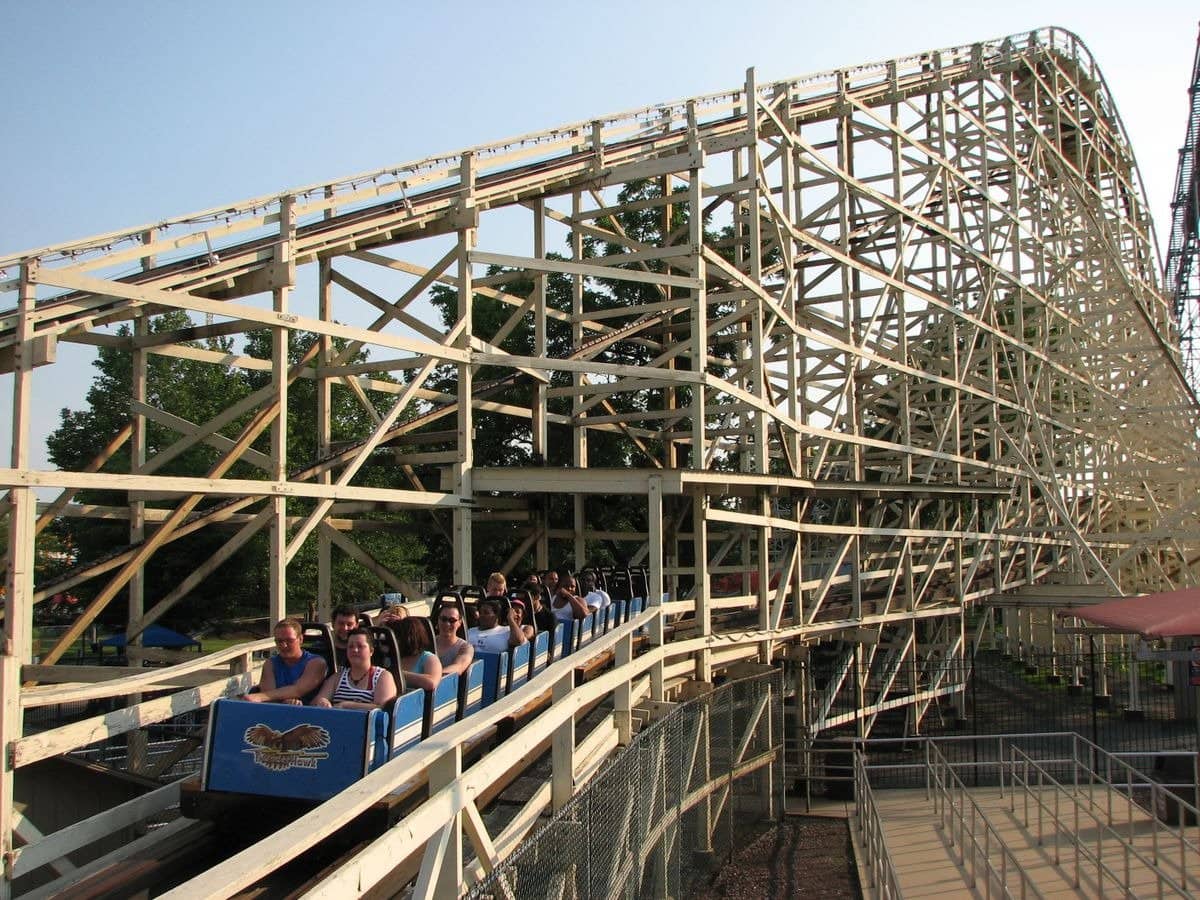
The Oldest Wooden Roller Coaster Still Standing: History, Engineering, and Legacy
Leap-The-Dips, located at Lakemont Park in Altoona, Pennsylvania, is the oldest wooden roller coaster still standing in the world. Built in 1902 by the E. Joy Morris Company, this historic figure-eight side-friction coaster survived de...
Leap-The-Dips, located at Lakemont Park in Altoona, Pennsylvania, is the oldest wooden roller coaster still standing in the world. Built in 1902 by the E. Joy Morris Company, this historic figure-eight side-friction coaster survived decades of amusement industry shifts, extended closures, and preservation campaigns to remain a designated National Historic Landmark.
Contents
| Property | Details |
|---|---|
| Name | LEAP-THE-DIPS |
| Location | Lakemont Park (Altoona, PA, USA) |
| Opened | 1902 |
| Designer | E. Joy Morris |
| Track Type | Side-Friction Figure-Eight |
| Status | Oldest Standing Wooden Roller Coaster in the World |
The Origin of Leap-The-Dips at Lakemont Park
The turn of the 20th century marked a golden age for American trolley parks—amusement grounds built at the end of streetcar lines to generate weekend passenger traffic. In 1902, Lakemont Park commissioned the E. Joy Morris Company of Philadelphia to construct a new attraction to draw visitors from nearby Altoona. The result was Leap-The-Dips, a wooden side-friction coaster designed on a traditional figure-eight layout.
Leap-The-Dips replaced an earlier, less stable gravity ride on the site. Rising to a height of just 41 feet (12.5 meters) and reaching a top speed of roughly 10 miles per hour (16 km/h), the coaster was engineered for accessible family recreation rather than extreme thrill-seeking. Despite its modest statistics by modern standards, the ride represented cutting-edge civil and mechanical engineering for the era, utilizing structural timber framing, gravity drops, and hand-cut wooden track channels.
- Station
- Lift Hill: 41 ft
- Upper Figure-Eight Loop
- Lower Track Return (returns to Station)
The ride operated continuously through the early decades of the 20th century, surviving the Great Depression and the decline of trolley parks across North America. However, by the late 20th century, age and shifting commercial interests threatened its existence. In 1985, structural fatigue and financial constraints forced Lakemont Park to shut down the coaster, leaving it standing but non-operational (SBNO) for over a decade.
Engineering Mechanics of Early Side-Friction Coasters
To understand why Leap-The-Dips is such an engineering milestone, one must examine the distinction between side-friction roller coasters and modern wooden coasters.
Prior to 1919—when legendary engineer John Miller patented the under-friction (upstop) wheel—roller coaster cars were not locked to the track from below. Side-friction coasters rely entirely on gravity to keep the train wheels resting on the main running rails, while vertical wooden sideboards along the track guide horizontal wheels to keep the car centered.
- Track Cross-Section:
- Wooden Car Structure
- Passenger Bench
- Guide Wheels (roll against vertical wooden wall)
- Running Wheels (rest on bottom rail)
- Timber Track Bed
- Wooden Car Structure
Because side-friction cars lack upstop wheels under the rails, the tracks cannot feature steep drops, bank angles over 45 degrees, or negative-G airtime hills that could lift the train completely off the structure.
Key Technical Specifications of Leap-The-Dips:
- Track Length: 1,452 feet (443 meters)
- Maximum Height: 41 feet (12.5 meters)
- Max Speed: ~10 mph (16 km/h)
- Structural Material: White pine frame with hard wood running strips
- Train Design: Individual four-passenger wooden cars (quadrangles)
- Braking System: Friction-based station hand-brake levers operated by a ride attendant
Because the cars do not lock onto the rails, structural alignment must be maintained with extreme precision. Slight warps in the wooden support bents (the vertical framing posts) can cause excessive friction, track binding, or derailment risks.
The World's Oldest Operating Wooden Roller Coasters
While Leap-The-Dips holds the record as the oldest wooden coaster still standing, several other historic wooden rides around the globe share rare historical significance. Distinctions exist between the oldest overall structure, the oldest continuously operating coaster without long closures, and the oldest coaster using modern under-friction technology.
| Coaster Name | Amusement Park | Location | Year Opened | Coaster Type | Historic Significance |
|---|---|---|---|---|---|
| Leap-The-Dips | Lakemont Park | Altoona, PA, USA | 1902 | Side-Friction | Oldest wooden roller coaster still standing worldwide; National Historic Landmark. |
| Scenic Railway | Luna Park | Melbourne, Australia | 1912 | Side-Friction | Oldest continuously operating wooden coaster in the world; utilizes an onboard brakeman. |
| Rutschebanen | Tivoli Gardens | Copenhagen, Denmark | 1914 | Side-Friction | Oldest major operating coaster in Europe; features an onboard brakeman navigating artificial mountains. |
| Jack Rabbit | Kennywood | West Mifflin, PA, USA | 1920 | Under-Friction (Miller) | Oldest operating coaster utilizing modern upstop wheel design and a famous double-dip drop. |
| Roller Coaster | Lagoon | Farmington, UT, USA | 1921 | Under-Friction (Miller/Baker) | Oldest operating coaster in the western United States; listed on the National Register of Historic Places. |
| Giant Dipper | Santa Cruz Beach Boardwalk | Santa Cruz, CA, USA | 1924 | Under-Friction (Prior & Church) | Iconic classic wooden coaster; recognized as a National Historic Landmark. |
Standing vs. Continuously Operating: The Historical Distinction
When analyzing historic roller coasters, historians separate structures that have remained standing from those with uninterrupted operation.
1. Leap-The-Dips (1902) – The Oldest Standing Structure
Although constructed in 1902, Leap-The-Dips did not operate continuously. Following its closure in 1985, the coaster sat dormant for 14 years. A dedicated campaign led by the American Coaster Enthusiasts (ACE) and the Every Dip Counts fundraising committee raised over $1 million to restore the timber frame, re-lay the tracks, and rebuild the wooden cars. The coaster reopened to the public on May 31, 1999. In subsequent decades, the ride has experienced occasional seasonal sabbaticals based on park operating models, yet the original 1902 wooden framing remains standing intact.
2. Scenic Railway at Luna Park Melbourne (1912) – The Oldest Continuously Operating Coaster
If the metric is defined strictly by uninterrupted service without multi-year abandonments, the Scenic Railway at Luna Park in St Kilda (Melbourne, Australia) holds the record. Designed by Edward Leofric Thornycroft, the Scenic Railway opened in December 1912 and has operated continuously through both World Wars and modern economic shifts. Unlike automated modern coasters, the Scenic Railway requires a trained brakeman to stand on a middle platform between the car seats to control the train's speed using a manual hand-brake lever throughout the circuit.
- Scenic Railway Brakeman Position:
- Car 1 Passenger Bench
- Brakeman (Friction Brake)
- Car 2 Bench
Historic Preservation and Engineering Maintenance
Preserving a 100-plus-year-old wooden structure poses immense engineering challenges. Timber subjected to changing weather conditions expands, contracts, and rots over time, requiring systematic structural replacement.
Historic Coaster Maintenance Protocol:
- Inspection: Daily track walk & wooden bent alignment checks
- Board Swap: Replacement of worn ledger boards with white pine / fir
- Metal Care: Cleaning & lubricating steel side-friction plates
- Fasteners: Tightening structural bolts & checking joint integrity
Lumber Replacement and Structural Integrity
To maintain historic status with organizations like the U.S. National Park Service, restoration efforts must preserve the original engineering design and materials wherever possible:
- Timber Specifications: Structural bents are typically constructed from dense yellow pine or Douglas fir, while running boards use hard woods like white oak to resist track wear.
- Component-by-Component Replacement: Maintenance crews replace damaged wooden members individually. Over a century, nearly every piece of wood may eventually be swapped out, akin to the philosophical "Ship of Theseus." However, because the design, dimensions, joinery, and structural configuration remain identical to the 1902 plans, the attraction maintains its historical integrity.
- Modern Safety Protocols: Historic coasters must balance preservation with modern safety mandates. Structural inspections follow standards established by the ASTM International F24 Committee on Amusement Rides and Devices. Inspectors use ultrasonic testing and resistance drilling to evaluate wood interior decay without damaging the structural frame.
Historic Landmark Designations
In 1996, the United States Department of the Interior designated Leap-The-Dips as a National Historic Landmark, following its addition to the National Register of Historic Places in 1991. It is one of only two roller coasters in the United States to hold National Historic Landmark status, the other being the 1924 Santa Cruz Beach Boardwalk Giant Dipper.
Riding Experience: What to Expect Onboard a 1902 Coaster
Riding an early 1902 side-friction roller coaster differs drastically from experiencing a modern steel hypercoaster or even a mid-century wooden coaster.
| Modern Steel/Wood Coaster | 1902 Side-Friction Coaster |
|---|---|
| • Upstop wheels lock car to track | • Car rests loosely on track rails |
| • Banked turns, high G-forces | • Flat turns, lateral sliding sensation |
| • Lap bars, shoulder restraints | • Open wooden car, simple seatbelts |
| • Speeds up to 60-100+ mph | • Gentle speeds of 10-15 mph |
Motion Profile and Forces
Because side-friction tracks feature unbanked or minimally banked turns, passengers experience pure lateral centrifugal forces. As the car enters the figure-eight turns, it slides gently sideways until the side-friction wheels contact the guide walls.
The drops are brief, gentle dips—hence the name Leap-The-Dips. Without deep drops or vertical loops, the sensation comes from the open-air wooden car, the clatter of steel-on-wood track channels, and the historic charm of early American mechanical design.
Structural Audio Profile
The soundscape of a side-friction coaster is distinct. Lacking polyurethane wheels, the iron-rimmed or hard-cast wheels running on steel-capped wood tracks produce a resonant rhythmic chatter, complemented by the creaking of the timber framework as the structure flexes under load—a design feature that intentionally absorbs dynamic energy.
Frequently Asked Questions
What is the oldest wooden roller coaster still standing?
The oldest wooden roller coaster still standing in the world is Leap-The-Dips, located at Lakemont Park in Altoona, Pennsylvania. Built in 1902 by the E. Joy Morris Company, it is a rare side-friction figure-eight coaster and a recognized U.S. National Historic Landmark.
What is the difference between a side-friction coaster and a modern wooden coaster?
Side-friction coasters use running wheels on the track and vertical side-guide wheels running against wooden sideboards to stay on course. They lack upstop wheels under the track, meaning the train is not locked down from below. Modern wooden coasters use three sets of wheels (running, side-friction, and upstop) designed to lock the car securely to the rail, allowing steep drops, sharp banking, and negative gravity forces.
Which is the oldest continuously operating wooden roller coaster?
The Scenic Railway at Luna Park in Melbourne, Australia, holds the record for the oldest continuously operating wooden roller coaster. Opened in December 1912, it has operated without extended decade-long shutdowns and still requires a manual onboard brakeman to control train speeds.
Who invented the upstop wheel that modernized wooden roller coasters?
Roller coaster designer and engineer John A. Miller patented the under-friction (upstop) wheel in 1919. This invention revolutionized amusement park design by locking coaster trains to the track, enabling much steeper drops, sharper banked turns, and higher speeds safely.
Are 100-year-old wooden roller coasters safe to ride?
Yes. Operating historic wooden roller coasters must comply with modern safety protocols and structural regulations, such as those published by the ASTM International F24 Committee. Parks perform daily track walks, routine timber replacements, nondestructive wood testing, and periodic mechanical safety certifications before opening historic rides to the public.
Recommendations for Historic Coaster Enthusiasts
For travelers, historians, and amusement park enthusiasts planning to visit historic wooden coasters:
- Verify Operating Schedules: Historic coasters at smaller legacy parks (such as Lakemont Park or Luna Park) often run on limited seasonal schedules. Check official park calendars directly prior to traveling.
- Support Preservation Organizations: Non-profit preservation groups, including the American Coaster Enthusiasts (ACE) and local historical societies, directly assist in funding maintenance projects for endangered historic rides.
- Explore Surrounding Historic Coaster Hubs: Pennsylvania contains the highest concentration of century-old coasters in North America. A historic coaster tour can comfortably connect Lakemont Park (Leap-The-Dips, 1902) with Kennywood (Jack Rabbit, 1920) near Pittsburgh.
Image Gallery