Examples of Public Policy: Understanding How Governments Shape Society
Public policy represents the formal system of laws, regulatory measures, courses of action, and funding priorities enacted by governmental entities or representatives to address public issues. From healthcare access to economic stabili...
Public policy represents the formal system of laws, regulatory measures, courses of action, and funding priorities enacted by governmental entities or representatives to address public issues. From healthcare access to economic stabilization, these deliberate choices dictate the distribution of resources, regulate private behavior, and establish the framework within which citizens and corporations operate.
Contents
What is Public Policy?
At its core, public policy is the response of a governing body to a perceived problem or public need. It is not merely a single law or executive order, but rather a dynamic continuum of intent, enactment, implementation, and evaluation. Governments at local, state, and national levels formulate policies to manage public goods, mitigate market failures, protect fundamental rights, and maintain social order.
The creation of public policy involves multiple stages, often referred to as the policy cycle. This process typically begins with agenda setting, where an issue gains the attention of lawmakers and the public. Next is policy formulation, during which legislators, bureaucrats, and think tanks draft potential solutions. Following formulation comes adoption, where the policy is officially approved through legislation, regulation, or judicial ruling. The subsequent phases—implementation and evaluation—ensure that the policy is executed by administrative agencies and later assessed for its effectiveness and unintended consequences.
Categorizing Public Policies
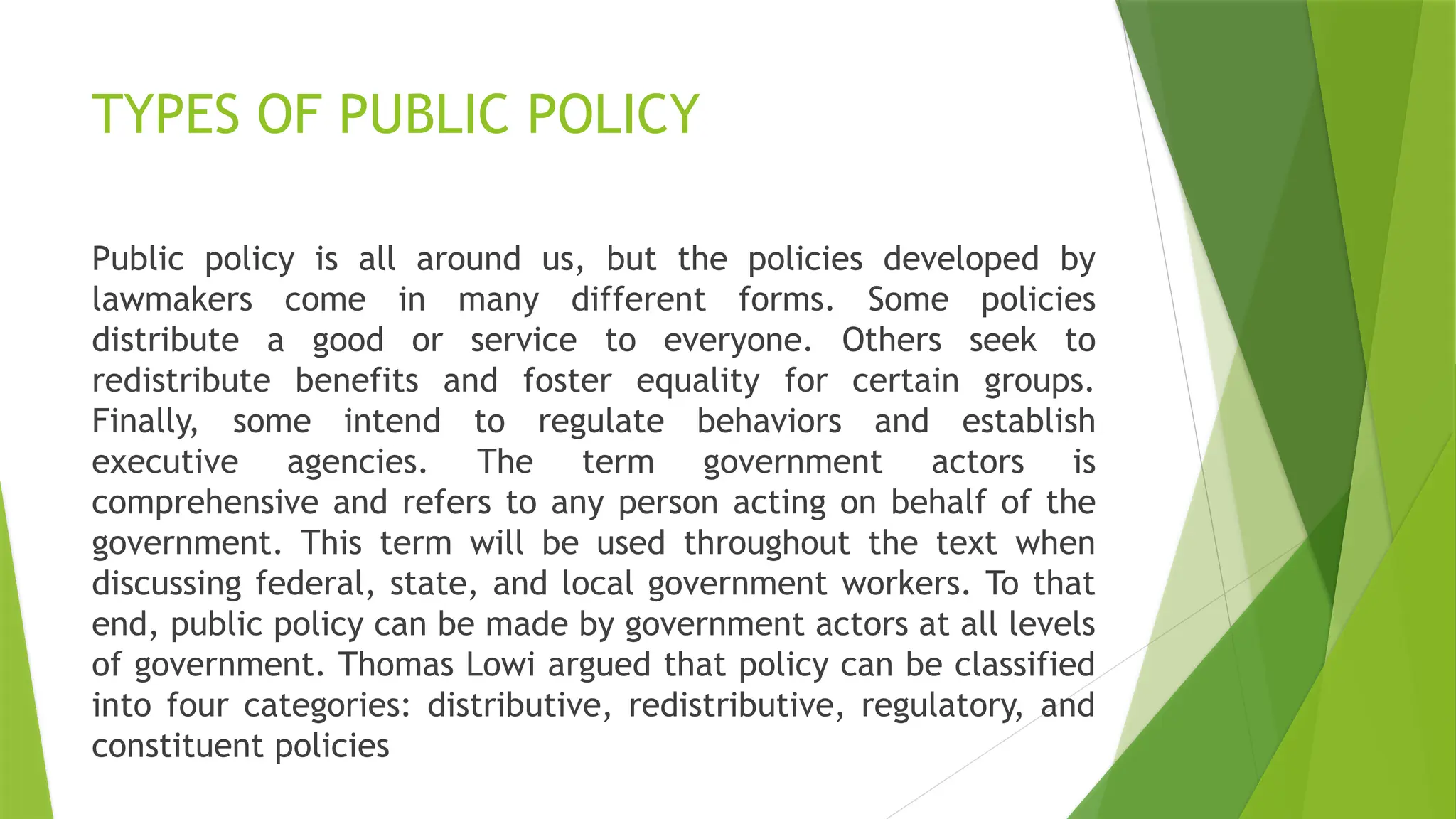
To understand the vast landscape of governmental actions, political scientists and public administrators often categorize public policies by their scope, intent, and mechanism. Recognizing these classifications helps clarify why certain interventions are chosen over others.
Distributive vs. Regulatory vs. Redistributive Policies
- Distributive Policies: These policies provide public goods and services to specific segments of the population or the entire community without explicitly taking resources away from any other group. Examples include funding for public education, national defense, infrastructure projects like highways, and scientific research grants.
- Regulatory Policies: These interventions restrict behavior, mandate compliance, and impose penalties on individuals or corporations that fail to adhere to established standards. Regulatory policies protect consumers, workers, and the environment by limiting monopolies, setting workplace safety rules, and curbing pollution.
- Redistributive Policies: These policies alter the allocation of wealth, property, or rights among social classes or economic groups. By taxing wealthier segments of the population to fund programs for low-income citizens, governments use redistributive policies to reduce economic inequality. Examples include progressive income tax structures, welfare programs, and subsidized healthcare.
Key Examples of Public Policy by Sector
Governments intervene across virtually every domain of daily life. Examining specific sectors reveals how high-level legislative intent translates into concrete operational realities.
| Policy Sector | Primary Objective | Typical Instruments / Mechanisms | Common Examples |
|---|---|---|---|
| Healthcare | Improve population health, expand coverage, and control costs | Subsidies, mandates, public insurance programs, licensing | Medicare, Medicaid, public health vaccination campaigns |
| Economic & Fiscal | Stabilize markets, promote growth, control inflation | Interest rates, taxation, government spending, trade tariffs | Federal Reserve monetary policy, federal stimulus packages |
| Environmental | Preserve natural resources, reduce emissions, mitigate climate change | Cap-and-trade systems, emission caps, conservation grants | Clean Air Act regulations, national park preservation |
| Education | Ensure equal access to learning, maintain academic standards | Funding formulas, curriculum standards, accreditation rules | Public school funding mandates, federal student loan programs |
| Social Welfare | Alleviate poverty, protect vulnerable populations, provide safety nets | Cash transfers, food assistance, housing vouchers | Social Security, Supplemental Nutrition Assistance Program (SNAP) |
Detailed Case Studies of Public Policy
To move beyond high-level definitions, it is helpful to analyze how specific public policies function in practice, including their mechanisms, beneficiaries, and operational limitations.
1. Healthcare Policy: The Expansion of Public Insurance
Healthcare policy is one of the most debated and complex areas of public governance. In many nations, governments act as both regulators and direct providers or financiers of medical services.
- Mechanisms: Governments utilize statutory funding, payroll taxes, and mandatory enrollment thresholds to pool financial risk across populations. For instance, programs like Medicare in the United States utilize federal trust funds to provide health insurance coverage to individuals aged 65 and older, as well as younger people with specific disabilities.
- Operational Challenges: Policymakers constantly balance rising medical technology costs, an aging demographic profile, and administrative overhead against taxpayer resistance and budget deficits. Regulatory compliance mandates require healthcare providers to maintain strict privacy standards (such as HIPAA regulations) while navigating complex reimbursement schedules.
2. Environmental Policy: Curbing Industrial Emissions
Environmental public policy addresses negative externalities—situations where private economic activities impose costs, such as pollution, on the broader public without financial compensation.
- Mechanisms: Environmental agencies use direct command-and-control regulations—such as maximum allowable particulate emission limits for factories—alongside market-based incentives like carbon pricing or cap-and-trade systems. Under a cap-and-trade framework, the government issues a limited number of pollution permits, which companies can buy and sell, creating a financial incentive to innovate and reduce emissions.
- Operational Challenges: Enforcement requires continuous monitoring, technical auditing, and legal mechanisms to penalize non-compliance. Furthermore, international policy coordination is frequently hindered by economic competition between nations with differing regulatory stringency.
3. Economic and Fiscal Policy: Managing Inflation and Employment
Fiscal policy involves government taxation and spending decisions designed to influence macroeconomic conditions, while monetary policy is managed by central banks through interest rates and money supply controls.
- Mechanisms: During economic downturns, expansionary fiscal policy may involve increased government infrastructure spending and temporary tax cuts to stimulate consumer demand. Conversely, contractionary policies raise taxes or reduce spending to cool down an overheating economy and curb inflation.
- Operational Challenges: Lag times represent a major hurdle in economic policymaking. By the time a legislative package is debated, passed, and implemented, economic conditions may have shifted, risking unintended consequences such as stagflation or runaway national debt.
The Role of Public Opinion and Interest Groups
Public policy is rarely shaped in an administrative vacuum. It is the product of intense negotiation, lobbying, and civic engagement.
Interest groups, trade associations, labor unions, and non-profit organizations actively attempt to influence the policy agenda. They provide legislators with specialized research, mobilize grassroots support, and participate in public comment periods during the administrative rulemaking process. While this pluralistic input helps ensure that diverse perspectives are considered, it also introduces the risk of regulatory capture, where industries successfully lobby for rules that protect their own commercial interests rather than the broader public good.
Frequently Asked Questions About Public Policy
What is the difference between public policy and law?
A law is a specific, legally binding statute passed by a legislative body and signed by an executive. Public policy is a broader concept that encompasses laws, but also includes executive orders, judicial rulings, administrative agency regulations, unspoken government practices, and funding allocations directed toward solving a public problem.
Who is responsible for making public policy?
Public policy is primarily formulated by elected officials in legislative and executive branches of government. However, unelected bureaucrats and administrative agencies play a massive role by writing the detailed regulations required to execute broad statutory mandates. Courts also shape policy through constitutional interpretation and landmark judicial precedents.
How do citizens influence public policy?
Citizens influence policy through formal electoral participation, such as voting in local and national elections. Beyond elections, individuals and groups participate by attending public hearings, submitting comments on proposed administrative rules, engaging in peaceful advocacy, and supporting non-governmental organizations that lobby for specific legislative outcomes.
Why do some public policies fail?
Policies frequently fail due to poor implementation, insufficient funding, shifting economic conditions, or a failure to accurately diagnose the root cause of the problem. Additionally, unforeseen negative externalities and strong political opposition from adversely affected industries can undermine a policy's long-effectiveness.
How are public policies evaluated after enactment?
Governments and independent research institutions use policy evaluation methods—such as cost-benefit analysis, randomized controlled trials, and longitudinal statistical studies—to measure whether a policy achieved its stated goals efficiently and equitably without creating unacceptable adverse side effects.
Next Actions and Further Exploration
Understanding public policy requires looking past partisan rhetoric to examine the actual mechanisms, budgets, and administrative frameworks that govern society. For professionals, researchers, and engaged citizens, monitoring legislative agendas, reviewing administrative rulemakings in federal or local registers, and analyzing policy impact reports provide clear insights into how governance directly affects daily life.
Image Gallery