Key Phases of Global AI Regulation (2022–2025): Evolution, Statutes, and Enterprise Compliance
Between 2022 and 2025, global AI regulation evolved through four distinct phases: early voluntary risk frameworks (2022), targeted executive actions and generative AI decrees (2023), comprehensive hard-law codification led by the Europ...
Between 2022 and 2025, global AI regulation evolved through four distinct phases: early voluntary risk frameworks (2022), targeted executive actions and generative AI decrees (2023), comprehensive hard-law codification led by the European Union (2024), and structured operational enforcement with technical compliance deadlines (2025). This progression shifted artificial intelligence oversight from flexible soft-law recommendations into legally binding, risk-stratified compliance obligations for global enterprises.
Contents
Executive Overview: The Paradigm Shift in AI Oversight
The regulatory landscape governing artificial intelligence underwent an unprecedented acceleration between 2022 and 2025. At the start of this era, enterprise deployment of automated systems operated largely under voluntary ethics codes, regional data privacy laws such as the GDPR, and sector-specific rules governing financial credit or medical devices. By the end of 2025, major economies had enacted binding legal frameworks establishing strict liability, algorithmic transparency requirements, mandatory pre-deployment impact assessments, and substantial monetary penalties for non-compliance.
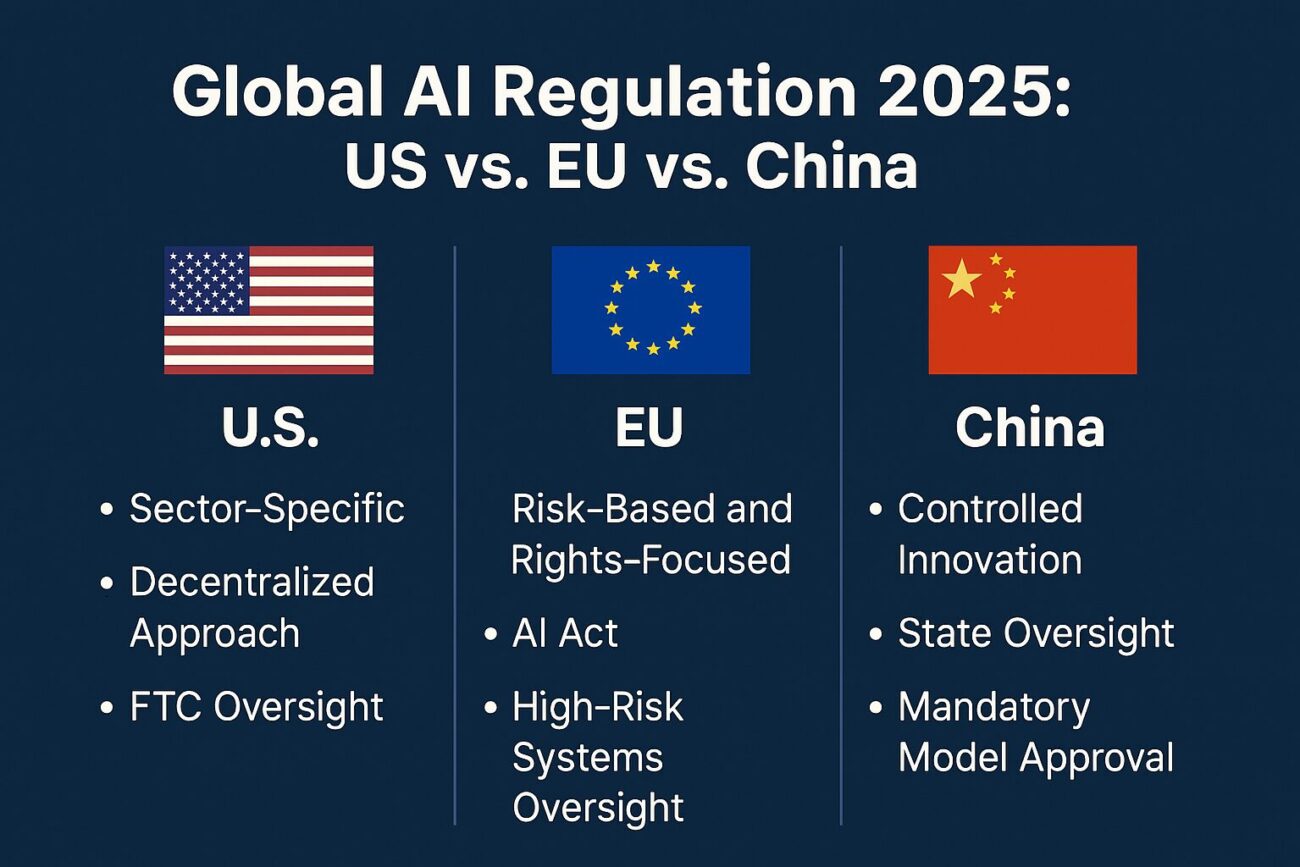
Understanding these foundational regulatory phases provides crucial context for managing compliance, enterprise governance, and global deployment architectures. Organizations operating cross-border systems must navigate a patchwork of prescriptive regional regimes—ranging from the EU's risk-tiered model to China’s content-focused governance and the United States' decentralized, sector-specific rules.
Phase 1 (2022): Voluntary Frameworks, Early Drafts, and the Generative Catalyst
The year 2022 marked the transition from high-level ethical discussions to structured, non-binding policy guidance. Regulators recognized that traditional data privacy laws were insufficient to address the unique risks posed by autonomous decision-making systems and machine learning models.
US Blueprint for an AI Bill of Rights and Voluntary Guidance
In October 2022, the White House Office of Science and Technology Policy (OSTP) published the Blueprint for an AI Bill of Rights. This document outlined five foundational principles to protect the public from algorithmic harms:
- Safe and Effective Systems: Protection from inappropriate or untested automated mechanisms.
- Algorithmic Discrimination Protections: Requirements ensuring algorithms do not bias outcomes based on protected characteristics.
- Data Privacy: Built-in safeguards against invasive data collection practices.
- Notice and Explanation: The right of individuals to know when an automated system is impacting their outcomes.
- Human Alternatives, Opt-Out, and Fallback: Access to human intervention when automated processes fail or yield contested results.
Concurrently, the National Institute of Standards and Technology (NIST) finalized the initial drafts of its voluntary AI Risk Management Framework (AI RMF 1.0), which aimed to help organizations systematically map, measure, and manage algorithmic risks.
Early Algorithmic Governance in China
China took an early regulatory lead by implementing targeted, single-issue regulations. In March 2022, the Cyberspace Administration of China (CAC) enforced the Administrative Provisions on Internet Information Service Recommendation Algorithms. This statute targeted recommendation engines, prohibiting synthetic content generation designed to manipulate public opinion and granting users the right to turn off algorithmic recommendations.
The November 2022 Generative AI Shockwave
The public release of consumer-facing Large Language Models (LLMs) in late 2022 fundamentally altered global policy priorities. The rapid deployment of generative AI revealed capabilities—and systemic risks—that existing policy drafts had not anticipated, accelerating legislative timelines across every major economy.
Phase 2 (2023): Executive Decrees, Generative AI Rules, and Multilateral Alignments
In 2023, governments shifted from foundational principles to binding executive actions and specialized decrees to directly address foundation models and generative capabilities.
- 2022: Voluntary Risk Frameworks & Principles
- 2023: Executive Actions & Generative AI Specific Rules
- 2024: Hard Law Codification (EU AI Act)
- 2025: Enforcement & GPAI Governance Mandates
US Executive Order 14110
In October 2023, U.S. President Joe Biden issued Executive Order 14110, Safe, Secure, and Trustworthy Development and Use of Artificial Intelligence. Utilizing executive procurement authority and the Defense Production Act, EO 14110 mandated:
- Red-Teaming and Reporting: Developers of dual-use foundation models above specific computational thresholds ($10^{26}$ FLOPS) must submit safety test results to the U.S. government.
- Watermarking and Content Authentication: Standards led by NIST for labeling AI-generated content.
- Civil Rights and Labor Oversight: Federal agency guidelines to prevent algorithmic bias in housing, hiring, and criminal justice.
China’s Interim Measures for Generative AI
In August 2023, China enacted the Interim Measures for the Management of Generative Artificial Intelligence Services. Unlike western frameworks focusing heavily on system architecture, China’s law focused on training data provenance, ideological compliance, and content authenticity, requiring providers of public-facing generative models to undergo security assessments and algorithm filings.
International Treaties and Multilateral Alignments
Recognizing that AI risks transcend borders, 2023 saw key international bodies step forward:
- The Bletchley Declaration (November 2023): 28 nations, including the US, China, and EU member states, signed a joint agreement at the UK AI Safety Summit committing to co-manage frontier AI risks.
- G7 Hiroshima AI Process: Established an international code of conduct and voluntary guidance for developers of advanced AI systems.
Phase 3 (2024): Legislative Codification and Comprehensive Hard Law
The year 2024 served as the turning point when non-binding guidance transformed into explicit statutory law with enforceable legal sanctions.
The European Union AI Act
Following years of negotiation, the European Parliament and Council passed the landmark EU Artificial Intelligence Act in early 2024, which formally entered into force in July 2024. As the world's first comprehensive horizontal AI statute, it established a risk-based classification architecture:
UNACCEPTABLE RISK (Prohibited: Social scoring, biometric risk)
HIGH RISK (Strict Conformity Assessments: Hiring, Infrastructure)
GENERAL PURPOSE AI / GPAI (Transparency & Systemic Risk Rules)
SPECIFIC / LOW RISK (Basic Transparency: Chatbots, Watermarking)
Prohibited AI Systems: Total bans on biometric categorization targeting sensitive characteristics, untargeted scraping of facial images, emotion recognition in workplaces/schools, and social scoring.
High-Risk Systems: Strict pre-market conformity assessments, mandatory continuous risk management, data governance mandates, and mandatory human oversight for systems deployed in critical infrastructure, education, employment, and law enforcement.
General-Purpose AI (GPAI) Models: Specific obligations for foundation model providers, including copyright policy compliance, model documentation, and additional requirements for models exhibiting "systemic risk."
Sub-National Legislation in the United States
In the absence of a single federal omnibus law, U.S. states moved independently. In May 2024, Colorado enacted Senate Bill 24-205 (Consumer Protection in Artificial Intelligence), establishing legal duties for developers and deployers of "high-risk" algorithmic tools to prevent algorithmic discrimination. Simultaneously, California passed several targeted transparency and anti-deepfake statutes.
International Legal Treaties
In May 2024, the Council of Europe adopted the Framework Convention on Artificial Intelligence and Human Rights, Democracy, and the Rule of Law, establishing the first legally binding international treaty open to global signatories designed to align AI deployment with human rights standards.
Phase 4 (2025): Phased Enforcement, GPAI Governance, and Operational Mandates
By 2025, the regulatory focus shifted decisively from statutory drafting to practical compliance, regulatory audits, and phased legal deadlines.
Implementation Milestones of the EU AI Act
The EU AI Act's enforcement structure activated in phased stages throughout 2025:
- February 2025: Absolute bans on prohibited AI practices (e.g., cognitive behavioral manipulation, untargeted facial recognition databases) took full effect.
- August 2025: Specific governance rules and transparency obligations for General Purpose AI (GPAI) model providers became legally binding across all 27 EU member states, supervised by the newly established European AI Office.
Enterprise Operationalization and Standards Integration
During 2025, compliance teams integrated formal management systems to fulfill worldwide legislative mandates. The international standard ISO/IEC 42001 (Artificial Intelligence Management System) became the global benchmark for enterprise governance, providing structured mechanisms for algorithmic impact assessments, data provenance validation, and continuous performance tracking.
Regional Regulatory Approaches Compared (2022–2025)
The table below summarizes the core differences in regulatory philosophy, primary enforcement mechanisms, and scope across key global jurisdictions established through the 2022–2025 regulatory evolution:
| Jurisdiction | Regulatory Approach | Primary Enacted Frameworks (2022–2025) | Operational Scope & Enforcement | Max Non-Compliance Penalty |
|---|---|---|---|---|
| European Union | Horizontal, Risk-Based Statutory Regulation | EU AI Act (2024) | Categorized by risk tiers (Prohibited, High, GPAI, Minimal). Binding across all sectors. | Up to €35M or 7% of global annual turnover (whichever is higher) |
| United States | Sector-Specific, Decentralized & Executive Orders | Executive Order 14110, NIST AI RMF, Colorado SB 24-205, State Laws | Procurement rules, federal agency guidelines, and state-level consumer protection acts. | Varies by state statute and federal sector regulator (e.g., FTC, SEC penalties) |
| China | Vertical, Targeted Content & Security Rules | Algorithmic Recommendations (2022), Generative AI Measures (2023) | Mandatory filings, algorithmic security reviews, political content moderation, training data verification. | Service suspension, fines up to 100,000 RMB per violation, criminal liability under data laws |
| United Kingdom | Contextual, Sector-Led ("Pro-Innovation") | UK AI Regulatory Framework, Safety Commitments (2023–2024) | Regulatory oversight delegated to existing sector bodies (FCA, ICO, CMA) without a centralized omnibus statute. | Governed by existing sectoral statutory caps (e.g., GDPR/Data Protection Act limits) |
Enterprise Action Plan for Compliance
To manage cross-border regulatory duties established during the 2022–2025 regulatory expansion, enterprises should implement a structured, five-step governance program:
- SYSTEM INVENTORY
- RISK CLASSIFICATION
- IMPACT ASSESSMENTS
- DATA & MODEL GOVERNANCE
- AUDIT TRAIL
Step 1: Establish a Comprehensive AI System Inventory
Identify and document every automated decision tool, machine learning model, and third-party API integrated into corporate operations. Record model origins, deployment context, training parameters, and processing inputs.
Step 2: Map Systems to Regional Risk Classifications
Evaluate each cataloged application against jurisdictional legal definitions. Determine whether a system qualifies as "High Risk" under the EU AI Act or state frameworks like Colorado SB 24-205, or whether it uses foundation models subject to specialized disclosure mandates.
Step 3: Conduct Mandatory Algorithmic Impact Assessments (AIAs)
Formalize pre-deployment risk evaluations. Assessments must evaluate potential bias, legal compliance, data protection impacts, systemic risk factors, and the availability of human-in-the-loop oversight mechanisms.
Step 4: Implement Rigorous Data Provenance and Model Governance
Ensure training sets are clean, legally sourced, non-discriminatory, and fully documented. Maintain metadata logs detailing copyright compliance, data curation techniques, and safety red-teaming outcomes.
Step 5: Adopt Standardized Management Systems (ISO/IEC 42001)
Align internal governance structures with internationally recognized standards. Implementing ISO/IEC 42001 helps satisfy third-party audit requirements, streamlines regulatory reporting across multiple jurisdictions, and creates clear internal lines of accountability.
Frequently Asked Questions
What was the defining legal milestone in global AI regulation between 2022 and 2025?
The passage of the European Union Artificial Intelligence Act in 2024 was the defining legal milestone. It established the world's first comprehensive, horizontal, risk-based statutory framework, setting a precedent for global extraterritorial compliance similar to the GDPR.
How did the approach to regulating generative AI differ between the US, EU, and China?
The EU focused on system-wide risk classifications, copyright transparency, and foundation model safety tiers. China prioritized content governance, ideological alignment, data security filings, and public-facing algorithm registrations. The US relied primarily on federal executive orders targeting high-computation dual-use models, combined with state-level anti-discrimination and transparency statutes.
What are the consequences of non-compliance under the EU AI Act established in 2024?
Fines under the EU AI Act are structured around severity. Violations involving prohibited AI practices can incur administrative fines up to €35 million or 7% of an enterprise’s total worldwide annual turnover, while failure to satisfy high-risk system obligations can lead to fines up to €15 million or 3% of global turnover.
What role did voluntary frameworks play during the 2022–2025 regulatory evolution?
Voluntary frameworks—such as the NIST AI Risk Management Framework (2023) and the US Blueprint for an AI Bill of Rights (2022)—served as technical and conceptual bridgehead documents. They provided organizations with early standardization tools and formed the foundation upon which binding legislative statutes (such as state-level US laws and international standards) were eventually built.
Do small and medium-sized enterprises (SMEs) face the same regulatory burdens as large tech firms?
Most statutory frameworks, including the EU AI Act, incorporate scalability provisions. While SMEs deploying high-risk systems must still meet mandatory safety and risk compliance requirements, regulatory bodies offer reduced administrative fee structures, simplified reporting pathways, and regulatory sandboxes to foster compliance without stifling market entry.
Strategic Guidance and Recommended Next Steps
Navigating global AI compliance requires moving beyond ad-hoc risk reviews to building a permanent, adaptable governance architecture. Organizations should immediately:
- Audit Enterprise AI Assets: Audit internal software pipelines and vendor capabilities against high-risk and general-purpose legal definitions.
- Harmonize Cross-Border Governance: Align corporate governance policies with standard frameworks like ISO/IEC 42001 to maintain compliance across diverging regional rules (EU, US states, China).
- Implement Automated Traceability: Deploy automated telemetry toolkits across all production models to log input data, performance metrics, and human-in-the-loop overrides for continuous regulatory oversight.
Disclaimer: This analysis provides regulatory context based on historical developments between 2022 and 2025 and does not constitute formal legal counsel. Enterprise compliance programs should involve qualified legal and technical specialists.
Image Gallery