Understanding What CFM Means for Home Airflow
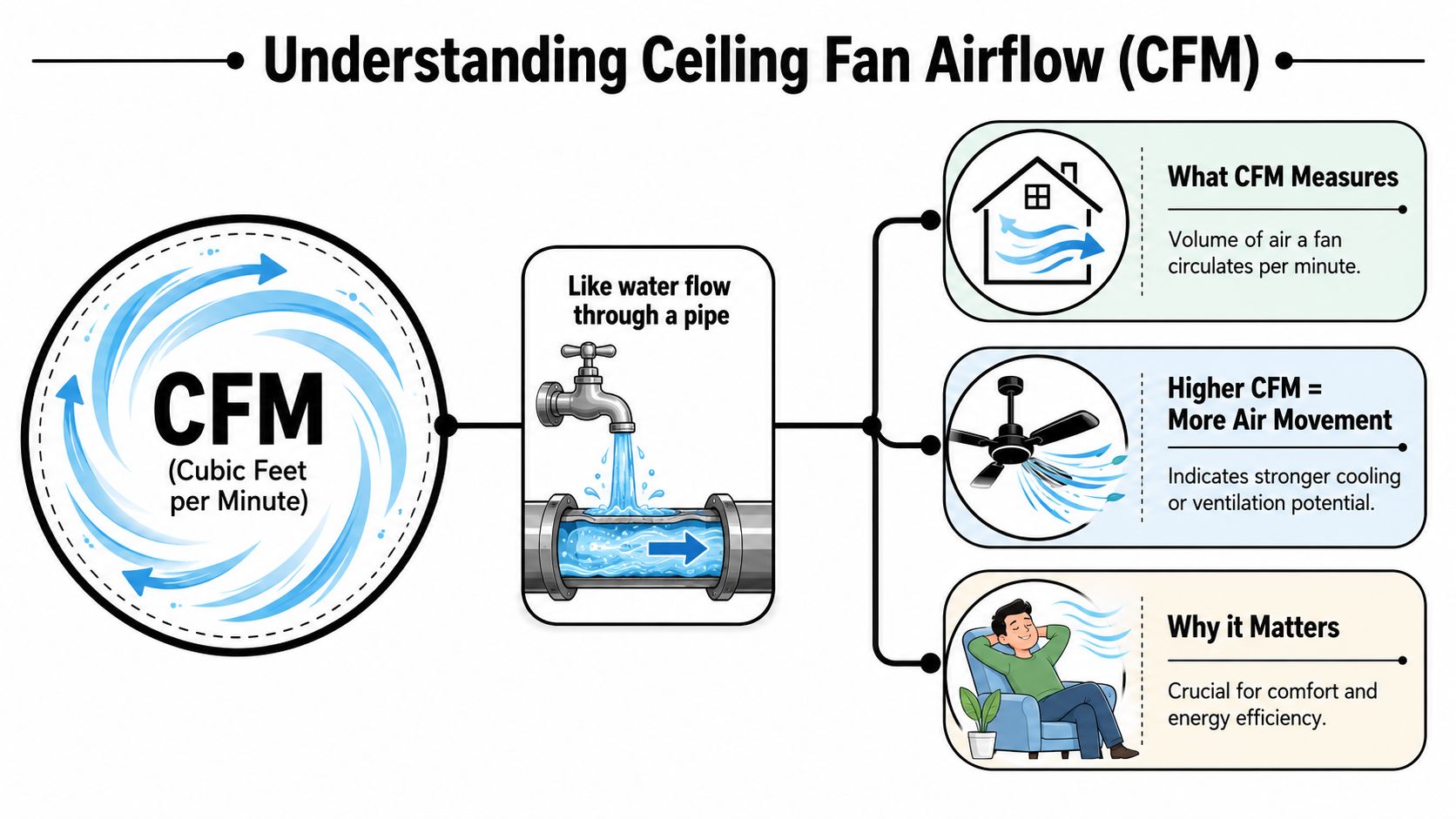
CFM stands for Cubic Feet per Minute, a standard unit of measurement that defines the volumetric flow rate of air moving through a specific space, duct, or mechanical appliance. For home airflow, understanding CFM is essential for main...
CFM stands for Cubic Feet per Minute, a standard unit of measurement that defines the volumetric flow rate of air moving through a specific space, duct, or mechanical appliance. For home airflow, understanding CFM is essential for maintaining optimal indoor air quality, ensuring energy efficiency, and preventing moisture-related problems such as mold and structural rot. Whether you are sizing a new bathroom exhaust fan, upgrading your kitchen range hood, or evaluating a whole-house ventilation system, knowing how to calculate and apply CFM ratings ensures your home breathes properly.
Contents
The Core Concept of Cubic Feet per Minute (CFM)
At its most fundamental level, CFM measures how many cubic feet of air pass a given point in one minute. Imagine a room that measures 10 feet wide, 10 feet long, and 8 feet high. This room has a total volume of 800 cubic feet ($10 \times 10 \times 8 = 800$). If an air-moving device has a rating of 800 CFM, it theoretically has the capacity to replace or move the entire volume of air in that room once every minute.
However, real-world home airflow is rarely this straightforward. Static pressure, duct length, bends, filters, and architectural restrictions create resistance that reduces the actual performance of fans and ventilation systems. When manufacturers test appliances, they often measure CFM at zero static pressure in laboratory settings. In a real home installation, the presence of ductwork creates resistance, meaning the rated CFM on a box is frequently higher than the effective CFM delivered at the exhaust termination point.
Understanding this distinction helps homeowners avoid undersizing their ventilation equipment. When air encounters friction along a duct wall or is forced through a narrow louver, the velocity and volume drop. Consequently, residential HVAC technicians and building code officials look at both the raw CFM rating and the performance curves under specific static pressure conditions to design reliable home airflow systems.
Why CFM Matters for Residential Indoor Air Quality and Comfort
Home airflow is directly tied to the health, safety, and comfort of the living environment. Without adequate CFM moving through high-moisture or high-pollutant zones, indoor air stagnation occurs. This stagnation traps airborne contaminants, cooking odors, volatile organic compounds (VOCs), and excessive humidity indoors.
Excess humidity is one of the most destructive forces in residential structures. Showers, cooking, washing machines, and human respiration constantly introduce moisture into the air. If bathroom and kitchen ventilation fans do not possess sufficient CFM capacity to exhaust this moisture quickly, relative humidity levels rise, creating ideal breeding grounds for mold and mildew. Prolonged high humidity also warps wood framing, damages drywall, and degrades indoor air quality (IAQ).
Conversely, excessive CFM can also create problems if it is unbalanced. If an exhaust fan pulls too much air out of a tightly sealed modern home without a corresponding makeup air supply, it creates negative pressure. Negative pressure can cause backdrafting in combustion appliances like gas water heaters and furnaces, pulling dangerous carbon monoxide into the living space instead of venting it safely outside. Balancing CFM ensures that indoor pressure remains neutral and airflow stays consistent.
Calculating Required CFM for Different Areas of the Home
Different areas of a house have unique ventilation requirements governed by building codes, such as ASHRAE (American Society of Heating, Refrigerating and Air-Conditioning Engineers) standards. Calculating the correct CFM for each zone ensures efficient operation without wasting electricity or overworking mechanical systems.
Bathroom Exhaust Ventilation
Bathrooms require consistent air exchange to remove steam and humidity rapidly. The standard rule of thumb for bathrooms up to 100 square feet is to provide at least 1 CFM per square foot of floor area, with a minimum baseline of 50 CFM.
- Small Bathrooms (Under 100 sq. ft.): Calculate by floor area (e.g., an 8x8 room = 64 sq. ft., requiring a minimum of 64 CFM, rounded up to the nearest standard fan size like 70 or 80 CFM).
- Large Bathrooms (Over 100 sq. ft.): Add requirements for individual fixtures. Allocate 50 CFM for each standard toilet, shower, and bathtub. Add 100 CFM for a jetted tub.
- Enclosed Water Closets: Require an independent fan rated for at least 50 CFM.
Kitchen Range Hood Ventilation
Kitchens generate grease, smoke, heat, and combustion byproducts that demand much higher CFM ratings than bathrooms. Kitchen ventilation is typically calculated based on either the square footage of the kitchen or the thermal output (measured in British Thermal Units or BTUs) of the cooking range.
- Standard Electric or Gas Ranges: A general guideline is to provide 100 CFM for every linear foot of cooking surface width. A standard 30-inch (2.5 feet) range typically requires a minimum of 250 to 300 CFM.
- High-Output Professional Ranges: Ranges with high-BTU burners require significantly more power. The standard industry rule states that for every 1,000 BTUs of burner output, the hood should provide 100 CFM. A stove with 60,000 total BTUs theoretically requires a 600 CFM hood. Any kitchen hood exceeding 400 CFM generally triggers building code requirements for a dedicated makeup air system to prevent negative pressure.
| Home Area | Calculation Method | Standard Minimum CFM Range |
|---|---|---|
| Small Bathroom | 1 CFM per sq. ft. of floor space | 50 – 80 CFM |
| Large Bathroom | Sum of individual fixtures | 100 – 150+ CFM |
| Standard Kitchen | 100 CFM per linear foot of range | 250 – 400 CFM |
| Professional Kitchen | 100 CFM per 1,000 BTUs of stove output | 400 – 1,200+ CFM |
| Whole-House Ventilation | Square footage and bedroom count formula | Varies by ASHRAE 62.2 standard |
Whole-House Ventilation and HVAC Airflow
Beyond localized spot ventilation in kitchens and bathrooms, whole-house airflow relies on the central heating, ventilation, and air conditioning (HVAC) system. An HVAC blower motor moves conditioned air through ductwork to maintain thermal comfort, typically operating between 350 and 400 CFM per ton of cooling capacity. For example, a standard 3-ton residential air conditioning system generally requires an airflow rate of roughly 1,000 to 1,200 CFM to function efficiently.
When HVAC airflow drops—often due to clogged air filters, collapsed flexible ducts, or blocked return vents—system efficiency plummets. Low CFM across an air conditioner evaporator coil causes the coil temperature to drop below freezing, turning trapped moisture into ice. This freezing blocks airflow entirely, strains the compressor, and can cause permanent mechanical failure. Conversely, excessive airflow can lead to noisy ducts, uncomfortable drafts, and poor dehumidification because air moves across the cooling coil too quickly to strip moisture from the environment.
Factors That Reduce Effective CFM in Real-World Installations
Purchasing a fan with a high CFM rating on the packaging does not guarantee that the appliance will deliver that exact performance once installed. Several physical variables diminish real-world airflow:
- Duct Length and Diameter: Long runs of ductwork introduce friction against moving air. Furthermore, undersized ducts (such as running a high-CFM range hood through a 4-inch duct instead of a recommended 6- or 8-inch duct) choke the airflow, increasing static pressure and drastically lowering the actual CFM delivered.
- Duct Bends and Transitions: Every 90-degree elbow, sharp turn, or transition piece in a duct system creates turbulence. Turbulence acts as a brake on airflow, reducing the overall volume of air moving through the system.
- Exhaust Hoods and Dampers: Exterior wall caps, roof caps, and backdraft dampers present physical barriers that the air must push open. Cheap louvers or bird screens clogged with lint or debris create immense resistance, cutting fan efficiency by half or more.
- Air Filters: In central HVAC systems, dirty or high-MERV (Minimum Efficiency Reporting Value) filters restrict air passage. While high-MERV filters catch smaller microscopic particles, they also increase static pressure, reducing total CFM unless the blower fan is specifically designed to handle the increased resistance.
Frequently Asked Questions About Home Airflow and CFM
What does CFM stand for in home ventilation?
CFM stands for Cubic Feet per Minute. It measures the volumetric flow rate of air, indicating how many cubic feet of air a fan or HVAC system can move in one minute.
How many CFM do I need for a bathroom exhaust fan?
You generally need 1 CFM per square foot of floor space for bathrooms under 100 square feet, with a strict minimum baseline of 50 CFM. For larger bathrooms, CFM requirements are calculated by adding requirements for individual fixtures like showers, tubs, and toilets.
Does a higher CFM rating always mean a better fan?
Not necessarily. Installing a fan with an excessively high CFM rating without adequate makeup air or proper duct sizing can create dangerous negative pressure, loud operational noise, and high energy consumption. The CFM should be matched precisely to the room size and duct capabilities.
Why is my high-CFM range hood not clearing smoke?
If a high-CFM range hood fails to clear smoke, the issue is usually restricted airflow caused by undersized ductwork, too many bends in the duct run, a clogged exterior vent cap, or a lack of makeup air preventing the fan from pulling air freely from the kitchen.
How does duct size affect CFM?
Duct size directly impacts static pressure. Smaller ducts force air to travel at higher speeds, creating friction and turbulence that lower the total CFM output. Matching the appliance exhaust collar size to the correct corresponding duct diameter preserves optimal airflow.
Practical Next Steps for Homeowners
To ensure your home maintains healthy airflow, start by auditing your current ventilation appliances. Check the CFM labels on your bathroom and kitchen exhaust fans against the square footage and fixture counts of those rooms. Inspect exterior termination points to ensure that wall caps and roof louvers open fully when fans are running and are free from lint, dust, or nests. If you are planning a kitchen or bathroom remodel, consult with a licensed HVAC professional or certified home energy auditor to calculate exact CFM and static pressure requirements before purchasing new equipment. Balancing proper airflow protects your home's structural integrity and ensures a healthier, more comfortable indoor living environment.
Image Gallery