Understanding the Reason Behind Dave Ramsey’s Life Insurance Philosophy
Dave Ramsey’s life insurance philosophy is predicated on a singular, risk-mitigation objective: to provide a financial safety net for dependents without incurring unnecessary costs or complicating personal wealth management. His approa...
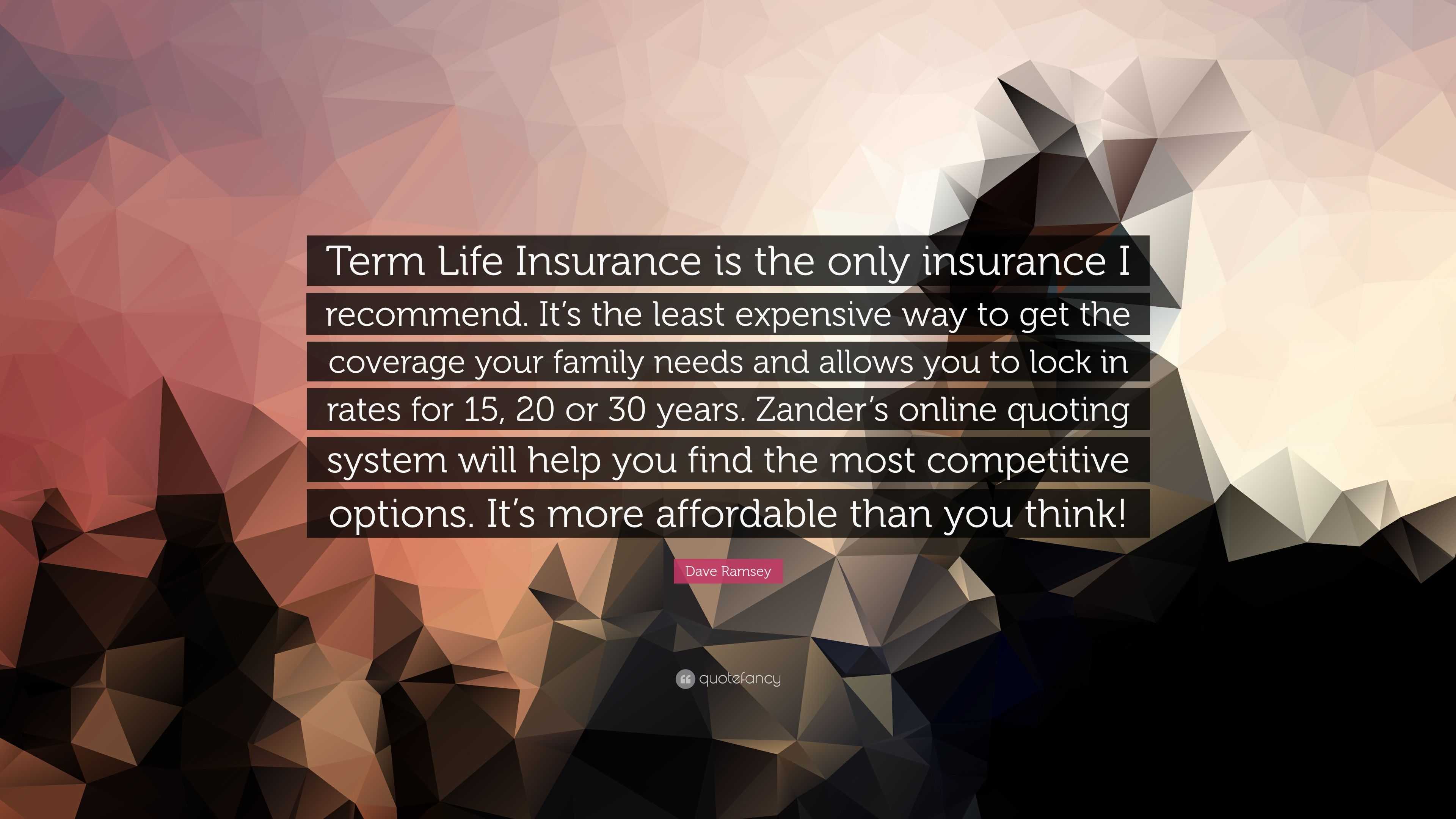
Dave Ramsey’s life insurance philosophy is predicated on a singular, risk-mitigation objective: to provide a financial safety net for dependents without incurring unnecessary costs or complicating personal wealth management. His approach mandates the use of term life insurance exclusively, rejecting cash-value products like whole or universal life insurance as inefficient tools for individuals focused on debt elimination and long-term wealth building.
Contents
The Foundation: Term Life vs. Cash-Value Insurance
At the heart of Ramsey’s stance is the distinction between "pure" insurance and insurance bundled with an investment component. Term life insurance functions as a simple risk-transfer mechanism: you pay a premium for a specified period (the term), and in exchange, the insurer guarantees a death benefit to your beneficiaries if you pass away during that period. It does not accumulate cash value and expires at the end of the term.
Conversely, whole life and universal life insurance policies are designed to last a lifetime. They include a savings or investment component often referred to as "cash value." A portion of the premiums paid goes toward the death benefit, while the remainder is invested by the insurance company. Ramsey argues that this structure is fundamentally flawed for the average person because the administrative fees are excessive, the investment returns are generally sub-par compared to market-based index funds, and the cost of insurance remains static while the death benefit remains stagnant relative to inflation.
Why Ramsey Rejects Whole Life Insurance
The primary reason Ramsey advocates against cash-value policies is the "opportunity cost." He asserts that the premiums for whole life insurance are significantly higher than those for term life insurance. By purchasing expensive permanent insurance, individuals tie up capital that could otherwise be used to pay off high-interest debt, fund an emergency savings account, or invest in diversified mutual funds or ETFs.
Furthermore, Ramsey emphasizes the "two pot" theory: insurance and investments should be kept entirely separate. He argues that insurance companies are not the ideal vehicle for long-term wealth accumulation. By separating these, you gain the flexibility to invest your money in vehicles with higher historical growth rates while maintaining cheap, high-coverage protection for your family.
Determining the Appropriate Coverage Amount
A critical component of Ramsey’s philosophy is the "10–12 times income" rule of thumb. He contends that most people are drastically underinsured. If a primary breadwinner passes away, the remaining family members need a sufficient lump sum to replace the lost income, pay off the mortgage, and fund future expenses such as college tuition.
Calculating Your Needs
Instead of relying on arbitrary numbers, Ramsey suggests a calculation based on replacement value:
- Debt Elimination: The policy should be large enough to pay off all debts, including the mortgage.
- Income Replacement: The remainder should provide enough capital to generate a reliable income stream, often calculated by assuming a 7% to 10% annual withdrawal rate on the total death benefit.
- Education Funding: Specific set-asides for children’s college expenses.
By securing 10 to 12 times your annual income, you ensure that your family can maintain their standard of living through the interest generated by the death benefit, effectively replacing your salary without depleting the principal too rapidly.
Comparing Life Insurance Structures
| Feature | Term Life Insurance | Whole Life Insurance |
|---|---|---|
| Duration | Fixed (10, 15, 20, 30 years) | Permanent (Lifelong) |
| Cash Value | None | Yes |
| Premium Cost | Low | High |
| Purpose | Pure risk protection | Protection + forced savings |
| Investment | N/A | Included in policy |
The Philosophy in Practice: The "Baby Steps" Context
To understand why Ramsey holds this view, one must consider his broader financial framework, known as the "Baby Steps." The insurance philosophy is most relevant during the early stages of debt reduction and emergency fund building.
Because Ramsey’s system prioritizes rapid debt payoff (the "Debt Snowball"), he requires an insurance product that provides maximum protection for the lowest possible price. Spending hundreds of dollars a month on whole life insurance premiums would directly sabotage the progress of someone working to pay off consumer debt. By choosing a 15- or 20-year term policy, the policyholder covers the years where they are most financially vulnerable—while children are young and mortgages are large—without sacrificing the cash flow needed to achieve financial independence.
Common Criticisms and Expert Perspectives
While Ramsey’s philosophy is popular, it is not without its detractors within the financial industry. Proponents of whole life insurance argue that it provides "forced savings" for those who lack the discipline to invest regularly on their own. They also point to the tax-advantaged growth of cash value and the ability to borrow against the policy as potential benefits.
Financial professionals often note that term life insurance carries a "renewability risk." If your health declines significantly during your term, you may find it prohibitively expensive or impossible to purchase a new policy once your current one expires. Ramsey counters this by emphasizing that if you follow his plan, you will be "self-insured" (debt-free with a massive investment portfolio) by the time your term policy expires, rendering the need for insurance obsolete.
Frequently Asked Questions
1. Is term life insurance always the best choice? For the vast majority of individuals focusing on debt repayment and wealth building, term life is the most mathematically efficient choice. It provides the highest death benefit for the lowest monthly cost, allowing you to direct your surplus funds into high-growth investment accounts.
2. What happens if I don't die during my term? If you reach the end of your term and are still living, the policy expires and coverage ends. In Ramsey’s view, this is a success. It means you survived the period of your highest financial risk, and you should have accumulated enough assets in your investment accounts to be self-insured.
3. Should I cancel my whole life insurance immediately? Ramsey advises caution before canceling. You should first ensure you are healthy enough to qualify for a new term policy. Once you have secured a new, cheaper term policy, you may then evaluate the cash-out value of your old policy to see if the liquidity can be better deployed toward paying off debt or investing.
4. Does the "10–12 times income" rule apply to stay-at-home parents? Yes. Ramsey argues that a stay-at-home parent provides essential services—childcare, transportation, household management—that would be expensive to outsource. He recommends carrying a policy of at least $300,000 to $500,000 on a stay-at-home spouse to cover these replacement costs.
5. Are there any instances where whole life insurance makes sense? Some financial advisors argue that whole life has a role in high-net-worth estate planning to provide liquidity for estate taxes or in specialized business succession planning. However, for 99% of the population, Ramsey maintains that these policies are unnecessary expenses.
Taking Action
To implement this philosophy, start by evaluating your current debt-to-income ratio and your total outstanding liabilities. Use an online insurance calculator to estimate the death benefit required to pay off your mortgage and replace 10 years of your salary. Once you have a target number, contact independent insurance brokers to shop for term rates. Ensure you are comparing "level term" policies, where the premium remains the same throughout the duration of the term, to guarantee budget stability. By prioritizing low-cost, high-coverage term insurance, you shift your financial focus from paying for products to building personal net worth.
Image Gallery