What to Know About Santa Cruz Car Accident Lawyers: A Complete Legal Guide
Santa Cruz car accident lawyers represent victims of traffic collisions by investigating crash causes, negotiating with insurance carriers, and litigating personal injury claims in Santa Cruz County Superior Court. They help injured pa...
Santa Cruz car accident lawyers represent victims of traffic collisions by investigating crash causes, negotiating with insurance carriers, and litigating personal injury claims in Santa Cruz County Superior Court. They help injured parties navigate California’s pure comparative fault rules, statutory deadlines, and complex insurance policy limits to secure maximum financial compensation.
Contents
Legal Advice Disclaimer
This article provides general information regarding California personal injury law and local legal processes in Santa Cruz County. It does not constitute formal legal advice, nor does it create an attorney-client relationship. If you have been injured in an accident, consult a licensed California attorney to receive advice tailored to your specific circumstances.
The Role of a Santa Cruz Car Accident Lawyer
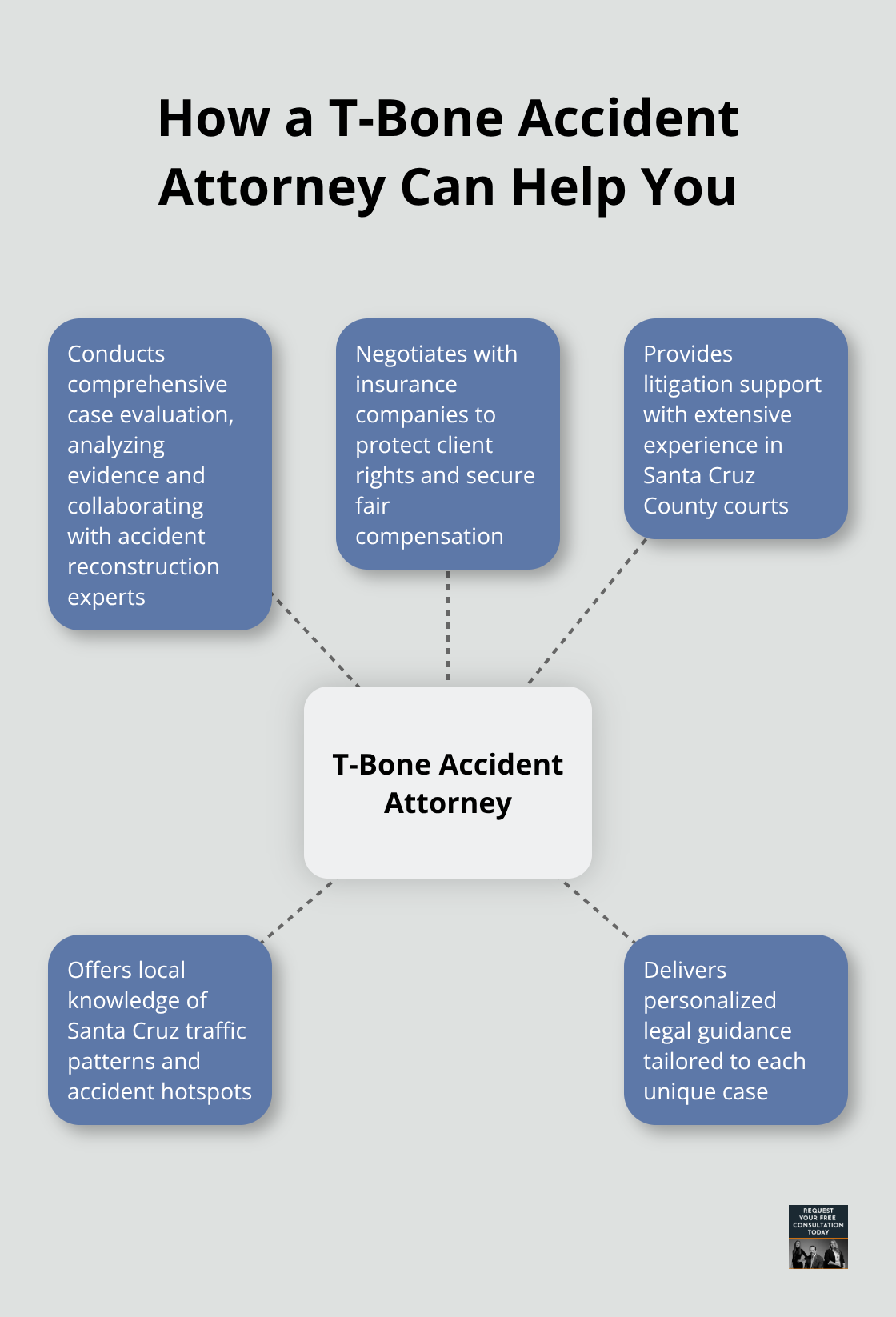
When a motor vehicle collision occurs in Santa Cruz County, victims often face severe physical injuries, mounting medical bills, vehicle replacement costs, and lost wages. Navigating the recovery process independently can be overwhelming, particularly when dealing with aggressive insurance claims adjusters whose primary goal is to minimize company payouts. A dedicated personal injury attorney serves as an advocate, handling every administrative, investigative, and legal aspect of a claim.
A local attorney begins by conducting an independent investigation into the collision. While police reports from the California Highway Patrol (CHP)—which frequently patrolled corridors like Highway 17 and Highway 1—or local municipal police departments provide initial documentation, they are not always final determiners of civil liability. Personal injury attorneys gather critical evidence, including collision scene photos, dashcam footage, witness statements, black box data from commercial vehicles, and surveillance video from nearby businesses.
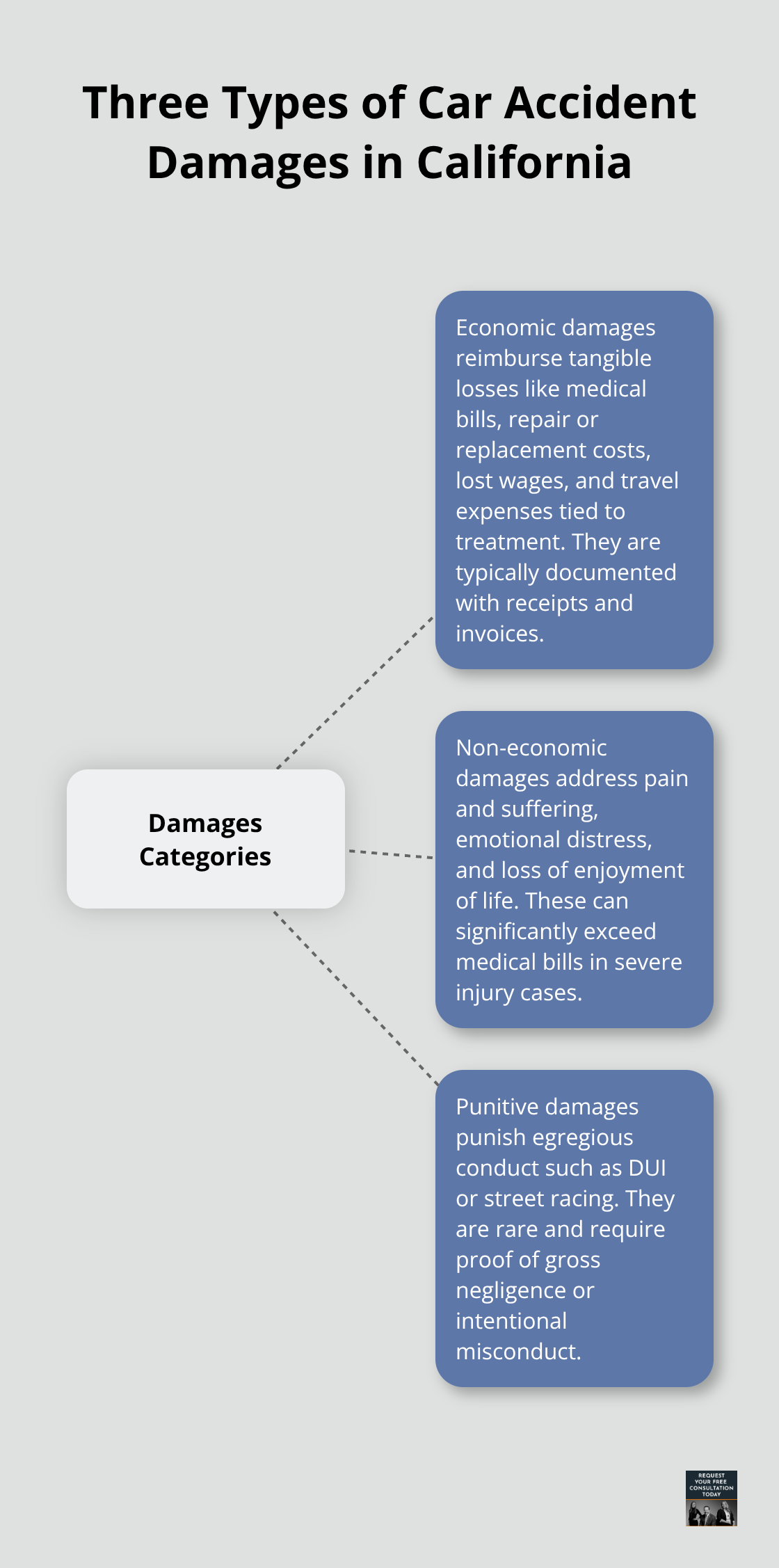
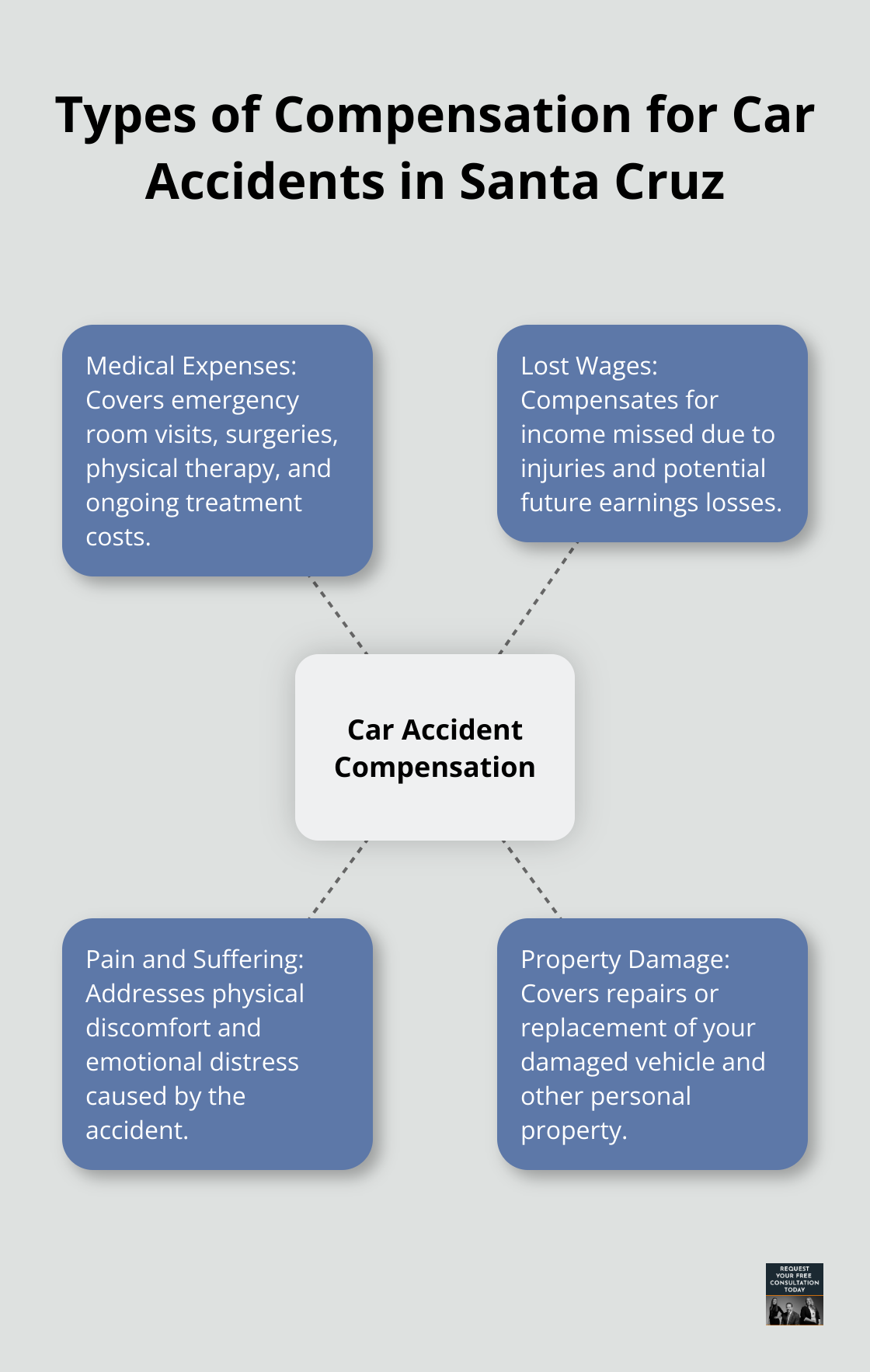
Beyond establishing fault, car accident lawyers evaluate the full extent of a client’s losses. This involves calculating both immediate economic damages, such as emergency room bills and auto repair costs, and long-term financial impacts, including future rehabilitation, reduced earning capacity, and pain and suffering.
When claims cannot be resolved through settlement negotiations, local attorneys prepare the case for civil litigation, filing formal complaints with the Santa Cruz County Superior Court located at 701 Ocean Street in Santa Cruz.
- CRASH INCIDENT IN SANTA CRUZ
- EVIDENCE GATHERING & INDEPENDENT INVESTIGATION
- CHP / Santa Cruz PD Incident Reports
- Scene Telematics, Video Footage & Witness Data
- VALUATION OF ECONOMIC & NON-ECONOMIC LOSSES
- Medical Bills, Wage Loss, Future Care Requirements
- INSURANCE DEMAND & PRE-SUIT NEGOTIATION
- Settlement Reached
- Release Signed
- Lien Resolution
- Disbursement of Funds
- Litigation Initiated
- Complaint Filed in Superior Court
- Discovery & Trial Preparation
- Verdict or Court-Ordered Settlement
- Settlement Reached
Key California Personal Injury Laws Affecting Santa Cruz Claims
California personal injury claims are governed by specific statutory framework and judicial precedents. Understanding these legal rules is essential for anyone involved in a traffic accident in Santa Cruz County.
1. Pure Comparative Negligence
California operates under a pure comparative fault doctrine, established in the landmark California Supreme Court decision Li v. Yellow Cab Co. (1975). Under this system, an injured party can recover financial damages even if they were partially at fault for the accident—even up to 99% at fault. However, the plaintiff's total financial recovery is reduced by their allocated percentage of fault.
For example, if a court determines that your total damages equal $100,000, but finds you were 20% responsible for the crash due to unsafe lane changing, your net financial award will be $80,000.
2. Statutes of Limitations
Filing deadlines in California are strict. Failing to file a lawsuit within the legally mandated timeframe permanently bars an injured person from seeking compensation in court:
- General Personal Injury Deadline: Under California Code of Civil Procedure § 335.1, an injured individual has two years from the date of the accident to file a personal injury lawsuit against non-governmental private parties.
- Property Damage Only: Under California Code of Civil Procedure § 338, claims for vehicle or property damage carry a three-year statute of limitations.
- Claims Involving Public Entities: If an accident involves a public vehicle (such as a Santa Cruz Metropolitan Transit District / METRO bus) or resulted from a dangerous road condition maintained by a public agency (such as Caltrans maintaining State Route 17 or the City of Santa Cruz), the California Government Claims Act (Gov. Code § 911.2) imposes a mandatory administrative claim deadline of just six months from the incident date.
3. California Automobile Insurance Requirements
California law requires all drivers to maintain minimum liability insurance limits. Under recent statutory updates, minimum financial responsibility coverage limits in California require drivers to maintain at least:
- $30,000 for bodily injury or death to one person per accident.
- $60,000 total for bodily injury or death to multiple persons per accident.
- $15,000 for property damage per accident.
Because catastrophic injuries frequently exceed these state minimum liability thresholds, an experienced lawyer will audit all applicable policies, including Uninsured/Underinsured Motorist (UM/UIM) policies, umbrella policies, and corporate commercial insurance policies.
4. Proposition 213 Restrictions
Under California Civil Code § 3333.4 (commonly known as Proposition 213), drivers who operate an uninsured vehicle at the time of an accident are generally prohibited from recovering non-economic damages (such as pain, suffering, and emotional distress), even if another driver caused the collision. Limited exceptions apply—for example, if the at-fault driver was convicted of driving under the influence (DUI) in connection with the crash.
Unique Driving Hazards and Roadways in Santa Cruz County
Santa Cruz County presents distinct legal and factual challenges in traffic accident litigation due to its unique geography, mountain passes, coastal corridors, and mix of commuters, tourists, and non-motorized road users.
SANTA CRUZ COUNTY TRAFFIC RISK CORRIDORS
| HIGHWAY 17 (MOUNTAIN PASS) | HIGHWAY 1 (COASTAL ARTERY) |
|---|---|
| • Sharp curves, steep grades• Frequent rain & mountain fog• High incidence of rollover crashes | • Severe weekend/holiday congestion• Multiple signalized intersections & cross-traffic• Frequent side-impact (t-bone) collisions |
| DOWNTOWN & UNIVERSITY ZONES | RURAL/COASTAL CONNECTORS |
| • High pedestrian/bicyclist volume• Commercial delivery conflicts | • Highway 9 & Soquel San Jose Rd• Narrow shoulders & limited sightlines |
Highway 17 Mountain Corridor
State Route 17 connects Santa Cruz to Silicon Valley across the Santa Cruz Mountains. Characterized by tight curves (such as the Laurel Curves), steep elevation changes, unpredictable mountain weather, and high-speed commuter traffic, Highway 17 sees frequent multi-vehicle pileups, barrier strikes, and rollover collisions. Establishing liability on Highway 17 often requires accident reconstruction experts to analyze road surface moisture, vehicle speeds, and tailgating distances.
Highway 1 Coastal Congestion
Highway 1 serves as the primary coastal artery through Santa Cruz, Watsonville, and Capitola. Severe traffic bottlenecks near the Fishhook interchange (where Highway 1 and Highway 17 merge) create frequent rear-end collisions during peak commuting hours and summer weekend tourist surges. Additionally, intersections along unsignalized stretches of Highway 1 present significant risks for broadside (T-bone) collisions.
Bicycle and Pedestrian Collisions
Santa Cruz features a high density of non-motorized transportation, particularly around the University of California, Santa Cruz (UCSC) campus, Downtown Santa Cruz, West Cliff Drive, and Beach Street near the Santa Cruz Beach Boardwalk. California Vehicle Code laws mandate that motorists yield right-of-way to pedestrians in marked and unmarked crosswalks and maintain a minimum safe distance when passing cyclists. Car accident attorneys handling bike or pedestrian accidents must thoroughly examine driver distraction, speed, and visibility conditions.
Self-Representation vs. Hiring a Santa Cruz Car Accident Lawyer
Deciding whether to handle a personal injury claim independently or hire legal counsel depends on the severity of injuries, clear liability, and policy limits.
| Consideration | Handling Claim Independently (Pro Se) | Hiring a Santa Cruz Car Accident Attorney |
|---|---|---|
| Ideal For | Minor property-damage-only claims or very minor injuries with no ongoing care. | Moderate to severe injuries, disputed fault, long-term treatment, or lost earnings. |
| Investigation Capability | Limited to police reports, personal photographs, and self-collected receipts. | Full professional access to accident reconstructionists, subpoenaed cell records, and dashcam data. |
| Insurance Communications | Direct exposure to adjuster tactics designed to minimize or deny claim value. | Attorney manages all communications, protecting the client from self-incriminating statements. |
| Knowledge of Local Courts | Must self-navigate procedural rules of Santa Cruz County Superior Court. | Local litigation experience, understanding court rules, local judges, and defense counsel. |
| Damage Valuation | Limited to current out-of-pocket medical expenses and property damage quotes. | Calculates past/future medical expenses, lost future earning capacity, and pain/suffering. |
| Lien Resolution | Claimant must negotiate health insurance (e.g., Medi-Cal, Medicare, Kaiser) liens manually. | Attorney legally negotiates and reduces medical liens to maximize net financial payout. |
| Fee Structure | No attorney fee, but risk of under-settling the underlying claim value. | Contingency fee model (no upfront cost; fee paid only as a percentage of recovery). |
Understanding Attorney Fees: The Contingency Fee Structure
Most personal injury attorneys in Santa Cruz represent clients on a contingency fee basis. Under this fee arrangement:
- No Upfront Legal Fees: The client pays no retainer or hourly fees out of pocket to begin representation.
- Payment Contingent on Payout: The attorney only receives legal fees if they successfully secure a financial settlement or court judgment.
- Standard Percentage: Contingency fees typically range between 33.3% and 40% of the total gross recovery. A common structure involves a 33.3% fee if the case settles prior to filing a lawsuit or formal litigation, increasing to 40% if formal court litigation or trial becomes necessary.
Case Costs vs. Legal Fees
It is essential to distinguish between attorney fees (the cost of the lawyer's professional services) and case costs (out-of-pocket litigation expenses). Case costs include:
- Fees for acquiring medical records and police incident reports.
- Filing fees required by the Santa Cruz County Superior Court clerk.
- Fees paid to expert witnesses (e.g., accident reconstruction specialists, orthopedic surgeons, economic loss experts).
- Deposition court reporter and videographer fees.
Reputable car accident lawyers advance these case costs during representation and deduct them from the final settlement or jury verdict. Clients should ensure their retainer agreement clearly specifies how case costs are handled if no financial recovery is obtained.
Steps to Take Following a Car Accident in Santa Cruz County
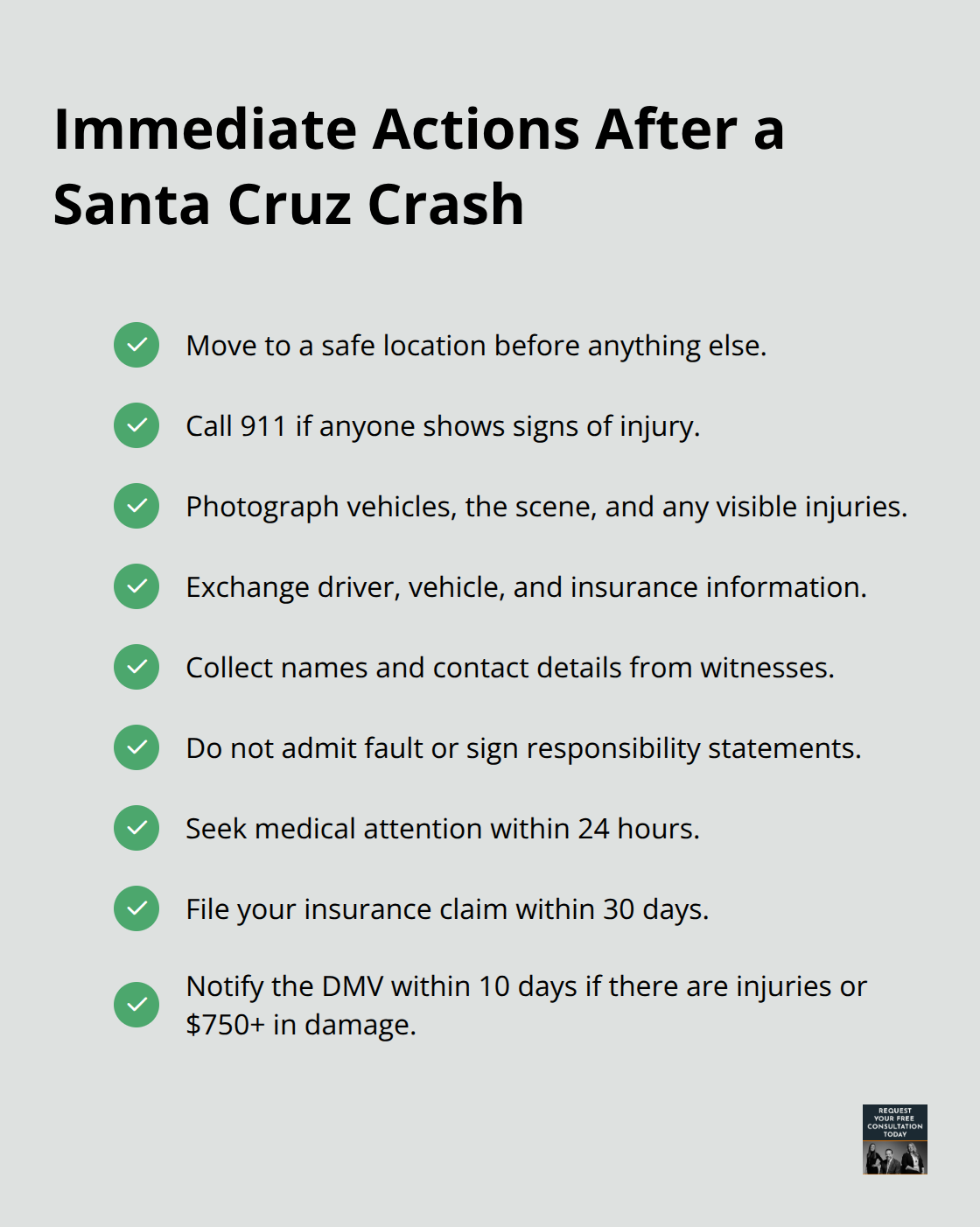
Taking immediate, deliberate steps after a crash helps safeguard both physical health and potential legal claims.
ACCIDENT OCCURS
Call Emergency (911)
- Dispatch CHP or Local PD
Document Scene & Photos
- Vehicle Placement, Skid Marks, Road Hazards
Seek Medical Care
- Dominican Hospital, Urgent Care, Primary Care
Consult Local Attorney
- Review Insurance Terms Before Giving Statements
Ensure Immediate Safety and Contact Emergency Services: Call 911 immediately. Request law enforcement to the scene so an official collision report is generated by the California Highway Patrol or local police.
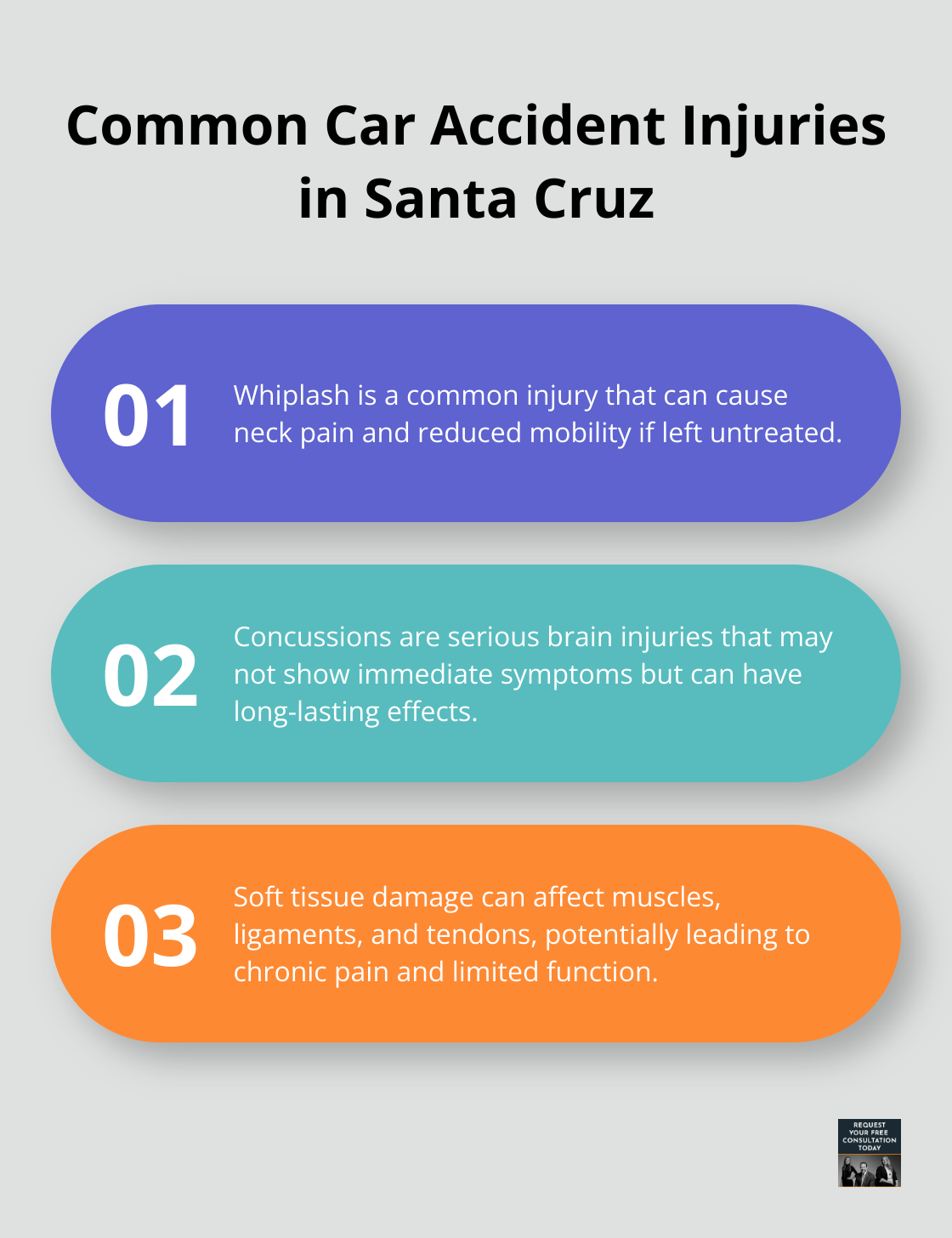
Obtain Medical Evaluation: Seek medical evaluation immediately at an emergency facility—such as Dominican Hospital on Soquel Drive or local urgent care centers—even if injuries seem minor. Symptoms like concussions, internal bleeding, and soft-tissue whiplash often present hours or days after an impact.
Gather Evidence at the Scene: If safe to do so, capture photographs and video of all vehicles, damage locations, license plates, skid marks, road conditions, and visible injuries. Exchange driver's license, contact, and insurance details with all involved parties.
Identify Witnesses: Obtain names, phone numbers, and email addresses of neutral bystanders who witnessed the incident.
Avoid Making Admissions of Fault: Limit conversations at the scene to basic factual exchange. Avoid apologizing or discussing fault with other drivers or insurance adjusters before consulting counsel.
Report the Crash to the DMV: Under California Vehicle Code § 16000, drivers must submit an SR-1 form to the California Department of Motor Vehicles (DMV) within 10 days if the collision resulted in bodily injury, death, or property damage exceeding $1,000.
Consult a Qualified Personal Injury Lawyer: Before giving recorded statements to any insurance carrier, consult a local attorney to evaluate your legal rights and preserve crucial evidence.
Key Questions to Ask When Selecting a Santa Cruz Car Accident Attorney
Selecting the right legal representation requires careful vetting. Consider asking prospective law firms these specific questions during an initial consultation:
- What percentage of your legal practice is dedicated to personal injury and car accident litigation?
- Do you routinely handle cases in Santa Cruz County Superior Court, and are you familiar with local judicial procedures?
- How do you evaluate liability and damages in cases involving California pure comparative fault?
- Will my case be handled primarily by an experienced trial attorney or passed off to legal assistants and case managers?
- What is your track record with jury trials if the insurance company refuses to offer a fair settlement?
- How are case expenses managed, advanced, and reimbursed if my case does not result in a financial recovery?
You can also verify an attorney's license status, bar admission date, and administrative standing via the official State Bar of California Attorney Search.
Frequently Asked Questions
How long does a car accident settlement take in Santa Cruz County?
Simple insurance claims with clear liability and fully resolved medical treatment can settle in 3 to 6 months. Complex cases involving severe injuries, disputed fault, multiple parties, or public entities often require filing a court action in Santa Cruz County Superior Court and may take 12 to 24 months to reach resolution or trial.
Should I give a recorded statement to the other driver’s insurance adjuster?
No. Insurance adjusters are trained to ask questions designed to elicit statements that reduce their company's financial liability. You are not legally obligated to provide a recorded statement to the opposing party’s insurer. Consult a personal injury lawyer to handle all communications on your behalf.
What if the driver who hit me is uninsured or underinsured?
If the at-fault driver lacks insurance or carries policy limits insufficient to cover your losses, you can file a claim under your own policy’s Uninsured/Underinsured Motorist (UM/UIM) coverage, provided you carry this elective coverage. An attorney can help analyze your policy language and pursue all accessible recovery sources.
Can I recover compensation if I was partially at fault for the crash?
Yes. Under California’s pure comparative negligence rule, you can seek financial recovery even if you were partially responsible for the crash. Your total monetary award will simply be reduced by the percentage of fault assigned to you by agreement or court verdict.
What is the deadline to file a government claim after a crash caused by poor road maintenance?
If your crash was caused by hazardous road conditions maintained by Caltrans, Santa Cruz County, or a local city entity, you must present a formal administrative claim under the California Government Claims Act within six months of the accident date before filing a formal court lawsuit.
Actionable Next Steps
If you or a family member has been involved in a collision in Santa Cruz County:
- Obtain Official Collision Reports: Request a copy of the traffic collision report from the responding agency (e.g., CHP Santa Cruz Area office or local municipal police department).
- Organize Medical and Expense Files: Maintain a centralized folder containing all emergency room records, medical bills, diagnostic imaging reports, out-of-pocket receipts, and employment pay stubs documenting missed work.
- Schedule a Case Evaluation: Arrange a free, confidential consultation with a licensed Santa Cruz car accident lawyer to review your claim's strengths, strict statutory deadlines, and strategy for maximizing financial recovery.
Image Gallery