Understanding the Role of a Restructuring Firm in Corporate Recovery
A restructuring firm provides strategic, financial, and operational guidance to companies facing financial distress, liquidity crises, or insolvency. These firms stabilize cash flow, negotiate with creditors, and implement structural c...
A restructuring firm provides strategic, financial, and operational guidance to companies facing financial distress, liquidity crises, or insolvency. These firms stabilize cash flow, negotiate with creditors, and implement structural changes to prevent liquidation. Their primary goal is to preserve enterprise value and return the business to a state of long-term viability and profitability.
Contents
Defining the Restructuring Firm’s Scope of Work
In the complex economic landscape of 2026, the role of a restructuring firm has evolved beyond mere "crisis management." These organizations are specialized consultancies—and often legal advisors—that intervene when a business’s capital structure is no longer compatible with its operational realities. Whether triggered by excessive debt, shifting market demands, or internal mismanagement, a restructuring firm acts as the bridge between imminent failure and sustainable recovery.
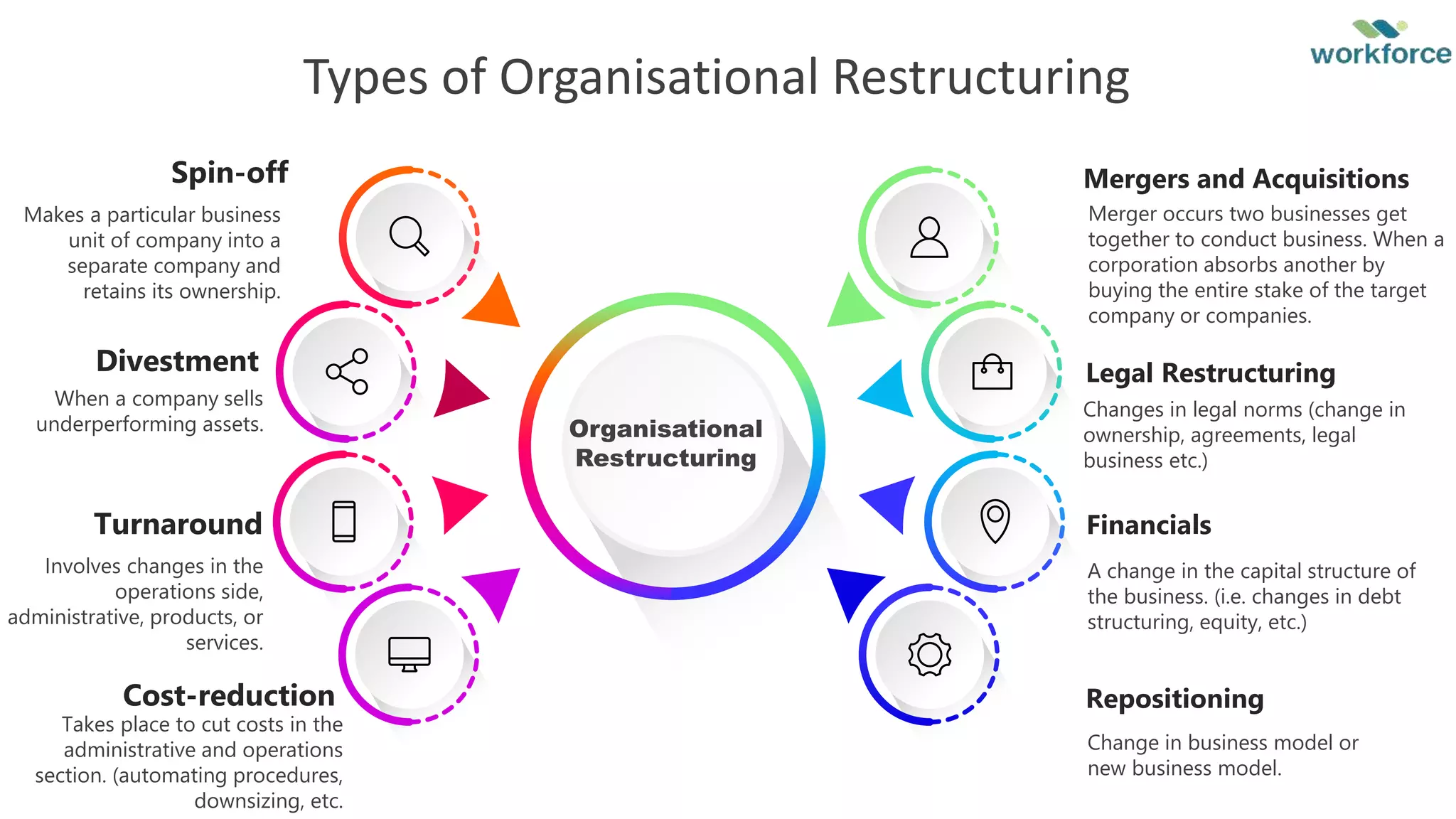
The scope of work generally falls into two categories: Financial Restructuring and Operational Restructuring. Financial restructuring focuses on the right-hand side of the balance sheet—renegotiating debt terms, securing new financing, or executing debt-for-equity swaps. Operational restructuring, conversely, addresses the "why" behind the financial struggle, looking at cost structures, supply chain inefficiencies, and non-performing business units.
A restructuring firm does not merely offer advice; it often takes a hands-on approach. In many cases, the firm will provide interim leadership to ensure that the proposed changes are executed without the bias or emotional attachment of the existing management team. This objectivity is critical when difficult decisions, such as mass layoffs or the sale of a legacy brand, become necessary for the survival of the greater entity.
Key Services and Functional Responsibilities
To understand what a restructuring firm does, one must examine the specific levers they pull during an engagement. These firms operate under immense pressure, often working within "burn rates" where every day of inaction costs the client significant capital.
Liquidity Management and Cash Flow Modeling
The first priority of any restructuring engagement is to "stop the bleeding." A restructuring firm immediately implements rigorous liquidity controls. This often involves the creation of a 13-week cash flow forecast, which provides a granular view of every dollar entering and exiting the business.
By managing disbursements and optimizing collections, the firm ensures the business has enough "runway" to negotiate with stakeholders. This phase often includes the suspension of non-essential capital expenditures and the implementation of strict "flash reporting" to monitor daily cash positions. Without this initial stabilization, the company risks a "hard landing" or forced liquidation before a turnaround plan can even be drafted.
Debt Negotiation and Capital Structure Alignment
Restructuring firms serve as the primary intermediaries between a distressed company and its lenders. In 2026, where interest rate volatility continues to impact debt service coverage ratios, these firms are essential for facilitating out-of-court workouts.
Negotiations may involve:
- Covenant Waivers: Persuading lenders to temporarily ignore breaches of financial ratios.
- Forbearance Agreements: Securing a "standstill" period where the lender agrees not to seize collateral while a plan is developed.
- Debt-for-Equity Swaps: A process where creditors cancel a portion of the debt in exchange for an ownership stake in the reorganized company.
- Exit Financing: Identifying new lenders willing to provide capital to a company emerging from a restructuring process.
Operational Turnaround and Efficiency
Solving the debt problem is a temporary fix if the underlying business model is broken. Restructuring firms analyze the profit-and-loss statement to identify "leakage." This involves a "bottom-up" review of every department. They may recommend the divestiture of underperforming assets or geographical exits. For example, if a retail chain is struggling, the firm will perform a four-wall profitability analysis to determine which specific stores should be shuttered and which leases should be renegotiated or rejected in a formal insolvency proceeding.
The Appointment of a Chief Restructuring Officer (CRO)
A hallmark of a high-stakes restructuring is the appointment of a Chief Restructuring Officer (CRO). Unlike a traditional CEO, who focuses on long-term growth and culture, the CRO is an external professional from the restructuring firm whose sole mandate is the preservation of value and the satisfaction of creditor claims.
The CRO typically reports to the Board of Directors but maintains a fiduciary-like responsibility to the "estate" of the company. Their presence provides immediate credibility to lenders and the court. Lenders are often more willing to provide Debtor-in-Possession (DIP) financing—specialized funding for companies in bankruptcy—if they know a seasoned restructuring professional is at the helm. The CRO has the authority to override existing management on financial decisions, ensuring that the turnaround plan is not compromised by internal politics.
Navigating the Legal Landscape: Bankruptcy and Out-of-Court Workouts
Restructuring firms must be experts in the legal frameworks governing insolvency. In the United States, this primarily involves Chapter 11 of the Bankruptcy Code, while in the United Kingdom, it involves the Insolvency Act 1986 and the Corporate Insolvency and Governance Act 2020.
| Feature | Out-of-Court Restructuring | Chapter 11 Reorganization |
|---|---|---|
| Cost | Generally lower; avoids high legal/court fees. | High; requires payment of professional fee examiners. |
| Publicity | Private; can be handled discreetly. | Public; all filings are a matter of public record. |
| Control | Management retains more control. | Subject to court oversight and creditor committees. |
| Creditor Consent | Usually requires unanimous or high-threshold consent. | Can "cram down" a plan on dissenting creditors via court order. |
| Speed | Can be slow if creditors are holdouts. | Structured timelines, but legal hurdles can add months. |
| Automatic Stay | No; creditors can still sue or seize assets. | Yes; provides an immediate injunction against collection. |
The restructuring firm helps the board decide which path is most viable. If a small group of "holdout" creditors is blocking a fair deal, the firm may recommend a "Pre-packaged" Bankruptcy, where the plan is negotiated and voted on before the company ever enters the courtroom, significantly reducing the time spent in insolvency.
Stakeholder Management and Negotiation Dynamics
A company in distress is a theater of conflicting interests. Equity holders want to retain value; senior secured lenders want to be paid first; unsecured trade creditors want to ensure their invoices are honored; and employees want job security.
The restructuring firm acts as the "honest broker." They use sophisticated valuation techniques to determine the Liquidation Value vs. the Going-Concern Value. By demonstrating that creditors will receive more through a structured reorganization than through a piecemeal liquidation, the firm builds the consensus necessary to approve a restructuring plan. According to the American Bankruptcy Institute, the success of a reorganization often hinges on the transparency and frequency of communication with these diverse stakeholder groups.
Identifying When a Business Needs a Restructuring Advisor
Waiting too long to engage a restructuring firm is a common cause of corporate failure. By the time a company misses a payroll or receives a default notice, its options are severely limited. Early indicators that a firm is required include:
- Consecutive Quarters of Negative Free Cash Flow: When the core business cannot fund its own operations.
- Looming "Debt Walls": Large principal payments due within 12–18 months that cannot be refinanced at current market rates.
- Qualified Audit Opinions: When an external auditor expresses "substantial doubt" about the company’s ability to continue as a going concern.
- Loss of Key Suppliers: When trade credit is pulled and suppliers demand "Cash on Delivery" (COD).
In 2026, restructuring firms also increasingly look at ESG (Environmental, Social, and Governance) liabilities. A company with significant environmental cleanup costs or pending mass-tort litigation may require a specialized restructuring to ring-fence these liabilities and allow the healthy parts of the business to survive.
Frequently Asked Questions
What is the difference between a restructuring firm and a turnaround consultant?
While the terms are often used interchangeably, a restructuring firm typically handles the broader financial and legal architecture, including bankruptcy filings and debt negotiations. A turnaround consultant often focuses more specifically on the operational improvements and management changes needed to fix the business model.
Can a restructuring firm save every company?
No. Some businesses are "structurally impaired," meaning their market has disappeared or their business model is fundamentally obsolete. In these cases, a restructuring firm shifts its role to an orderly liquidation or a Chapter 7 filing to ensure assets are sold for the highest possible value and proceeds are distributed fairly according to legal priority.
Who pays for the restructuring firm's services?
The distressed company itself typically pays the fees. In a bankruptcy scenario, these fees are considered "administrative expenses" and are paid out of the company's assets before most other creditors are satisfied. This is often a point of contention, but courts generally recognize that professional guidance is necessary to maximize the value of the estate.
How long does a typical corporate restructuring take?
An out-of-court restructuring can take 3 to 9 months. A formal Chapter 11 process can last anywhere from 6 months to several years, depending on the complexity of the debt and the level of creditor opposition. "Pre-packaged" bankruptcies are the fastest, often concluding in 30 to 90 days.
Will the existing management stay during a restructuring?
It depends. If the distress was caused by external market factors, the restructuring firm might keep the management team to leverage their industry expertise. If the crisis resulted from incompetence or fraud, the restructuring firm (and the creditors) will usually insist on a management overhaul.
Practical Recommendations for Distressed Entities
For leadership teams facing financial instability in 2026, the first action should be a comprehensive debt audit. Evaluate all upcoming maturities and interest rate hedges to identify "liquidity gaps" well before they occur. If internal projections suggest a covenant breach within the next six months, engage a restructuring advisor immediately to begin informal dialogues with lenders.
Early engagement provides the "luxury of time," allowing for a wider array of out-of-court solutions that preserve management's control and the company's reputation. Once a restructuring firm is onboarded, prioritize total transparency; hiding liabilities or inflating asset values will destroy the firm's credibility with creditors and can lead to a total collapse of the reorganization process.
Image Gallery