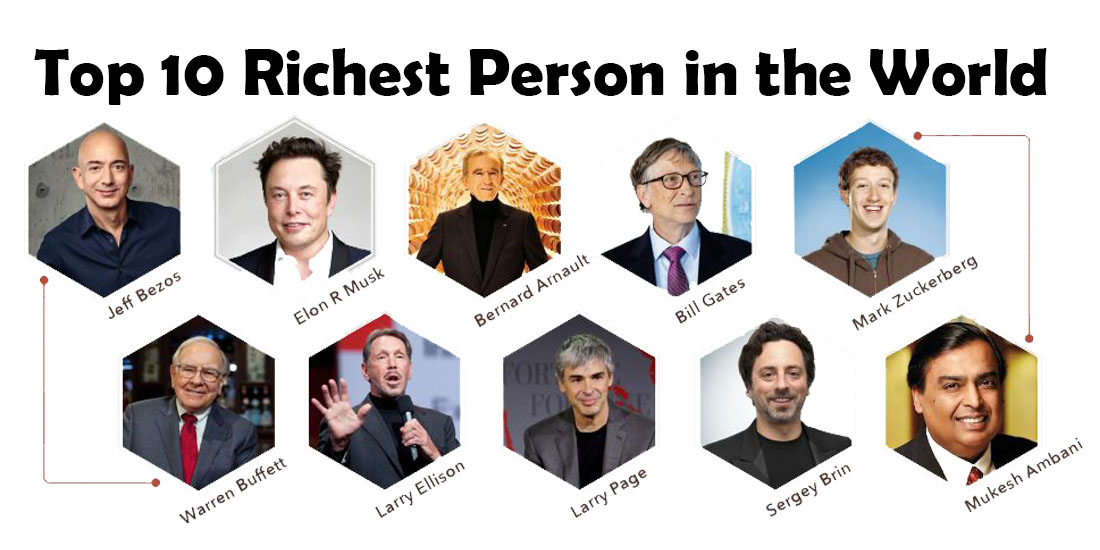
Understanding the World Top 10 Rich Person List: Tracking Global Wealth
The world top 10 rich person list represents the pinnacle of individual financial accumulation, tracking the real-time net worth of the planet’s wealthiest figures. These rankings are primarily driven by fluctuating equity stakes in pu...
The world top 10 rich person list represents the pinnacle of individual financial accumulation, tracking the real-time net worth of the planet’s wealthiest figures. These rankings are primarily driven by fluctuating equity stakes in publicly traded corporations, private asset valuations, and real estate holdings. As of 2026, these figures represent the intersection of global technology, retail, and luxury goods sectors.
Contents
The Mechanics of Wealth Valuation
Tracking the world’s wealthiest individuals is an exercise in complex financial estimation rather than simple bank account auditing. Most of the wealth held by the top 10 is illiquid, existing as shares in companies the individuals founded or currently lead. Because stock markets fluctuate daily, these lists—maintained by institutions such as Forbes and Bloomberg—act as snapshots based on market close prices.
The primary method used to determine a spot on the list involves identifying an individual’s ownership percentage in public companies, then multiplying that by the current stock price. Added to this are estimates of private business value, real estate, cash, art, and aircraft. Debt and other liabilities are then subtracted. For instance, when a CEO exercises stock options or a major conglomerate acquires a subsidiary, the ripple effects are felt instantly in their valuation.
Key Factors Influencing the Rankings
Several variables cause the list to rotate throughout the year. Understanding these factors helps in interpreting why a specific individual might rise or fall without necessarily changing their lifestyle or business strategy.
- Equity Market Volatility: Since the majority of billionaire wealth is tied to stocks, a 5% drop in the tech-heavy Nasdaq index can erase billions from a net worth in a single afternoon.
- Currency Fluctuations: Most lists are denominated in U.S. dollars. When the dollar strengthens against other currencies, non-U.S.-based billionaires may see their nominal wealth decrease even if their domestic businesses are performing well.
- Mergers and Acquisitions: When a billionaire’s company completes a major acquisition or goes through a spin-off, the valuation process must be recalculated to account for the new asset structure.
- Philanthropic Distributions: Massive charitable donations represent a reduction in net worth. However, the timing of these transfers—often made in stock rather than cash—can impact how the valuation is reported at any given quarter.
Comparison of Wealth Sources
The top 10 list is currently dominated by specific industries that have defined the early 21st-century economy. The following table highlights the common sectors where the current cohort derives their wealth and how these sectors differ in terms of liquidity and volatility.
| Sector | Primary Driver | Volatility Level | Common Asset Class |
|---|---|---|---|
| Technology | Innovation & Cloud Computing | High | Public Equities |
| Luxury Goods | Brand Equity & Scarcity | Moderate | Holding Companies |
| Retail/E-commerce | Logistics & Consumer Scale | Moderate | Founder Shares |
| Manufacturing | Global Supply Chains | Moderate | Industrial Holdings |
| Investment Firms | Asset Management Fees | Low to Moderate | Private & Public Assets |
The Role of Private vs. Public Assets
A critical challenge in compiling the world top 10 rich person list is the valuation of private entities. While public company data is transparent due to regulatory filings (such as 10-K reports in the U.S.), private company valuations are based on "mark-to-model" estimations.
Researchers often compare a private company to its closest public competitors, applying a valuation multiple based on revenue or EBITDA (Earnings Before Interest, Taxes, Depreciation, and Amortization). This introduces a margin of error. If a private company completes a new funding round at a specific valuation, it provides a "hard" data point that analysts use to update the billionaire’s standing. Without such a round, estimates can remain stagnant for months, even if the underlying business is growing.
Ethical and Economic Considerations
The concentration of wealth in the hands of ten individuals often draws scrutiny regarding economic inequality. From an analytical perspective, it is important to distinguish between "net worth" and "liquid wealth." A billionaire with a $200 billion net worth does not typically have access to that amount in cash.
The influence of these individuals often extends beyond their bank accounts. Many in the top 10 hold significant sway over global policy, infrastructure, and even space exploration. As of 2026, the focus has shifted toward how these individuals deploy capital for climate technology, artificial intelligence, and private aerospace ventures, which in turn influences the market sentiment of their primary businesses.
Troubleshooting and Verification
Readers often encounter discrepancies between different wealth lists. When checking if a figure is accurate, consider these common issues:
- Reporting Dates: If one source is three days behind another, a major market move might account for a "missing" billion dollars.
- Family Wealth Aggregation: Some lists group wealth by family units (e.g., the Walton family or the Koch family), while others insist on individual attribution. Always verify the methodology of the specific report you are viewing.
- Double Counting: In cases of complex ownership structures, where one billionaire owns shares in a company owned by another billionaire, analysts must be careful to avoid double-counting assets.
Frequently Asked Questions
1. Why does the ranking change so frequently? The ranking changes because the underlying assets are mostly public stocks. As market prices fluctuate every trading day, the net worth of those holding large blocks of shares moves in lockstep with the market.
2. Are these individuals actually the richest in history? In nominal terms, yes. However, when adjusted for inflation or as a percentage of global GDP, several historical figures from the late 19th or early 20th centuries (such as John D. Rockefeller) were arguably wealthier relative to the size of the economy at the time.
3. Does this list include heads of state or royalty? Most reputable wealth lists exclude autocrats, monarchs, or heads of state whose wealth is tied to national assets or state-controlled resources. This is because it is often impossible to distinguish between personal property and government property.
4. How do I verify a billionaire’s current wealth? The most reliable method is to review their company's latest proxy statement or annual report to determine their exact share count, then multiply that count by the current market price of the stock.
5. Why are there no billionaires from certain industries? The list is biased toward scalable industries. While traditional industries like agriculture or real estate create wealth, they rarely create the extreme, rapid appreciation seen in software or retail tech, which allows for the meteoric rise of the individuals in the top 10.
Next Steps for Investors
If you are tracking these figures to understand broader economic trends, do not view the top 10 list as a static leaderboard. Instead, use it as a sentiment indicator for specific sectors. When individuals in the top 10 begin offloading large amounts of stock, it often signals a shift in market confidence or a diversification move that may precede broader sector volatility. To conduct a deep analysis, prioritize the SEC EDGAR database for U.S.-based entities to see the most accurate, verified filings regarding ownership stakes.
Image Gallery