Canadian 2 Dollar Bill Value: Comprehensive Collector's Guide for 2026
The market value of a Canadian 2-dollar bill typically ranges from face value ($2 CAD) for common circulated specimens to over $100 CAD for pristine, uncirculated notes or rare replacement issues. Issued by the Bank of Canada between 1...
The market value of a Canadian 2-dollar bill typically ranges from face value ($2 CAD) for common circulated specimens to over $100 CAD for pristine, uncirculated notes or rare replacement issues. Issued by the Bank of Canada between 1935 and 1986, the paper $2 bill was eventually replaced by the "Toonie" coin in 1996, making these historical notes popular among currency collectors.
Contents
Historical Context and Evolution of the Canadian Two-Dollar Bill
The Canadian two-dollar bill holds a rich place in the nation's monetary history. Introduced initially under the Dominion of Canada and later issued by the Bank of Canada upon its establishment in 1935, these notes underwent several significant redesigns. Understanding the series helps collectors accurately pinpoint the era and specific variant of a bill.
Banknotes of this denomination were printed by the Canadian Bank Note Company and the American Bank Company (in early issues). Over decades of production, security features evolved, artistic depictions of monarchs and Canadian landscapes changed, and signature combinations shifted. While the Bank of Canada demonetized older series of banknotes in recent years for legal tender status—meaning they no longer have legal tender status for retail transactions—they retain their full face value when redeemed directly through the central bank, though their numismatic value often exceeds face value significantly.
Key Factors Determining the Value of a Canadian 2-Dollar Bill
Evaluating a paper currency note requires analyzing specific physical and historical criteria. Unlike modern currency, where condition dictates everything, older Canadian notes derive value from a combination of age, rarity, serial number characteristics, and grading quality.
1. Condition and Grading Scale
Paper money uses a standardized grading system ranging from Poor (P-1) to Gem Uncirculated (70).
- Circulated Notes: Bills that passed through commerce often feature folds, creases, dirt, limpness, or minor tears. Most common circulated 1954 or 1986 series bills trade close to face value or slightly above ($3 to $5).
- Uncirculated (Crisp) Notes: Notes showing zero handling, sharp corners, and original mint sheen command higher premiums.
- Certified Notes: High-grade notes authenticated by third-party grading services like Paper Money Guaranty (PMG) or Professional Coin Grading Service (PCGS) achieve maximum market prices.
2. Signature Combinations
The signatures printed on the lower portion of the bill indicate the term of the Governor and Deputy Governor of the Bank of Canada. Certain signature pairings span very short production windows, creating scarcity. For instance, the Coyne-Towers or Lawson-Bouey signatures in specific series can elevate a note's desirability among specialist collectors.
3. Prefix Letters and Replacement Notes
Serial numbers on Canadian banknotes feature a prefix of one or two letters followed by digits.
- Standard Prefixes: Regular production runs.
- Replacement Notes (Star or Special Prefixes): When a sheet of notes was damaged during printing, the mint replaced it with a special series note to maintain exact auditing totals. In Canadian currency, specific letter prefixes denote replacement notes (such as certain "X" prefixes depending on the series). These scarce notes command substantial collector interest.
Valuation Breakdown by Series
| Bank of Canada Series | Years of Issue | Common Circulated Value | Uncirculated Value (Choice to Gem) | Rare Variations & Notable Features |
|---|---|---|---|---|
| 1935 Series | 1935 | $50.00 – $200.00+ | $300.00 – $1,500.00+ | First series; English and French variants exist; high demand. |
| 1937 Series | 1937 | $10.00 – $25.00 | $50.00 – $250.00 | Features King George VI; diverse signature combinations. |
| 1954 Series (Devil's Face) | 1954 | $5.00 – $15.00 | $30.00 – $200.00+ | Modified hair design hiding a perceived demon face; highly sought after. |
| 1954 Series (Modified Portrait) | 1956 – 1965 | $2.50 – $5.00 | $10.00 – $40.00 | Adjusted portrait background to remove controversial imagery. |
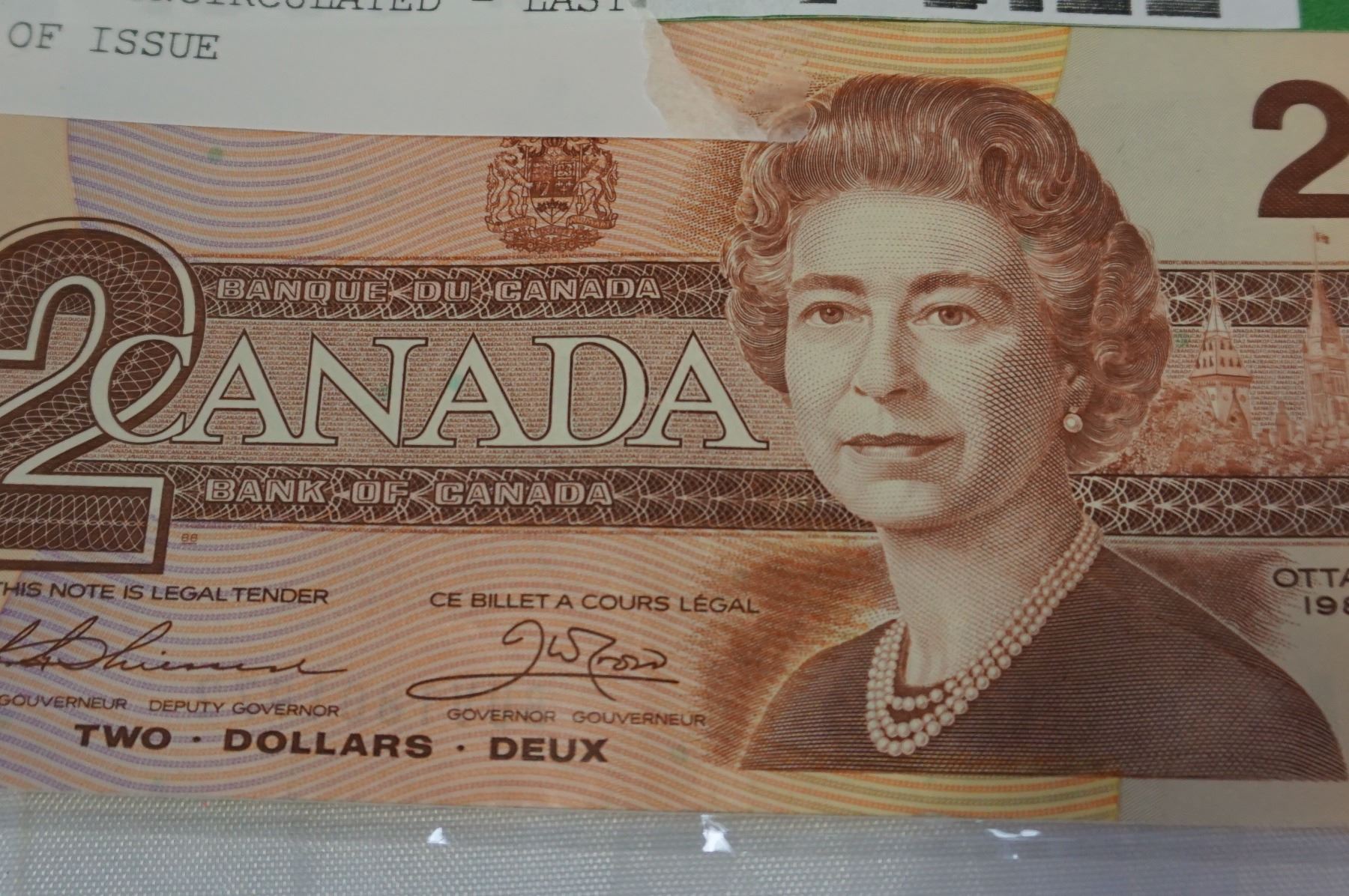
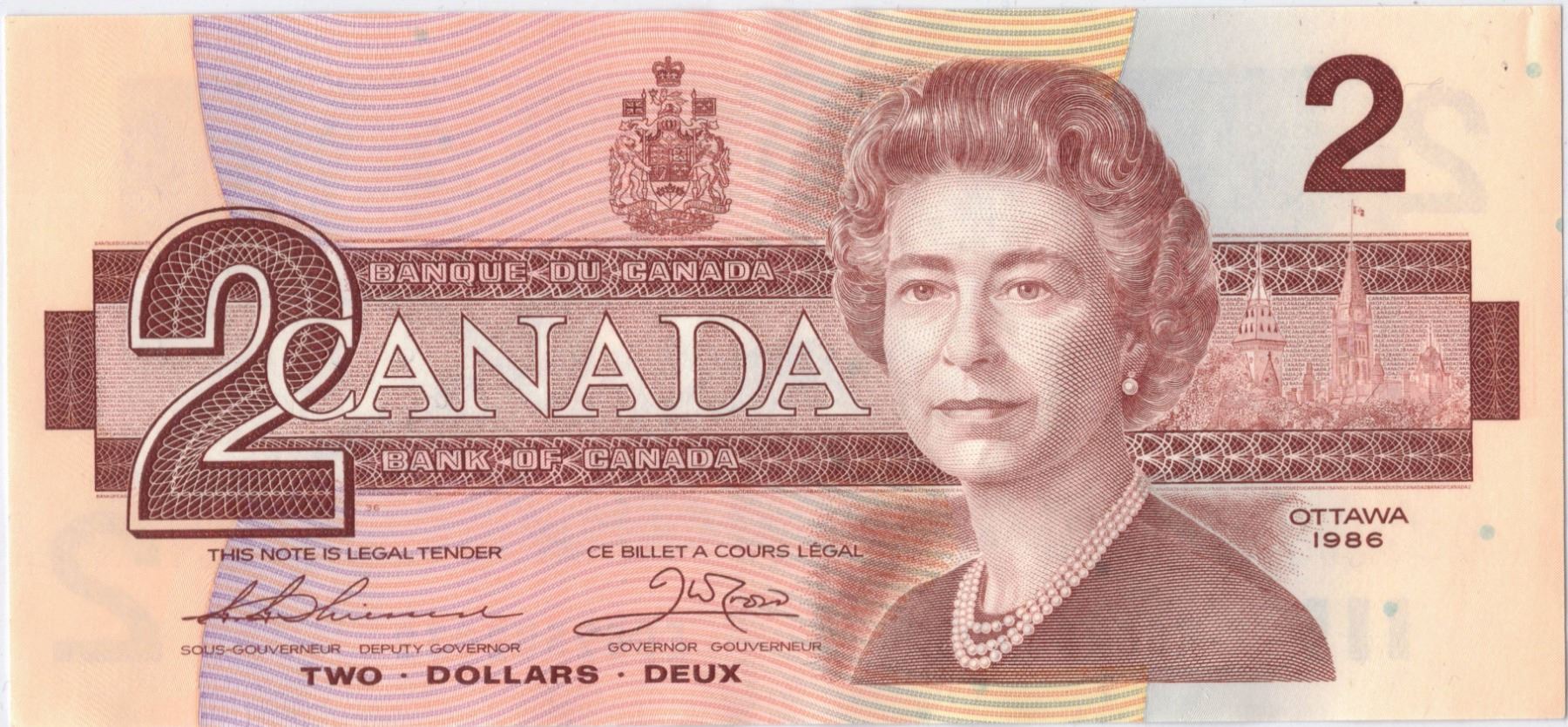
| 1986 Series (Birds of Canada) | 1986 – 1991 | $2.00 – $3.00 | $5.00 – $20.00 | Features the American Robin; very high print runs keep values modest. |
The Legend of the 1954 "Devil's Face" Series
The 1954 Canadian banknote series, depicting Queen Elizabeth II, is universally famous among numismatists due to a design anomaly known as the "Devil's Face." Shortly after the notes entered circulation, observant members of the public noticed that the engraving in the Queen's hair behind her ear created the distinct optical illusion of a grinning devil's face.
The Bank of Canada quickly instructed banknote printers to modify the plates, darkening and simplifying the hair lines in subsequent printings (known as the modified or regular portrait series). Today, bills from the initial unedited 1954 run carry a notable collectible premium. Even in moderately circulated condition, a 1954 $2 bill with the Devil's Face modification fetches more than standard 1970s or 1980s issues, while pristine uncirculated versions command strong collector bids.
Step-by-Step Guide to Assessing Your Canadian $2 Bill
Proper handling and evaluation ensure you do not inadvertently damage a valuable collectible note or misidentify a common bill.
- Protect the Note: Place the bill inside a clean, PVC-free currency sleeve or holder immediately. Avoid touching the surface oils to the paper fibers.
- Identify the Series: Locate the date printed near the bottom center or read the visual artwork (e.g., King George VI, Queen Elizabeth II, or the American Robin bird).
- Inspect the Serial Number: Check the prefix letters and numbers. Look for low serial numbers (e.g., under 1,000), solid repeating digits (like 111111), or radar numbers (palindromes like 1234321).
- Examine Under Magnification: Use a magnifying glass to check for folds, pinholes, stains, fading, or trimming. Never attempt to clean, iron, or wash a banknote, as cleaning drastically reduces numismatic value.
- Consult Current Price Guides: Cross-reference your findings with up-to-date numismatic literature such as The Charlton Standard Catalogue of Canadian Bank Notes.
Common Mistakes When Collecting Paper Money
Avoiding rookie pitfalls protects the long-term integrity and financial potential of a paper currency collection.
- Cleaning or Pressing: Attempting to wash away a stain or iron out a crease alters the natural texture of the paper currency paper (which is a cotton-linen blend). Professional graders easily spot pressed notes and penalize the grade severely.
- Ignoring Storage Environment: Storing paper money in humid basements or attics invites foxing (brown age spots caused by mold and chemical reactions) and paper degradation. Keep notes in climate-controlled, acid-free containers.
- Assuming Old Equals Expensive: Age alone does not guarantee high value. Survival rate, total initial print run volume, and condition play much larger roles. Millions of 1986 series notes were printed, meaning high supply keeps market prices modest.
Frequently Asked Questions
Are old Canadian 2 dollar bills still legal tender?
While older series banknotes have been stripped of their status as legal tender for everyday retail purchases by the federal government, they can still be redeemed at face value directly through the Bank of Canada. However, selling them to a coin and currency dealer or collector will almost always yield a higher financial return than bank redemption.
How much is a 1986 Canadian 2 dollar bill worth?
Most circulated 1986 "Birds of Canada" series two-dollar bills are worth close to face value or between $2.50 and $4.00. Uncirculated notes in crisp, flawless condition may sell for $5 to $15 depending on the specific signature combination and prefix block.
What makes a Canadian 2 dollar bill rare?
Rarity is driven by early issue years (such as the 1935 series), low serial numbers, replacement note prefixes, error printing mistakes, and high numerical grades (such as MS-65 or higher certified by a grading authority).
Where can I sell my Canadian paper money?
You can sell Canadian banknotes through reputable numismatic auction houses, local coin and stamp dealers, online collector marketplaces, or specialized coin clubs. Always secure multiple appraisals before parting with vintage currency collections.
How should I store old paper money safely?
Store banknotes flat inside archival-grade, acid-free, and PVC-free Mylar sleeves or currency holders. Keep them away from direct sunlight, extreme temperature fluctuations, and high humidity to prevent paper yellowing and deterioration.
Secure Your Collection's Future Today
Evaluating and preserving historical Canadian currency requires careful attention to detail, proper storage, and accurate grading. Whether you inherited a single crisp 1954 Devil's Face note or are building a complete type set of Bank of Canada issues, consulting specialized numismatic resources ensures you understand the true market worth of your collection. Begin by cataloging your bills by series and serial prefix today, and safeguard your pieces in archival holders to maintain their condition for years to come.
Image Gallery